Showing posts with label Armenia. Show all posts

Saturday, April 24, 2021

The Martyrs of Armenia


Armenia is located at the east end of modern Turkey, with some of its traditional territory now in Turkey and some across the border in the former Soviet Union. The Armenians were converted to Christianity around 280 or 290, and are accounted the first country to become predominantly Christian. Their country is located at a spot where empires have clashed for centuries, and they have often been caught in the middle. For centuries they have been dominated by their Mohammedan neighbors, most recently the Turks of the Ottoman Empire.

The Turks were concerned about the possibility of an Armenian revolt. In 1895 and 1896 the Turkish Army killed about 100,000 Armenian civilians. Then in 1915, early in World War I, with Turkey fighting on the side of Germany and Austria-Hungary, and Russia fighting in alliance with the British and French on the other side, the Turkish government accused the Armenians of plotting with the Russians to assist a Russian invasion of Turkey. That spring, around 600,000 Armenians were killed by the Turkish Army, in an attempt to exterminate the Armenians completely. Much of the slaughter took place on 24 April 1915. The survivors were driven eastward and escaped into Russia. On 29 November 1920, most of Armenia was annexed by the Soviet Union.

It is sometimes said that the issues here were national, political, and ethnic rather than religious, and that the victims therefore do no qualify as martyrs. However, many of the Armenians, when about to be killed, were given the option of saving their lives by converting to Mohammedanism. Few did.


The Martyrs of Armenia - 24 April

The Collect -

O Almighty God, by whose grace and power thy holy martyrs of Armenia triumphed over suffering and were faithful even unto death: Grant us, who now remember them with thanksgiving, to be so faithful in our witness to thee in this world, that we may receive with them the crown of life; through Jesus Christ our Lord, who liveth and reigneth with thee and the Holy Ghost, one God, for ever and ever. Amen.


The Epistle - 1 Peter 4:12-19


The Holy Gospel - St. Mark 8:34-38


References and Resources:

http://en.wikipedia.org/wiki/Armenian_Genocide
http://www.armenian-genocide.org/


†

Tuesday, March 23, 2021

Gregory the Illuminator

The ancient kingdom of Armenia was the first country to become Christian, and it recognizes Gregory as its apostle. Armenia was a buffer state between the powerful empires of Rome and Parthia (Persia), and both of them sought to control it. Gregory was born about 257. When he was still an infant, his father assassinated the King of Parthia, and friends of the family carried Gregory away for protection to Caesarea in Cappadocia, where he was reared as a Christian. About 280 he returned to Armenia, where he was at first treated severely, but eventually by his preaching and example brought both King Tiridates and a majority of his people to the Christian faith. About 300, Gregory was consecrated the first bishop of Armenia. He died about 332. Armenian Christians to this day remember him with honor and gratitude.


Propers for Gregory the Illuminator - 23 March - Apostle to Armenia

The Collect.

Almighty God, who willest to be glorified in thy saints, and didst raise up thy servant Gregory the Illuminator to be a light in the world, and to preach the Gospel to the people of Armenia: Shine, we pray thee, in our hearts, that we also in our generation may show forth thy praise, who hast called us out of darkness into thy marvelous light; through Jesus Christ our Lord, who liveth and reigneth with thee and the Holy Ghost, one God, now and for ever. Amen.


The Epistle - Acts 17:22-31.

Then Paul stood in the midst of Mars' hill, and said, Ye men of Athens, I perceive that in all things ye are too superstitious. For as I passed by, and beheld your devotions, I found an altar with this inscription, TO THE UNKNOWN GOD. Whom therefore ye ignorantly worship, him declare I unto you. God that made the world and all things therein, seeing that he is Lord of heaven and earth, dwelleth not in temples made with hands; Neither is worshipped with men's hands, as though he needed any thing, seeing he giveth to all life, and breath, and all things; And hath made of one blood all nations of men for to dwell on all the face of the earth, and hath determined the times before appointed, and the bounds of their habitation; That they should seek the Lord, if haply they might feel after him, and find him, though he be not far from every one of us: For in him we live, and move, and have our being; as certain also of your own poets have said, For we are also his offspring. Forasmuch then as we are the offspring of God, we ought not to think that the Godhead is like unto gold, or silver, or stone, graven by art and man's device. And the times of this ignorance God winked at; but now commandeth all men every where to repent: Because he hath appointed a day, in the which he will judge the world in righteousness by that man whom he hath ordained; whereof he hath given assurance unto all men, in that he hath raised him from the dead.


The Gospel - St. Matthew 5:11-16.

Blessed are ye, when men shall revile you, and persecute you, and shall say all manner of evil against you falsely, for my sake. Rejoice, and be exceeding glad: for great is your reward in heaven: for so persecuted they the prophets which were before you. Ye are the salt of the earth: but if the salt have lost his savour, wherewith shall it be salted? it is thenceforth good for nothing, but to be cast out, and to be trodden under foot of men. Ye are the light of the world. A city that is set on an hill cannot be hid. Neither do men light a candle, and put it under a bushel, but on a candlestick; and it giveth light unto all that are in the house. Let your light so shine before men, that they may see your good works, and glorify your Father which is in heaven.


Reference and Resources:

http://en.wikipedia.org/wiki/Gregory_the_Illuminator
http://elvis.rowan.edu/~kilroy/JEK/03/23.html
http://www.missionstclare.com/english/people/mar23.html
http://ohioanglican.blogspot.com/2007/03/gregory-illuminator-apostle-to-armenia.html


†

Wednesday, March 10, 2021

The Forty Martyrs of Sebaste


The Forty Martyrs of Sebaste or the Holy Forty (Ancient/Katharevousa Greek Ἃγιοι Τεσσεράκοντα, Demotic Άγιοι Σαράντα) were a group of Roman soldiers in the Legio XII Fulminata,who became martyrs for their Christian faith in 320.

In the year 320, Constantine was Emperor of the West and Licinius of the East. Licinius, under pressure from Constantine, had agreed to legalize Christianity in his territory, and the two made an alliance (cemented by the marriage of Licinius to Constantia the sister of Constantine), but now Licinius broke the alliance and made a new attempt to suppress Christianity. He ordered his soldiers to repudiate it on pain of death. In the "Thundering Legion," stationed near Sebaste in Armenia (now Sivas in Turkey), forty soldiers refused, and when promises, threats, and beatings failed to shake them, they were stripped naked one evening and herded onto the middle of a frozen lake, and told, "You may come ashore when you are ready to deny your faith." To tempt them, fires were built on shore, with warm baths, blankets, clothing, and hot food and drink close by. The mother of the youngest soldier was present and encouraged her son from the bank. As night deepened, thirty-nine men stood firm, while one broke and ran to the shore. However, one of the soldiers standing guard on shore was so moved by the steadfastness of the Christians that he stripped off his clothes and ran out to join them. They welcomed him into their company, and so the number of the martyrs remained at forty, and by morning, all were dead of exposure. (One source says that the few in whom a little life remained were stabbed to death at dawn.)

We still have what some scholars believe to be an authentic eyewitness account of their martyrdom. It includes farewell messages to their family and friends written shortly before their deaths.


According to Antonio Borrelli, their names were "Aetius, Eutychius, Cyrius, Theophilus, Sisinnius, Smaragdus, Candidus, Aggia, Gaius, Cudio, Heraclius, John, Philotemon, Gorgonius, Cirillus, Severianus, Theodulus, Nicallus, Flavius, Xantius, Valerius, Aesychius, Eunoicus, Domitian, Domninus, Helianus, Leontius (Theoctistus), Valens, Acacius, Alexander, Vicratius (Vibianus), Priscus, Sacerdos, Ecdicius, Athanasius, Lisimachus, Claudius, Ile, Melito and Eutychus (Aglaius)."


Propers for The Forty Martyrs of Sebaste - 10 March


The Collect.

O Almighty God, by whose grace and power Thy holy martyrs of Sebaste triumphed over suffering and were faithful even unto death: Grant us, who now remember them with thanksgiving, to be so faithful in our witness to Thee in this world, that we may receive with them the crown of life; through Jesus Christ our Lord, who liveth and reigneth with Thee and the Holy Ghost, one God, for ever and ever. Amen.


The Epistle - 2 Esdras 2:42-48.

I ESDRAS saw upon the mount Sion a great people, whom I could not number, and they all praised the Lord with songs. And in the midst of them there was a young man of a high stature, taller than all the rest, and upon every one of their heads he set crowns, and was more exalted; which I marvelled at greatly. So I asked the angel, and said, Sir, what are these? He answered and said unto me, These be they that have put off the mortal clothing, and put on the immortal, and have confessed the name of God: now are they crowned, and receive palms. Then said I unto the angel. What young person is it that crowneth them, and giveth them palms in their hands? So he answered and said unto me, It is the Son of God, whom they have confessed in the world. Then began I greatly to commend them that stood so stiffly for the name of the Lord. Then the angel said unto me, Go thy way, and tell my people what manner of things, and how great wonders of the Lord thy God, thou hast seen.


The Gospel - St. Matthew 10:16-22.

BEHOLD, I send you forth as sheep in the midst of wolves: be ye therefore wise as serpents, and harmless as doves. But beware of men: for they will deliver you up to the councils, and they will scourge you in their synagogues; and ye shall he brought before governors and kings for my sake, for a witness to them and the Gentiles. But when they deliver you up, be not anxious how or what ye shall speak: for it shall be given you in that same hour what ye shall speak. For it is not ye that speak, but the Spirit of your Father which speaketh in you. And the brother shall deliver up the brother to death, and the father the child: and the children shall rise up against their parents, and cause them to be put to death. And ye shall be hated of all men for my name's sake: but he that endureth to the end shall be saved.


Reference and Resources:

https://catholicsaints.info/butlers-lives-of-the-saints-the-forty-martyrs-of-sebaste/
http://en.wikipedia.org/wiki/Forty_Martyrs_of_Sebaste
http://www.commonprayer.org/calend/propers/com_mart.cfm
http://elvis.rowan.edu/~kilroy/JEK/03/10.html

†

Wednesday, February 17, 2021

Mesrob of Armenia


(also Mesrob, Mashtotz, Armenian: Մեսրոպ Մաշտոց) (361 or 362, Hatsik, in Taron - February 17, 440, Echmiadzin) was an Armenian monk, theologian and linguist. He is best known for having invented the Armenian alphabet, which was a fundamental step in strengthening the Armenian Church, the government of the Armenian Kingdom, and ultimately the bond between the Armenian Kingdom and Armenians living in the Byzantine Empire and the Persian Empire.


Propers for Mesrob - 17 February - Monk, Theologian, and Linguist

The Collect.

GOD, who hast endowed thy servant Mesrob with clarity of faith and holiness of life: Grant us to keep with steadfast minds the faith which he taught, and in his fellowship to be made partakers of eternal glory; through Jesus Christ our Lord. Amen.


The Epistle - Philippians 3:7-15.

HOWBEIT what things were gain to me, these have I counted loss for Christ. Yea verily, and I count all things to be loss for the excellency of the knowledge of Christ Jesus my Lord: for whom I suffer the loss of all things, and do count them but dung, that I may gain Christ, and be found in him, not having a righteousness of mine own, even that which is of the law, but that which is through faith in Christ, the righteousness which is of God by faith: that I may know him, and the power of his resurrection, and the fellowship of his sufferings, becoming conformed unto his death; if by any means I may attain unto the resurrection of the dead. Not that I have already obtained, or am already made perfect: but I press on, if so be that I
may apprehend that for which also I was apprehended by Christ Jesus. Brethren, I count not myself yet to have apprehended: but one thing I do, forgetting the things which are behind, and stretching forward to the things which are before, I press on toward the goal unto the prize of the high calling of God in Christ Jesus. Let us
therefore, as many as be perfect, be thus minded: and if in anything ye are otherwise minded, even this shall God reveal unto you.


The Gospel. St - Matthew 25:31-40.

WHEN the Son of man shall come in his glory, and all the holy angels with him, then shall he sit upon the throne of his glory: and before him shall be gathered all nations: and he shall separate them one from another, as a shepherd divideth his sheep from the goats: and he shall set the sheep on his right hand, but the goats on the left. Then shall the King say unto them on his right hand, Come, ye blessed of my Father, inherit the kingdom prepared for you from the foundation of the world: for I was an hungred, and ye gave me meat: I was thirsty, and ye gave me. drink: I was a stranger, and ye took me in: naked, and ye clothed me: I was sick, and ye visited me: I was in prison, and ye came unto me. Then shall the righteous answer him, saying, Lord, when saw we thee an hungred, and fed thee? or thirsty, and gave thee drink? When saw we thee a stranger, and took thee in? or naked, and clothed thee? Or when saw we thee sick, or in prison, and came unto thee? And the King shall answer and say unto them, Verily I say unto you, Inasmuch as ye have done it unto one of the least of these my brethren, ye have done it unto me.


Reference and Resources:

http://en.wikipedia.org/wiki/Saint_Mesrob

†

Wednesday, February 3, 2021

Blasius of Sebaste

(or Blasius Βλάσιος, Armenian: Սուրբ Բարսեղ) was a physician and bishop of Sebaste (modern Sivas), Armenia. According to his Acta he was martyred by being beaten, attacked with iron carding combs, and beheaded.

In iconography, Blaise is often shown with the instruments of his martyrdom, iron combs. The similarity of these instruments of torture to wool combs led to his adoption as patron of wool combers in particular, and the wool trade in general. He may also be depicted with crossed candles. Such crossed candles (left unlighted for safety reasons) are used for the blessing of throats on the feast day of St. Blaise, which falls on February 3, the day after Candlemas on the Kalendar, Blaise is traditionally believed to intercede in cases of throat illnesses, especially for fish-bones stuck in the throat. The blessing is: "Per intercessionem Sancti Blasii liberet te Deus a malo gutteris et a quovis alio malo." (May God at the intercession of Saint Blaise preserve you from throat troubles and every other evil).

Indeed, the first reference we have to him is in manuscripts of the medical writings of Aëtius Amidenus, the court physician of Justinian I, where his aid is invoked in treating objects stuck in the throat. He cured animals and lived in a cage. Before being killed, he spoke to a wolf and told it to release a pig it was harming. The wolf did so. Saint Blaise was going to be starved but the owner of the pig secretly gave him food in order to survive. After a while, he was tortured because of what he believed in but did not give up faith, he then died in the year 316.

Propers for Blasius - 3 February - Bishop and Martyr

The Collect.

O GOD, who didst make blessed Blasius, they Martyr and Bishop, strong to endure his own sufferings and to lighten the infirmities of other men: Mercifully grant that we may imitate his constancy of faith, and in danger may feel thy protection as he did; through Jesus Christ our Lord. Amen.


The Epistle - 2 Esdras 2:42-48.

I ESDRAS saw upon the mount Sion a great people, whom I could not number, and they all praised the Lord with songs. And in the midst of them there was a young man of a high stature, taller than all the rest, and upon every one of their heads he set crowns, and was more exalted; which I marvelled at greatly. So I asked the angel, and said, Sir, what are these? He answered and said unto me, These be they that have put off the mortal clothing, and put on the immortal, and have confessed the name of God: now are they crowned, and receive palms. Then said I unto the angel. What young person is it that crowneth them, and giveth them palms in their hands? So he answered and said unto me, It is the Son of God, whom they have confessed in the world. Then began I greatly to commend them that stood so stiffly for the name of the Lord. Then the angel said unto me, Go thy way, and tell my people what manner of things, and how great wonders of the Lord thy God, thou hast seen.


The Gospel - St. Matthew 10:16-22.

BEHOLD, I send you forth as sheep in the midst of wolves: be ye therefore wise as serpents, and harmless as doves. But beware of men: for they will deliver you up to the councils, and they will scourge you in their synagogues; and ye shall he brought before governors and kings for my sake, for a witness to them and the Gentiles. But when they deliver you up, be not anxious how or what ye shall speak: for it shall be given you in that same hour what ye shall speak. For it is not ye that speak, but the Spirit of your Father which speaketh in you. And the brother shall deliver up the brother to death, and the father the child: and the children shall rise up against their parents, and cause them to be put to death. And ye shall be hated of all men for my name's sake: but he that endureth to the end shall be saved.

Reference and Resources:

http://en.wikipedia.org/wiki/Saint_Blaise
http://www.commonprayer.org/calend/propers/blasius.cfm

†

Saturday, January 9, 2021

Polyeuktos

lived during the reign of Emperors Decius and Vallerian in 255. He knew well the art of warfare and used to live in the Armenian city of Melitine. He was the first to suffer martyrdom in this city. An impious law was pronounced that ordered Christians to deny Christ. Whoever was not convinced ought to be punished with death. Because of this law the athlete of Christ Polyeuktos, without losing his nerve at all, preached Christ openly and with his great courage and valour he smashed the idols which the Greeks respected.

Although his father-in-law advised him to deny Christ and his wife was crying and lamenting for him, he persevered and neither was he convinced by his father-in-law's advice nor did he sympathize with his wife's wailing. Instead, he kept his promises and what he had agreed with his friend Nearkhos, who was afraid and suspected that he would deny the faith of Christ. So, he stayed firm and would not be moved from the confession of faith. Because of this he died by the sword and rose to heaven.

Propers for Polyeuktos - 9 January - Soldier, Confessor and Martyr


The Collect.

ALMIGHTY and everlasting God, who didst strengthen thy blessed martyr Polyeuktos with the virtue of constancy in faith and truth: Grant us in like manner for love of thee to despise the prosperity of this world, and to fear none of its adversities; through Jesus Christ our Lord. Amen.


The Epistle - 2 Esdras 2:42-48.

I ESDRAS saw upon the mount Sion a great people, whom I could not number, and they all praised the Lord with songs. And in the midst of them there was a young man of a high stature, taller than all the rest, and upon every one of their heads he set crowns, and was more exalted; which I marvelled at greatly. So I asked the angel, and said, Sir, what are these? He answered and said unto me, These be they that have put off the mortal clothing, and put on the immortal, and have confessed the name of God: now are they crowned, and receive palms. Then said I unto the angel. What young person is it that crowneth them, and giveth them palms in their hands? So he answered and said unto me, It is the Son of God, whom they have confessed in the world. Then began I greatly to commend them that stood so stiffly for the name of the Lord. Then the angel said unto me, Go thy way, and tell my people what manner of things, and how great wonders of the Lord thy God, thou hast seen.


The Gospel - St. Matthew 10:16-22.

BEHOLD, I send you forth as sheep in the midst of wolves: be ye therefore wise as serpents, and harmless as doves. But beware of men: for they will deliver you up to the councils, and they will scourge you in their synagogues; and ye shall he brought before governors and kings for my sake, for a witness to them and the Gentiles. But when they deliver you up, be not anxious how or what ye shall speak: for it shall be given you in that same hour what ye shall speak. For it is not ye that speak, but the Spirit of your Father which speaketh in you. And the brother shall deliver up the brother to death, and the father the child: and the children shall rise up against their parents, and cause them to be put to death. And ye shall be hated of all men for my name's sake: but he that endureth to the end shall be saved.


Reference and Resources:

http://www.holytrinityorthodox.com/calendar/los/January/09-01.htm
http://www.commonprayer.org/calend/propers/com_mart.cfm
http://www.missionstclare.com/english/people/jan9o.html

†

Monday, August 24, 2020

Bartholomew the Apostle


was one of the twelve Apostles of Jesus. Bartholomew (Greek: Βαρθολομαίος, transliterated "Bartholomaios") comes from the Aramaic bar-Tôlmay (תולמי‎‎‎‎‎-בר‎‎), meaning son of Tolmay (Ptolemy) or son of the furrows (perhaps a ploughman). Many have, based on this meaning, assumed it was not a given name, but a family name.

Though Bartholomew is listed among the Twelve Apostles in the three Synoptic gospels: Matthew, Mark, and Luke, and also appears as one of the witnesses of the Ascension (Acts 1:4, 12, 13), each time named in the company of Philip, he is one of the apostles of whom no word is reported nor any individual action recorded in the New Testament.

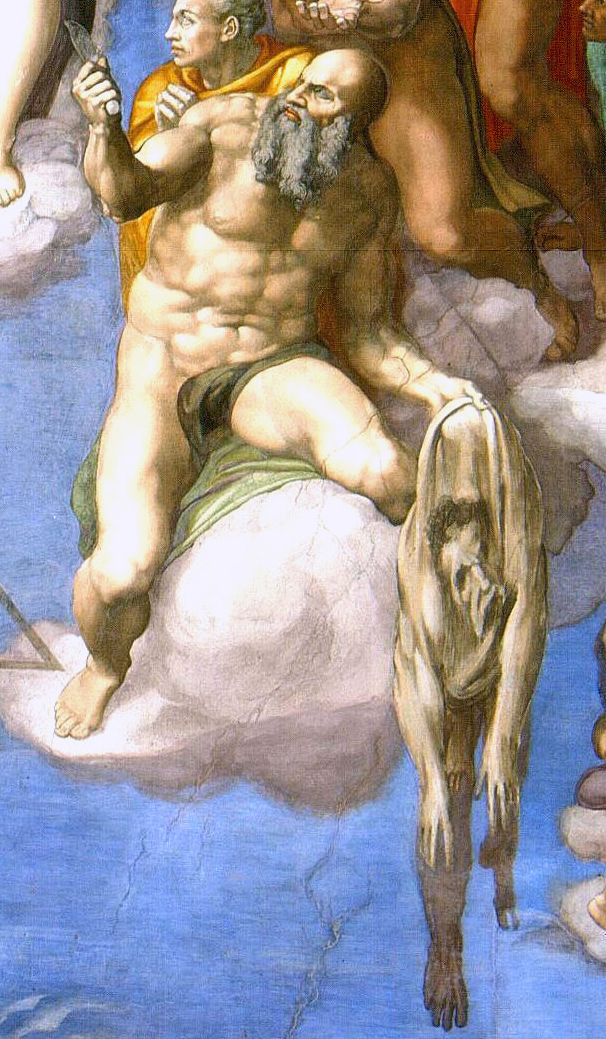
We have no certain information about Bartholomew's later life. The majority tradition, with varying details, is that Bartholomew preached in Armenia, and was finally skinned alive and beheaded in Albanus or Albanopolis on the Caspian Sea. His emblem in art is a flaying knife. The flayed Bartholomew can be seen in Michelangelo's Sistine painting of the Last Judgement. He is holding his skin. The face on the skin is generally considered to be a self-portrait of Michelangelo.


Saint Bartholomew the Apostle - 24 August

The Collect.

O ALMIGHTY and everlasting God, who didst give to thine Apostle Bartholomew grace truly to believe and to preach thy Word; Grant, we beseech thee, unto thy Church, to love that Word which he believed, and both to preach and receive the same; through Jesus Christ our Lord. Amen.


The Epistle - Acts v. 12.

BY the hands of the apostles were many signs and wonders wrought among the people; (and they were all with one accord in Solomon's porch. And of the rest durst no man join himself to them: but the people magnified them. And believers were the more added to the Lord, multitudes both of men and women.) Insomuch that they brought forth the sick into the streets, and laid them on beds and couches, that at the least the shadow of Peter passing by might overshadow some of them. There came also a multitude out of the cities round about unto Jerusalem, bringing sick folks, and them which were vexed with unclean spirits: and they were healed every one.


The Gospel - St. Luke xxii. 24.

AND there was also a strife among them, which of them should be accounted the greatest. And he said unto them, The kings of the Gentiles exercise lordship over them; and they that exercise authority upon them are called benefactors. But ye shall not be so: but he that is greatest among you, let him be as the younger; and he that is chief, as he that doth serve. For whether is greater, he that sitteth at meat, or he that serveth? is not he that sitteth at meat? but I am among you as he that serveth. Ye are they which have continued with me in my temptations. And I appoint unto you a kingdom, as my Father hath appointed unto me; that ye may eat and drink at my table in my kingdom, and sit on thrones judging the twelve tribes of Israel.


Reference and Resources:

http://en.wikipedia.org/wiki/St._Bartholomew
http://www.commonprayer.org/calend/propers/s_barth.cfm
http://elvis.rowan.edu/~kilroy/JEK/08/24.html
http://www.episcopalnet.org/1928bcp/propers/stbartholomew.html


†

Friday, April 24, 2020

The Martyrs of Armenia


Armenia is located at the east end of modern Turkey, with some of its traditional territory now in Turkey and some across the border in the former Soviet Union. The Armenians were converted to Christianity around 280 or 290, and are accounted the first country to become predominantly Christian. Their country is located at a spot where empires have clashed for centuries, and they have often been caught in the middle. For centuries they have been dominated by their Mohammedan neighbors, most recently the Turks of the Ottoman Empire.

The Turks were concerned about the possibility of an Armenian revolt. In 1895 and 1896 the Turkish Army killed about 100,000 Armenian civilians. Then in 1915, early in World War I, with Turkey fighting on the side of Germany and Austria-Hungary, and Russia fighting in alliance with the British and French on the other side, the Turkish government accused the Armenians of plotting with the Russians to assist a Russian invasion of Turkey. That spring, around 600,000 Armenians were killed by the Turkish Army, in an attempt to exterminate the Armenians completely. Much of the slaughter took place on 24 April 1915. The survivors were driven eastward and escaped into Russia. On 29 November 1920, most of Armenia was annexed by the Soviet Union.

It is sometimes said that the issues here were national, political, and ethnic rather than religious, and that the victims therefore do no qualify as martyrs. However, many of the Armenians, when about to be killed, were given the option of saving their lives by converting to Mohammedanism. Few did.


The Martyrs of Armenia - 24 April

The Collect -

O Almighty God, by whose grace and power thy holy martyrs of Armenia triumphed over suffering and were faithful even unto death: Grant us, who now remember them with thanksgiving, to be so faithful in our witness to thee in this world, that we may receive with them the crown of life; through Jesus Christ our Lord, who liveth and reigneth with thee and the Holy Ghost, one God, for ever and ever. Amen.


The Epistle - 1 Peter 4:12-19


The Holy Gospel - St. Mark 8:34-38


References and Resources:

http://en.wikipedia.org/wiki/Armenian_Genocide
http://www.armenian-genocide.org/


†

Monday, March 23, 2020

Gregory the Illuminator

The ancient kingdom of Armenia was the first country to become Christian, and it recognizes Gregory as its apostle. Armenia was a buffer state between the powerful empires of Rome and Parthia (Persia), and both of them sought to control it. Gregory was born about 257. When he was still an infant, his father assassinated the King of Parthia, and friends of the family carried Gregory away for protection to Caesarea in Cappadocia, where he was reared as a Christian. About 280 he returned to Armenia, where he was at first treated severely, but eventually by his preaching and example brought both King Tiridates and a majority of his people to the Christian faith. About 300, Gregory was consecrated the first bishop of Armenia. He died about 332. Armenian Christians to this day remember him with honor and gratitude.


Propers for Gregory the Illuminator - 23 March - Apostle to Armenia

The Collect.

Almighty God, who willest to be glorified in thy saints, and didst raise up thy servant Gregory the Illuminator to be a light in the world, and to preach the Gospel to the people of Armenia: Shine, we pray thee, in our hearts, that we also in our generation may show forth thy praise, who hast called us out of darkness into thy marvelous light; through Jesus Christ our Lord, who liveth and reigneth with thee and the Holy Ghost, one God, now and for ever. Amen.


The Epistle - Acts 17:22-31.

Then Paul stood in the midst of Mars' hill, and said, Ye men of Athens, I perceive that in all things ye are too superstitious. For as I passed by, and beheld your devotions, I found an altar with this inscription, TO THE UNKNOWN GOD. Whom therefore ye ignorantly worship, him declare I unto you. God that made the world and all things therein, seeing that he is Lord of heaven and earth, dwelleth not in temples made with hands; Neither is worshipped with men's hands, as though he needed any thing, seeing he giveth to all life, and breath, and all things; And hath made of one blood all nations of men for to dwell on all the face of the earth, and hath determined the times before appointed, and the bounds of their habitation; That they should seek the Lord, if haply they might feel after him, and find him, though he be not far from every one of us: For in him we live, and move, and have our being; as certain also of your own poets have said, For we are also his offspring. Forasmuch then as we are the offspring of God, we ought not to think that the Godhead is like unto gold, or silver, or stone, graven by art and man's device. And the times of this ignorance God winked at; but now commandeth all men every where to repent: Because he hath appointed a day, in the which he will judge the world in righteousness by that man whom he hath ordained; whereof he hath given assurance unto all men, in that he hath raised him from the dead.


The Gospel - St. Matthew 5:11-16.

Blessed are ye, when men shall revile you, and persecute you, and shall say all manner of evil against you falsely, for my sake. Rejoice, and be exceeding glad: for great is your reward in heaven: for so persecuted they the prophets which were before you. Ye are the salt of the earth: but if the salt have lost his savour, wherewith shall it be salted? it is thenceforth good for nothing, but to be cast out, and to be trodden under foot of men. Ye are the light of the world. A city that is set on an hill cannot be hid. Neither do men light a candle, and put it under a bushel, but on a candlestick; and it giveth light unto all that are in the house. Let your light so shine before men, that they may see your good works, and glorify your Father which is in heaven.


Reference and Resources:

http://en.wikipedia.org/wiki/Gregory_the_Illuminator
http://elvis.rowan.edu/~kilroy/JEK/03/23.html
http://www.missionstclare.com/english/people/mar23.html
http://ohioanglican.blogspot.com/2007/03/gregory-illuminator-apostle-to-armenia.html


†

Tuesday, March 10, 2020

The Forty Martyrs of Sebaste


The Forty Martyrs of Sebaste or the Holy Forty (Ancient/Katharevousa Greek Ἃγιοι Τεσσεράκοντα, Demotic Άγιοι Σαράντα) were a group of Roman soldiers in the Legio XII Fulminata,who became martyrs for their Christian faith in 320.

In the year 320, Constantine was Emperor of the West and Licinius of the East. Licinius, under pressure from Constantine, had agreed to legalize Christianity in his territory, and the two made an alliance (cemented by the marriage of Licinius to Constantia the sister of Constantine), but now Licinius broke the alliance and made a new attempt to suppress Christianity. He ordered his soldiers to repudiate it on pain of death. In the "Thundering Legion," stationed near Sebaste in Armenia (now Sivas in Turkey), forty soldiers refused, and when promises, threats, and beatings failed to shake them, they were stripped naked one evening and herded onto the middle of a frozen lake, and told, "You may come ashore when you are ready to deny your faith." To tempt them, fires were built on shore, with warm baths, blankets, clothing, and hot food and drink close by. The mother of the youngest soldier was present and encouraged her son from the bank. As night deepened, thirty-nine men stood firm, while one broke and ran to the shore. However, one of the soldiers standing guard on shore was so moved by the steadfastness of the Christians that he stripped off his clothes and ran out to join them. They welcomed him into their company, and so the number of the martyrs remained at forty, and by morning, all were dead of exposure. (One source says that the few in whom a little life remained were stabbed to death at dawn.)

We still have what some scholars believe to be an authentic eyewitness account of their martyrdom. It includes farewell messages to their family and friends written shortly before their deaths.


According to Antonio Borrelli, their names were "Aetius, Eutychius, Cyrius, Theophilus, Sisinnius, Smaragdus, Candidus, Aggia, Gaius, Cudio, Heraclius, John, Philotemon, Gorgonius, Cirillus, Severianus, Theodulus, Nicallus, Flavius, Xantius, Valerius, Aesychius, Eunoicus, Domitian, Domninus, Helianus, Leontius (Theoctistus), Valens, Acacius, Alexander, Vicratius (Vibianus), Priscus, Sacerdos, Ecdicius, Athanasius, Lisimachus, Claudius, Ile, Melito and Eutychus (Aglaius)."


Propers for The Forty Martyrs of Sebaste - 10 March


The Collect.

O Almighty God, by whose grace and power Thy holy martyrs of Sebaste triumphed over suffering and were faithful even unto death: Grant us, who now remember them with thanksgiving, to be so faithful in our witness to Thee in this world, that we may receive with them the crown of life; through Jesus Christ our Lord, who liveth and reigneth with Thee and the Holy Ghost, one God, for ever and ever. Amen.


The Epistle - 2 Esdras 2:42-48.

I ESDRAS saw upon the mount Sion a great people, whom I could not number, and they all praised the Lord with songs. And in the midst of them there was a young man of a high stature, taller than all the rest, and upon every one of their heads he set crowns, and was more exalted; which I marvelled at greatly. So I asked the angel, and said, Sir, what are these? He answered and said unto me, These be they that have put off the mortal clothing, and put on the immortal, and have confessed the name of God: now are they crowned, and receive palms. Then said I unto the angel. What young person is it that crowneth them, and giveth them palms in their hands? So he answered and said unto me, It is the Son of God, whom they have confessed in the world. Then began I greatly to commend them that stood so stiffly for the name of the Lord. Then the angel said unto me, Go thy way, and tell my people what manner of things, and how great wonders of the Lord thy God, thou hast seen.


The Gospel - St. Matthew 10:16-22.

BEHOLD, I send you forth as sheep in the midst of wolves: be ye therefore wise as serpents, and harmless as doves. But beware of men: for they will deliver you up to the councils, and they will scourge you in their synagogues; and ye shall he brought before governors and kings for my sake, for a witness to them and the Gentiles. But when they deliver you up, be not anxious how or what ye shall speak: for it shall be given you in that same hour what ye shall speak. For it is not ye that speak, but the Spirit of your Father which speaketh in you. And the brother shall deliver up the brother to death, and the father the child: and the children shall rise up against their parents, and cause them to be put to death. And ye shall be hated of all men for my name's sake: but he that endureth to the end shall be saved.


Reference and Resources:

https://catholicsaints.info/butlers-lives-of-the-saints-the-forty-martyrs-of-sebaste/
http://en.wikipedia.org/wiki/Forty_Martyrs_of_Sebaste
http://www.commonprayer.org/calend/propers/com_mart.cfm
http://elvis.rowan.edu/~kilroy/JEK/03/10.html

†

Monday, February 17, 2020

Mesrob of Armenia


(also Mesrob, Mashtotz, Armenian: Մեսրոպ Մաշտոց) (361 or 362, Hatsik, in Taron - February 17, 440, Echmiadzin) was an Armenian monk, theologian and linguist. He is best known for having invented the Armenian alphabet, which was a fundamental step in strengthening the Armenian Church, the government of the Armenian Kingdom, and ultimately the bond between the Armenian Kingdom and Armenians living in the Byzantine Empire and the Persian Empire.


Propers for Mesrob - 17 February - Monk, Theologian, and Linguist

The Collect.

GOD, who hast endowed thy servant Mesrob with clarity of faith and holiness of life: Grant us to keep with steadfast minds the faith which he taught, and in his fellowship to be made partakers of eternal glory; through Jesus Christ our Lord. Amen.


The Epistle - Philippians 3:7-15.

HOWBEIT what things were gain to me, these have I counted loss for Christ. Yea verily, and I count all things to be loss for the excellency of the knowledge of Christ Jesus my Lord: for whom I suffer the loss of all things, and do count them but dung, that I may gain Christ, and be found in him, not having a righteousness of mine own, even that which is of the law, but that which is through faith in Christ, the righteousness which is of God by faith: that I may know him, and the power of his resurrection, and the fellowship of his sufferings, becoming conformed unto his death; if by any means I may attain unto the resurrection of the dead. Not that I have already obtained, or am already made perfect: but I press on, if so be that I
may apprehend that for which also I was apprehended by Christ Jesus. Brethren, I count not myself yet to have apprehended: but one thing I do, forgetting the things which are behind, and stretching forward to the things which are before, I press on toward the goal unto the prize of the high calling of God in Christ Jesus. Let us
therefore, as many as be perfect, be thus minded: and if in anything ye are otherwise minded, even this shall God reveal unto you.


The Gospel. St - Matthew 25:31-40.

WHEN the Son of man shall come in his glory, and all the holy angels with him, then shall he sit upon the throne of his glory: and before him shall be gathered all nations: and he shall separate them one from another, as a shepherd divideth his sheep from the goats: and he shall set the sheep on his right hand, but the goats on the left. Then shall the King say unto them on his right hand, Come, ye blessed of my Father, inherit the kingdom prepared for you from the foundation of the world: for I was an hungred, and ye gave me meat: I was thirsty, and ye gave me. drink: I was a stranger, and ye took me in: naked, and ye clothed me: I was sick, and ye visited me: I was in prison, and ye came unto me. Then shall the righteous answer him, saying, Lord, when saw we thee an hungred, and fed thee? or thirsty, and gave thee drink? When saw we thee a stranger, and took thee in? or naked, and clothed thee? Or when saw we thee sick, or in prison, and came unto thee? And the King shall answer and say unto them, Verily I say unto you, Inasmuch as ye have done it unto one of the least of these my brethren, ye have done it unto me.


Reference and Resources:

http://en.wikipedia.org/wiki/Saint_Mesrob

†

Monday, February 3, 2020

Blasius of Sebaste

(or Blasius Βλάσιος, Armenian: Սուրբ Բարսեղ) was a physician and bishop of Sebaste (modern Sivas), Armenia. According to his Acta he was martyred by being beaten, attacked with iron carding combs, and beheaded.

In iconography, Blaise is often shown with the instruments of his martyrdom, iron combs. The similarity of these instruments of torture to wool combs led to his adoption as patron of wool combers in particular, and the wool trade in general. He may also be depicted with crossed candles. Such crossed candles (left unlighted for safety reasons) are used for the blessing of throats on the feast day of St. Blaise, which falls on February 3, the day after Candlemas on the Kalendar, Blaise is traditionally believed to intercede in cases of throat illnesses, especially for fish-bones stuck in the throat. The blessing is: "Per intercessionem Sancti Blasii liberet te Deus a malo gutteris et a quovis alio malo." (May God at the intercession of Saint Blaise preserve you from throat troubles and every other evil).

Indeed, the first reference we have to him is in manuscripts of the medical writings of Aëtius Amidenus, the court physician of Justinian I, where his aid is invoked in treating objects stuck in the throat. He cured animals and lived in a cage. Before being killed, he spoke to a wolf and told it to release a pig it was harming. The wolf did so. Saint Blaise was going to be starved but the owner of the pig secretly gave him food in order to survive. After a while, he was tortured because of what he believed in but did not give up faith, he then died in the year 316.

Propers for Blasius - 3 February - Bishop and Martyr

The Collect.

O GOD, who didst make blessed Blasius, they Martyr and Bishop, strong to endure his own sufferings and to lighten the infirmities of other men: Mercifully grant that we may imitate his constancy of faith, and in danger may feel thy protection as he did; through Jesus Christ our Lord. Amen.


The Epistle - 2 Esdras 2:42-48.

I ESDRAS saw upon the mount Sion a great people, whom I could not number, and they all praised the Lord with songs. And in the midst of them there was a young man of a high stature, taller than all the rest, and upon every one of their heads he set crowns, and was more exalted; which I marvelled at greatly. So I asked the angel, and said, Sir, what are these? He answered and said unto me, These be they that have put off the mortal clothing, and put on the immortal, and have confessed the name of God: now are they crowned, and receive palms. Then said I unto the angel. What young person is it that crowneth them, and giveth them palms in their hands? So he answered and said unto me, It is the Son of God, whom they have confessed in the world. Then began I greatly to commend them that stood so stiffly for the name of the Lord. Then the angel said unto me, Go thy way, and tell my people what manner of things, and how great wonders of the Lord thy God, thou hast seen.


The Gospel - St. Matthew 10:16-22.

BEHOLD, I send you forth as sheep in the midst of wolves: be ye therefore wise as serpents, and harmless as doves. But beware of men: for they will deliver you up to the councils, and they will scourge you in their synagogues; and ye shall he brought before governors and kings for my sake, for a witness to them and the Gentiles. But when they deliver you up, be not anxious how or what ye shall speak: for it shall be given you in that same hour what ye shall speak. For it is not ye that speak, but the Spirit of your Father which speaketh in you. And the brother shall deliver up the brother to death, and the father the child: and the children shall rise up against their parents, and cause them to be put to death. And ye shall be hated of all men for my name's sake: but he that endureth to the end shall be saved.

Reference and Resources:

http://en.wikipedia.org/wiki/Saint_Blaise
http://www.commonprayer.org/calend/propers/blasius.cfm

†

Thursday, January 9, 2020

Polyeuktos

lived during the reign of Emperors Decius and Vallerian in 255. He knew well the art of warfare and used to live in the Armenian city of Melitine. He was the first to suffer martyrdom in this city. An impious law was pronounced that ordered Christians to deny Christ. Whoever was not convinced ought to be punished with death. Because of this law the athlete of Christ Polyeuktos, without losing his nerve at all, preached Christ openly and with his great courage and valour he smashed the idols which the Greeks respected.

Although his father-in-law advised him to deny Christ and his wife was crying and lamenting for him, he persevered and neither was he convinced by his father-in-law's advice nor did he sympathize with his wife's wailing. Instead, he kept his promises and what he had agreed with his friend Nearkhos, who was afraid and suspected that he would deny the faith of Christ. So, he stayed firm and would not be moved from the confession of faith. Because of this he died by the sword and rose to heaven.

Propers for Polyeuktos - 9 January - Soldier, Confessor and Martyr


The Collect.

ALMIGHTY and everlasting God, who didst strengthen thy blessed martyr Polyeuktos with the virtue of constancy in faith and truth: Grant us in like manner for love of thee to despise the prosperity of this world, and to fear none of its adversities; through Jesus Christ our Lord. Amen.


The Epistle - 2 Esdras 2:42-48.

I ESDRAS saw upon the mount Sion a great people, whom I could not number, and they all praised the Lord with songs. And in the midst of them there was a young man of a high stature, taller than all the rest, and upon every one of their heads he set crowns, and was more exalted; which I marvelled at greatly. So I asked the angel, and said, Sir, what are these? He answered and said unto me, These be they that have put off the mortal clothing, and put on the immortal, and have confessed the name of God: now are they crowned, and receive palms. Then said I unto the angel. What young person is it that crowneth them, and giveth them palms in their hands? So he answered and said unto me, It is the Son of God, whom they have confessed in the world. Then began I greatly to commend them that stood so stiffly for the name of the Lord. Then the angel said unto me, Go thy way, and tell my people what manner of things, and how great wonders of the Lord thy God, thou hast seen.


The Gospel - St. Matthew 10:16-22.

BEHOLD, I send you forth as sheep in the midst of wolves: be ye therefore wise as serpents, and harmless as doves. But beware of men: for they will deliver you up to the councils, and they will scourge you in their synagogues; and ye shall he brought before governors and kings for my sake, for a witness to them and the Gentiles. But when they deliver you up, be not anxious how or what ye shall speak: for it shall be given you in that same hour what ye shall speak. For it is not ye that speak, but the Spirit of your Father which speaketh in you. And the brother shall deliver up the brother to death, and the father the child: and the children shall rise up against their parents, and cause them to be put to death. And ye shall be hated of all men for my name's sake: but he that endureth to the end shall be saved.


Reference and Resources:

http://www.holytrinityorthodox.com/calendar/los/January/09-01.htm
http://www.commonprayer.org/calend/propers/com_mart.cfm
http://www.missionstclare.com/english/people/jan9o.html

†

Wednesday, April 24, 2019

The Martyrs of Armenia


This is a photo recently published that was in the custody of the secret archives of the Vatican. It is the massacre of Armenian Christians, victims of muslims of the Turkish Army. They did unspeakable things to the pregnant women and their infants. More than a million and a half Armenian Christians died also during the First World War, but who knows this? This 25th of March many locales will celebrate the "Day of the Newborn Child"

Armenia is located at the east end of modern Turkey, with some of its traditional territory now in Turkey and some across the border in the former Soviet Union. The Armenians were converted to Christianity around 280 or 290, and are accounted the first country to become predominantly Christian. Their country is located at a spot where empires have clashed for centuries, and they have often been caught in the middle. For centuries they have been dominated by their Mohammedan neighbors, most recently the Turks of the Ottoman Empire.

The Turks were concerned about the possibility of an Armenian revolt. In 1895 and 1896 the Turkish Army killed about 100,000 Armenian civilians. Then in 1915, early in World War I, with Turkey fighting on the side of Germany and Austria-Hungary, and Russia fighting in alliance with the British and French on the other side, the Turkish government accused the Armenians of plotting with the Russians to assist a Russian invasion of Turkey. That spring, around 600,000 Armenians were killed by the Turkish Army, in an attempt to exterminate the Armenians completely. Much of the slaughter took place on 24 April 1915. The survivors were driven eastward and escaped into Russia. On 29 November 1920, most of Armenia was annexed by the Soviet Union.

It is sometimes said that the issues here were national, political, and ethnic rather than religious, and that the victims therefore do no qualify as martyrs. However, many of the Armenians, when about to be killed, were given the option of saving their lives by converting to Mohammedanism. Few did.


The Martyrs of Armenia - 24 April

The Collect -

O Almighty God, by whose grace and power thy holy martyrs of Armenia triumphed over suffering and were faithful even unto death: Grant us, who now remember them with thanksgiving, to be so faithful in our witness to thee in this world, that we may receive with them the crown of life; through Jesus Christ our Lord, who liveth and reigneth with thee and the Holy Ghost, one God, for ever and ever. Amen.


The Epistle - 1 Peter 4:12-19


The Holy Gospel - St. Mark 8:34-38


References and Resources:

http://en.wikipedia.org/wiki/Armenian_Genocide
http://www.armenian-genocide.org/


†

Saturday, March 23, 2019

Gregory the Illuminator

The ancient kingdom of Armenia was the first country to become Christian, and it recognizes Gregory as its apostle. Armenia was a buffer state between the powerful empires of Rome and Parthia (Persia), and both of them sought to control it. Gregory was born about 257. When he was still an infant, his father assassinated the King of Parthia, and friends of the family carried Gregory away for protection to Caesarea in Cappadocia, where he was reared as a Christian. About 280 he returned to Armenia, where he was at first treated severely, but eventually by his preaching and example brought both King Tiridates and a majority of his people to the Christian faith. About 300, Gregory was consecrated the first bishop of Armenia. He died about 332. Armenian Christians to this day remember him with honor and gratitude.


Propers for Gregory the Illuminator - 23 March - Apostle to Armenia

The Collect.

Almighty God, who willest to be glorified in thy saints, and didst raise up thy servant Gregory the Illuminator to be a light in the world, and to preach the Gospel to the people of Armenia: Shine, we pray thee, in our hearts, that we also in our generation may show forth thy praise, who hast called us out of darkness into thy marvelous light; through Jesus Christ our Lord, who liveth and reigneth with thee and the Holy Ghost, one God, now and for ever. Amen.


The Epistle - Acts 17:22-31.

Then Paul stood in the midst of Mars' hill, and said, Ye men of Athens, I perceive that in all things ye are too superstitious. For as I passed by, and beheld your devotions, I found an altar with this inscription, TO THE UNKNOWN GOD. Whom therefore ye ignorantly worship, him declare I unto you. God that made the world and all things therein, seeing that he is Lord of heaven and earth, dwelleth not in temples made with hands; Neither is worshipped with men's hands, as though he needed any thing, seeing he giveth to all life, and breath, and all things; And hath made of one blood all nations of men for to dwell on all the face of the earth, and hath determined the times before appointed, and the bounds of their habitation; That they should seek the Lord, if haply they might feel after him, and find him, though he be not far from every one of us: For in him we live, and move, and have our being; as certain also of your own poets have said, For we are also his offspring. Forasmuch then as we are the offspring of God, we ought not to think that the Godhead is like unto gold, or silver, or stone, graven by art and man's device. And the times of this ignorance God winked at; but now commandeth all men every where to repent: Because he hath appointed a day, in the which he will judge the world in righteousness by that man whom he hath ordained; whereof he hath given assurance unto all men, in that he hath raised him from the dead.


The Gospel - St. Matthew 5:11-16.

Blessed are ye, when men shall revile you, and persecute you, and shall say all manner of evil against you falsely, for my sake. Rejoice, and be exceeding glad: for great is your reward in heaven: for so persecuted they the prophets which were before you. Ye are the salt of the earth: but if the salt have lost his savour, wherewith shall it be salted? it is thenceforth good for nothing, but to be cast out, and to be trodden under foot of men. Ye are the light of the world. A city that is set on an hill cannot be hid. Neither do men light a candle, and put it under a bushel, but on a candlestick; and it giveth light unto all that are in the house. Let your light so shine before men, that they may see your good works, and glorify your Father which is in heaven.


Reference and Resources:

http://en.wikipedia.org/wiki/Gregory_the_Illuminator
http://elvis.rowan.edu/~kilroy/JEK/03/23.html
http://www.missionstclare.com/english/people/mar23.html
http://ohioanglican.blogspot.com/2007/03/gregory-illuminator-apostle-to-armenia.html


†

Sunday, March 10, 2019

The Forty Martyrs of Sebaste

or the Holy Forty (Ancient/Katharevousa Greek Ἃγιοι Τεσσεράκοντα, Demotic Άγιοι Σαράντα) were a group of Roman soldiers in the Legio XII Fulminata,who became martyrs for their Christian faith in 320.

In the year 320, Constantine was Emperor of the West and Licinius of the East. Licinius, under pressure from Constantine, had agreed to legalize Christianity in his territory, and the two made an alliance (cemented by the marriage of Licinius to Constantia the sister of Constantine), but now Licinius broke the alliance and made a new attempt to suppress Christianity. He ordered his soldiers to repudiate it on pain of death. In the "Thundering Legion," stationed near Sebaste in Armenia (now Sivas in Turkey), forty soldiers refused, and when promises, threats, and beatings failed to shake them, they were stripped naked one evening and herded onto the middle of a frozen lake, and told, "You may come ashore when you are ready to deny your faith." To tempt them, fires were built on shore, with warm baths, blankets, clothing, and hot food and drink close by. The mother of the youngest soldier was present and encouraged her son from the bank. As night deepened, thirty-nine men stood firm, while one broke and ran to the shore. However, one of the soldiers standing guard on shore was so moved by the steadfastness of the Christians that he stripped off his clothes and ran out to join them. They welcomed him into their company, and so the number of the martyrs remained at forty, and by morning, all were dead of exposure. (One source says that the few in whom a little life remained were stabbed to death at dawn.)

We still have what some scholars believe to be an authentic eyewitness account of their martyrdom. It includes farewell messages to their family and friends written shortly before their deaths.

According to Antonio Borrelli, their names were "Aetius, Eutychius, Cyrius, Theophilus, Sisinnius, Smaragdus, Candidus, Aggia, Gaius, Cudio, Heraclius, John, Philotemon, Gorgonius, Cirillus, Severianus, Theodulus, Nicallus, Flavius, Xantius, Valerius, Aesychius, Eunoicus, Domitian, Domninus, Helianus, Leontius (Theoctistus), Valens, Acacius, Alexander, Vicratius (Vibianus), Priscus, Sacerdos, Ecdicius, Athanasius, Lisimachus, Claudius, Ile, Melito and Eutychus (Aglaius)."


Propers for The Forty Martyrs of Sebaste - 10 March


The Collect.

O Almighty God, by whose grace and power Thy holy martyrs of Sebaste triumphed over suffering and were faithful even unto death: Grant us, who now remember them with thanksgiving, to be so faithful in our witness to Thee in this world, that we may receive with them the crown of life; through Jesus Christ our Lord, who liveth and reigneth with Thee and the Holy Ghost, one God, for ever and ever. Amen.


The Epistle - 2 Esdras 2:42-48.

I ESDRAS saw upon the mount Sion a great people, whom I could not number, and they all praised the Lord with songs. And in the midst of them there was a young man of a high stature, taller than all the rest, and upon every one of their heads he set crowns, and was more exalted; which I marvelled at greatly. So I asked the angel, and said, Sir, what are these? He answered and said unto me, These be they that have put off the mortal clothing, and put on the immortal, and have confessed the name of God: now are they crowned, and receive palms. Then said I unto the angel. What young person is it that crowneth them, and giveth them palms in their hands? So he answered and said unto me, It is the Son of God, whom they have confessed in the world. Then began I greatly to commend them that stood so stiffly for the name of the Lord. Then the angel said unto me, Go thy way, and tell my people what manner of things, and how great wonders of the Lord thy God, thou hast seen.


The Gospel - St. Matthew 10:16-22.

BEHOLD, I send you forth as sheep in the midst of wolves: be ye therefore wise as serpents, and harmless as doves. But beware of men: for they will deliver you up to the councils, and they will scourge you in their synagogues; and ye shall he brought before governors and kings for my sake, for a witness to them and the Gentiles. But when they deliver you up, be not anxious how or what ye shall speak: for it shall be given you in that same hour what ye shall speak. For it is not ye that speak, but the Spirit of your Father which speaketh in you. And the brother shall deliver up the brother to death, and the father the child: and the children shall rise up against their parents, and cause them to be put to death. And ye shall be hated of all men for my name's sake: but he that endureth to the end shall be saved.


Reference and Resources:

http://en.wikipedia.org/wiki/Forty_Martyrs_of_Sebaste
http://www.commonprayer.org/calend/propers/com_mart.cfm
http://elvis.rowan.edu/~kilroy/JEK/03/10.html

†

Sunday, February 17, 2019

Mesrob of Armenia

(also Mesrob, Mashtotz, Armenian: Մեսրոպ Մաշտոց) (361 or 362, Hatsik, in Taron - February 17, 440, Echmiadzin) was an Armenian monk, theologian and linguist. He is best known for having invented the Armenian alphabet, which was a fundamental step in strengthening the Armenian Church, the government of the Armenian Kingdom, and ultimately the bond between the Armenian Kingdom and Armenians living in the Byzantine Empire and the Persian Empire.


Propers for Mesrob - 17 February - Monk, Theologian, and Linguist

The Collect.

GOD, who hast endowed thy servant Mesrob with clarity of faith and holiness of life: Grant us to keep with steadfast minds the faith which he taught, and in his fellowship to be made partakers of eternal glory; through Jesus Christ our Lord. Amen.


The Epistle - Philippians 3:7-15.

HOWBEIT what things were gain to me, these have I counted loss for Christ. Yea verily, and I count all things to be loss for the excellency of the knowledge of Christ Jesus my Lord: for whom I suffer the loss of all things, and do count them but dung, that I may gain Christ, and be found in him, not having a righteousness of mine own, even that which is of the law, but that which is through faith in Christ, the righteousness which is of God by faith: that I may know him, and the power of his resurrection, and the fellowship of his sufferings, becoming conformed unto his death; if by any means I may attain unto the resurrection of the dead. Not that I have already obtained, or am already made perfect: but I press on, if so be that I
may apprehend that for which also I was apprehended by Christ Jesus. Brethren, I count not myself yet to have apprehended: but one thing I do, forgetting the things which are behind, and stretching forward to the things which are before, I press on toward the goal unto the prize of the high calling of God in Christ Jesus. Let us
therefore, as many as be perfect, be thus minded: and if in anything ye are otherwise minded, even this shall God reveal unto you.


The Gospel. St - Matthew 25:31-40.

WHEN the Son of man shall come in his glory, and all the holy angels with him, then shall he sit upon the throne of his glory: and before him shall be gathered all nations: and he shall separate them one from another, as a shepherd divideth his sheep from the goats: and he shall set the sheep on his right hand, but the goats on the left. Then shall the King say unto them on his right hand, Come, ye blessed of my Father, inherit the kingdom prepared for you from the foundation of the world: for I was an hungred, and ye gave me meat: I was thirsty, and ye gave me. drink: I was a stranger, and ye took me in: naked, and ye clothed me: I was sick, and ye visited me: I was in prison, and ye came unto me. Then shall the righteous answer him, saying, Lord, when saw we thee an hungred, and fed thee? or thirsty, and gave thee drink? When saw we thee a stranger, and took thee in? or naked, and clothed thee? Or when saw we thee sick, or in prison, and came unto thee? And the King shall answer and say unto them, Verily I say unto you, Inasmuch as ye have done it unto one of the least of these my brethren, ye have done it unto me.


Reference and Resources:

http://en.wikipedia.org/wiki/Saint_Mesrob

†

Sunday, February 3, 2019

Blasius of Sebaste

(or Blasius Βλάσιος, Armenian: Սուրբ Բարսեղ) was a physician and bishop of Sebaste (modern Sivas), Armenia. According to his Acta he was martyred by being beaten, attacked with iron carding combs, and beheaded.

In iconography, Blaise is often shown with the instruments of his martyrdom, iron combs. The similarity of these instruments of torture to wool combs led to his adoption as patron of wool combers in particular, and the wool trade in general. He may also be depicted with crossed candles. Such crossed candles (left unlighted for safety reasons) are used for the blessing of throats on the feast day of St. Blaise, which falls on February 3, the day after Candlemas on the Kalendar, Blaise is traditionally believed to intercede in cases of throat illnesses, especially for fish-bones stuck in the throat. The blessing is: "Per intercessionem Sancti Blasii liberet te Deus a malo gutteris et a quovis alio malo." (May God at the intercession of Saint Blaise preserve you from throat troubles and every other evil).

Indeed, the first reference we have to him is in manuscripts of the medical writings of Aëtius Amidenus, the court physician of Justinian I, where his aid is invoked in treating objects stuck in the throat. He cured animals and lived in a cage. Before being killed, he spoke to a wolf and told it to release a pig it was harming. The wolf did so. Saint Blaise was going to be starved but the owner of the pig secretly gave him food in order to survive. After a while, he was tortured because of what he believed in but did not give up faith, he then died in the year 316.

Propers for Blasius - 3 February - Bishop and Martyr

The Collect.

O GOD, who didst make blessed Blasius, they Martyr and Bishop, strong to endure his own sufferings and to lighten the infirmities of other men: Mercifully grant that we may imitate his constancy of faith, and in danger may feel thy protection as he did; through Jesus Christ our Lord. Amen.


The Epistle - 2 Esdras 2:42-48.

I ESDRAS saw upon the mount Sion a great people, whom I could not number, and they all praised the Lord with songs. And in the midst of them there was a young man of a high stature, taller than all the rest, and upon every one of their heads he set crowns, and was more exalted; which I marvelled at greatly. So I asked the angel, and said, Sir, what are these? He answered and said unto me, These be they that have put off the mortal clothing, and put on the immortal, and have confessed the name of God: now are they crowned, and receive palms. Then said I unto the angel. What young person is it that crowneth them, and giveth them palms in their hands? So he answered and said unto me, It is the Son of God, whom they have confessed in the world. Then began I greatly to commend them that stood so stiffly for the name of the Lord. Then the angel said unto me, Go thy way, and tell my people what manner of things, and how great wonders of the Lord thy God, thou hast seen.


The Gospel - St. Matthew 10:16-22.

BEHOLD, I send you forth as sheep in the midst of wolves: be ye therefore wise as serpents, and harmless as doves. But beware of men: for they will deliver you up to the councils, and they will scourge you in their synagogues; and ye shall he brought before governors and kings for my sake, for a witness to them and the Gentiles. But when they deliver you up, be not anxious how or what ye shall speak: for it shall be given you in that same hour what ye shall speak. For it is not ye that speak, but the Spirit of your Father which speaketh in you. And the brother shall deliver up the brother to death, and the father the child: and the children shall rise up against their parents, and cause them to be put to death. And ye shall be hated of all men for my name's sake: but he that endureth to the end shall be saved.

Reference and Resources:

http://en.wikipedia.org/wiki/Saint_Blaise
http://www.commonprayer.org/calend/propers/blasius.cfm

†

Wednesday, January 9, 2019

Polyeuktos

lived during the reign of Emperors Decius and Vallerian in 255. He knew well the art of warfare and used to live in the Armenian city of Melitine. He was the first to suffer martyrdom in this city. An impious law was pronounced that ordered Christians to deny Christ. Whoever was not convinced ought to be punished with death. Because of this law the athlete of Christ Polyeuktos, without losing his nerve at all, preached Christ openly and with his great courage and valour he smashed the idols which the Greeks respected.

Although his father-in-law advised him to deny Christ and his wife was crying and lamenting for him, he persevered and neither was he convinced by his father-in-law's advice nor did he sympathize with his wife's wailing. Instead, he kept his promises and what he had agreed with his friend Nearkhos, who was afraid and suspected that he would deny the faith of Christ. So, he stayed firm and would not be moved from the confession of faith. Because of this he died by the sword and rose to heaven.

Propers for Polyeuktos - 9 January - Soldier, Confessor and Martyr


The Collect.

ALMIGHTY and everlasting God, who didst strengthen thy blessed martyr Polyeuktos with the virtue of constancy in faith and truth: Grant us in like manner for love of thee to despise the prosperity of this world, and to fear none of its adversities; through Jesus Christ our Lord. Amen.


The Epistle - 2 Esdras 2:42-48.

I ESDRAS saw upon the mount Sion a great people, whom I could not number, and they all praised the Lord with songs. And in the midst of them there was a young man of a high stature, taller than all the rest, and upon every one of their heads he set crowns, and was more exalted; which I marvelled at greatly. So I asked the angel, and said, Sir, what are these? He answered and said unto me, These be they that have put off the mortal clothing, and put on the immortal, and have confessed the name of God: now are they crowned, and receive palms. Then said I unto the angel. What young person is it that crowneth them, and giveth them palms in their hands? So he answered and said unto me, It is the Son of God, whom they have confessed in the world. Then began I greatly to commend them that stood so stiffly for the name of the Lord. Then the angel said unto me, Go thy way, and tell my people what manner of things, and how great wonders of the Lord thy God, thou hast seen.


The Gospel - St. Matthew 10:16-22.

BEHOLD, I send you forth as sheep in the midst of wolves: be ye therefore wise as serpents, and harmless as doves. But beware of men: for they will deliver you up to the councils, and they will scourge you in their synagogues; and ye shall he brought before governors and kings for my sake, for a witness to them and the Gentiles. But when they deliver you up, be not anxious how or what ye shall speak: for it shall be given you in that same hour what ye shall speak. For it is not ye that speak, but the Spirit of your Father which speaketh in you. And the brother shall deliver up the brother to death, and the father the child: and the children shall rise up against their parents, and cause them to be put to death. And ye shall be hated of all men for my name's sake: but he that endureth to the end shall be saved.


Reference and Resources:

http://www.holytrinityorthodox.com/calendar/los/January/09-01.htm
http://www.commonprayer.org/calend/propers/com_mart.cfm
http://www.missionstclare.com/english/people/jan9o.html

†

Thursday, August 24, 2017

Bartholomew the Apostle


was one of the twelve Apostles of Jesus. Bartholomew (Greek: Βαρθολομαίος, transliterated "Bartholomaios") comes from the Aramaic bar-Tôlmay (תולמי‎‎‎‎‎-בר‎‎), meaning son of Tolmay (Ptolemy) or son of the furrows (perhaps a ploughman). Many have, based on this meaning, assumed it was not a given name, but a family name.

Though Bartholomew is listed among the Twelve Apostles in the three Synoptic gospels: Matthew, Mark, and Luke, and also appears as one of the witnesses of the Ascension (Acts 1:4, 12, 13), each time named in the company of Philip, he is one of the apostles of whom no word is reported nor any individual action recorded in the New Testament.

We have no certain information about Bartholomew's later life. The majority tradition, with varying details, is that Bartholomew preached in Armenia, and was finally skinned alive and beheaded in Albanus or Albanopolis on the Caspian Sea. His emblem in art is a flaying knife. The flayed Bartholomew can be seen in Michelangelo's Sistine painting of the Last Judgement. He is holding his skin. The face on the skin is generally considered to be a self-portrait of Michelangelo.


Saint Bartholomew the Apostle - 24 August

The Collect.

O ALMIGHTY and everlasting God, who didst give to thine Apostle Bartholomew grace truly to believe and to preach thy Word; Grant, we beseech thee, unto thy Church, to love that Word which he believed, and both to preach and receive the same; through Jesus Christ our Lord. Amen.


The Epistle - Acts v. 12.

BY the hands of the apostles were many signs and wonders wrought among the people; (and they were all with one accord in Solomon's porch. And of the rest durst no man join himself to them: but the people magnified them. And believers were the more added to the Lord, multitudes both of men and women.) Insomuch that they brought forth the sick into the streets, and laid them on beds and couches, that at the least the shadow of Peter passing by might overshadow some of them. There came also a multitude out of the cities round about unto Jerusalem, bringing sick folks, and them which were vexed with unclean spirits: and they were healed every one.


The Gospel - St. Luke xxii. 24.

AND there was also a strife among them, which of them should be accounted the greatest. And he said unto them, The kings of the Gentiles exercise lordship over them; and they that exercise authority upon them are called benefactors. But ye shall not be so: but he that is greatest among you, let him be as the younger; and he that is chief, as he that doth serve. For whether is greater, he that sitteth at meat, or he that serveth? is not he that sitteth at meat? but I am among you as he that serveth. Ye are they which have continued with me in my temptations. And I appoint unto you a kingdom, as my Father hath appointed unto me; that ye may eat and drink at my table in my kingdom, and sit on thrones judging the twelve tribes of Israel.


Reference and Resources:

http://en.wikipedia.org/wiki/St._Bartholomew
http://www.commonprayer.org/calend/propers/s_barth.cfm
http://elvis.rowan.edu/~kilroy/JEK/08/24.html
http://www.episcopalnet.org/1928bcp/propers/stbartholomew.html


†