Showing posts with label Saints. Show all posts

Monday, December 12, 2022

Edburga of Thanet

Edburga of Minster-in-Thanet was the, apparently only, daughter of King Centwine of Wessex and his wife, Engyth. She was a disciple of St. Mildred and became Abbess of her Abbey at Minster-in-Thanet in AD 716.

A woman of great ability and zealous in her pursuit of knowledge, she secured several Royal charters for her monastery. She was a friend and correspondent of St. Boniface and is to be identified with Heaburg, more commonly called Bugga, to whom several interesting letters of his are addressed, including the account of the Monk of Much Wenlock's vision of heaven. Unfortunately, hers to him are not preserved. His letters to Edburga were written in 718 and 719, before she had become an abbess.

Between 718 and 722 her mother wrote to Boniface and soon after, Edburga herself wrote to him, sending him an altar cloth and some money. She went to Rome, a good many years later, and there met Boniface, who sent a message through her to Aethelbert, King of Kent, promising to pray for him. Edburga built a new church for her monastery and removed, into it, the body of her re predecessor, St. Mildred. St. Edburga died at Minster on 13th December AD 759 and was buried alongside her, but both appear to have later been translated to the chapel of St. Gregory's Hospital in Canterbury.


Edburga of Thanet - 12 December - Abbes


The Collect.

O GOD, by whose grace the blessed (abbes) Edburga enkindled with the fire of thy love, became a burning and a shining light in thy Church: Grant that we may be inflamed with the same spirit of discipline and love, and ever walk before thee as children of light; through Jesus Christ our Lord. Amen.


The Epistle - Philippians 3:7-15.

HOWBEIT what things were gain to me, these have I counted loss for Christ. Yea verily, and I count all things to be loss for the excellency of the knowledge of Christ Jesus my Lord: for whom I suffer the loss of all things, and do count them but dung, that I may gain Christ, and be found in him, not having a righteousness of mine own, even that which is of the law, but that which is through faith in Christ, the righteousness which is of God by faith: that I may know him, and the power of his resurrection, and the fellowship of his sufferings, becoming conformed unto his death; if by any means I may attain unto the resurrection of the dead. Not that I have already obtained, or am already made perfect: but I press on, if so be that I may apprehend that for which also I was apprehended by Christ Jesus. Brethren, I count not myself yet to have apprehended: but one thing I do, forgetting the things which are behind, and stretching forward to the things which are before, I press on toward the goal unto the prize of the high calling of God in Christ Jesus. Let us therefore, as many as be perfect, be thus minded: and if in anything ye are otherwise minded, even this shall God reveal unto you.


The Gospel - St. Luke 12:22-37.

JESUS said unto his disciples, Therefore I say unto you. Be not anxious for your life, what ye shall eat; neither for the body, what ye shall put on. The life is more than meat, and the body is more than raiment. Consider the ravens: for they neither sow nor reap; which neither have storehouse nor barn; and God feedeth them: how much more are ye better than the fowls? And which of you by being anxious can add a cubit to his span of life? If ye then be not able to do that which is least, why are ye anxious for the rest? Consider the lilies how they grow: they toil not, they spin not; and yet I say unto you, that Solomon in all his glory was not arrayed like one of these. If then God so clothe the grass, which is to day in the field, and to morrow is cast into the oven; how much more will he clothe you, O ye of little faith? And seek not ye what ye shall eat, or what ye shall drink, neither be ye of anxious mind. For all these things do the nations of the world seek after: and your Father knoweth that ye have need of these things. But rather seek ye the kingdom of God; and all these things shall he added unto you. Fear not, little flock; for it is your Father's good pleasure to give you the kingdom. Sell that ye have, and give alms; provide yourselves bags which wax not old, a treasure in the heavens that faileth not, where no thief approacheth, neither moth corrupteth. For where your treasure is, there will your heart be also. Let your loins be girded about, and your lamps burning; and ye yourselves like unto men that wait for their lord, when he will return from the wedding; that when he cometh and knocketh, they may open unto him immediately. Blessed are those servants, whom the lord when he cometh shall find watching: verily I say unto you, that he shall gird himself, and make them to sit down to meat, and will come forth and serve them.


Reference and Resources:

http://en.wikipedia.org/wiki/Edburga_of_Minster-in-Thanet
http://saints.sqpn.com/saint-edburga-of-thanet/
http://www.earlybritishkingdoms.com/adversaries/bios/edburgaminster.html


+

Sunday, December 11, 2022

Damasus I of Rome


He was born around 305, probably near the city of Egitania, Lusitania, in what is the present-day village of Idanha-a-Velha, Portugal, then part of the Western Roman Empire. His life coincided with the rise of Emperor Constantine I and the reunion and re-division of the Western and Eastern Roman Empires, which is associated with the legitimization of Christianity and its later adoption as the official religion of the Roman state in 380.

Raised in a pious family; his father was a priest in Rome, Italy and Damasus served for a time as deacon in his father‘s church, Saint Laurence. Priest. Assistant to Pope Liberius. Chosen 37th pope in a disputed election in which a minority chose the anti-pope Ursinus. The two reigned simultaneously in Rome which eventually led to violence between their supporters and false accusations of Damasus having committed a crime.

Damasus I was active in defending the Catholic Church against the threat of schisms. In two Roman synods (368 and 369) he condemned Arianism, Apollinarianism and Macedonianism, and sent legates to the First Council of Constantinople that was convoked in 381 to address these heresies.

Economic patron of his secretary, Saint Jerome, commissioning him to make the translation of scripture now known as the Vulgate. Damasus restored catacombs, shrines, and the tombs of martyrs, and wrote poetry and metrical inscriptions about and dedicated to martyrs. They state that he would like to be buried in the catacombs with the early martyrs, but that the presence of one of his lowly status would profane such an august place. Ten of his letters, personal and pontifical, have survived.

Damasus I - 11 December - Bishop of Rome


The Collect.

O ALMIGHTY God, who hast called us to faith in thee, and hast compassed us about with so great a cloud of witnesses; Grant that we, encouraged by the good examples of thy Saints, and especially of thy servant Damasus, may persevere in running the race that is set before us, until at length, through thy mercy, we with them attain to thine eternal joy; through him who is the author and finisher of our faith, thy Son Jesus Christ our Lord. Amen.


The Epistle - Philippians 4:4-9.

REJOICE in the Lord alway: and again I say, Rejoice, Let your moderation be known unto all men. The Lord is at hand. Be anxious for nothing; but in every thing by prayer and supplication with thanksgiving let your requests be made known unto God. And the peace of God, which passeth all understanding, shall keep your hearts and minds through Christ Jesus. Finally, brethren, whatsoever things are true, whatsoever things are honest, whatsoever things are just, whatsoever things are pure, whatsoever things are lovely, whatsoever things are of good report; if there be any virtue, and if there be any praise, think on these things. Those things, which ye have both learned, and received, and heard, and seen in me, do: and the God of peace shall be with you.


 The Holy Gospel - St. Luke 6:17-23. 

JESUS came down and stood in the plain, with the company of his disciples, and a great multitude of people out of all Judea and Jerusalem, and from the sea coasts of Tyre and Sidon, which came to hear him, and to be healed of their diseases; and they that were vexed with unclean spirits: and they were healed. And the whole multitude sought to touch him: for there went virtue out of him, and healed them all. And he lifted up his eyes on his disciples, and said, Blessed be ye poor: for yours is the kingdom of God. Blessed are ye that hunger now: for ye shall be filled. Blessed are ye that weep now: for ye shall laugh. Blessed are ye, when men shall hate you, and when they shall separate you from their company, and shall reproach you, and cast out your name as evil, for the Son of man's sake. Rejoice ye in that day, and leap for joy: for, behold, your reward is great in heaven.


Reference and Resources:

http://saints.sqpn.com/pope-saint-damasus-i/
http://en.wikipedia.org/wiki/Pope_Damasus_I


+

Friday, December 9, 2022

Budoc of Dol

Born a prince, the son of a king of Brittany; his mother was Azenor, princess of Brest, France. Legend says that his mother was set adrift in a cask, and that Budoc was born at sea with Saint Brigid of Ireland in attendance. Educated in a monastery near Waterford, Ireland. Abbot at Youghal, Ireland. Bishop of Dol, Brittany for 26 years. Several places in Devon and Cornwall in England are named after him.

Saint Budoc was the Bishop of Dol in Brittany. The details of his life are shrouded in legend. He is reputed to have been grandson of the King of Brest. Budoc was supposed to have been born at sea under incredible circumstances. His mother, Princess Azenor of Brest, had been falsely accused of infidelity by her jealous stepmother. Budoc's furious father, the King of Goello (Treguier), had Azenor exiled, and near Brest had thrown his pregnant wife into the sea in a cask. There Budoc was born attended in his mother's visions by Saint Brigid. She took refuge in Ireland, where Budoc was raised. Both Azenor and Budoc were later welcomed back to the Kingdom of Brest after Azenor's stepmother fell ill, and upon her deathbed recanted the evil lies she had spread. (Evans, 1919) Budoc was raised and educated at Youghal monastery, and later became its abbot. The vita of Breton Saint Winwaloe describes Budoc as a teacher living on the island of Laurea. Later Budoc was elected bishop, and then returned to Brittany, where he succeeded Saint Samson and Saint Maglorius as bishop of Dol and ruled for 26 years (according to the 10th century vita of Maglorius and the 11th century 'Chronicle of Dol').

Budoc is reputed to have sailed across the Plymouth Sound, until he found an inlet on the Devon side of the River Tamar. He landed in Budshead Creek, part of the present district of Plymouth called St Budeaux. His supposed activity suggests the foundation of an early church in Plymouth. However, there is no evidence of the name in Devon prior to the 16th century. There is also an ancient church said to have been dedicated by him at Budock in Cornwall, and there was once one in Oxford too.

Budoc of Dol - 9 December - Monastic, Missionary and Bishop

The Collect.

O ALMIGHTY God, who hast called us to faith in thee, and hast compassed us about with so great a cloud of witnesses: Grant that we, encouraged by the good examples of thy Saints, and especially of thy servant Budoc of Dol, may persevere in running the race that is set before us, until at length, through thy mercy, we with them attain to thine eternal joy; through him who is the author and finisher of our faith, thy Son Jesus Christ our Lord. Amen.


The Epistle - Philippians 3:7-15.

HOWBEIT what things were gain to me, these have I counted loss for Christ. Yea verily, and I count all things to be loss for the excellency of the knowledge of Christ Jesus my Lord: for whom I suffer the loss of all things, and do count them but dung, that I may gain Christ, and be found in him, not having a righteousness of mine own, even that which is of the law, but that which is through faith in Christ, the righteousness which is of God by faith: that I may know him, and the power of his resurrection, and the fellowship of his sufferings, becoming conformed unto his death; if by any means I may attain unto the resurrection of the dead. Not that I have already obtained, or am already made perfect: but I press on, if so be that I may apprehend that for which also I was apprehended by Christ Jesus. Brethren, I count not myself yet to have apprehended: but one thing I do, forgetting the things which are behind, and stretching forward to the things which are before, I press on toward the goal unto the prize of the high calling of God in Christ Jesus. Let us therefore, as many as be perfect, be thus minded: and if in anything ye are otherwise minded, even this shall God reveal unto you.


The Gospel - St. Luke 10:1-9.

AFTER these things the Lord appointed other seventy also, and sent them two and two before his face into every city and place, whither he himself would come. Therefore said he unto them, The harvest truly is great, but the labourers are few: pray ye therefore the Lord of the harvest, that he would send forth labourers into his harvest. Go your ways: behold, I send you forth as lambs among wolves. Carry neither purse, nor pack, nor shoes: and salute no man by the way. And into whatsoever house ye enter, first say, Peace be to this house. And if the son of peace be there, your peace shall rest upon it: if not, it shall turn to you again. And in the same house remain, eating and drinking such things as they give: for the labourer is worthy of his hire. Go not from house to house. And into whatso ever city ye enter, and they receive you, eat such things as are set before you: and heal the sick that are therein, and say unto them, The kingdom of God is come nigh unto you.


Reference and Resources:

http://en.wikipedia.org/wiki/Budoc
http://saints.sqpn.com/saint-budoc-of-brittany/

†

Thursday, December 8, 2022

Conception of the Blessed Virgin Mary


The Collect.

O MERCIFUL God, hear the supplication of thy servants: that we who are gathered together to honour the Conception of the Virgin Mother of God, may through her intercession be delivered by thee from the perils which beset us. Through Jesus Christ thy Son our Lord, who livest and reignest with thee in the unity of the Holy Ghost, ever one God, world without end. Amen.


The Epistle - Proverbs viii. 22.

THE Lord possessed me in the beginning of his way, before his works of old. I was set up from everlasting, from the beginning, or ever the earth was. When there were no depths, I was brought forth; when there were no fountains abounding with water. Before the mountains were settled, before the hills was I brought forth: while as yet he had not made the earth, nor the fields, nor the highest part of the dust of the world. When he prepared the heavens, I was there: when he set a compass upon the face of the depth: when he established the clouds above: when he strengthened the fountains of the deep: when he gave to the sea his decree, that the waters should not pass his commandment: when he appointed the foundations of the earth: then I was by him, as one brought up with him: and I was daily his delight, rejoicing always before him; rejoicing in the habitable part of the earth: and my delights were with the sons of men. Now therefore hearken unto me, O ye children: for blessed are they that keep my ways. Hear instruction, and be wise, and refuse it not. Blessed is the man that heareth me, watching daily at my gates, waiting at the posts of my doors. For whoso findeth me findeth life, and shall obtain favour of the Lord.


The Gospel - St. Luke i. 26.

AND in the sixth month the angel Gabriel was sent from God unto a city of Galilee named Nazareth, to a Virgin espoused to a man whose name was Joseph, of the house of David; and the Virgin's name was Mary. And the angel came in unto her, and said, Hail, thou that art highly favoured, the Lord is with thee; blessed art thou among women.

†

Wednesday, December 7, 2022

Servus

(d. 7 December 484) African martyr. A nobleman, he was tortured and then executed for being an orthodox Christian by the Arian Vandals who were then masters of Africa. Additional details of his life are not extant.


Servus - 7 December - Martyr


The Collect.

ALMIGHTY and everlasting God, who didst strengthen thy blessed martyr Servus with the virtue of constancy in faith and truth: Grant us in like manner for love of thee to despise the prosperity of this world, and to fear none of its adversities; through Jesus Christ our Lord. Amen.


The Epistle - 2 Esdras 2:42-48.

I ESDRAS saw upon the mount Sion a great people, whom I could not number, and they all praised the Lord with songs. And in the midst of them there was a young man of a high stature, taller than all the rest, and upon every one of their heads he set crowns, and was more exalted; which I marvelled at greatly. So I asked the angel, and said, Sir, what are these? He answered and said unto me, These be they that have put off the mortal clothing, and put on the immortal, and have confessed the name of God: now are they crowned, and receive palms. Then said I unto the angel. What young person is it that crowneth them, and giveth them palms in their hands? So he answered and said unto me, It is the Son of God, whom they have confessed in the world. Then began I greatly to commend them that stood so stiffly for the name of the Lord. Then the angel said unto me, Go thy way, and tell my people what manner of things, and how great wonders of the Lord thy God, thou hast seen.


The Gospel - St. Matthew 10:16-22.

BEHOLD, I send you forth as sheep in the midst of wolves: be ye therefore wise as serpents, and harmless as doves. But beware of men: for they will deliver you up to the councils, and they will scourge you in their synagogues; and ye shall he brought before governors and kings for my sake, for a witness to them and the Gentiles. But when they deliver you up, be not anxious how or what ye shall speak: for it shall be given you in that same hour what ye shall speak. For it is not ye that speak, but the Spirit of your Father which speaketh in you. And the brother shall deliver up the brother to death, and the father the child: and the children shall rise up against their parents, and cause them to be put to death. And ye shall be hated of all men for my name's sake: but he that endureth to the end shall be saved.


+


Tuesday, December 6, 2022

Nicholas of Myra


was born in Asia Minor during the third century in the Greek colony of Patara in Lycia in the Roman province of Asia- today Antalya, Turkey — at a time when the region was Hellenistic in its culture and outlook. Nicholas became bishop of the city of Myra. He was very religious from an early age and devoted his life entirely to Christianity. According to legend, Nicholas was said to have rigorously observed the canonical fasts of Wednesdays and Fridays, even when an infant, by abstaining on those days from his mother's breasts. Nicholas is said to have been born to relatively affluent Christian parents in Patara, Lycia, where he also received his early schooling.

As the patron saint also of sailors, Nicholas is claimed to have been a sailor or fisherman himself. More likely, however, is that one of his family businesses involved managing a fishing fleet. When his parents died, Nicholas received his inheritance but is said to have given it away to the poor. So was St Nicholas a working, albeit wealthy, man who complemented his day job with caring for his congregation, or was he a full-time bishop? The impressive list of deeds of Nicholas seems to point to the latter. This does not mean, however, that his appointment to priest or bishop meant a complete rupture with his former life. More likely this was a gradual process.

Nicholas's early activities as a priest are said to have occurred during the persecution of Christians under the reign of co-ruling Roman Emperors Diocletian (reigned 284–305) and Maximian (reigned 286–305) In the Eastern Empire Galerius (reigned 305–311) continued the persecution until 311 when he issued a general edict of toleration from his deathbed. Nicholas survived this period, although his activities at the time are uncertain.

Following Galerius' death his surviving co-ruler Licinius (reigned 307–324) mostly tolerated Christians. As a result their community was allowed to further develop, and the various bishops who acted as their leaders managed to concentrate religious, social, and political influence as well as wealth in their hands. In many cases they acted as the heads of their respective cities. It is apparently in this period that Nicholas rose to become bishop of Myra. Judging from tradition, he was probably well loved and respected in his area, mostly as a result of his charitable activities. As with other bishops of the time, Nicholas's popularity would serve to ensure his position and influence during and after this period.

The destruction of several pagan temples is also attributed to him, among them the temple of Artemis. Because the celebration of Diana's birth is on December 6, some authors have speculated that this date was deliberately chosen for Nicholas's feast day to overshadow or replace the pagan celebrations.

Not only was Nicholas intolerant of pagans, he was also intolerant of Arianism. Nicholas is listed as a participant in the First Council of Nicaea. There according to legend he became so angry upon hearing the views of Arius that he rushed over to the heretic and gave him a tremendous box on his ears, sending him to the ground.

Nicholas is also known for coming to the defence of the falsely accused, often preventing them from being executed, and for his intercession on behalf of sailors and other travelers. The popular veneration of Nicholas as a saint seems to have started relatively early. Justinian I, Emperor of the Eastern Roman Empire (reigned 527–565) is reported to have built a temple (i.e. a church building) in Nicholas's honor in Constantinople.


Nicholas - 6 December - Bishop of Myra, Defender of the Orthodox Catholic Faith, and Miracle Worker

The Collect.

ALMIGHTY and everlasting God, who didst enkindle the flame of thy love in the heart of thy servant Nicholas: Grant to us, thy humble servants, the same faith and power of love; that, as we rejoice in his triumph, we may profit by his example; through Jesus Christ our Lord. Amen.


The Epistle - Philippians 4:4-9.

REJOICE in the Lord alway: and again I say, Rejoice, Let your moderation be known unto all men. The Lord is at hand. Be anxious for nothing; but in every thing by prayer and supplication with thanksgiving let your requests be made known unto God. And the peace of God, which passeth all understanding, shall keep your hearts and minds through Christ Jesus. Finally, brethren, whatsoever things are true, whatsoever things are honest, whatsoever things are just, whatsoever things are pure, whatsoever things are lovely, whatsoever things are of good report; if there be any virtue, and if there be any praise, think on these things. Those things, which ye have both learned, and received, and heard, and seen in me, do: and the God of peace shall be with you.


The Gospel - St. Matthew 25:31-40.

WHEN the Son of man shall come in his glory, and all the holy angels with him, then shall he sit upon the throne of his glory: and before him shall be gathered all nations: and he shall separate them one from another, as a shepherd divideth his sheep from the goats: and he shall set the sheep on his right hand, but the goats on the left. Then shall the King say unto them on his right hand, Come, ye blessed of my Father, inherit the kingdom prepared for you from the foundation of the world: for I was a hungered, and ye gave me meat: I was thirsty, and ye gave me drink: I was a stranger, and ye took me in: naked, and ye clothed me: I was sick, and ye visited me: I was in prison, and ye came unto me. Then shall the righteous answer him, saying, Lord, when saw we thee an hungered, and fed thee? or thirsty, and gave thee drink? When saw we thee a stranger, and took thee in? or naked, and clothed thee? Or when saw we thee sick, or in prison, and came unto thee? And the King shall answer and say unto them, Verily I say unto you, Inasmuch as ye have done it unto one of the least of these my brethren, ye have done it unto me.


Reference and Resources:

http://en.wikipedia.org/wiki/St._Nicholas
http://anglicancontinuum.blogspot.com/2007/12/st-nicholos-december-6th.html
http://www.commonprayer.org/calend/propers/nicholas.cfm
http://elvis.rowan.edu/~kilroy/JEK/12/06.html

†

Monday, December 5, 2022

Clement of Alexandria


A native of Athens, was converted to Christianity by Pantaenus, founder of the Catechetical School at Alexandria (then the intellectual capital of the Mediterranean world), and succeeded his teacher as head of the School about 180.

For over 20 years he labored effectively as an apologist for the faith and catechist of the faithful. He regarded the science and philosophy of the Greeks as being, like the Torah of the Hebrews, a preparation for the Gospel, and the curriculum of his School undertook to give his students both a knowledge the Gospel of Christ and a sound liberal education. His speculative theology, his scholarly defense of the faith and his willingness to meet non-Christian scholars on their own grounds, helped to establish the good reputation of Christianity in the world of learning and prepare the way for his pupils.

Clement is not on the present Roman calendar (having been removed by Bellarmine at the time of Galileo, when the Roman See was undergoing a period of wariness about intellectual venturesomeness), but is on the Eastern calendar and many modern revisions of the Anglican calendar. His influence has been considerable.

Clement of Alexandria - 5 December - Priest, Teacher, and Apologist


The Collect.

O GOD, who hast enlightened thy Church by the teaching of thy servant Clement: Enrich us evermore, we beseech thee, with thy heavenly grace, and raise up faithful witnesses who by their life and doctrine will set forth the truth of thy salvation; through Jesus Christ our Lord. Amen.


The Epistle - 2 Peter 1:2-8.

GRACE and peace be multiplied unto you through the knowledge of God, and of Jesus our Lord, according as his divine power hath given unto us all things that pertain unto life and godliness, through the knowledge of him that hath called us to glory and virtue: whereby are given unto us exceeding great and precious promises: that by these ye might be partakers of the divine nature, having escaped the corruption that is in the world through lust. And beside this, giving all diligence, add to your faith virtue; and to virtue knowledge; and to knowledge temperance; and to temperance patience; and to patience godliness; and to godliness brotherly kindness; and to brotherly kindness charity. For if these things be in you, and abound, they make you that ye shall neither be barren nor unfruitful in the knowledge of our Lord Jesus Christ.


The Gospel - St. John 6:57-63.

AS the living Father hath sent me, and I live by the Father: so he that eateth me, even he shall live by me. This is that bread which came down from heaven: not as your fathers did eat manna, and are dead: he that eateth of this bread shall live for ever. These things said he in the synagogue, as he taught in Capernaum. Many therefore of his disciples, when they had heard this, said, This is an hard saying; who can hear it? When Jesus knew in himself that his disciples murmured at it, he said unto them, Doth this offend you? What and if ye shall see the Son of man ascend up where he was before? It is the spirit that quickeneth; the flesh profiteth nothing: the words that I speak unto you, they are spirit, and they are life.

Reference and Resources:

http://en.wikipedia.org/wiki/Clement_of_alexandria
http://www.commonprayer.org/calend/propers/clement.cfm
http://elvis.rowan.edu/~kilroy/JEK/12/05.html

+

Sunday, December 4, 2022

John of Damascus


(Arabic: يحيى ابن منصور Yaḥyā ibn Manṣūr; Greek: Ιωάννης Δαμασκήνος/Ioannês Damaskinos; Latin: Iohannes Damascenus or Johannes Damascenus also known as John Damascene, Χρυσορρόας/Chrysorrhoas, "streaming with gold"—i.e., "the golden speaker") (c. 676 – December 5, 749) was a Syrian monk and priest. He was born and raised in Damascus, and died (in all probability) at his monastery Mar Saba, southeast of Jerusalem.

He was a polymath whose fields of interest and contribution included Law, Theology, Philosophy and Music. He was the Chief Administrator to the ruler of Damascus, wrote works expounding the Christian faith, and composed hymns which are still in everyday use in Eastern Christian monasteries throughout the world.


John of Damascus - 4 December - Hymn-writer, Defender of Icons


Collect.

O ALMIGHTY God, who hast called us to faith in thee, and bast compassed us about with so great a cloud of witnesses; Grant that we, encouraged by the good examples of thy Saints, and especially of thy servant John Damascene, may persevere in running the race that is set before us, until at length, through thy mercy, we with them attain to thine eternal joy; through him who is the author and finisher of our faith, thy Son Jesus Christ our Lord. Amen.


The Epistle - Hebrews 12:1-2.

SEEING we also are compassed about with so great a of cloud of witnesses, let us lay aside every weight, and the sin which doth so easily beset us, and let us run with patience the race that is set before us, looking unto Jesus the author and finisher of our faith; who for the joy that was set before him endured the cross, despising the shame, and is set down at the right hand of the throne of God.


The Gospel - St. Luke 6:17-23.

JESUS came down and stood in the plain, with the company of his disciples, and a great multitude of people out of all Judea and Jerusalem, and from the sea coasts of Tyre and Sidon, which came to hear him, and to be healed of their diseases; and they that were vexed with unclean spirits: and they were healed. And the whole multitude sought to touch him: for there went virtue out of him, and healed them all. And he lifted up his eyes on his disciples, and said, Blessed be ye poor: for yours is the kingdom of God. Blessed are ye that hunger now: for ye still be filled. Blessed are ye that weep now: for ye shall laugh. Blessed are ye, when men shall hate you, and when they shall separate you from their company, and shall reproach you, and cast out your name as evil, for the Son of man's sake. Rejoice ye in that day, and leap for joy: for, behold, your reward is great in heaven.


Reference and Resources:

http://en.wikipedia.org/wiki/John_of_Damascus
http://www.commonprayer.org/calend/propers/common.cfm
http://elvis.rowan.edu/~kilroy/JEK/12/04.html

†

Saturday, December 3, 2022

Francis Xavier

Francis Xavier, or Francisco do Yasu y Javier, was a Basque. (The Basques are a people from the region of Biscay in northern Spain, whose language is unrelated to any other known language.) He was born in 1506 and studied at the University of Paris, where he met Ignatius Loyola and joined together with him and five others in dedicating their lives to the will and service of God, and forming the Society of Jesus (the Jesuits) in 1534.

In 1541 Francis sailed with two companions from Portugal to the Portuguese colony of Goa on the west coast of India (arriving in May 1542), where he set about learning the language and writing a catechism for the instruction of converts.

He visited the prisons and the hospitals, conducted worship services among the lepers, and walked the streets ringing a bell to call the children for religious instruction. His chief method of instructing the people was to write verses in their language setting forth the truths of the Christian faith, and set them to music. Both words and tunes tended to be "catchy," and his doggerel instructions were extremely popular and were sung everywhere. He preached tirelessly, both to the native peoples and to the Europeans living there.

Francis found to his dismay that the Portuguese settlers and soldiers of the colony were brutal in their treatment of the natives, and that, even aside from this, their manner of life did not commend their nominal faith to the native observer. He wrote boldly to the King of Portugal to complain: "It is possible that when our Lord God calls your Highness to his Judgement that your Highness may hear angry words from him: "Why did you not punish those who were your subjects and owned your authority, and were enemies to me in India?'"

After five months in Goa, Francis went to the east coast of India, near Sri Lanka (Ceylon), where he preached to a people called the Paravas, with considerable success until the ruler of Jaffna in northern Ceylon became alarmed and suppressed his mission by force.

Throughout most of 1545 to 1547, Francis preached in Malacca (another Portuguese possession) and other places on or near the Malay Peninsula. Here he encountered a Japanese expatriate (Anjiro, later baptized as Paul), and became interested in the possibility of a Japanese mission. After a brief return to Goa, he set out for Japan with another Jesuit priest and three Japanese converts. Here he learned the language, wrote a catechism, and preached. The authorities welcomed him in some towns and prevented him from teaching in others. Altogether Francis, the first to preach the Gospel in Japan, made perhaps 2000 converts there.

He then determined to carry the Gospel to China, at that time closed to outsiders. He bribed a ship's captain to smuggle him into the country, but had barely arrived there when he was stricken with fever and died on 3 December 1552. His body was brought back to Goa and buried there.

By all acounts, he was a man who preached the Gospel with tireless energy, and with great power and effectiveness. Estimates of the number of converts that he personally baptized vary, but some of them are in the six-digit range. One biographer says that he preached to more persons than anyone else since New Testament times.

Francis wrote as follows in a letter to Ignatius:
Many, many people hereabouts are not becoming Christians for one reason only: there is nobody to make them Christians. Again and again I have thought of going around the universities of Europe, especially Paris, and crying out to the scholars: "What a tragedy: how many souls are being shut out of heaven, thanks to you!"

This thought would certainly stir most of them to listen actively to what God is saying to them. They would forget their own desires and give themselves over entirely to God's will and his choice. They would cry out with all their heart: "Lord, here am I! Send me. Send me anywhere you like -- even to India!"


Francis Xavier - 3 December - Priest, Missionary, and Confessor

The Collect.

Almighty and everlasting God, we thank thee for thy servant Francis Xavier, whom thou didst call to preach the Gospel to the peoples of Asia. Raise up, we beseech thee, in this and every land heralds and evangelists of thy kingdom, that thy Church may proclaim the unsearchable riches of our Saviour Jesus Christ; who liveth and reigneth with thee and the Holy Ghost, one God, now and for ever. Amen.


The Epistle - Romans 10:9-21.

IF thou shalt confess with thy mouth the Lord Jesus, and shalt believe in thine heart that God hath raised him from the dead, thou shalt be saved. For with the heart man believeth unto righteousness; and with the mouth confession is made unto salvation. For the scripture saith, Whosoever believeth on him shall not be ashamed. For there is no difference between the Jew and the Greek: for the same Lord over all is rich unto all that call upon him. For whosoever shall call upon the name of the Lord shall be saved. How then shall they call on him in whom they have not believed? and how shall they believe in him of whom they have not heard? and how shall they hear without a preacher? And how shall they preach, except they be sent? as it is written, How beautiful are the feet of them that preach the gospel of peace, and bring glad tidings of good things! But they have not all obeyed the gospel. For Esaias saith, Lord, who hath believed our report? So then faith cometh by hearing, and hearing by the word of God. But I say, Have they not heard? Yes verily, their sound went into all the earth, and their words unto the ends of the world. But I say, Did not Israel know? First Moses saith, I will provoke you to jealousy by them that are no people, and by a foolish nation I will anger you. But Esaias is very bold, and saith, I was found of them that sought me not; I was made manifest unto them that asked not after me. But to Israel he saith, All day long I have stretched forth my hands unto a disobedient and gainsaying people.


The Gospel - St Mark 16:15-18.

AT that time: Jesus said unto his disciples:, Go ye into all the world, and preach the gospel to every creature. He that believeth and is baptized shall be saved; but he that believeth not shall be damned. And these signs shall follow them that believe; In my name shall they cast out devils; they shall speak with new tongues; They shall take up serpents; and if they drink any deadly thing, it shall not hurt them; they shall lay hands on the sick, and they shall recover.


Reference and Resources:

http://elvis.rowan.edu/~kilroy/JEK/12/03.html
http://www.episcopalnet.org/1928bcp/propers/Missal/Dec3.html
http://debugmybrain.blogspot.com/2008/12/feast-of-st-francis-xavier.html

†

Friday, December 2, 2022

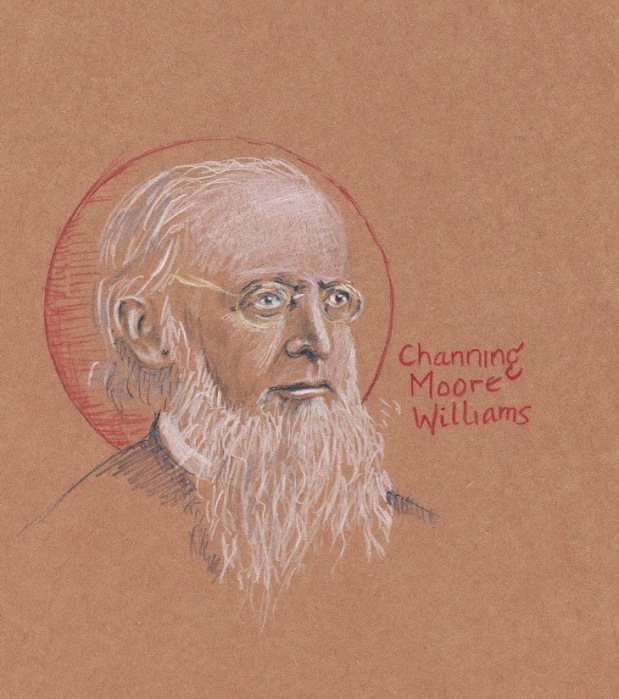
Channing Moore Williams


(17 July 1829 – 2 December 1910) was an Episcopalian missionary to China and Japan and later bishop. His saint's day on the Anglican calendar is 2 December.

Moore was born in Richmond, Virginia, and ordained a deacon in 1855. He was ordained a priest in China in 1857 and later posted to Nagasaki, Japan in 1857. In 1866, he was consecrated Bishop of China and Japan. He went to Tokyo in 1874 and founded St. Paul's University, today known as Rikkyo University in Tokyo.

In 1878 he united various national Anglican missionary efforts into the Nippon Sei Ko Kai, (i.e. the "Holy Catholic Church"), the branch of the Anglican church in Japan. He stayed on in Kyoto, Japan after a successor was appointed in 1893, returning to America only in 1908, two years before his death in Richmond in 1910.


Channing Moore Williams - 2 December - Missionary and Bishop

The Collect.

Almighty and everlasting God, we thank thee for thy servant Channing Moore Williams, whom thou didst call to preach the Gospel to the peoples of China and Japan. Raise up, we beseech thee, in this and every land heralds and evangelists of thy kingdom, that thy Church may proclaim the unsearchable riches of our Saviour Jesus Christ; who liveth and reigneth with thee and the Holy Ghost, one God, now and for ever. Amen.


The Epistle - Acts 1:1-9.

The former treatise have I made, O Theophilus, of all that Jesus began both to do and teach, Until the day in which he was taken up, after that he through the Holy Ghost had given commandments unto the apostles whom he had chosen: To whom also he shewed himself alive after his passion by many infallible proofs, being seen of them forty days, and speaking of the things pertaining to the kingdom of God: And, being assembled together with them, commanded them that they should not depart from Jerusalem, but wait for the promise of the Father, which, saith he, ye have heard of me. For John truly baptized with water; but ye shall be baptized with the Holy Ghost not many days hence. When they therefore were come together, they asked of him, saying, Lord, wilt thou at this time restore again the kingdom to Israel? And he said unto them, It is not for you to know the times or the seasons, which the Father hath put in his own power. But ye shall receive power, after that the Holy Ghost is come upon you: and ye shall be witnesses unto me both in Jerusalem, and in all Judaea, and in Samaria, and unto the uttermost part of the earth. And when he had spoken these things, while they beheld, he was taken up; and a cloud received him out of their sight.


The Gospel - St. Luke 10:1-9.

After these things the Lord appointed other seventy also, and sent them two and two before his face into every city and place, whither he himself would come. Therefore said he unto them, The harvest truly is great, but the labourers are few: pray ye therefore the Lord of the harvest, that he would send forth labourers into his harvest. Go your ways: behold, I send you forth as lambs among wolves. Carry neither purse, nor scrip, nor shoes: and salute no man by the way. And into whatsoever house ye enter, first say, Peace be to this house. And if the son of peace be there, your peace shall rest upon it: if not, it shall turn to you again. And in the same house remain, eating and drinking such things as they give: for the labourer is worthy of his hire. Go not from house to house. And into whatsoever city ye enter, and they receive you, eat such things as are set before you: And heal the sick that are therein, and say unto them, The kingdom of God is come nigh unto you.


Reference and Resources:

http://elvis.rowan.edu/~kilroy/JEK/12/02.html
http://en.wikipedia.org/wiki/Channing_Moore_Williams


+

Wednesday, November 30, 2022

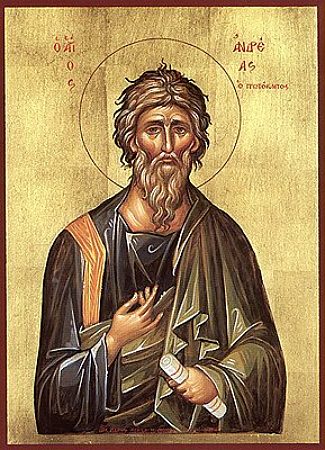
St. Andrew the Apostle

(Greek: Ανδρέας, Andreas), called in the Orthodox tradition Protocletos, or the First-called, is a Christian Apostle and the elder brother of Saint Peter. The name "Andrew" (from Greek : ανδρεία, manhood, or valour), like other Greek names, appears to have been common among the Jews from the second or third century B.C. No Hebrew or Aramaic name is recorded for him.

The Bible records that St Andrew was a son of Jonah, or John, (Matthew 16:17; John 1:42). He was born in Bethsaida on the Sea of Galilee (John 1:44). Both he and his brother Peter were fishermen by trade, hence the tradition that Jesus called them to be his disciples by saying that He will make them "fishers of men" (Greek: ἁλιείς ἀνθρώπων, halieis anthropon). At the beginning of Jesus' public life they occupied the same house at Capernaum (Mark 1:21, 29).

From the Gospel of John we learn that Andrew was a disciple of John the Baptist, whose testimony first led him and John the Evangelist to follow Jesus (John 1:35-40). Andrew at once recognized Jesus as the Messiah, and hastened to introduce Him to his brother(John 1:41). Thenceforth the two brothers were disciples of Christ. On a subsequent occasion, prior to the final call to the apostolate, they were called to a closer companionship, and then they left all things to follow Jesus (Luke 5:11; Matthew 4:19-20; Mark 1:17-18).

In the gospels he is referred to as being present on some important occasions as one of the disciples more closely attached to Jesus (Mark 13:3; John 6:8, 12:22); but in Acts there is only a bare mention of him (1:13).

Eusebius quotes Origen as saying Andrew preached in Asia Minor and in Scythia, along the Black Sea as far as the Volga and Kiev. Hence he became a patron saint of Romania and Russia. According to tradition, he founded the See of Byzantium in AD 38, installing Stachys as bishop (the only bishopric in that neighbourhood before that time had been established at Heraclea). This See would later develop into the Patriarchate of Constantinople. Andrew is recognized as its Patron Saint.

He is said to have been martyred by crucifixion at Patras (Patrae) in Achaea, on a cross of the form called Crux decussata (X-shaped cross) and commonly known as "St. Andrew's cross", at his own request, as he deemed himself unworthy to be crucified on the same type of cross on which Christ was crucified. Saint Andrew is the patron of Patras. According to tradition his relics were moved from Patras to Constantinople, and thence to St. Andrews (see below). Local legends say that the relics were sold to the Romans. The head of the saint, considered as one of the treasures of St. Peter's Basilica, was given by the Byzantine despot Thomas Palaeologus to Pope Pius II in 1461. In recent years, the relics were kept in the Vatican City, but were sent back to Patras by decision of the Pope Paul VI in 1964. The relics, which consist of the small finger, part of the top of the cranium of Saint Andrew and small parts of the cross, have since that time been kept in the Church of St. Andrew at Patras in a special tomb, and are reverenced in a special ceremony every November 30.

St. Andrew Basilica at Patras, where the saint's relics are kept, said to be erected over the place of his martyrdom. The apocryphal Acts of Andrew, mentioned by Eusebius, Epiphanius and others, is among a disparate group of Acts of the Apostles that were traditionally attributed to Leucius Charinus. "These Acts may be the latest of the five leading apostolic romances. The Acts, as well as a Gospel of St. Andrew, appear among rejected books in the Decretum Gelasianum connected with the name of Pope Gelasius I. The Acts of Andrew was edited and published by Constantin von Tischendorf in the Acta Apostolorum apocrypha (Leipzig, 1821) Another version of the Andrew legend is found in the Passio Andreae, published by Max Bonnet (Supplementum II Codicis apocryphi, Paris, 1895).

Saint Andrew the Apostle - 30 November


The Collect.

ALMIGHTY God, who didst give such grace unto thy holy Apostle Saint Andrew, that he readily obeyed the calling of thy Son Jesus Christ, and followed him without delay; Grant unto us all, that we, being called by thy holy Word, may forthwith give up ourselves obediently to fulfill thy holy commandments; through the same Jesus Christ our Lord. Amen.


The Epistle - Romans x. 9.

IF thou shalt confess with thy mouth the Lord Jesus, and shalt believe in thine heart that God hath raised him from the dead, thou shalt be saved. For with the heart man believeth unto righteousness; and with the mouth confession is made unto salvation. For the scripture saith, Whosoever believeth on him shall not be ashamed. For there is no difference between the Jew and the Greek: for the same Lord over all is rich unto all that call upon him. For whosoever shall call upon the name of the Lord shall be saved. How then shall they call on him in whom they have not believed? and how shall they believe in him of whom they have not heard? and how shall they hear without a preacher? and how shall they preach, except they be sent? as it is written, How beautiful are the feet of them that preach the gospel of peace, and bring glad tidings of good things ! But they have not all obeyed the gospel. For Esaias saith, Lord, who hath believed our report? So then faith cometh by hearing, and hearing by the word of God. But I say, Have they not heard? Yes verily, their sound went into all the earth, and their words unto the ends of the world. But I say, Did not Israel know? First Moses saith, I will provoke you to jealousy by them that are no people, and by a foolish nation I will anger you. But Esaias is very bold, and saith, I was found of them that sought me not; I was made manifest unto them that asked not after me. But to Israel he saith, All day long I have stretched forth my hands unto a disobedient and gainsaying people.


The Gospel - St. Matthew iv. 18.

JESUS, walking by the sea of Galilee, saw two brethren, Simon called Peter, and Andrew his brother, casting a net into the sea: for they were fishers. And he saith unto them, Follow me, and I will make you fishers of men. And they straightway left their nets, and followed him. And going on from thence, he saw other two brethren, James the son of Zebedee, and John his brother, in a ship with Zebedee their father, mending their nets; and he called them. And they immediately left the ship and their father. and followed him.


Reference and Resources:

http://en.wikipedia.org/wiki/St._Andrew
http://www.commonprayer.org/calend/propers/s_andr.cfm
http://elvis.rowan.edu/~kilroy/JEK/11/30.html

†

Tuesday, November 29, 2022

Saturninus of Toulouse

Born to the third century Roman nobility. Missionary to Gaul, the Pyrenees, and the Iberian peninsula. Worked with Saint Papoul. He converted many, including the farmer now known as Saint Honestus who joined him as a missionary. Imprisoned in Carcassone by the prefect Rufinus, Saturninus and his group were freed by an angel. He became the first bishop of Toulouse in modern France), where he teamed with Saint Martial to perform miraculous healings. Converted and baptized Saint Firminus of Amiens.

When Saturninus began his work in Toulouse, the local pagan priests stopped receiving oracular messages from their gods. One day in 257, when the priests were hopelessly frustrated, Saturninus passed by in the street. The priests blamed the bishop, and ordered the crowd of heathens to seize him and force him to offer sacrifice to their gods. The idols fell to pieces in front of the bishop, and the crowd murdered him.

Saturninus of Toulouse - 29 November - Missionary, Bishop and Martyr


The Collect.


O Almighty God, who didst give to thy servant Saturninus boldness to confess the Name of our Saviour Jesus Christ before the rulers of this world, and courage to die for this faith: Grant that we may always be ready to give a reason for the hope that is in us, and to suffer gladly for the sake of the same our Lord Jesus Christ; who liveth and reigneth with thee and the Holy Ghost, one God, for ever and ever. Amen.


The Lesson - 2 Esdras 2:42-48.


The Holy Gospel - St. Matthew 10:16-22


Reference and Resources:

http://en.wikipedia.org/wiki/Saturninus_of_Toulouse
http://saints.sqpn.com/saint-saturninus-of-toulouse/


+

Sunday, June 6, 2021

Norbert of Xanten


Born to the nobility, Norbert was raised around the royal court and served as almoner for Emperor Henry V. In the court he developed a very worldly view, and took holy orders as a career move, joining the Benedictines at Siegburg. A narrow escape from death led to a conversion experience, and he began taking his vows seriously. He tried to reform his order’s local house, then became a wandering preacher. He founded a community of Augustinian canons at Premontre, France; they became known as the Norbertines or Premonstratensians, and started a reform movement that swept through European monastic houses.

Norbert of Xanten - 6 June - Monastic, Bishop, and Reformer  

The Collect.

O GOD, by whose grace the blessed Norbert enkindled with the fire of thy love, became a burning and a shining light in thy Church: Grant that we may be inflamed with the same spirit of discipline and love, and ever walk before thee as children of light; through Jesus Christ our Lord. Amen.


The Epistle - Philippians 4:4-9.

 REJOICE in the Lord alway: and again I say, Rejoice, Let your moderation be known unto all men. The Lord is at hand. Be anxious for nothing; but in every thing by prayer and supplication with thanksgiving let your requests be made known unto God. And the peace of God, which passeth all understanding, shall keep your hearts and minds through Christ Jesus. Finally, brethren, whatsoever things are true, whatsoever things are honest, whatsoever things are just, whatsoever things are pure, whatsoever things are lovely, whatsoever things are of good report; if there be any virtue, and if there be any praise, think on these things. Those things, which ye have both learned, and received, and heard, and seen in me, do: and the God of peace shall be with you.

The Gospel - St. Luke 6:17-23

JESUS came down and stood in the plain, with the company of his disciples, and a great multitude of people out of all Judea and Jerusalem, and from the sea coasts of Tyre and Sidon, which came to hear him, and to be healed of their diseases; and they that were vexed with unclean spirits: and they were healed. And the whole multitude sought to touch him: for there went virtue out of him, and healed them all. And he lifted up his eyes on his disciples, and said, Blessed be ye poor: for yours is the kingdom of God. Blessed are ye that hunger now: for ye shall be filled. Blessed are ye that weep now: for ye shall laugh. Blessed are ye, when men shall hate you, and when they shall separate you from their company, and shall reproach you, and cast out your name as evil, for the Son of man's sake. Rejoice ye in that day, and leap for joy: for, behold, your reward is great in heaven.


Reference and Resources:

http://en.wikipedia.org/wiki/Norbert_of_Xanten
http://saints.sqpn.com/saint-norbert-of-xanten/

 †

Saturday, June 5, 2021

Boniface of Mentz


(Latin: Bonifacius; German: Bonifatius; c. 672 – June 5, 754), the Apostle of the Germans, born Winfrid or Wynfrith at Crediton in the kingdom of Wessex (now in Devon, England), was a missionary who propagated Christianity in the Frankish Empire during the 8th century. He is the patron saint of Germany and the Netherlands.

Winfrid was of a respected and prosperous family. It was somewhat against his father's wishes that he devoted himself at an early age to the monastic life. He received his theological training in the Benedictine monasteries of Adescancastre, near Exeter and Nursling, on the western edge of Southampton, under the abbot Winbert. Winfrid taught in the abbey school and at the age of 30 became a priest. He wrote the first Latin grammar produced in England.

Later he set out to preach in Friesland (overlaps with modern Holland), whence he was soon expelled because of war between its heathen king and Charles Martel of France. Boniface, after a brief withdrawal, went into Hesse and Bavaria, having secured the support of the Pope and of Charles Martel for his work there. In Hesse, in the presence of a large crowd of pagans, he cut down the Sacred Oak of Geismar, a tree of immense age and girth, sacred to the god Thor. It is said that after only a few blows of his axe, the tree tottered and crashed to the ground, breaking into four pieces and revealing itself to be rotted away within. It was the beginning of a highly successful missionary effort, and the planting of a vigorous Christian church in Germany, where Boniface was eventually consecrated bishop. He asked the Christian Saxons of England to support his work among their kinsmen on the continent, and they responded with money, books, supplies, and above all, with a steady supply of monks to assist him in teaching and preaching.

Boniface did not confine his attentions to Germany. He worked to establish cooperation between the Pope and others in Italy on the one hand and Charles and his successors in France on the other. He persuaded Carloman and Pepin, the sons of Charles, to call synods for the reform of the church in their territories, where under previous rulers bishoprics had often been sold to the highest bidder. He never forgot his initial failure in Friesland, and in old age resigned his bishopric and returned to work there. Many Frisians had been converted earlier by Willibrord (another Saxon missionary from England--see 7 Nov), but had lapsed after his death. Boniface preached among them with considerable success. On June 5, the eve of Pentecost, 754, he was preparing a group of Frisians for confirmation when they were attacked and killed by heathen warriors. His tomb is in the crypt of Fulda Cathedral.


Boniface of Mentz (Winfrid of Wessex) - 5 June - Missionary, Bishop and Martyr

The Collect.

Almighty God, who didst call thy faithful servant Boniface to be a witness and martyr in the lands of Germany and Friesland, and by his labor and suffering didst raise up a people for thine own possession: Pour forth thy Holy Spirit upon thy Church in every land, that by the service and sacrifice of many thy holy Name may be glorified and thy kingdom enlarged; through Jesus Christ our Lord, who liveth and reigneth with thee and the same Spirit, one God, for ever and ever. Amen.


The Epistle - Acts 1:1-9.


The Gospel - St. Matthew 10:16-22.


Reference and Resources:

http://www.commonprayer.org/calend/propers/com_mart.cfm
http://www.commonprayer.org/calend/propers/com_miss.cfm
http://elvis.rowan.edu/~kilroy/JEK/06/05.html
http://en.wikipedia.org/wiki/Boniface

†

Friday, June 4, 2021

Petroc of Briton


 (English: Petrock, Welsh: Pedrog, Latin: Petrocus and French: Perreux) (died 564) is a 6th century Celtic Christian saint. He was born in Wales but primarily ministered to the Britons of Dumnonia which included the modern counties of Devon (Dewnans), Cornwall (Kernow), and parts of Somerset (Gwlas an Hav) and Dorset. He also became a popular saint in Brittany by the end of the tenth century.

The earliest Life of Petroc states that he was the son of an unnamed Welsh king. This was rewritten at Bodmin in the twelfth century in a version known as the 'Gotha Life' which states that he was a son of King Glywys of Glywysing (Orme 2000, p. 215) and a brother of Gwynllyw, and there are local dedications to him at St Petroc near Pembroke and Ferwig near Cardigan. He has also given his name to Llanbedrog, a village on the Lleyn peninsula. He studied in Ireland where he is said to have been the teacher of Saint Kevin.

After studying, he began his mission to Cornwall, where he is associated with monasteries at Padstow and Bodmin. The name of the earlier monastery was Lanwethinoc (the church of Wethinoc an earlier holy man). Padstow, which is named after him (Pedroc-stowe, or 'Petrock's Place'), appears to have been his major cult centre for some time. Some time after the middle of the ninth century Bodmin became the major centre for his veneration and his relics were moved there,[1] with the Bodmin monastery becoming one of the wealthiest Cornish churches by the eleventh century.[2] There are other dedications to him in Cornwall, including Little Petherick, and he is even said to have converted its king, Constantine of Dumnonia, to Christianity. After thirty years, legend says that he went on the pilgrimage to Rome by way of Brittany.

Upon his return Petroc is said to have passed through Devon, where ancient dedications to him are even more numerous: a probable seventeen (plus Timberscombe just over the border in Somerset), compared to Cornwall's five. The position of churches bearing his name, including one within the old Roman walls of Exeter (Karesk), are nearly always near the coast reminding us that in those days travelling was done mainly by sea. The Devonian villages of Petrockstowe and Newton St Petroc are also named after Saint Petroc.

The legendary tales surrounding Petroc are exceptionally vivid and imaginative (giving him a second pilgrimage, travels to India, taming wolves) and may represent interpolation from pagan tales.

In iconography, Petroc is usually shown with a stag. His feast day is June 4. His major shrine was always at St Petroc's Church, Bodmin. In 1177, a Breton stole his relics from Bodmin and gave them to the Abbey of St Meen. However, Henry II restored them and, though the relics were thrown out during the English Reformation, their beautiful ivory casket is still on public display in the church. With Saint Piran and Saint Michael, he is one of the patron saints of Cornwall.


St. Petroc - 4 June - Pilgrim, Missionary, and Abbot


The Collect.

O GOD, by whose grace the blessed Petroc enkindled with the fire of thy love, became a burning and a shining light in thy Church: Grant that we may be inflamed with the same spirit of discipline and love, and ever walk before thee as children of light; through Jesus Christ our Lord. Amen.


The Epistle - Philippians 3:7-15.

HOWBEIT what things were gain to me, these have I counted loss for Christ. Yea verily, and I count all things to be loss for the excellency of the knowledge of Christ Jesus my Lord: for whom I suffer the loss of all things, and do count them but dung, that I may gain Christ, and be found in him, not having a righteousness of mine own, even that which is of the law, but that which is through faith in Christ, the righteousness which is of God by faith: that I may know him, and the power of his resurrection, and the fellowship of his sufferings, becoming conformed unto his death; if by any means I may attain unto the resurrection of the dead. Not that I have already obtained, or am already made perfect: but I press on, if so be that I may apprehend that for which also I was apprehended by Christ Jesus. Brethren, I count not myself yet to have apprehended: but one thing I do, forgetting the things which are behind, and stretching forward to the things which are before, I press on toward the goal unto the prize of the high calling of God in Christ Jesus. Let us therefore, as many as be perfect, be thus minded: and if in anything ye are otherwise minded, even this shall God reveal unto you.


The Gospel - St. Luke 12:22-37.

JESUS said unto his disciples, Therefore I say unto you. Be not anxious for your life, what ye shall eat; neither for the body, what ye shall put on. The life is more than meat, and the body is more than raiment. Consider the ravens: for they neither sow nor reap; which neither have storehouse nor barn; and God feedeth them: how much more are ye better than the fowls? And which of you by being anxious can add a cubit to his span of life? If ye then be not able to do that which is least, why are ye anxious for the rest? Consider the lilies how they grow: they toil not, they spin not; and yet I say unto you, that Solomon in all his glory was not arrayed like one of these. If then God so clothe the grass, which is to day in the field, and to morrow is cast into the oven; how much more will he clothe you, O ye of little faith? And seek not ye what ye shall eat, or what ye shall drink, neither be ye of anxious mind. For all these things do the nations of the world seek after: and your Father knoweth that ye have need of these things. But rather seek ye the kingdom of God; and all these things shall he added unto you. Fear not, little flock; for it is your Father's good pleasure to give you the kingdom. Sell that ye have, and give alms; provide yourselves bags which wax not old, a treasure in the heavens that faileth not, where no thief approacheth, neither moth corrupteth. For where your treasure is, there will your heart be also. Let your loins be girded about, and your lamps burning; and ye yourselves like unto men that wait for their lord, when he will return from the wedding; that when he cometh and knocketh, they may open unto him immediately. Blessed are those servants, whom the lord when he cometh shall find watching: verily I say unto you, that he shall gird himself, and make them to sit down to meat, and will come forth and serve them.


Reference and Resources:

http://www.commonprayer.org/calend/propers/com_mona.cfm
http://www.britannia.com/bios/ebk/pedrogg.html
http://en.wikipedia.org/wiki/Saint_Petroc


†

Saturday, May 29, 2021

The Martyrs of Atchara


Atchara has been a Christian stronghold since apostolic times. It was through this region that Saint Andrew the First-called entered Georgia, preaching the Gospel for the first time in the Iberian land. In this land, in the village of Gonio, the holy relics of the martyred Apostle Matthias are buried.

Since the 16th century Atchara has been subject to constant assaults by the Turks. Having attained a victory in the Ottoman-Persian War, the Turks gained a large part of southern and western Georgia: Samtskhe, Atchara, and Chaneti were declared Turkish provinces. The invaders knew well that, in order to completely conquer the Georgian people, it was necessary to uproot Christianity. Thus they instituted a systematic campaign of forced conversion to Islam.

When they failed to achieve their goal with bribery and deception, they resorted to violence.

In his work The Islamization of Georgia, or the Spread of Islam in Western Georgia in the 17th-18th Centuries, the renowned early twentieth-century scholar Zakaria Chichinadze retold a story he had heard from one elderly Atcharan man: “In Atchara the implanting of Islam faced a powerful opposition. Many of the elderly men and the majority of women stood firmly by the Christian Faith, and even challenged and debated the Turkish mullahs.... The number of these aged men in Atchara was considerably high. In the end an order was issued: to arrest all dissidents, forcibly convert them to Islam, and execute those who resisted. Before long all the elderly Christians of Atchara were arrested and cast in prison. Then they were led to the River Atcharistsqali, to a 12th-century bridge known as the ‘Bridge of Queen Tamar.’ On that bridge the Ottomans erected a guillotine.

“They chopped off the heads of the elderly people, sent the ends of their tongues to the pasha, and threw their bodies into the river. This happened one hundred years ago, in the year 1790.”

Gallows and a guillotine were erected in the villages of Atcharistsqali, Keda, Chakvi, Khulo, Machakhela, and Gonio. The documents preserved in the manuscript collection at Akhaltsikhe Museum describe in even more horrific detail the martyrdom of the Atcharan Christians: “The human tongue is powerless to describe the tortures that the Georgians suffered in those years for confessing Christianity. While they were still alive their flesh was stripped and their bodies quartered; they were slashed to pieces with swords, their bellies ripped open; they were roasted over campfires. They were pierced with flaming rods, thrown into cauldrons of boiling water; molten lead was poured down their throats; they were tossed into pools of hot lime....”

The Georgian Apostolic Church has numbered among the saints all the holy fathers and mothers of Atchara who sacrificed their lives in defense of the Christian Faith.


Propers for the Martyrs of Atchara - 29 May


The Collect

Almighty and Everlasting God, who didst enkindle the flame of thy love in the heart of thy holy martyrs of Atchara.: Grant to us, thy humble servants, a like faith and power of love, that we who rejoice in their triumph may profit by their example; through Jesus Christ our Lord, who liveth and reigneth with thee and the Holy Spirit, one God, for ever and ever. Amen.


The Epistle - 1 Peter 4:12-19

Beloved, think it not strange concerning the fiery trial which is to try you, as though some strange thing happened unto you; but rejoice inasmuch as ye are partakers of Christ’s sufferings, that, when His glory shall be revealed, ye may be glad also with exceeding joy. If ye be reproached for the name of Christ, happy are ye, for the Spirit of glory and of God resteth upon you. On their part evil is spoken of Him, but on your part He is glorified. But let none of you suffer as a murderer, or as a thief, or as an evildoer, or as a busybody in other men’s matters. Yet if any man suffer as a Christian, let him not be ashamed, but let him glorify God on this account. For the time has come that judgment must begin at the house of God. And if it first begin with us, what shall the end be of those who obey not the Gospel of God? And, “If the righteous scarcely be saved, where shall the ungodly and the sinner appear?” Therefore let those who suffer according to the will of God commit the keeping of their souls to Him in welldoing, as unto a faithful Creator.


The Holy Gospel - St. Mark 8:34-38

And when He had called the people unto Him with His disciples also, He said unto them, “Whosoever will come after Me, let him deny himself, and take up his cross, and follow Me. For whosoever will save his life shall lose it; but whosoever shall lose his life for My sake and the Gospel’s, the same shall save it. For what shall it profit a man if he shall gain the whole world, and lose his own soul? Or what shall a man give in exchange for his soul? Whosoever, therefore, shall be ashamed of Me and of My words in this adulterous and sinful generation, of him also shall the Son of Man be ashamed when He cometh in the glory of His Father with the holy angels.”


+

Friday, May 28, 2021

Germanus of Paris

Germanus was born near Autun in 496. He was abbot of St Symphorian’s monastery at Autun, and was made Bishop of Paris around 536.

He was tireless and courageous in his efforts to end civil strife and to restrain the viciousness of the Frankish kings, though he was not very successful in this. Radegund (August 13) appealed to him for protection from her cruel husband King Chlotar I.

Cured King Childebert I from an unnamed illness, and converted him from a misspent life. The king then built him the abbey of Saint Vincent, now known as Saint-Germain-des-Pres.


Germanus of Paris - 28 May - Monastic and Bishop

The Collect.

O GOD, by whose grace the blessed Germanus enkindled with the fire of thy love, became a burning and a shining light in thy Church: Grant that we may be inflamed with the same spirit of discipline and love, and ever walk before thee as children of light; through Jesus Christ our Lord. Amen.


The Epistle - Philippians 3:7-15


The Gospel - St. Luke 12:22-37


+

Thursday, May 27, 2021

Bede of Jarrow


Bede (IPA: /ˈbiːd/) (also Saint Bede, the Venerable Bede, or (from Latin) Beda (IPA: [beda])), (c. 672 or 673 – May 25, 735), was a monk at the Northumbrian monastery of Saint Peter at Wearmouth, today part of Sunderland, and of its companion monastery, Saint Paul's, in modern Jarrow (see Wearmouth-Jarrow), both Northumbria. He is well known as an author and scholar, and his most famous work, Historia ecclesiastica gentis Anglorum (The Ecclesiastical History of the English People) gained him the title "The father of English history".

He was the first person to write scholarly works in the English language, although unfortunately only fragments of his English writings have survived. He translated the Gospel of John into Old English, completing the work on the very day of his death. He also wrote extensively in Latin. He wrote commentaries on the Pentateuch and other portions of Holy Scripture. His best-known work is his History of The English Church and People. It gives a history of Britain up to 729, speaking of the Celtic peoples who were converted to Christianity during the first three centuries of the Christian era, and the invasion of the Anglo-Saxon pagans in the fifth and sixth centuries, and their subsequent conversion by Celtic missionaries from the north and west, and Roman missionaries from the south and east. His work is our chief source for the history of the British Isles during this period. Fortunately, Bede was careful to sort fact from hearsay, and to tell us the sources of his information. He also wrote hymns and other verse, the first martyrology with historical notes, letters and homilies, works on grammar, on chronology and astronomy -- he was aware that the earth is a sphere, and he is the first historian to date events Anno Domini, and the earliest known writer to state that the solar year is not exactly 365 and a quarter days long, so that the Julian calendar (one leap year every four years) requires some adjusting if the months are not to get out of step with the seasons.

Almost all that is known of Bede's life is contained in a notice added by himself when he was 59 to his Historia (Book V, Chapter 24), which states that he was placed in the monastery at Wearmouth at the age of seven, that he became deacon in his nineteenth year, and priest in his thirtieth. He implies that he finished the Historia at the age of 59, and since the work was finished around 731, he must have been born in 672/3. It is not clear whether he was of noble birth. He was trained by the abbots Benedict Biscop and Ceolfrid, and probably accompanied the latter to Wearmouth's sister monastery of Jarrow in 682. There he spent his life, prominent activities evidently being teaching and writing, the two of most interest to him. There he also died, on May 25, 735, and was buried, although his body was later transferred to Durham Cathedral.


Bede of Jarrow - 27 May - Priest, Teacher, and Historian

The Collect.

ALMIGHTY God, who hast enriched thy Church with the singular learning and holiness of thy servant Bede: Grant us to hold fast the true doctrine of thy Son our Saviour Jesus Christ, and to fashion our lives according to the same, to the glory of thy great Name and the benefit of thy holy Church; through the same Jesus Christ our Lord. Amen.

The Epistle - Malachi 3:16-18.

THEN they that feared the Lord spake one to another: and the LORD hearkened, and heard it, and a book of remembrance was written before him for them that feared the Lord, and that thought upon his name. And they shall be mine, saith the Lord of hosts, in that day when I make up my jewels; and I will spare them, as a man spareth his own son that serveth him. Then once more shall ye discern between the righteous and the wicked, between him that serveth God and him that serveth him not.


The Gospel - St. Matthew 13:47-52.

JESUS said, The kingdom of heaven is like unto a net, that was cast into the sea, and gathered of every kind: which, when it was full, they drew to shore, and sat down, and gathered the good into vessels, but cast the bad away. So shall it be at the end of the world: the angels shall come forth, and sever the wicked from among the just, and shall cast them into the furnace of fire: there shall be wailing and gnashing of teeth. Jesus saith unto them, Have ye understood all these things? They say unto him, Yea, Lord. Then said he unto them, Therefore every scribe which is instructed unto the kingdom of heaven is like unto a man that is an householder, which bringeth forth out of his treasure things new and old.


Reference and Resources:

http://www.commonprayer.org/calend/propers/bede.cfm
http://en.wikipedia.org/wiki/Bede
http://elvis.rowan.edu/~kilroy/JEK/05/25.html
http://orthodoxwiki.org/Bede

†

Wednesday, May 26, 2021

Augustine of Canterbury


was a Benedictine monk who became the first Archbishop of Canterbury in 598. He is considered the "Apostle to the English",a founder of the English Church, and a patron of England.

The Christian Church was established in the British Isles well before 300. Some scholars believe that it was introduced by missionaries from the Eastern or Greek-speaking half of the Mediterranean world. Celtic Christianity had its own distinctive culture, and Greek scholarship flourished in Ireland for several centuries after it had died elsewhere in Western Europe.

However, in the fifth century Britain was invaded by non-Christian Germanic tribes: the Angles, Saxons, and Jutes. They conquered the native Celtic Christians (despite resistance by, among others, a leader whose story has come down to us, doubtless with some exaggeration, as that of King Arthur), or drove them north and west into Cornwall, Wales, Scotland, and Ireland. From these regions Celtic Christian missionaries returned to England to preach the Gospel to the heathen invaders.

Augustine was the prior of a monastery in Rome when Pope Gregory the Great chose him in 595 to lead a mission to Britain to convert the pagan King Æthelberht of Kent to Christianity. Kent was probably chosen because it was near the Christian kingdoms in Gaul, and because Æthelberht had married a Christian princess, Bertha, daughter of Charibert, the King of Paris, who was expected to exert some influence over her husband. Although the missionaries considered turning back before they reached Kent, Gregory urged them on, and in 597 Augustine landed on the Isle of Thanet and proceeded to Æthelberht's main town of Canterbury.

Æthelberht allowed the missionaries to preach freely and converted to Christianity, giving the missionaries land to found a monastery outside the city walls. Augustine was consecrated bishop of the English, and converted many of the king's subjects, including thousands during a mass baptism on Christmas Day in 597. Pope Gregory sent more missionaries in 601, along with encouraging letters and gifts for the churches, although attempts to persuade the native Celtic bishops to submit to Augustine's authority failed.

Augustine was consecrated bishop and established his headquarters at Canterbury. From his day to the present, there has been an unbroken succession of archbishops of Canterbury. Roman Catholic bishops were established at London and Rochester in 604, and a school was founded to train Anglo-Saxon priests and missionaries. Augustine also arranged the consecration of his successor, Laurence of Canterbury.

In 603, he held a conference with the leaders of the already existing Christian congregations in Britain, but failed to reach an accommodation with them, largely due to his own tactlessness, and his insistence (contrary, it may be noted, to Gregory's explicit advice) on imposing Roman customs on a church long accustomed to its own traditions of worship. It is said that the English bishops, before going to meet Augustine, consulted a hermit with a reputation for wisdom and holiness, asking him, "Shall we accept this man as our leader, or not?" The hermit replied, "If, at your meeting, he rises to greet you, then accept him, but if he remains seated, then he is arrogant and unfit to lead, and you ought to reject him." Augustine, alas, remained seated. It took another sixty years before the breach was healed.

Augustine died in 604 and was soon revered as a saint. The Church of England remained in communion with The Church of Rome until it declared its independence in the sixteenth century.


Augustine - 26 May - First Archbishop of Canterbury

The Collect.

O Lord our God, who by thy Son Jesus Christ didst call thine apostles and send them forth to preach the Gospel to the nations: We bless thy holy name for thy servant Augustine, first Archbishop of Canterbury, whose labors in propagating thy Church among the English people we commemorate today; and we pray that all whom thou dost call and send may do thy will, and bide thy time, and see thy glory; through Jesus Christ our Lord, who liveth and reigneth with thee and the Holy Ghost, one God, for ever and ever. Amen.


The Epistle - 2 Corinthians 5:17-20.

IF any man be in Christ, he is a new creature: old things are passed away; behold, all things are become new. And all things are of God, who hath reconciled us to himself by Jesus Christ, and hath given to us the ministry of reconciliation to wit, that God was in Christ, reconciling the world unto himself, not imputing their trespasses unto them; and hath committed unto us the word of reconciliation. Now then we are ambassadors for Christ, as though God did beseech you by us: we pray you in Christ's stead, be ye reconciled to God.


The Gospel - St. Matthew 13:31-33.

ANOTHER parable put Jesus forth unto them, saying, The kingdom of heaven is like to a grain of mustard seed, which a man took, and sowed in his field: which indeed is the least of all seeds: but when it is grown, it is the greatest among herbs, and becometh a tree, so that the birds of the air come and lodge in the branches thereof. Another parable spake he unto them; The kingdom of heaven is like unto leaven, which a woman took, and hid in three measures of meal, till the whole was leavened. All these things spake Jesus unto the multitude in parables.


Reference and Resources:

http://elvis.rowan.edu/~kilroy/JEK/05/26.html
http://en.wikipedia.org/wiki/Augustine_of_Canterbury
http://www.commonprayer.org/calend/propers/s_august.cfm

†