Showing posts with label Christians. Show all posts
Wednesday, June 2, 2021
The Martyrs of Lyons
At Lyons and Vienne, in Gaul, there were missionary centres which had drawn many Christians from Asia and Greece. Persecution began in 177.
At first, Christians were excluded from the public baths, the marketplace, and from social and public life. They were subject to attack when they appeared in public, and many Christian homes were vandalized. At this point, the government became involved and began to take Christians into custody for questioning. Some slaves from Christian households were tortured to obtain confessions and were induced to say that Christians practiced cannibalism and incest. These charges were used to arouse the whole city against the Christians, particularly against Pothinus, the aged bishop of Lyons; Sanctus, a deacon; Attalus; Maturus, a recent convert; and Blandina, a slave. Pothinus was beaten and then released, to die of his wounds a few days later. Sanctus was tormented with red-hot irons. Blandina tortured all day long, would say nothing except, "I am a Christian, and nothing vile is done among us." Finally, the survivors were put to death in the public arena.
Martyrs of Lyons - 2 June
The Collect.
Grant, O Lord, we beseech thee, that we who keep the feast of the holy martyrs Blandina and her companions may be rooted and grounded in love of thee, and may endure the sufferings of this life for the glory that shall be revealed in us; through Jesus Christ our Lord, who liveth and reigneth with thee and the Holy Ghost, one God, for ever and ever. Amen.
The Epistle - 1 Peter 1:3-9
The Gospel - St. Mark 8:34-38
Reference and Resources:
http://elvis.rowan.edu/~kilroy/JEK/06/02.html
†
Sunday, May 23, 2021
Michael The Black Robed
lived in the ninth century, and came from the city of Edessa (Mesopotamia) of Christian parents. He was a zealous disciple of St Theodore of Edessa (July 9). He distributed to the poor the inheritance left him by his parents, then went to Jerusalem to venerate the Holy Places.Jerusalem at the time was under the control of the Mohammedans. St Michael remained in Palestine and settled in the monastery of St Sava. Once, he was sent from the monastery to Jerusalem to sell goods for the monks. At the marketplace, the eunuch of the Mohammedan empress Seida, seeing that the monastery goods were both fine and well-made, took him along to the empress.
The young monk caught the fancy of the empress, who tried to lead him into sin, but her intent proved to be in vain. Then by order of the enraged Seida they beat the monk with rods, and then accused him of being an enemy of Islam.
Having interrogated the monk, the emperor began to urge him to accept the Moslem faith, but St Michael answered, "I implore you, either send me back to the monastery to my instructor, or be baptized in our Christian Faith, or cut off my head, and then I shall go to Christ my God." The emperor gave the saint a cup with deadly poison, which St Michael drank and remained unharmed. After this the emperor gave orders to cut off his head.
The death of the martyr occurred in Jerusalem, but the monks of the monastery of St Sava took the body of the saint to their Lavra and buried it there with reverence. At the beginning of the twelfth century the relics of the holy martyr were seen there by Daniel, the igumen of the Kiev Caves monastery, while on pilgrimage to the Holy Places.
Michael The Black Robed - 23 May - Monk and Martyr
The Collect.
ALMIGHTY and everlasting God, who didst strengthen thy blessed martyr Michael with the virtue of constancy in faith and truth: Grant us in like manner for love of thee to despise the prosperity of this world, and to fear none of its adversities; through Jesus Christ our Lord. Amen.
The Epistle - 2 Esdras 2:42-48.
The Gospel - St. Matthew 10:16-22.
Reference and Resources:
http://www.commonprayer.org/calend/propers/com_mart.cfm
http://ocafs.oca.org/FeastSaintsViewer.asp?FSID=101501
†
Friday, May 21, 2021
John Eliot
was born in Hertfordshire, England, in 1604 and graduated from Cambridge in 1622. He taught school for a while, came under Puritan influence, and determined to become a minister. In 1631 he went to New England and was ordained to preach at Roxbury. He developed an interest in Indian language and customs, and began to preach to the Indians in 1646, at first in English but within a year in their own tongue, Algonkian. He published a catechism for them in 1654 and by 1658 translated the Bible into Algonkian, the first Bible to be printed in North America. A revised edition was published in 1685. Eliot also wrote The Christian Commonwealth (1659), Up-Bookum Psalmes (1663), The Communion of Churches (1665), The Indian Primer (1669), and The Harmony of The Gospels (1678), and was a major contributor to the Bay Psalm Book.
Eliot planned towns for Indian converts, away from the white towns, in areas where they could preserve their own language and culture and live by their own laws. He prepared Indians to be missionaries to their own people. Daniel Takawambpait was the first Indian minister in New England, being ordained at Natick, Massachusetts, in 1681. Eliot's Indian towns grew to fourteen in number, with thousands of inhabitants, but they were scattered in King Philip's War in 1675 (King Philip was an Indian leader who undertook to drive the English out of New England), and although four communities were restored, they did not continue long.
Eliot died after a long illness on 21 May 1690.
John Eliot - 21 May - Missionary to the American Indians
The Collect.
Almighty and everlasting God, we thank thee for thy servant John Eliot, whom thou didst call to preach the Gospel to the native peoples of North America. Raise up, we beseech thee, in this and every land, evangelists and heralds of thy kingdom, that thy Church may proclaim the unsearchable riches of our Savior Jesus Christ; who liveth and reigneth with thee and the Holy Spirit, one God, now and for ever. Amen.
The Epistle - Acts 1:1-9.
The Gospel - St. Luke 10:1-9.
Reference and Resources:
http://elvis.rowan.edu/~kilroy/JEK/05/21.html
http://www.commonprayer.org/calend/propers/com_miss.cfm
http://en.wikipedia.org/wiki/John_Eliot_%28missionary%29
†
Tuesday, May 18, 2021
Eric of Sweden
Erik IX Jedvardsson was ruler of much of Sweden from 1150 to 1160. He was the head of a Christian kingdom with nearby pagan kingdoms, all sharing an old tradition of fighting. Around 1155, he headed an expedition into Finland, then loosely under Swedish rule, to consolidate Swedish authority there and to establish a protected Christian mission, headed by Henry of Uppsala, now considered the founder of the Church in Finland (see 19 Jan). Erik is also known for undertaking to provide Sweden with fair laws and fair courts, and for measures designed to assist the poor and the infirm. As he was in church on 18 May 1160, the day after Ascension Day, he was told that a pagan Danish army was approaching to kill him. He replied, "Let us at least finish the sacrifice. The rest of the feast I shall keep elsewhere." As he was leaving the church, the pagans rushed upon him and killed him.
Erik was honored both as an upholder of the Christian faith and as a national hero, the ancestor of a long line of Swedish kings. Within thirty years after his death his name appeared on the Swedish Calendar, and he is accounted the principal patron of Sweden, as (for example) Patrick is of Ireland. The silver casket with his remains still rests in the cathedral at Uppsala.
Propers for Erik of Sweden - 18 May - King and Martyr
The Collect.
O God, who didst call thy servant Erik of Sweden to an earthly throne that he might advance thy heavenly kingdom, and didst give him zeal for thy Church and love for thy people: Mercifully grant that we who commemorate him this day may be fruitful in good works, and attain to the glorious crown of thy saints; through Jesus Christ our Lord, who liveth and reigneth with thee and the Holy Spirit, one God, for ever and ever. Amen.
The Epistle - 2 Esdras 2:42-48.
I ESDRAS saw upon the mount Sion a great people, whom I could not number, and they all praised the Lord with songs. And in the midst of them there was a young man of a high stature, taller than all the rest, and upon every one of their heads he set crowns, and was more exalted; which I marvelled at greatly. So I asked the angel, and said, Sir, what are these? He answered and said unto me, These be they that have put off the mortal clothing, and put on the immortal, and have confessed the name of God: now are they crowned, and receive palms. Then said I unto the angel. What young person is it that crowneth them, and giveth them palms in their hands? So he answered and said unto me, It is the Son of God, whom they have confessed in the world. Then began I greatly to commend them that stood so stiffly for the name of the Lord. Then the angel said unto me, Go thy way, and tell my people what manner of things, and how great wonders of the Lord thy God, thou hast seen.
The Gospel - St. Matthew 10:16-22.
BEHOLD, I send you forth as sheep in the midst of wolves: be ye therefore wise as serpents, and harmless as doves. But beware of men: for they will deliver you up to the councils, and they will scourge you in their synagogues; and ye shall he brought before governors and kings for my sake, for a witness to them and the Gentiles. But when they deliver you up, be not anxious how or what ye shall speak: for it shall be given you in that same hour what ye shall speak. For it is not ye that speak, but the Spirit of your Father which speaketh in you. And the brother shall deliver up the brother to death, and the father the child: and the children shall rise up against their parents, and cause them to be put to death. And ye shall be hated of all men for my name's sake: but he that endureth to the end shall be saved.
Reference and Resources:
http://www.commonprayer.org/calend/propers/com_mart.cfm
http://en.wikipedia.org/wiki/St._Erik
http://elvis.rowan.edu/~kilroy/JEK/05/17.html
†
Wednesday, May 5, 2021
Irene of Thessalonica
Born Penelope in Magedon of Persia during the reign of Constantine the Great (306-337 AD) of the governor Licinius and his wife Licinia. One day, while sitting in the tower her father had built for her safekeeping, the saint saw three birds enter her room and place articles on her table. The first was a dove with an olive branch, the second an eagle with a garland of flowers, and the third a crow with a snake. Her tutor Apellian interpreted these events, saying that these were various symbols of her calling and preparation to proclaim the Christian faith to her people and of her trials and sufferings as well. Penelope was baptized and received the name Irene at that time.Her father, discovering Irene's new faith, decided to punish her with death by having her trampled under the hooves of his horses. The saint, however, remained unhurt, whereas her father himself fell and was mortally wounded. Through the prayer of Saint Irene, though, her father was resurrected and came to believe in Christ, along with his wife. Her resigned his governorship and took to the tower in order to spend the remainder of his days in acts of repentance.
The new governor, Sedekias, resolved to have Irene sacrifice to his idols. After her repeated refusals, he cast her into a pit filled with poisonous snakes and lizards. Once again, though, she suffered no harm. Subsequent attempts to harm her by governors Sedekias, Sabor, and Noumerianos failed time and again, and all the while Irene's peaceful faith in the face of torture won many converts to Christianity among her people.
Irene of Thessalonica - 5 May - Martyr
The Collect.
ALMIGHTY and everlasting God, who didst strengthen thy blessed martyr Irene of Thessalonica with the virtue of constancy in faith and truth: Grant us in like manner for love of thee to despise the prosperity of this world, and to fear none of its adversities; through Jesus Christ our Lord. Amen.
The Epistle - 2 Esdras 2:42-48.
I ESDRAS saw upon the mount Sion a great people, whom I could not number, and they all praised the Lord with songs. And in the midst of them there was a young man of a high stature, taller than all the rest, and upon every one of their heads he set crowns, and was more exalted; which I marvelled at greatly. So I asked the angel, and said, Sir, what are these? He answered and said unto me, These be they that have put off the mortal clothing, and put on the immortal, and have confessed the name of God: now are they crowned, and receive palms. Then said I unto the angel. What young person is it that crowneth them, and giveth them palms in their hands? So he answered and said unto me, It is the Son of God, whom they have confessed in the world. Then began I greatly to commend them that stood so stiffly for the name of the Lord. Then the angel said unto me, Go thy way, and tell my people what manner of things, and how great wonders of the Lord thy God, thou hast seen.
The Gospel - St. Matthew 10:16-22.
BEHOLD, I send you forth as sheep in the midst of wolves: be ye therefore wise as serpents, and harmless as doves. But beware of men: for they will deliver you up to the councils, and they will scourge you in their synagogues; and ye shall he brought before governors and kings for my sake, for a witness to them and the Gentiles. But when they deliver you up, be not anxious how or what ye shall speak: for it shall be given you in that same hour what ye shall speak. For it is not ye that speak, but the Spirit of your Father which speaketh in you. And the brother shall deliver up the brother to death, and the father the child: and the children shall rise up against their parents, and cause them to be put to death. And ye shall be hated of all men for my name's sake: but he that endureth to the end shall be saved.
Reference and Resources:
http://ocafs.oca.org/FeastSaintsViewer.asp?SID=4&ID=1&FSID=101297
http://www.commonprayer.org/calend/propers/com_mart.cfm
http://www.missionstclare.com/english/people/may5o.html
†
Wednesday, April 28, 2021
The Martyrs of Georgia and of Lazeti
On this day we remember those Christians of the East martyred by the followers of Mohammed that had invaded the region.
The Laz and Georgian peoples are inhabitants of the Black Sea region and trace their Christian heritage back to the Apostle Andrew and are numbered as some of the first Christians outside of the Old Roman Empire.
In the first half of the 17th century, the region was invaded by Mohammedan Turks and Persians in a bid to build their empires. Those people who resided in captured areas were faced with the choice of conversion to Islam or death, many brave Christians perished by the sword rather than denounce their faith in Christ.
The Martyrs of Georgia and Lazeti - 28 April
The Collect.
O Almighty God, by whose grace and power thy holy martyrs of Lazeti and Georgia triumphed over suffering and were faithful even unto death: Grant us, who now remember them with thanksgiving, to be so faithful in our witness to thee in this world, that we may receive with them the crown of life; through Jesus Christ our Lord, who liveth and reigneth with thee and the Holy Ghost, one God, for ever and ever. Amen.
The Epistle - 2 Esdras 2:42-48.
I ESDRAS saw upon the mount Sion a great people, whom I could not number, and they all praised the Lord with songs. And in the midst of them there was a young man of a high stature, taller than all the rest, and upon every one of their heads he set crowns, and was more exalted; which I marvelled at greatly. So I asked the angel, and said, Sir, what are these? He answered and said unto me, These be they that have put off the mortal clothing, and put on the immortal, and have confessed the name of God: now are they crowned, and receive palms. Then said I unto the angel. What young person is it that crowneth them, and giveth them palms in their hands? So he answered and said unto me, It is the Son of God, whom they have confessed in the world. Then began I greatly to commend them that stood so stiffly for the name of the Lord. Then the angel said unto me, Go thy way, and tell my people what manner of things, and how great wonders of the Lord thy God, thou hast seen.
The Gospel - St. Matthew 10:16-22.
BEHOLD, I send you forth as sheep in the midst of wolves: be ye therefore wise as serpents, and harmless as doves. But beware of men: for they will deliver you up to the councils, and they will scourge you in their synagogues; and ye shall he brought before governors and kings for my sake, for a witness to them and the Gentiles. But when they deliver you up, be not anxious how or what ye shall speak: for it shall be given you in that same hour what ye shall speak. For it is not ye that speak, but the Spirit of your Father which speaketh in you. And the brother shall deliver up the brother to death, and the father the child: and the children shall rise up against their parents, and cause them to be put to death. And ye shall be hated of all men for my name's sake: but he that endureth to the end shall be saved.
Reference and Resources:
http://ocafs.oca.org/FeastSaintsViewer.asp?FSID=500
http://www.commonprayer.org/calend/propers/com_mart.cfm
†
Saturday, April 24, 2021
The Martyrs of Armenia
Armenia is located at the east end of modern Turkey, with some of its traditional territory now in Turkey and some across the border in the former Soviet Union. The Armenians were converted to Christianity around 280 or 290, and are accounted the first country to become predominantly Christian. Their country is located at a spot where empires have clashed for centuries, and they have often been caught in the middle. For centuries they have been dominated by their Mohammedan neighbors, most recently the Turks of the Ottoman Empire.
The Turks were concerned about the possibility of an Armenian revolt. In 1895 and 1896 the Turkish Army killed about 100,000 Armenian civilians. Then in 1915, early in World War I, with Turkey fighting on the side of Germany and Austria-Hungary, and Russia fighting in alliance with the British and French on the other side, the Turkish government accused the Armenians of plotting with the Russians to assist a Russian invasion of Turkey. That spring, around 600,000 Armenians were killed by the Turkish Army, in an attempt to exterminate the Armenians completely. Much of the slaughter took place on 24 April 1915. The survivors were driven eastward and escaped into Russia. On 29 November 1920, most of Armenia was annexed by the Soviet Union.
It is sometimes said that the issues here were national, political, and ethnic rather than religious, and that the victims therefore do no qualify as martyrs. However, many of the Armenians, when about to be killed, were given the option of saving their lives by converting to Mohammedanism. Few did.
The Martyrs of Armenia - 24 April
The Collect -
O Almighty God, by whose grace and power thy holy martyrs of Armenia triumphed over suffering and were faithful even unto death: Grant us, who now remember them with thanksgiving, to be so faithful in our witness to thee in this world, that we may receive with them the crown of life; through Jesus Christ our Lord, who liveth and reigneth with thee and the Holy Ghost, one God, for ever and ever. Amen.
The Epistle - 1 Peter 4:12-19
The Holy Gospel - St. Mark 8:34-38
References and Resources:
http://en.wikipedia.org/wiki/Armenian_Genocide
http://www.armenian-genocide.org/
†
Friday, April 23, 2021
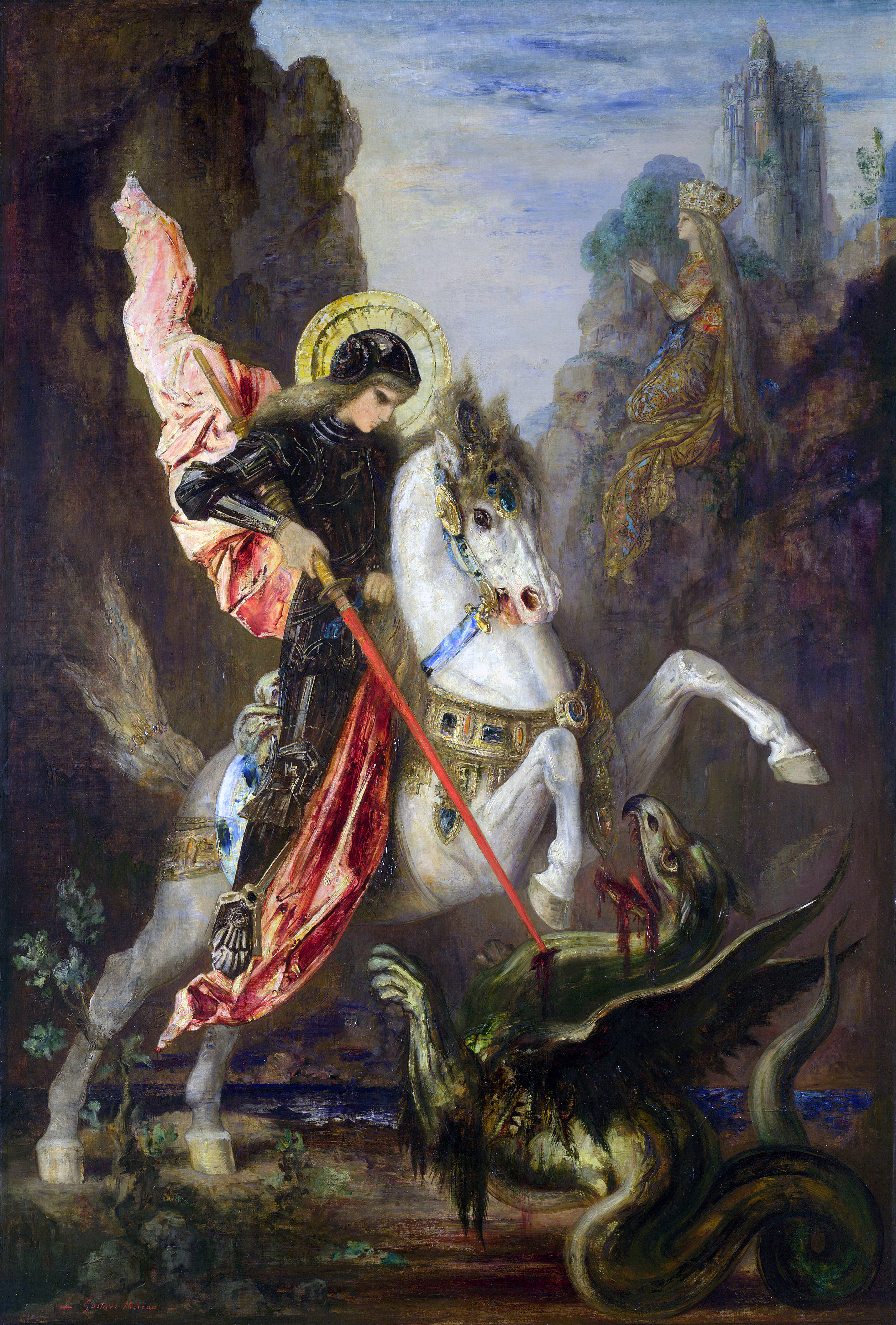
St. George
George was a soldier and martyr who suffered around 303 at Lydda (Diospolis) in Palestine. The earliest surviving record of him is a church inscription in Syria, dated about 346. Commemorations of him are numerous, early, and widespread. However, no details of his life are known. In 495 his name appears on a list of "good men, justly remembered, whose good deeds are known only to God." The best-known story about him is that he rescued a beautiful princess in Libya by killing a dragon. It should be noted that this story is unknown before the appearance in 1265 of a romance called the Golden Legend (Legendum Aureum), translated into English in 1483.
When the soldiers of the First Crusade were besieging Antioch in 1098, they had a vision of George and Demetrius (a deacon of Sirmium in Serbia, martyred under Maximian, and referred to as a "soldier of Christ," from which he was often understood to be a literal soldier) encouraging them to maintain the siege, which ultimately proved successful. Richard I ("the Lion-Heart") of England, who fought in the Holy Land in 1191-1192, placed himself and his army under George's protection, and with the return home of the Crusaders, the popularity of George in England increased greatly. Edward III founded the Order of the Garter in 1348 under his patronage, his banner (a red cross on a white field) began to be used as the English national flag in 1284, and in 1415 Henry V spoke of him to rally the troops before the battle of Agincourt ("Once more unto the breach, dear friends, once more, or close the wall up with our English dead!" and the English troops are rallied with the cry “God for Harry, England and St George.”), and in the years following George was regarded as the special patron of England, of soldiers, and of the Boy Scouts, as well as of Venice, Genoa, Portugal, and Catalonia. He is also remembered with enthusiasm in many parts of the Eastern Orthodox Church. He is a principal character in Edmund Spenser's allegorical poem The Faerie Queene, written in the late 1500's.
St. George - 23 April -Soldier, Martyr, and Patron of England
The Collect.
ALMIGHTY and everlasting God, who didst strengthen thy blessed martyr George with the virtue of constancy in faith and truth: Grant us in like manner for love of thee to despise the prosperity of this world, and to fear none of its adversities; through Jesus Christ our Lord. Amen.
The Epistle - 2 Esdras 2:42-48.
I ESDRAS saw upon the mount Sion a great people, whom I could not number, and they all praised the Lord with songs. And in the midst of them there was a young man of a high stature, taller than all the rest, and upon every one of their heads he set crowns, and was more exalted; which I marvelled at greatly. So I asked the angel, and said, Sir, what are these? He answered and said unto me, These be they that have put off the mortal clothing, and put on the immortal, and have confessed the name of God: now are they crowned, and receive palms. Then said I unto the angel. What young person is it that crowneth them, and giveth them palms in their hands? So he answered and said unto me, It is the Son of God, whom they have confessed in the world. Then began I greatly to commend them that stood so stiffly for the name of the Lord. Then the angel said unto me, Go thy way, and tell my people what manner of things, and how great wonders of the Lord thy God, thou hast seen.
The Gospel - St. Matthew 10:16-22.
BEHOLD, I send you forth as sheep in the midst of wolves: be ye therefore wise as serpents, and harmless as doves. But beware of men: for they will deliver you up to the councils, and they will scourge you in their synagogues; and ye shall he brought before governors and kings for my sake, for a witness to them and the Gentiles. But when they deliver you up, be not anxious how or what ye shall speak: for it shall be given you in that same hour what ye shall speak. For it is not ye that speak, but the Spirit of your Father which speaketh in you. And the brother shall deliver up the brother to death, and the father the child: and the children shall rise up against their parents, and cause them to be put to death. And ye shall be hated of all men for my name's sake: but he that endureth to the end shall be saved.
Sunday, April 18, 2021
John of Epirus
John Kulikos was born in the Greek district of Epirus, in the city of Ioannina. His parents were pious, but he was orphaned at an early age, and he went to Constantinople. With the means left him by his parents, he built a small stall in the city bazaar and was occupied with trade.He loved to work, he honorably filled all his orders, and his business was successful. However, his soul did not yearn for earthly blessings, but for the Kingdom of Heaven.
John lived during difficult times. Constantinople was under the dominion of the Turks, and Christians were subjected to oppression. Many Christian tradesmen and merchants went over to the Mohammedan religion. John reproached them for their betrayal of Christ, and he also sustained the unwavering in their faith. The apostates were filled with hatred for John, and they desired his ruin. The saint knew this, but was not afraid. He was willing to suffer for Christ.
On Great and Holy Friday he went to his spiritual Father and asked his blessing to seek martyrdom. The priest counseled the youth to examine himself and to prepare himself by fasting and prayer, so that at the time of torture he would not deny Christ. John prayed ardently to the Lord to strengthen him. At night on Great and Holy Saturday he saw himself in a dream, standing in a fiery furnace and singing praises to the Lord. Interpreting this vision as an indication to go to martyrdom, John received the Holy Mysteries and asked the priest's blessing.
When John arrived at the market, the vexed tradesmen began to reproach him that he had promised to renounced Christ, but that he was not fulfilling his word. In reply, the confessor declared that he was a Christian and had never renounced, nor would he ever renounce Christ.
Then the envious merchants had him arrested. The judge tried to persuade John to accept the religion of Mohamed, for he respected him as a skilled master craftsman. But the John steadfastly confessed himself a Christian. For several days, they wearied him with hunger and thirst, and beat him without mercy. They sentenced the martyr to be burned alive.
John met his sentence with joy. When they led him to the blazing fire, he went boldly into the midst of the flames. The torturers, seeing that he was prepared to die in the fire, pulled him out and beheaded him with the sword (+ 1526). They then threw the martyr's head and body into the fire.
Christians gathered up the bones of the martyr which remained from the fire, and reverently brought them to the cathedral church.
John of Epirus - 18 April - Confessor and Martyr
The Collect.
ALMIGHTY and everlasting God, who didst strengthen thy blessed martyr John of Epirus with the virtue of constancy in faith and truth: Grant us in like manner for love of thee to despise the prosperity of this world, and to fear none of its adversities; through Jesus Christ our Lord. Amen.
The Epistle - 2 Esdras 2:42-48.
I ESDRAS saw upon the mount Sion a great people, whom I could not number, and they all praised the Lord with songs. And in the midst of them there was a young man of a high stature, taller than all the rest, and upon every one of their heads he set crowns, and was more exalted; which I marvelled at greatly. So I asked the angel, and said, Sir, what are these? He answered and said unto me, These be they that have put off the mortal clothing, and put on the immortal, and have confessed the name of God: now are they crowned, and receive palms. Then said I unto the angel. What young person is it that crowneth them, and giveth them palms in their hands? So he answered and said unto me, It is the Son of God, whom they have confessed in the world. Then began I greatly to commend them that stood so stiffly for the name of the Lord. Then the angel said unto me, Go thy way, and tell my people what manner of things, and how great wonders of the Lord thy God, thou hast seen.
The Gospel - St. Matthew 10:16-22.
BEHOLD, I send you forth as sheep in the midst of wolves: be ye therefore wise as serpents, and harmless as doves. But beware of men: for they will deliver you up to the councils, and they will scourge you in their synagogues; and ye shall he brought before governors and kings for my sake, for a witness to them and the Gentiles. But when they deliver you up, be not anxious how or what ye shall speak: for it shall be given you in that same hour what ye shall speak. For it is not ye that speak, but the Spirit of your Father which speaketh in you. And the brother shall deliver up the brother to death, and the father the child: and the children shall rise up against their parents, and cause them to be put to death. And ye shall be hated of all men for my name's sake: but he that endureth to the end shall be saved.
Reference and Resources:
http://ocafs.oca.org/FeastSaintsViewer.asp?FSID=101143
http://www.commonprayer.org/calend/propers/com_mart.cfm
†
Friday, April 9, 2021
Dietrich Bonhoeffer
(February 4, 1906 – April 9, 1945) was a Lutheran pastor, theologian, participant in the German Resistance movement against Nazism, and a founding member of the Confessing Church.
Bonhoeffer was born in Breslau (Wrocław), Silesia. He and his sister Sabine were twins and the sixth and seventh of eight children. His brother Walter was killed during World War I. His sister was married to Hans von Dohnanyi and was mother of the conductor Christoph von Dohnanyi and the later mayor of Hamburg, Klaus von Dohnanyi. His father, Karl Bonhoeffer, was a prominent German psychiatrist in Berlin; his mother, Paula, home-schooled the children. Though he was initially expected to follow his father into the field of psychology, Dietrich decided at an early age to become a theologian and later a Christian pastor. His parents supported his decision. He attended college in Tübingen and later at the University of Berlin, where he received his doctorate in theology at the age of only 21. As Dietrich was under 25 at the time [per church regulations], he was unable to be ordained. This, however, gave Dietrich the opportunity to go abroad. He then spent a post-graduate year abroad studying at Union Theological Seminary in New York City. During this time, he would often visit the Abyssinian Baptist Church in Harlem, where he became acquainted with the musical form that ethnomusicologists call the African-American Spiritual. He amassed a substantial collection of these spirituals, which he took with him when he went back to Germany.
Bonhoeffer returned to Germany in 1931, where he lectured on theology in Berlin and wrote several books. A strong opponent of Nazism, he was involved, together with Martin Niemöller, Karl Barth and others, in establishing the Confessing Church. In August 1933, he co-authored the Bethel Confession with Hermann Sasse and others. Between late 1933 and 1935, he served as pastor of two German-speaking Protestant churches in London: St. Paul's and Sydenham. While Bonhoeffer desired a trip to India to discover non-violent resistance with Gandhi, he returned to Germany to head a seminary for Confessing Church pastors which had been made illegal by the Nazi regime, first in Finkenwalde and then at the von Blumenthal estate of Gross Schlönwitz, which was closed at the outbreak of World War II. The Gestapo also banned him from preaching; then teaching; and finally any kind of public speaking. During this time, Bonhoeffer worked closely with numerous opponents of Adolf Hitler.
In 1939, Bonhoeffer joined a secret group of high-ranking military officers based in the Abwehr, or Military intelligence Office, who wanted to overthrow the National Socialist regime by killing Hitler. Bonhoeffer was arrested in April 1943 after money used to help Jews escape to Switzerland was traced to him. He was charged with conspiracy and imprisoned in Berlin for a year and a half.
In Flossenbürg, Bonhoeffer was executed by hanging at dawn on 1945 April 9, just three weeks before the liberation of Berlin and one month before the capitulation of Nazi Germany. The manner of execution was, like other executions associated with the July 20 Plot, so brutal and graphic that even Wehrmacht soldiers were loathe to watch. Bonhoeffer was stripped of clothing in his cell, tortured and ridiculed by the guards, and led naked into the execution yard. The lack of sufficient gallows to hang thousands of Germans after the July 20 Plot had caused Hitler and Nazi propagandist Josef Goebbels to seize on the idea of using meathooks from slaughterhouses and slowly hoisting the victim to dangle from an incrementally tightening noose formed of piano wire. The asphyxiation is thought to have taken approximately half an hour.
Propers for Dietrich Bonhoeffer - 9 April - Pastor, Writer, Theologian, and Martyr
The Collect
O God our Father, Who art the source of strength to all Thy saints, and Who didst bring Thy servant Dietrich Bonhoeffer through imprisonment and death to the joys of life eternal: Grant that we, being encouraged by his example, may hold fast the faith that we profess, and that we may seek to know, and according to our knowledge to do, Thy will, even unto death; through Jesus Christ our Lord, Who liveth and reigneth with Thee and the Holy Ghost, one God, now and for ever. Amen.
The Lesson - Proverbs 3:1-7
The Holy Gospel - St. Matthew 13:47-52
Reference and Resources:
http://en.wikipedia.org/wiki/Dietrich_Bonhoeffer
http://elvis.rowan.edu/~kilroy/JEK/04/10.html
†
Sunday, April 4, 2021
Martin Luther King, Jr.

(January 15, 1929 – April 4, 1968) was one of the pivotal leaders of the American civil rights movement. King was a Baptist minister, one of the few leadership roles available to black men at the time. He became a civil rights activist early in his career. He led the Montgomery Bus Boycott (1955–1956) and helped found the Southern Christian Leadership Conference (1957), serving as its first president. His efforts led to the 1963 March on Washington, where King delivered his “I Have a Dream” speech. Here he raised public consciousness of the civil rights movement and established himself as one of the greatest orators in U.S. history. In 1964, King became the youngest person to receive the Nobel Peace Prize for his efforts to end segregation and racial discrimination through civil disobedience and other non-violent means.
King was assassinated on April 4, 1968, in Memphis, Tennessee. He was posthumously awarded the Presidential Medal of Freedom by President Jimmy Carter in 1977. Martin Luther King Day was established as a national holiday in the United States in 1986. In 2004, King was posthumously awarded a Congressional Gold Medal.
Propers for Dr. Martin Luther King, Jr. - 4 April - Pastor and Civil Rights Leader
The Collect.
Almighty God, by the hand of Moses Thy servant who led Thine people out of slavery, and made them free at last; Grant that Thy Church, following the example of Thy servant Martin Luther King, may resist oppression in the name of Thy love, and may secure for all of Thy children the blessed liberty of the Gospel of Jesus Christ; who liveth and reigneth with Thee and the Holy Ghost, one God, now and for ever. Amen.
The Epistle - Exodus 3:7-12.
And the LORD said, I have surely seen the affliction of my people which are in Egypt, and have heard their cry by reason of their taskmasters; for I know their sorrows; And I am come down to deliver them out of the hand of the Egyptians, and to bring them up out of that land unto a good land and a large, unto a land flowing with milk and honey; unto the place of the Canaanites, and the Hittites, and the Amorites, and the Perizzites, and the Hivites, and the Jebusites. Now therefore, behold, the cry of the children of Israel is come unto me: and I have also seen the oppression wherewith the Egyptians oppress them. Come now therefore, and I will send thee unto Pharaoh, that thou mayest bring forth my people the children of Israel out of Egypt. And Moses said unto God, Who am I, that I should go unto Pharaoh, and that I should bring forth the children of Israel out of Egypt? And he said, Certainly I will be with thee; and this shall be a token unto thee, that I have sent thee: When thou hast brought forth the people out of Egypt, ye shall serve God upon this mountain.
The Gospel - St. Luke 6:27-36.
But I say unto you which hear, Love your enemies, do good to them which hate you, Bless them that curse you, and pray for them which despitefully use you. And unto him that smiteth thee on the one cheek offer also the other; and him that taketh away thy cloak forbid not to take thy coat also. Give to every man that asketh of thee; and of him that taketh away thy goods ask them not again. And as ye would that men should do to you, do ye also to them likewise. For if ye love them which love you, what thank have ye? for sinners also love those that love them. And if ye do good to them which do good to you, what thank have ye? for sinners also do even the same. And if ye lend to them of whom ye hope to receive, what thank have ye? for sinners also lend to sinners, to receive as much again. But love ye your enemies, and do good, and lend, hoping for nothing again; and your reward shall be great, and ye shall be the children of the Highest: for he is kind unto the unthankful and to the evil. Be ye therefore merciful, as your Father also is merciful.
Reference and Resources:
http://www.io.com/~kellywp/LesserFF/Apr/King.html
http://en.wikipedia.org/wiki/Martin_Luther_King
†
Thursday, April 1, 2021
Abraham the Martyr
Abraham lived during the thirteenth century, and was descended from the Kamska Bulgars and brought up as a Moslem. He was good and kindly towards the destitute, and when the Lord enlightened him with the light of reason, he accepted Christianity.
In the city of Bolgara, on the lower stretches of the Volga, St Abraham began to preach to his fellow countrymen about the true God. They seized him and tried to force him to renounce Christ, but the saint remained firm in his confession. They tortured the martyr fiercely and for a long while, but he endured everything with unshakable patience.
On April 1, 1229 they quartered the holy Martyr Abraham, and then cut off his venerable head. Russian Christians living in the city buried the saint's body in the Christian cemetery. On March 6, 1230, the relics of St Abraham were transferred by the Great Prince St George Vsevolodovich of Vladimir (February 4) to the Dormition cathedral of the Knyaginin (Princess) monastery. His memory began to be celebrated from that time.
Propers for Abraham - 1 April - Confessor and Martyr
The Collect.
ALMIGHTY and everlasting God, who didst strengthen thy blessed martyr Abraham with the virtue of constancy in faith and truth: Grant us in like manner for love of thee to despise the prosperity of this world, and to fear none of its adversities; through Jesus Christ our Lord. Amen.
The Epistle - 2 Esdras 2:42-48.
I ESDRAS saw upon the mount Sion a great people, whom I could not number, and they all praised the Lord with songs. And in the midst of them there was a young man of a high stature, taller than all the rest, and upon every one of their heads he set crowns, and was more exalted; which I marvelled at greatly. So I asked the angel, and said, Sir, what are these? He answered and said unto me, These be they that have put off the mortal clothing, and put on the immortal, and have confessed the name of God: now are they crowned, and receive palms. Then said I unto the angel. What young person is it that crowneth them, and giveth them palms in their hands? So he answered and said unto me, It is the Son of God, whom they have confessed in the world. Then began I greatly to commend them that stood so stiffly for the name of the Lord. Then the angel said unto me, Go thy way, and tell my people what manner of things, and how great wonders of the Lord thy God, thou hast seen.
The Gospel - St. Matthew 10:16-22.
BEHOLD, I send you forth as sheep in the midst of wolves: be ye therefore wise as serpents, and harmless as doves. But beware of men: for they will deliver you up to the councils, and they will scourge you in their synagogues; and ye shall he brought before governors and kings for my sake, for a witness to them and the Gentiles. But when they deliver you up, be not anxious how or what ye shall speak: for it shall be given you in that same hour what ye shall speak. For it is not ye that speak, but the Spirit of your Father which speaketh in you. And the brother shall deliver up the brother to death, and the father the child: and the children shall rise up against their parents, and cause them to be put to death. And ye shall be hated of all men for my name's sake: but he that endureth to the end shall be saved.
Reference and Resources:
http://ocafs.oca.org/FeastSaintsViewer.asp?FSID=100965
http://en.wikipedia.org/wiki/Abraham_of_Bulgaria
http://www.commonprayer.org/calend/propers/com_mart.cfm
†
Saturday, March 13, 2021
The Martyrs of Iraq

Though there is has not been an official commemoration set by any Christian denomination, it is time to reflect on the persecution of Christians in Iraq and remember those who have been martyred for their Faith.
I propose that Christians should commemorate the Martyrs of Iraq on 13 March of each year (the date is to coincide with the discovery of the remains of Archbishop Mar Paulos Faraj Rahho) and will remember all Christians, regardless of denomination, that have been murdered for their faith and witness in Jesus Christ.
Please follow the links below for a small snapshot of the plight of Iraq's Christian population.
Prayer:
O Almighty God, to whom is all power and glory, we beseech thee to remember and bless thy servants and people in Iraq and especially those who have suffered unto death for their belief in the life eternal, this we ask in the name of Jesus Christ, who liveth and reigneth with thee and the Holy Ghost, now and forever. Amen
http://www.christiansofiraq.com/
http://the-hermeneutic-of-continuity.blogspot.com/2007/06/christian-martyrs-in-iraq.html
http://www.persecution.com/recent_twoSistersKilledInIraq.html
http://www.timesonline.co.uk/tol/news/world/iraq/article572207.ece
†
Sunday, March 7, 2021
Perpetua and Her Companions, Martyrs

During a persecution of Christians under the emperor Septimius Severus, a group of Christians died together in the arena at Carthage. Their final days have been recorded for us in a document that is partly in their own words, and partly in those of an anonymous narrator (sometimes thought to be Tertullian). What follow are extracts, sometimes condensed, from that document.
Vivia Perpetua was a catchumen (i.e. a convert not yet baptized), well educated and from a prosperous family, about 22 years old, married and apparently recently widowed, with a child at her breast, and with two brothers and both parents still living. (Her father was not a Christian.) Felicity (Latin: Felicitas) was a slave woman in advanced pregnancy. With them were Revocatus (also a slave), Saturninus, and Secundus.
They were arrested and placed in a dungeon, but after a few days two deacons visited the prison and by a gift of money to the jailers arranged (1) that they should have an interval in the better part of the prison to refresh themselves, and (2) that Perpetua should be allowed to keep her child with her.
Perpetua had a vision in which she saw a golden ladder, guarded by a fierce dragon, but she climbed it, stepping on the dragon's head to do so. At the top, she found herself in a green meadow, with many white-robed figures, and in their midst a shepherd, who welcomed her and gave her a morsel of cheese from the sheep-milk. She awakened and understood that their martyrdom was certain.
Perpetua had had a brother who died of cancer when he was eight years old. She prayed for him, and received assurance in a vision that all was well with him.
Perpetua had another vision, in which she saw herself fighting against a gladiator in the arena, and winning. She understood this to signify victory over the devil.
Saturus also had a vision, which he records in his own words, in which he and the others, having died in the arena, are borne by angels into a beautiful garden, where they greet other martyrs who have gone before them, and are brought before the throne of God, surrounded by twenty-four elders (see Revelation 4), who greet them and say, "Enter into joy." Perpetua says to Saturus: "I was joyful in the flesh, and here I am more joyful still."
Now Felicitas was eight months pregnant, and the law did not allow a pregnant woman to be executed. She was accordingly fearful that her death would be postponed, and instead of dying with her fellow Christians she would be put to death later in the company of some group of criminals. She and her companions accordingly prayed, and Felicity went into labor, with the pains normal to an eight-month delivery. And a servant of the jailers said to her, "If you cry out like that now, what will you do when you are thrown to the beasts, which you despised when you refused to sacrifice?" And she replied: "Now it is I that suffer what I suffer; but then Another will be in me, who will suffer for me, because I also am about to suffer for Him." Thus she brought forth a little girl, whom a certain sister brought up as her own.
The day of their victory shone forth, and they proceeded from the prison to the amphitheater, as if to an assembly, joyous and of brilliant countenance. At the gate, the guards were going to dress them in the robes of those dedicated to Saturn and to Ceres. But that noble-minded woman [Perpetua?] said: "We are here precisely for refusing to honor your gods. By our deaths we earn the right not to wear such garments." The guards recognized the justice of her words, and let them wear their own clothing.
The men of their company were scheduled to be killed by beasts, but the wild boar turned on its keeper instead, and the bear refused to leave its cage. The leopard, however, attacked Saturus and mortally wounded him. He bade farewell to his guard, Pudens, encouraging him to obey God rather than man, and then fell unconscious.
For the young women there was prepared a fierce cow. Perpetua was first led in. She was tossed, and when she saw her tunic torn from her side, she drew it as a veil over her middle, rather mindful of her modesty than of her sufferings. Then the was called up again, and bound up her disheveled hair, for it is not becoming for a martyr to die with disheveled hair, which is a sign of mourning. She saw Felicity wounded, and took her hand and raised her up, and at the demand of the populace they were given a respite.
Now all the prisoners were to be slain with the sword, and they went to the center of the arena, first exchanging a farewell kiss of peace. The others died unmoving and silent, but when the awkward hand of the young executioner bungled her death-stroke, Perpetua cried out in pain, and herself guided his hand to her throat. Possibly such a woman could not have been slain unless she herself willed it, because she was feared by the impure spirit.
Propers for Perpetua and Her Companions - 7 March - Martyrs at Carthage
The Collect.
ALMIGHTY and everlasting God, with whom thy meek ones go forth as the mighty: Grant us so to cherish the memory of thy blessed martyrs Perpetua and her companions, that we may share their pure and steadfast faith in thee; through Jesus Christ our Lord. Amen.
The Epistle - Hebrews 10:32-39.
BUT call to remembrance the former days, in which, after ye were illuminated, ye endured a great fight of afflictions; partly, whilst ye were made a gazingstock both by reproaches and afflictions; and partly, whilst ye became companions of them that were so used. For ye had compassion of me in my bonds, and took joyfully the spoiling of your goods, knowing in yourselves that ye have in heaven a better and an enduring substance. Cast not away therefore your confidence, which hath great recompence of reward. For ye have need of patience, that, after ye have done the will of God, ye might receive the promise. For yet a little while, and he that shall come will come, and will not tarry. Now the just shall live by faith: but if any man draw back, my soul shall have no pleasure in him. But we are not of them who draw back unto perdition; but of them that believe to the saving of the soul.
The Gospel - St. Matthew 24:9-14.
THEY shall deliver you up to be afflicted, and shall kill you: and ye shall be hated of all nations for my name's sake. And then shall many be offended, and shall betray one another, and shall hate one another. And many false prophets shall rise, and shall deceive many. And because iniquity shall abound, the love of many shall wax cold. But he that shall endure unto the end, the same shall be saved. And this gospel of the kingdom shall be preached in all the world for a witness unto all nations.
Reference and Resources:
http://en.wikipedia.org/wiki/Perpetua
http://www.commonprayer.org/calend/propers/s_perpet.cfm
http://elvis.rowan.edu/~kilroy/JEK/03/07.html
+
Thursday, February 4, 2021
Cornelius the Centurion
Cornelius (in Greek, Κορνήλιος) was a Roman Centurion who is considered by Christians to be the first Gentile to convert to the faith, as related in Acts of the Apostles.
Stationed in Caesarea, Cornelius is depicted in the New Testament as a man full of good works and deeds of alms. Cornelius receives a vision in which an angel of God tells him that his prayers have been heard. The angel then instructs Cornelius to send the men of his household to Joppa, where they will find Simon Peter, who is residing with a tanner by the name of Simon.
The conversion of Cornelius only comes after yet another vision given to Simon Peter (Acts 10:10-16) himself; in Simon Peter's vision, he sees all manner of four-footed beasts and birds of the air being lowed from Heaven in a sheet. A voice commands Simon Peter to eat. When he objects to eating those animals that are unclean to Mosaic Law, the voice tells him not to call unclean that which God has cleansed.
When Cornelius' men arrive, Simon Peter understands that the vision permits the conversion of the Gentiles. When Cornelius himself meets Simon Peter, Cornelius falls at his feet in adoration. Picking Cornelius up, Simon Peter welcomes him. After the two men share their visions, and Simon Peter tells of Jesus' ministry and the Resurrection, the Holy Spirit falls on everyone at the gathering. The Jews among the group are amazed that Cornelius and other uncircumcised should begin speaking in tongues, praising God. Thereupon Simon Peter orders that Cornelius and his followers be baptized.
Cornelius lived in Caesarea, the political capital of Judea under Herod and the Romans. Although he is not mentioned again, he and his household presumably formed the nucleus of the Christian community that we find mentioned later (Acts 8:40; 21:18) in this important city.
The controversial aspect of Gentile conversion is taken up later at the Council of Jerusalem (Acts 15).
Propers for Cornelius the Centurion - 4 February - First of the Gentiles.
The Collect.
O GOD, who by thy spirit didst call Cornelius the Centurion to be the first Christian among the Gentiles: Grant to thy Church in every nation a ready mind and will to proclaim thy love to all who turn to thee with unfeigned hope and faith; for the sake of Jesus Christ our Lord, who liveth and reigneth with thee and the same Spirit ever, one God, world without end. Amen.
The Epistle - Acts 11:1-18.
AND the apostles and brethren that were in Judea heard that the Gentiles had also received the word of God. And when Peter was come up to Jerusalem, they that were of the circumcision contended with him, saying, Thou wentest in to men uncircumcised, and didst eat with them. But Peter rehearsed the matter from the beginning, and expounded it by order unto them, saying, I was in the city of Joppa praying: and in a trance I saw a vision, A certain vessel descended, as it had been a great sheet, let down from heaven by four corners; and it came even to me: upon the which when I had fastened mine eyes, I considered, and saw fourfooted beasts of the earth, and wild beasts, and creeping things, and fowls of the air. And I heard a voice saying unto me, Arise, Peter; slay and eat. But I said, Not so, Lord: for nothing common or unclean hath at any time entered into my mouth. But the voice answered me again from heaven, What God hath cleansed, that call not thou common. And this was done three times: and all were drawn up again into heaven. And, behold, immediately there were three men already come unto the house where I was, sent from Caesarea unto me. And the Spirit bade me go with them, nothing doubting. Moreover these six brethren accompanied me, and we entered into the man's house: and he shewed us how he had seen an angel in his house, which stood and said unto him, Send men to Joppa, and call for Simon, whose surname is Peter; who shall tell thee words, whereby thou and all thy house shall be saved. And as I began to speak, the Holy Ghost fell on them, as on us at the beginning. Then remembered I the word of the Lord, how that he said, John indeed baptized with water; but ye shall be baptized with the Holy Ghost. Forasmuch then as God gave them the like gift as he did unto us, who believed on the Lord Jesus Christ; what was I, that I could withstand God? When they heard these things, they held their peace, and glorified God, saying, Then hath God also to the Gentiles granted repentance unto life.
The Gospel - St. John 4:4-14.
JESUS must needs go through Samaria. Then cometh he to a city of Samaria, which is called Sychar, near to the parcel of ground that Jacob gave to his son Joseph. Now Jacob's well was there. Jesus therefore, being wearied with his journey, sat thus on the well: and it was about the sixth hour. There cometh a woman of Samaria to draw water: Jesus saith unto her, Give me to drink. (For his disciples were gone away unto the city to buy meat.) Then saith the woman of Samaria unto him, How is it that thou, being a Jew, askest drink of me, which am a woman of Samaria? for the Jews have no dealings with the Samaritans. Jesus answered and said unto her, If thou knewest the gift of God, and who it is that saith to thee, Give me to drink; thou wouldest have asked of him, and he would have given thee living water. The woman saith unto him, Sir, thou hast nothing to draw with, and the well is deep: from whence then hast thou that living water? Art thou greater than our father Jacob, which gave us the well, and drank thereof himself, and his children, and his cattle? Jesus answered and said unto her, whosoever drinketh of this water shall thirst again: but whosoever drinketh of the water that I shall give him shall never thirst; but the water that I shall give him shall be in him a well of water springing up into everlasting life.
Reference and Resources:
http://www.wcg.org/lit/bible/acts/acts10.htm
http://orderofcenturions.org/history.html
http://en.wikipedia.org/wiki/Cornelius_the_Centurion
http://www.commonprayer.org/calend/propers/s_corne.cfm
http://elvis.rowan.edu/~kilroy/JEK/02/04.html
†
Wednesday, February 3, 2021
The Four Chaplains
The Four Chaplains were four United States Army chaplains who gave their lives to save other soldiers during the sinking of the USAT Dorchester during World War II. They helped other soldiers board lifeboats and gave up their own life jackets when the supply ran out; 230 of the 904 men aboard the ship were rescued. Life jackets offered little protection from hypothermia which killed most men in the water. Water temperature was 34 °F (1 °C) and air temperature was 36 °F (2 °C). By the time additional rescue ships arrived "...hundreds of dead bodies were seen floating on the water, kept up by their life jackets."
The chaplains, who all held the rank of lieutenant, were the Methodist Reverend George L. Fox, the Jewish Rabbi Alexander D. Goode, the Roman Catholic Priest John P. Washington and the Reformed Church in America Reverend Clark V. Poling. They were sailing on the USAT Dorchester troop transport on February 3, 1943, when the vessel, travelling in convoy, was torpedoed by the German submarine U-223 in the North Atlantic. As the vessel sank, the four chaplains calmed the frightened soldiers and sailors, aided in the evacuation of the ship, and helped guide wounded men to safety. The chaplains also gave up their own life jackets.
As I swam away from the ship, I looked back. The flares had lighted everything. The bow came up high and she slid under. The last thing I saw, the Four Chaplains were up there praying for the safety of the men. They had done everything they could. I did not see them again. They themselves did not have a chance without their life jackets.—Grady Clark, survivor
On December 19, 1944, all four chaplains were posthumously awarded the Purple Heart and the Distinguished Service Cross. The Four Chaplains' Medal was established by act of Congress on July 14, 1960, and was presented posthumously to their next of kin by Secretary of the Army Wilber M. Brucker at Ft. Myer, Virginia on January 18, 1961.
The chaplains were also honored with a stamp, issued in 1948 and by an act of Congress designating February 3 as "Four Chaplains Day."
The Dorchester Chaplains - 3 February
The Collect
Holy God, who didst inspire the Dorchester Chaplains to be models of steadfast sacrificial love in a tragic and terrifying time: Help us to follow their example, that their courageous ministry may inspire chaplains and all who serve, to recognize thy presence in the midst of peril; through Jesus Christ our Savior, who livest and reignest with thee and the Holy Ghost, one God, for ever and ever. Amen.
The Epistle - Romans 8:15-19, 38-39
For ye have not received the spirit of bondage again to fear; but ye have received the Spirit of adoption, whereby we cry, Abba, Father. The Spirit itself beareth witness with our spirit, that we are the children of God: And if children, then heirs; heirs of God, and joint-heirs with Christ; if so be that we suffer with him, that we may be also glorified together. For I reckon that the sufferings of this present time are not worthy to be compared with the glory which shall be revealed in us. For the earnest expectation of the creature waiteth for the manifestation of the sons of God. For I am persuaded, that neither death, nor life, nor angels, nor principalities, nor powers, nor things present, nor things to come, Nor height, nor depth, nor any other creature, shall be able to separate us from the love of God, which is in Christ Jesus our Lord.
The Holy Gospel - St. John 15:9-14
As the Father hath loved me, so have I loved you: continue ye in my love. If ye keep my commandments, ye shall abide in my love; even as I have kept my Father’s commandments, and abide in his love. These things have I spoken unto you, that my joy might remain in you, and that your joy might be full. This is my commandment, That ye love one another, as I have loved you. Greater love hath no man than this, that a man lay down his life for his friends. Ye are my friends, if ye do whatsoever I command you.
+
Labels:
Christians,
Civil Holidays,
Commemoration,
Faithful,
History,
Holidays,
Jew,
Liturgy,
Memorials,
Pastors,
Prayer,
Priest,
Protestant,
Roman Catholic,
Soldiers,
USA,
War
Saturday, January 30, 2021
King Charles the Martyr
(19 November 1600 – 30 January 1649) was King of England, King of Scotland and King of Ireland from 27 March 1625 until his execution.
Charles famously engaged in a struggle for power with the Parliament of England. He was an advocate of the Divine Right of Kings, and many in England feared that he was attempting to gain absolute power. Many of his actions, particularly the levying of taxes without Parliament's consent, caused widespread opposition.
Religious conflicts permeated Charles's reign. He married a Catholic princess, Henrietta Maria of France, over the objections of Parliament and public opinion. He further allied himself with controversial religious figures, including the ecclesiastic Richard Montagu and William Laud, whom Charles appointed Archbishop of Canterbury. Many of Charles's subjects felt this brought the Church of England too close to Roman Catholicism. Charles's later attempts to force religious reforms upon Scotland led to the Bishops' Wars that weakened England's government and helped precipitate his downfall.
His last years were marked by the English Civil War, in which he was opposed by the forces of Parliament, which challenged his attempts to augment his own power, and by Puritans, who were hostile to his religious policies and Catholic sympathy. Charles was defeated in the first Civil War (1642 - 1645), after which Parliament expected him to accept demands for a constitutional monarchy. He instead remained defiant by attempting to forge an alliance with Scotland and escaping to the Isle of Wight. This provoked a second Civil War (1648 - 1649) and a second defeat for Charles, who was subsequently captured, tried, convicted, and executed for high treason.
Charles was never a Roman Catholic, and firmly refused all urgings to become one, saying that he believed the Church of England to be more truly Catholic than the Church of Rome. However, there were many Roman Catholics in his family. His mother, Anne of Denmark, had converted to Rome. His own wife, Henrietta Maria, a French princess whom he had married in what was originally a political alliance but ended as a love match, was a Roman Catholic. His oldest son Charles became a Roman on his deathbed, and his second son, later James II, became one while still healthy, and lost his throne on account of it. It was accordingly not surprising that the Puritans accused him of being secretly disposed toward Rome, and that they regarded all his moves toward religious toleration as part of a Roman Catholic plan to seize the government.
The monarchy was then abolished and a republic called the Commonwealth of England was declared. Charles's son, Charles II, became King after the restoration of the monarchy in 1660.
Propers for Charles I - 30 January - King of England, Scotland and Ireland - Martyr
The Collect.
Blessed Lord, in whose sight the death of thy saints is precious; we magnify thy Name for that abundant grace bestowed on our late Martyred Sovereign; by which he was enabled so cheerfully to follow the steps of his blessed Master and Saviour, in a constant meek bearing of all barbarous indignities, and at last resisting unto blood; and even then, according to the same pattern, praying for his murderers. Let his memory, O Lord, be ever blessed among us, that we may follow the example of his patience, and charity; And grant, that this our Land may be freed from the vengeance of his blood, and Thy mercy glorified in the forgiveness of our sins; and all for Jesus Christ His sake. Amen.
The Epistle - I St Peter 2: 13-23.
Submit yourselves to every ordinance of man for the Lord's sake: whether it be to the king, as supreme; Or unto governors, as unto them that are sent by him for the punishment of evildoers, and for the praise of them that do well. For so is the will of God, that with well doing ye may put to silence the ignorance of foolish men: As free, and not using your liberty for a cloke of maliciousness, but as the servants of God. Honour all men. Love the brotherhood. Fear God. Honour the king. Servants, be subject to your masters with all fear; not only to the good and gentle, but also to the froward. For this is thankworthy, if a man for conscience toward God endure grief, suffering wrongfully. For what glory is it, if, when ye be buffeted for your faults, ye shall take it patiently? but if, when ye do well, and suffer for it, ye take it patiently, this is acceptable with God. For even hereunto were ye called: because Christ also suffered for us, leaving us an example, that ye should follow his steps: Who did no sin, neither was guile found in his mouth: Who, when he was reviled, reviled not again; when he suffered, he threatened not; but committed himself to him that judgeth righteously:
The Gospel - St Matthew xxi., 33-42 .
Hear another parable: There was a certain householder, which planted a vineyard, and hedged it round about, and digged a wine press in it, and built a tower, and let it out to husbandmen, and went into a far country: And when the time of the fruit drew near, he sent his servants to the husbandmen, that they might receive the fruits of it. And the husbandmen took his servants, and beat one, and killed another, and stoned another. Again, he sent other servants more than the first: and they did unto them likewise. But last of all he sent unto them his son, saying, They will reverence my son. But when the husbandmen saw the son, they said among themselves, This is the heir; come, let us kill him, and let us seize on his inheritance. And they caught him, and cast him out of the vineyard, and slew him. When the lord therefore of the vineyard cometh, what will he do unto those husbandmen? They say unto him, He will miserably destroy those wicked men, and will let out his vineyard unto other husbandmen, which shall render him the fruits in their seasons. Jesus saith unto them, Did ye never read in the scriptures, The stone which the builders rejected, the same is become the head of the corner: this is the Lord's doing, and it is marvellous in our eyes?
Reference and Resources:
http://en.wikipedia.org/wiki/Charles_I_of_England
http://anglicanhistory.org/charles/kcm.html
http://elvis.rowan.edu/~kilroy/JEK/01/30a.html
†
Friday, January 22, 2021
Graham Staines
Graham Stuart Staines (1941-January 1999) was an Australian missionary who was burnt to death while he was sleeping with his two sons Timothy (aged 9) and Philip (aged 7) in his station wagon at Manoharpur village in Keonjhar district in Orissa, India in January 1999. In 2003, the Hindu activist Dara Singh was convicted of leading the gang.Graham Staines had been working in Orissa among the tribal poor and especially with leprosy patients since 1965.
Graham Staines - 22 January - Missionary and Martyr
Prayer -
Precious in thy sight, O Lord, is the death of Thy servants, whose faithful witness, by Thy providence, hath its great reward: We give Thee thanks for Thy martyr Graham Staines who purchased with his blood a hearing for the Gospel among the people of Orissa, India and for his wife, daughter and martyred sons, who shared with him in his work and witness; and we pray that with them we also may obtain the crown of righteousness which is laid up for all who love the appearing of our Savior Jesus Christ; who liveth and reigneth with Thee and the Holy Ghost, one God, for ever and ever. Amen.
Reference and Resources:
http://en.wikipedia.org/wiki/Graham_Staines
†
Sunday, January 17, 2021
Anthony of Egypt
Before the conversion of the Emperor Constantine in 312 AD, back in the days when Christianity was still a persecuted religion, the act of becoming a Christian involved turning one's back on the pursuit of security, of fashionable prestige and popularity, of success as the term is widely understood. After the Emperor had changed Christianity from a persecuted religion into a fashionable one, many earnest Christians felt the need to make such a renunciation in the service of Christ, and did not see mere Church membership as any longer enough to constitute such a renunciation. Accordingly, many of them sought Christian commitment by fleeing from society into the desert, and becoming hermits, devoting themselves to solitude, fasting, and prayer. Although this trend was much accelerated and reinforced by the conversion of Constantine and attendant changes, it had already begun earlier. An outstanding early example is Antony of Egypt, often reckoned as the founder of Christian monasticism.
Antony of Egypt, the son of Christian parents, inherited a large estate. On his way to church one day, he found himself meditating on the text, "Sell all that you have, and give to the poor, and come follow me." When he got to church, he heard the preacher speaking on that very text. He took this as a message for him, and, having provided for the care of his sister, he gave his land to the tenants who lived on it, and gave his other wealth to the poor, and became a hermit, living alone for twenty years, praying and reading, and doing manual labor. In 305, he gave up his solitude to become the head of a group of monks, living in a cluster of huts or cells, devoting themselves to communal singing and worship, to prayer and study and manual labor under Antony's direction. They did not simply renounce the world, but were diligent in prayer for their fellow Christians, worked with their hands to earn money that they might distribute it as alms, and preached and gave personal counseling to those who sought them out.
In 321, Christians in Alexandria were being persecuted by the Emperor Maximinus (the rule of Constantine was not yet universal), and Antony visited Alexandria to encourage those facing the possibility of martyrdom. He visited again in 335, when Arianism was strong in the city, and converted many, by his preaching and testimony, and by prayer and the working of miracles. His biography was written by Athanasius, who said of him: "Who ever met him grieving and failed to go away rejoicing?"
Propers for Anthony - 17 January - Abbot in Egypt
The Collect.
O God, who by thy Holy Spirit didst enable thy servant Antony to withstand the temptations of the world, the flesh, and the devil: Give us grace, with pure hearts and minds, to follow thee, the only God; through Jesus Christ our Lord, who liveth and reigneth with thee and the same Spirit, one God, for ever and ever. Amen.
The Epistle - Philippians 3:7-14.
HOWBEIT what things were gain to me, these have I counted loss for Christ. Yea verily, and I count all things to be loss for the excellency of the knowledge of Christ Jesus my Lord: for whom I suffer the loss of all things, and do count them but dung, that I may gain Christ, and be found in him, not having a righteousness of mine own, even that which is of the law, but that which is through faith in Christ, the righteousness which is of God by faith: that I may know him, and the power of his resurrection, and the fellowship of his sufferings, becoming conformed unto his death; if by any means I may attain unto the resurrection of the dead. Not that I have already obtained, or am already made perfect: but I press on, if so be that I may apprehend that for which also I was apprehended by Christ Jesus. Brethren, I count not myself yet to have apprehended: but one thing I do, forgetting the things which are behind, and stretching forward to the things which are before, I press on toward the goal unto the prize of the high calling of God in Christ Jesus.
The Gospel - St. Luke 12:32-34.
FEAR not, little flock; for it is your Father's good pleasure to give you the kingdom. Sell that ye have, and give alms; provide yourselves bags which wax not old, a treasure in the heavens that faileth not, where no thief approacheth, neither moth corrupteth. For where your treasure is, there will your heart be also.
Reference and Resources:
http://en.wikipedia.org/wiki/Anthony_the_Great
http://elvis.rowan.edu/~kilroy/JEK/01/17.html
http://www.commonprayer.org/calend/propers/antony.cfm
†
Labels:
Christians,
Church Fathers,
History,
Monastic,
Propers,
Saints
Friday, January 8, 2021
The Martyrs of the Ecuador Mission
In the dense rain-forests of Ecuador, on the Pacific side of the Andes Mountains, lives a tribe of Indians who call themselves the Huaorani ("people" in their language, Huao), but whose neighbors have called them the Aucas ("savages" in Quechua). For many generations they have been completely isolated from the outside world, disposed to kill any stranger on sight, and feared even by their head-hunting neighbors, the Jivaro tribe.
In 1955, four missionaries from the United States who were working with the Quechas, Jivaros, and other Indians of the interior of Ecuador became persuaded that they were being called to preach the Gospel to the Huaorani as well.
Nate Saint was 32 years old (born 1923), and devoted to flying. He had taken flying lessons in high school and served in the Air Force in WWII. After the war, he enrolled in Wheaton College to prepare for foreign mission work but dropped out to join the Missionary Aviation Fellowship. With his wife, Marjorie Farris, he established a base at Shell Mera (an abandoned oil exploration camp in Ecuador) in September 1948, and flew short hops to keep missionaries supplied with medicines, mail, etc. Once his plane crashed, but a few weeks later he returned to work in a cast from his neck to his thighs.
The other three, Ed McCully, Jim Elliot, and Peter Fleming, all Plymouth Brethren, came to Ecuador in 1952 to work for CMML (Christian Missions in Many Lands).
Ed McCully was 28 years old (born 1927). He had been a football and track star at Wheaton College and president of his senior class. After Wheaton, he enrolled at Marquette to study law, but dropped out to go to Ecuador. He and his wife, Marilou Hobolth, worked with the Quechuas at Arajuno, a base near the Huaorani. Half a dozen Quechuas had been killed at the base by Huaorani in the previous year.
Jim Elliot was 28 years old (born 1927) and an honors graduate of Wheaton College, where he had been a debater, public speaker, and champion wrestler. In Ecuador, he married Elisabeth Howard. They did paramedic work, tending broken arms, malaria, snakebite. They taught sanitation, wrote books in Quechua, and taught literacy.
Peter Fleming was 27 years old (born 1928), from the University of Washington, an honor student, and a linguist. With his wife, Olive Ainslie, he ran a literacy program among the Quechuas.
Nate and Ed found a Huaorani settlement from the air in late September 1955. Nate made four more flights on Thursday, 29 September, and found a settlement only fifteen minutes from their station. They told Jim and Pete, and the four planned their strategy.
They would keep the project secret from everyone but their wives, to avoid being joined by adventurers and the press, with the chance that someone not dedicated to the mission would start shooting at the first sign of real or imagined danger, and destroy the project.
They had one language resource, a Huaorani girl, Dayuma, who had fled from her tribe years earlier after her family was killed in a dispute. Dayuma, who spoke both Huao and Quechua, was now living with Nate's sister Rachel. From her the missionaries learned enough of the language to get started.
They would fly over the village every Thursday and drop gifts as a means of making contact and establishing a friendly relationship. Eventually they would try for closer contact. Nate had discovered that, if he lowered a bucket on a line from the plane, and flew in tight circles, the bucket remained almost stationary, and could be used to lower objects to the ground. He had devised a mechanism to release the bucket when it touched down.
On Thursday, 6 October, one week after locating the village, they dropped an aluminum kettle into an apparently deserted village. On the next flight, several Huaorani were waiting, and the missionaries dropped a machete. On the third flight, they dropped another machete to a considerably larger crowd. Beginning with the fourth flight, they used a loudspeaker system to call out friendly messages in Huao.
Soon the Huaorani were responding with gifts of their own tied to the line: a woven headband, carved wooden combs, two live parrots, cooked fish, parcels of peanuts, a piece of smoked monkey tail.... They cleared a space near their village and built platforms to make the exchanges easier.
After three months of air-to-ground contact, during which they made far more progress than they had hoped, the missionaries decided that it was time for ground contact. They feared that they could not keep their activities secret much longer, and that delay risked a hostile encounter between the Huaorani and some third party.
They decided that the expedition needed a fifth man, so they brought in Roger Youderian, a 31-year-old (born 1924) former paratrooper who had fought in the Battle of the Bulge (a major German offensive in Belgium in the last stages of WWII) and had been in General Eisenhower's honor guard. Roger and his wife, Barbara Orton, were working with the Jivaros, and Roger was thoroughly at home in the jungle, accustomed to living like the Jivaros and blessed with acute survival instincts.
They located a beach that would serve as a landing strip, about four miles from the village, and decided to go in on Tuesday, 3 January 1956. After some discussion, they decided to carry guns, having heard that the Huaorani never attacked anyone who was carrying a gun, and having resolved that they would, as a last resort, fire the guns into the air to ward off an attack, but would shoot no one, even to save their own lives.
On Tuesday they flew in and made camp, then flew over the village to invite the Huaorani to visit them. The first visitors showed up on Friday: a man, a woman, and a teen-aged girl. They stayed for several hours in apparent friendliness, then left abruptly. On Saturday, no one showed, and when the plane flew over the village, the Huaorani seemed frightened at first, but lost their fright when presents were dropped. On Sunday afternoon, 8 January 1956, at about 3 PM, all five missionaries were speared to death at their camp. A search party the next day found no signs of a struggle, and the lookout who was to be stationed in a tree-house overlooking the camp at ground level had come down, so it appeared that the meeting had originally seemed friendly, and that the attack had been a surprise. Ed McCully's body was seen and identified, but was swept away by the river and not recovered. The other four, at the request of their wives, were buried at the site of the camp where they had died. Besides their wives, they left behind a total of nine children.
The effort to reach the Huaorani was not abandoned but rather intensified. Within three weeks, Johnny Keenan, another pilot of the Ecuador Mission, was continuing the flights over the Huaorani village. More than twenty fliers from the United States promptly applied to take Nate's place. More than 1000 college students volunteered for foreign missions in direct response to the story of the Five Martyrs. In Ecuador, Indian attendance at mission schools and church services reached record levels, and the number of conversions skyrocketed. A Jivaro undertook to go at once to another Jivaro tribe that had been at war with his own tribe for years, bearing the Christian message, and his visit brought peace between the two tribes. Truly, as Tertullian said 1800 years ago, the blood of the martyrs is the seed of the Church.
In less than three years, Rachel Saint (sister of Nate Saint) and Elisabeth Elliot (widow of Jim Elliot) had not only renewed contact but had established permanent residence in a Huaorani settlement, where they practiced basic medicine and began the process of developing a written form of the language.
Nine years after the murder of the five missionaries, two of those who had killed Nate Saint and his companions baptized two of Nate's children, Kathy and Stephen Saint. In June 1995, at the request of the Huaorani, Nate's son Stephen moved to the settlement with his wife, Ginny, and their four children, to assist the Huaorani in developing greater internal leadership for a church committed to meeting the medical, economic, and social needs of their own people as a means of showing them God's love and his desire to provide for their eternal needs as well.
Why did the Huaorani suddenly turn hostile? Much later, one of the Huaorani who had helped to kill the five martyrs explained that the tribe, who had had almost no contact with outsiders that did not involve killing or attempted killing on one side or another, wondered why the whites wanted to make contact with them; and while they wanted to believe that their visitors were friendly, they feared a trap. After the killings, they realized their mistake. When they were attacked, one of the missionaries fired two shots as warnings, and one shot grazed a Huaorani who was hiding in the brush, unknown to the missionaries. It was therefore clear that the visitors had weapons, were capable of killing, and had chosen not to do so. Thus, the Huaorani realized that the visitors were indeed their friends, willing to die for them if necessary. When in subsequent months they heard the message that the Son of God had come down from heaven to reconcile men with God, and to die in order to bring about that reconciliation, they recognized that the message of the missionaries was the basis of what they had seen enacted in the lives of the missionaries. They believed the Gospel preached because they had seen the Gospel lived.
The Martyrs of the Ecuador Mission - 8 January
The Collect.
Almighty God, who didst call thy faithful servants Nate Saint, Ed McCully, Jim Elliot, Peter Fleming, and Roger Youderian to be witnesses and martyrs to the Huaorani peoples in the rain forests of Ecuador, and by their labors and suffering didst raise up a people for thine own possession: Pour forth thy Holy Spirit upon thy Church in every land, that by the service and sacrifice of many, thy holy Name may be glorified and thy kingdom enlarged; through Jesus Christ our Lord, who liveth and reigneth with thee and the Holy Ghost, one God, for ever and ever. Amen.
The Epistle - 2 Esdras 2:42-48.
I ESDRAS saw upon the mount Sion a great people, whom I could not number, and they all praised the Lord with songs. And in the midst of them there was a young man of a high stature, taller than all the rest, and upon every one of their heads he set crowns, and was more exalted; which I marvelled at greatly. So I asked the angel, and
said, Sir, what are these? He answered and said unto me, These be they that have put off the mortal clothing, and put on the immortal, and have confessed the name of God; now are they crowned, and receive palms. Then said I unto the angel. What young person is it that crowneth them, and giveth them palms in their hands? So he answered and said unto me, It is the Son of God, whom they have confessed in the world. Then began I greatly to commend them that stood so stiffly for the name of the Lord. Then the angel thy way, and tell my people what manner of things, and how great wonders of the Lord thy God,. thou hast seen.
The Gospel - St. Matthew 10:16-22.
BEHOLD, I send you forth as sheep in the midst of wolves: be ye therefore wise as serpents, and harmless. as doves. But beware of men: for they will deliver you up to the councils, and they will scourge you in their synagogues; and ye shall be brought before governors and kings. for my sake, for a witness to them and the Gentiles. But when they deliver you up, be not anxious how or what ye-shall speak: for it shall be given you in that same hour what ye shall speak. For it is not ye that speak, but the Spirit of your Father which speaketh in you. And the brother shall deliver up the brother to death, and the father the child: and the children shall rise up against their parents, and cause-them to be put to death. And ye shall be hated of all men for my name's sake: but he that endureth to the end shall! be saved.
Reference and Resources:
http://elvis.rowan.edu/~kilroy/JEK/01/08.html
http://en.wikipedia.org/wiki/Operation_Auca
†
Subscribe to:
Posts (Atom)