Showing posts with label Bishop. Show all posts

Sunday, December 11, 2022

Damasus I of Rome


He was born around 305, probably near the city of Egitania, Lusitania, in what is the present-day village of Idanha-a-Velha, Portugal, then part of the Western Roman Empire. His life coincided with the rise of Emperor Constantine I and the reunion and re-division of the Western and Eastern Roman Empires, which is associated with the legitimization of Christianity and its later adoption as the official religion of the Roman state in 380.

Raised in a pious family; his father was a priest in Rome, Italy and Damasus served for a time as deacon in his father‘s church, Saint Laurence. Priest. Assistant to Pope Liberius. Chosen 37th pope in a disputed election in which a minority chose the anti-pope Ursinus. The two reigned simultaneously in Rome which eventually led to violence between their supporters and false accusations of Damasus having committed a crime.

Damasus I was active in defending the Catholic Church against the threat of schisms. In two Roman synods (368 and 369) he condemned Arianism, Apollinarianism and Macedonianism, and sent legates to the First Council of Constantinople that was convoked in 381 to address these heresies.

Economic patron of his secretary, Saint Jerome, commissioning him to make the translation of scripture now known as the Vulgate. Damasus restored catacombs, shrines, and the tombs of martyrs, and wrote poetry and metrical inscriptions about and dedicated to martyrs. They state that he would like to be buried in the catacombs with the early martyrs, but that the presence of one of his lowly status would profane such an august place. Ten of his letters, personal and pontifical, have survived.

Damasus I - 11 December - Bishop of Rome


The Collect.

O ALMIGHTY God, who hast called us to faith in thee, and hast compassed us about with so great a cloud of witnesses; Grant that we, encouraged by the good examples of thy Saints, and especially of thy servant Damasus, may persevere in running the race that is set before us, until at length, through thy mercy, we with them attain to thine eternal joy; through him who is the author and finisher of our faith, thy Son Jesus Christ our Lord. Amen.


The Epistle - Philippians 4:4-9.

REJOICE in the Lord alway: and again I say, Rejoice, Let your moderation be known unto all men. The Lord is at hand. Be anxious for nothing; but in every thing by prayer and supplication with thanksgiving let your requests be made known unto God. And the peace of God, which passeth all understanding, shall keep your hearts and minds through Christ Jesus. Finally, brethren, whatsoever things are true, whatsoever things are honest, whatsoever things are just, whatsoever things are pure, whatsoever things are lovely, whatsoever things are of good report; if there be any virtue, and if there be any praise, think on these things. Those things, which ye have both learned, and received, and heard, and seen in me, do: and the God of peace shall be with you.


 The Holy Gospel - St. Luke 6:17-23. 

JESUS came down and stood in the plain, with the company of his disciples, and a great multitude of people out of all Judea and Jerusalem, and from the sea coasts of Tyre and Sidon, which came to hear him, and to be healed of their diseases; and they that were vexed with unclean spirits: and they were healed. And the whole multitude sought to touch him: for there went virtue out of him, and healed them all. And he lifted up his eyes on his disciples, and said, Blessed be ye poor: for yours is the kingdom of God. Blessed are ye that hunger now: for ye shall be filled. Blessed are ye that weep now: for ye shall laugh. Blessed are ye, when men shall hate you, and when they shall separate you from their company, and shall reproach you, and cast out your name as evil, for the Son of man's sake. Rejoice ye in that day, and leap for joy: for, behold, your reward is great in heaven.


Reference and Resources:

http://saints.sqpn.com/pope-saint-damasus-i/
http://en.wikipedia.org/wiki/Pope_Damasus_I


+

Friday, December 9, 2022

Budoc of Dol

Born a prince, the son of a king of Brittany; his mother was Azenor, princess of Brest, France. Legend says that his mother was set adrift in a cask, and that Budoc was born at sea with Saint Brigid of Ireland in attendance. Educated in a monastery near Waterford, Ireland. Abbot at Youghal, Ireland. Bishop of Dol, Brittany for 26 years. Several places in Devon and Cornwall in England are named after him.

Saint Budoc was the Bishop of Dol in Brittany. The details of his life are shrouded in legend. He is reputed to have been grandson of the King of Brest. Budoc was supposed to have been born at sea under incredible circumstances. His mother, Princess Azenor of Brest, had been falsely accused of infidelity by her jealous stepmother. Budoc's furious father, the King of Goello (Treguier), had Azenor exiled, and near Brest had thrown his pregnant wife into the sea in a cask. There Budoc was born attended in his mother's visions by Saint Brigid. She took refuge in Ireland, where Budoc was raised. Both Azenor and Budoc were later welcomed back to the Kingdom of Brest after Azenor's stepmother fell ill, and upon her deathbed recanted the evil lies she had spread. (Evans, 1919) Budoc was raised and educated at Youghal monastery, and later became its abbot. The vita of Breton Saint Winwaloe describes Budoc as a teacher living on the island of Laurea. Later Budoc was elected bishop, and then returned to Brittany, where he succeeded Saint Samson and Saint Maglorius as bishop of Dol and ruled for 26 years (according to the 10th century vita of Maglorius and the 11th century 'Chronicle of Dol').

Budoc is reputed to have sailed across the Plymouth Sound, until he found an inlet on the Devon side of the River Tamar. He landed in Budshead Creek, part of the present district of Plymouth called St Budeaux. His supposed activity suggests the foundation of an early church in Plymouth. However, there is no evidence of the name in Devon prior to the 16th century. There is also an ancient church said to have been dedicated by him at Budock in Cornwall, and there was once one in Oxford too.

Budoc of Dol - 9 December - Monastic, Missionary and Bishop

The Collect.

O ALMIGHTY God, who hast called us to faith in thee, and hast compassed us about with so great a cloud of witnesses: Grant that we, encouraged by the good examples of thy Saints, and especially of thy servant Budoc of Dol, may persevere in running the race that is set before us, until at length, through thy mercy, we with them attain to thine eternal joy; through him who is the author and finisher of our faith, thy Son Jesus Christ our Lord. Amen.


The Epistle - Philippians 3:7-15.

HOWBEIT what things were gain to me, these have I counted loss for Christ. Yea verily, and I count all things to be loss for the excellency of the knowledge of Christ Jesus my Lord: for whom I suffer the loss of all things, and do count them but dung, that I may gain Christ, and be found in him, not having a righteousness of mine own, even that which is of the law, but that which is through faith in Christ, the righteousness which is of God by faith: that I may know him, and the power of his resurrection, and the fellowship of his sufferings, becoming conformed unto his death; if by any means I may attain unto the resurrection of the dead. Not that I have already obtained, or am already made perfect: but I press on, if so be that I may apprehend that for which also I was apprehended by Christ Jesus. Brethren, I count not myself yet to have apprehended: but one thing I do, forgetting the things which are behind, and stretching forward to the things which are before, I press on toward the goal unto the prize of the high calling of God in Christ Jesus. Let us therefore, as many as be perfect, be thus minded: and if in anything ye are otherwise minded, even this shall God reveal unto you.


The Gospel - St. Luke 10:1-9.

AFTER these things the Lord appointed other seventy also, and sent them two and two before his face into every city and place, whither he himself would come. Therefore said he unto them, The harvest truly is great, but the labourers are few: pray ye therefore the Lord of the harvest, that he would send forth labourers into his harvest. Go your ways: behold, I send you forth as lambs among wolves. Carry neither purse, nor pack, nor shoes: and salute no man by the way. And into whatsoever house ye enter, first say, Peace be to this house. And if the son of peace be there, your peace shall rest upon it: if not, it shall turn to you again. And in the same house remain, eating and drinking such things as they give: for the labourer is worthy of his hire. Go not from house to house. And into whatso ever city ye enter, and they receive you, eat such things as are set before you: and heal the sick that are therein, and say unto them, The kingdom of God is come nigh unto you.


Reference and Resources:

http://en.wikipedia.org/wiki/Budoc
http://saints.sqpn.com/saint-budoc-of-brittany/

†

Tuesday, December 6, 2022

Nicholas of Myra


was born in Asia Minor during the third century in the Greek colony of Patara in Lycia in the Roman province of Asia- today Antalya, Turkey — at a time when the region was Hellenistic in its culture and outlook. Nicholas became bishop of the city of Myra. He was very religious from an early age and devoted his life entirely to Christianity. According to legend, Nicholas was said to have rigorously observed the canonical fasts of Wednesdays and Fridays, even when an infant, by abstaining on those days from his mother's breasts. Nicholas is said to have been born to relatively affluent Christian parents in Patara, Lycia, where he also received his early schooling.

As the patron saint also of sailors, Nicholas is claimed to have been a sailor or fisherman himself. More likely, however, is that one of his family businesses involved managing a fishing fleet. When his parents died, Nicholas received his inheritance but is said to have given it away to the poor. So was St Nicholas a working, albeit wealthy, man who complemented his day job with caring for his congregation, or was he a full-time bishop? The impressive list of deeds of Nicholas seems to point to the latter. This does not mean, however, that his appointment to priest or bishop meant a complete rupture with his former life. More likely this was a gradual process.

Nicholas's early activities as a priest are said to have occurred during the persecution of Christians under the reign of co-ruling Roman Emperors Diocletian (reigned 284–305) and Maximian (reigned 286–305) In the Eastern Empire Galerius (reigned 305–311) continued the persecution until 311 when he issued a general edict of toleration from his deathbed. Nicholas survived this period, although his activities at the time are uncertain.

Following Galerius' death his surviving co-ruler Licinius (reigned 307–324) mostly tolerated Christians. As a result their community was allowed to further develop, and the various bishops who acted as their leaders managed to concentrate religious, social, and political influence as well as wealth in their hands. In many cases they acted as the heads of their respective cities. It is apparently in this period that Nicholas rose to become bishop of Myra. Judging from tradition, he was probably well loved and respected in his area, mostly as a result of his charitable activities. As with other bishops of the time, Nicholas's popularity would serve to ensure his position and influence during and after this period.

The destruction of several pagan temples is also attributed to him, among them the temple of Artemis. Because the celebration of Diana's birth is on December 6, some authors have speculated that this date was deliberately chosen for Nicholas's feast day to overshadow or replace the pagan celebrations.

Not only was Nicholas intolerant of pagans, he was also intolerant of Arianism. Nicholas is listed as a participant in the First Council of Nicaea. There according to legend he became so angry upon hearing the views of Arius that he rushed over to the heretic and gave him a tremendous box on his ears, sending him to the ground.

Nicholas is also known for coming to the defence of the falsely accused, often preventing them from being executed, and for his intercession on behalf of sailors and other travelers. The popular veneration of Nicholas as a saint seems to have started relatively early. Justinian I, Emperor of the Eastern Roman Empire (reigned 527–565) is reported to have built a temple (i.e. a church building) in Nicholas's honor in Constantinople.


Nicholas - 6 December - Bishop of Myra, Defender of the Orthodox Catholic Faith, and Miracle Worker

The Collect.

ALMIGHTY and everlasting God, who didst enkindle the flame of thy love in the heart of thy servant Nicholas: Grant to us, thy humble servants, the same faith and power of love; that, as we rejoice in his triumph, we may profit by his example; through Jesus Christ our Lord. Amen.


The Epistle - Philippians 4:4-9.

REJOICE in the Lord alway: and again I say, Rejoice, Let your moderation be known unto all men. The Lord is at hand. Be anxious for nothing; but in every thing by prayer and supplication with thanksgiving let your requests be made known unto God. And the peace of God, which passeth all understanding, shall keep your hearts and minds through Christ Jesus. Finally, brethren, whatsoever things are true, whatsoever things are honest, whatsoever things are just, whatsoever things are pure, whatsoever things are lovely, whatsoever things are of good report; if there be any virtue, and if there be any praise, think on these things. Those things, which ye have both learned, and received, and heard, and seen in me, do: and the God of peace shall be with you.


The Gospel - St. Matthew 25:31-40.

WHEN the Son of man shall come in his glory, and all the holy angels with him, then shall he sit upon the throne of his glory: and before him shall be gathered all nations: and he shall separate them one from another, as a shepherd divideth his sheep from the goats: and he shall set the sheep on his right hand, but the goats on the left. Then shall the King say unto them on his right hand, Come, ye blessed of my Father, inherit the kingdom prepared for you from the foundation of the world: for I was a hungered, and ye gave me meat: I was thirsty, and ye gave me drink: I was a stranger, and ye took me in: naked, and ye clothed me: I was sick, and ye visited me: I was in prison, and ye came unto me. Then shall the righteous answer him, saying, Lord, when saw we thee an hungered, and fed thee? or thirsty, and gave thee drink? When saw we thee a stranger, and took thee in? or naked, and clothed thee? Or when saw we thee sick, or in prison, and came unto thee? And the King shall answer and say unto them, Verily I say unto you, Inasmuch as ye have done it unto one of the least of these my brethren, ye have done it unto me.


Reference and Resources:

http://en.wikipedia.org/wiki/St._Nicholas
http://anglicancontinuum.blogspot.com/2007/12/st-nicholos-december-6th.html
http://www.commonprayer.org/calend/propers/nicholas.cfm
http://elvis.rowan.edu/~kilroy/JEK/12/06.html

†

Friday, December 2, 2022

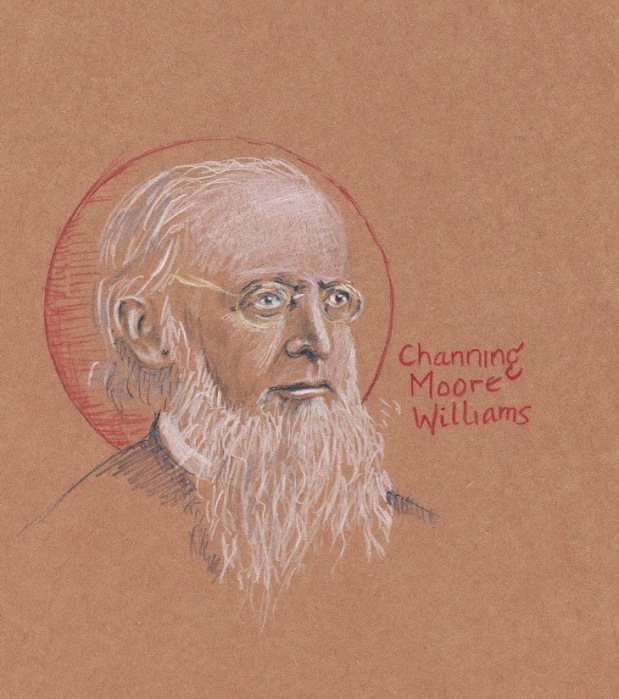
Channing Moore Williams


(17 July 1829 – 2 December 1910) was an Episcopalian missionary to China and Japan and later bishop. His saint's day on the Anglican calendar is 2 December.

Moore was born in Richmond, Virginia, and ordained a deacon in 1855. He was ordained a priest in China in 1857 and later posted to Nagasaki, Japan in 1857. In 1866, he was consecrated Bishop of China and Japan. He went to Tokyo in 1874 and founded St. Paul's University, today known as Rikkyo University in Tokyo.

In 1878 he united various national Anglican missionary efforts into the Nippon Sei Ko Kai, (i.e. the "Holy Catholic Church"), the branch of the Anglican church in Japan. He stayed on in Kyoto, Japan after a successor was appointed in 1893, returning to America only in 1908, two years before his death in Richmond in 1910.


Channing Moore Williams - 2 December - Missionary and Bishop

The Collect.

Almighty and everlasting God, we thank thee for thy servant Channing Moore Williams, whom thou didst call to preach the Gospel to the peoples of China and Japan. Raise up, we beseech thee, in this and every land heralds and evangelists of thy kingdom, that thy Church may proclaim the unsearchable riches of our Saviour Jesus Christ; who liveth and reigneth with thee and the Holy Ghost, one God, now and for ever. Amen.


The Epistle - Acts 1:1-9.

The former treatise have I made, O Theophilus, of all that Jesus began both to do and teach, Until the day in which he was taken up, after that he through the Holy Ghost had given commandments unto the apostles whom he had chosen: To whom also he shewed himself alive after his passion by many infallible proofs, being seen of them forty days, and speaking of the things pertaining to the kingdom of God: And, being assembled together with them, commanded them that they should not depart from Jerusalem, but wait for the promise of the Father, which, saith he, ye have heard of me. For John truly baptized with water; but ye shall be baptized with the Holy Ghost not many days hence. When they therefore were come together, they asked of him, saying, Lord, wilt thou at this time restore again the kingdom to Israel? And he said unto them, It is not for you to know the times or the seasons, which the Father hath put in his own power. But ye shall receive power, after that the Holy Ghost is come upon you: and ye shall be witnesses unto me both in Jerusalem, and in all Judaea, and in Samaria, and unto the uttermost part of the earth. And when he had spoken these things, while they beheld, he was taken up; and a cloud received him out of their sight.


The Gospel - St. Luke 10:1-9.

After these things the Lord appointed other seventy also, and sent them two and two before his face into every city and place, whither he himself would come. Therefore said he unto them, The harvest truly is great, but the labourers are few: pray ye therefore the Lord of the harvest, that he would send forth labourers into his harvest. Go your ways: behold, I send you forth as lambs among wolves. Carry neither purse, nor scrip, nor shoes: and salute no man by the way. And into whatsoever house ye enter, first say, Peace be to this house. And if the son of peace be there, your peace shall rest upon it: if not, it shall turn to you again. And in the same house remain, eating and drinking such things as they give: for the labourer is worthy of his hire. Go not from house to house. And into whatsoever city ye enter, and they receive you, eat such things as are set before you: And heal the sick that are therein, and say unto them, The kingdom of God is come nigh unto you.


Reference and Resources:

http://elvis.rowan.edu/~kilroy/JEK/12/02.html
http://en.wikipedia.org/wiki/Channing_Moore_Williams


+

Tuesday, November 29, 2022

Saturninus of Toulouse

Born to the third century Roman nobility. Missionary to Gaul, the Pyrenees, and the Iberian peninsula. Worked with Saint Papoul. He converted many, including the farmer now known as Saint Honestus who joined him as a missionary. Imprisoned in Carcassone by the prefect Rufinus, Saturninus and his group were freed by an angel. He became the first bishop of Toulouse in modern France), where he teamed with Saint Martial to perform miraculous healings. Converted and baptized Saint Firminus of Amiens.

When Saturninus began his work in Toulouse, the local pagan priests stopped receiving oracular messages from their gods. One day in 257, when the priests were hopelessly frustrated, Saturninus passed by in the street. The priests blamed the bishop, and ordered the crowd of heathens to seize him and force him to offer sacrifice to their gods. The idols fell to pieces in front of the bishop, and the crowd murdered him.

Saturninus of Toulouse - 29 November - Missionary, Bishop and Martyr


The Collect.


O Almighty God, who didst give to thy servant Saturninus boldness to confess the Name of our Saviour Jesus Christ before the rulers of this world, and courage to die for this faith: Grant that we may always be ready to give a reason for the hope that is in us, and to suffer gladly for the sake of the same our Lord Jesus Christ; who liveth and reigneth with thee and the Holy Ghost, one God, for ever and ever. Amen.


The Lesson - 2 Esdras 2:42-48.


The Holy Gospel - St. Matthew 10:16-22


Reference and Resources:

http://en.wikipedia.org/wiki/Saturninus_of_Toulouse
http://saints.sqpn.com/saint-saturninus-of-toulouse/


+

Sunday, November 27, 2022

Cungar of Congresbury

was traditionally born in Llanwngar in Pembrokshire in the late 5th century. It seems that he should not be identified with St. Cyngar of Llangefni as their feast days are different. The latter was the son of King Gerren Llyngesog of Dumnonia, but Cungar may perhaps be the grandson of King Ceredig Ceredigion named in the Bonedd y Saint as father of Saints Gwynlleu and Cyndeyrn. His father was Prince Garthog.

It appears that Cungar left Wales at a young age and crossed the Bristol Channel, settling at Congresbury in Somerset. He apparently turned the surrounding marsh into fertile farmland, thus attracting many followers to his side. Tradition holds that Congresbury became the centre of a West Country See, a precussor of Wells, and that Cungar was its first Bishop. But he was desirous of a solitary life once more and felt himself recalled to Wales. There, he founded a monastery in Morgannwg. The 16th century publisher of his "Life" wrongly identified this as Llandochau (Llandough-juxta-Cardiff) and perpetuated the myth that St. Dochau was an alternative name for Cungar. This is incorrect.

Cungar may have spent some time in Cornwall and Brittany where churches dedicated to him may still be found. Though there may have been a third Breton Saint of a similar name.

He died, on a pilgrimage to Jerusalem, on 27th November, supposedly in AD 520, and was buried in his foundation at Congresbury.


Cungar of Congresbury - 27 November - Monastic and Bishop

The Collect.

O God, whose blessed Son became poor that we through his poverty might be rich: Deliver us, we pray thee, from an inordinate love of this world, that, inspired by the devotion of thy servant Cungar., we may serve thee with singleness of heart, and attain to the riches of the age to come; through the same thy Son Jesus Christ our Lord, who liveth and reigneth with thee, in the unity of the Holy Ghost, one God, now and for ever. Amen.


The Lesson - Song of Solomon 8:6-7


The Holy Gospel - St. Luke 12:33-37


†

Sunday, June 6, 2021

Norbert of Xanten


Born to the nobility, Norbert was raised around the royal court and served as almoner for Emperor Henry V. In the court he developed a very worldly view, and took holy orders as a career move, joining the Benedictines at Siegburg. A narrow escape from death led to a conversion experience, and he began taking his vows seriously. He tried to reform his order’s local house, then became a wandering preacher. He founded a community of Augustinian canons at Premontre, France; they became known as the Norbertines or Premonstratensians, and started a reform movement that swept through European monastic houses.

Norbert of Xanten - 6 June - Monastic, Bishop, and Reformer  

The Collect.

O GOD, by whose grace the blessed Norbert enkindled with the fire of thy love, became a burning and a shining light in thy Church: Grant that we may be inflamed with the same spirit of discipline and love, and ever walk before thee as children of light; through Jesus Christ our Lord. Amen.


The Epistle - Philippians 4:4-9.

 REJOICE in the Lord alway: and again I say, Rejoice, Let your moderation be known unto all men. The Lord is at hand. Be anxious for nothing; but in every thing by prayer and supplication with thanksgiving let your requests be made known unto God. And the peace of God, which passeth all understanding, shall keep your hearts and minds through Christ Jesus. Finally, brethren, whatsoever things are true, whatsoever things are honest, whatsoever things are just, whatsoever things are pure, whatsoever things are lovely, whatsoever things are of good report; if there be any virtue, and if there be any praise, think on these things. Those things, which ye have both learned, and received, and heard, and seen in me, do: and the God of peace shall be with you.

The Gospel - St. Luke 6:17-23

JESUS came down and stood in the plain, with the company of his disciples, and a great multitude of people out of all Judea and Jerusalem, and from the sea coasts of Tyre and Sidon, which came to hear him, and to be healed of their diseases; and they that were vexed with unclean spirits: and they were healed. And the whole multitude sought to touch him: for there went virtue out of him, and healed them all. And he lifted up his eyes on his disciples, and said, Blessed be ye poor: for yours is the kingdom of God. Blessed are ye that hunger now: for ye shall be filled. Blessed are ye that weep now: for ye shall laugh. Blessed are ye, when men shall hate you, and when they shall separate you from their company, and shall reproach you, and cast out your name as evil, for the Son of man's sake. Rejoice ye in that day, and leap for joy: for, behold, your reward is great in heaven.


Reference and Resources:

http://en.wikipedia.org/wiki/Norbert_of_Xanten
http://saints.sqpn.com/saint-norbert-of-xanten/

 †

Saturday, June 5, 2021

Boniface of Mentz


(Latin: Bonifacius; German: Bonifatius; c. 672 – June 5, 754), the Apostle of the Germans, born Winfrid or Wynfrith at Crediton in the kingdom of Wessex (now in Devon, England), was a missionary who propagated Christianity in the Frankish Empire during the 8th century. He is the patron saint of Germany and the Netherlands.

Winfrid was of a respected and prosperous family. It was somewhat against his father's wishes that he devoted himself at an early age to the monastic life. He received his theological training in the Benedictine monasteries of Adescancastre, near Exeter and Nursling, on the western edge of Southampton, under the abbot Winbert. Winfrid taught in the abbey school and at the age of 30 became a priest. He wrote the first Latin grammar produced in England.

Later he set out to preach in Friesland (overlaps with modern Holland), whence he was soon expelled because of war between its heathen king and Charles Martel of France. Boniface, after a brief withdrawal, went into Hesse and Bavaria, having secured the support of the Pope and of Charles Martel for his work there. In Hesse, in the presence of a large crowd of pagans, he cut down the Sacred Oak of Geismar, a tree of immense age and girth, sacred to the god Thor. It is said that after only a few blows of his axe, the tree tottered and crashed to the ground, breaking into four pieces and revealing itself to be rotted away within. It was the beginning of a highly successful missionary effort, and the planting of a vigorous Christian church in Germany, where Boniface was eventually consecrated bishop. He asked the Christian Saxons of England to support his work among their kinsmen on the continent, and they responded with money, books, supplies, and above all, with a steady supply of monks to assist him in teaching and preaching.

Boniface did not confine his attentions to Germany. He worked to establish cooperation between the Pope and others in Italy on the one hand and Charles and his successors in France on the other. He persuaded Carloman and Pepin, the sons of Charles, to call synods for the reform of the church in their territories, where under previous rulers bishoprics had often been sold to the highest bidder. He never forgot his initial failure in Friesland, and in old age resigned his bishopric and returned to work there. Many Frisians had been converted earlier by Willibrord (another Saxon missionary from England--see 7 Nov), but had lapsed after his death. Boniface preached among them with considerable success. On June 5, the eve of Pentecost, 754, he was preparing a group of Frisians for confirmation when they were attacked and killed by heathen warriors. His tomb is in the crypt of Fulda Cathedral.


Boniface of Mentz (Winfrid of Wessex) - 5 June - Missionary, Bishop and Martyr

The Collect.

Almighty God, who didst call thy faithful servant Boniface to be a witness and martyr in the lands of Germany and Friesland, and by his labor and suffering didst raise up a people for thine own possession: Pour forth thy Holy Spirit upon thy Church in every land, that by the service and sacrifice of many thy holy Name may be glorified and thy kingdom enlarged; through Jesus Christ our Lord, who liveth and reigneth with thee and the same Spirit, one God, for ever and ever. Amen.


The Epistle - Acts 1:1-9.


The Gospel - St. Matthew 10:16-22.


Reference and Resources:

http://www.commonprayer.org/calend/propers/com_mart.cfm
http://www.commonprayer.org/calend/propers/com_miss.cfm
http://elvis.rowan.edu/~kilroy/JEK/06/05.html
http://en.wikipedia.org/wiki/Boniface

†

Friday, May 28, 2021

Germanus of Paris

Germanus was born near Autun in 496. He was abbot of St Symphorian’s monastery at Autun, and was made Bishop of Paris around 536.

He was tireless and courageous in his efforts to end civil strife and to restrain the viciousness of the Frankish kings, though he was not very successful in this. Radegund (August 13) appealed to him for protection from her cruel husband King Chlotar I.

Cured King Childebert I from an unnamed illness, and converted him from a misspent life. The king then built him the abbey of Saint Vincent, now known as Saint-Germain-des-Pres.


Germanus of Paris - 28 May - Monastic and Bishop

The Collect.

O GOD, by whose grace the blessed Germanus enkindled with the fire of thy love, became a burning and a shining light in thy Church: Grant that we may be inflamed with the same spirit of discipline and love, and ever walk before thee as children of light; through Jesus Christ our Lord. Amen.


The Epistle - Philippians 3:7-15


The Gospel - St. Luke 12:22-37


+

Wednesday, May 26, 2021

Augustine of Canterbury


was a Benedictine monk who became the first Archbishop of Canterbury in 598. He is considered the "Apostle to the English",a founder of the English Church, and a patron of England.

The Christian Church was established in the British Isles well before 300. Some scholars believe that it was introduced by missionaries from the Eastern or Greek-speaking half of the Mediterranean world. Celtic Christianity had its own distinctive culture, and Greek scholarship flourished in Ireland for several centuries after it had died elsewhere in Western Europe.

However, in the fifth century Britain was invaded by non-Christian Germanic tribes: the Angles, Saxons, and Jutes. They conquered the native Celtic Christians (despite resistance by, among others, a leader whose story has come down to us, doubtless with some exaggeration, as that of King Arthur), or drove them north and west into Cornwall, Wales, Scotland, and Ireland. From these regions Celtic Christian missionaries returned to England to preach the Gospel to the heathen invaders.

Augustine was the prior of a monastery in Rome when Pope Gregory the Great chose him in 595 to lead a mission to Britain to convert the pagan King Æthelberht of Kent to Christianity. Kent was probably chosen because it was near the Christian kingdoms in Gaul, and because Æthelberht had married a Christian princess, Bertha, daughter of Charibert, the King of Paris, who was expected to exert some influence over her husband. Although the missionaries considered turning back before they reached Kent, Gregory urged them on, and in 597 Augustine landed on the Isle of Thanet and proceeded to Æthelberht's main town of Canterbury.

Æthelberht allowed the missionaries to preach freely and converted to Christianity, giving the missionaries land to found a monastery outside the city walls. Augustine was consecrated bishop of the English, and converted many of the king's subjects, including thousands during a mass baptism on Christmas Day in 597. Pope Gregory sent more missionaries in 601, along with encouraging letters and gifts for the churches, although attempts to persuade the native Celtic bishops to submit to Augustine's authority failed.

Augustine was consecrated bishop and established his headquarters at Canterbury. From his day to the present, there has been an unbroken succession of archbishops of Canterbury. Roman Catholic bishops were established at London and Rochester in 604, and a school was founded to train Anglo-Saxon priests and missionaries. Augustine also arranged the consecration of his successor, Laurence of Canterbury.

In 603, he held a conference with the leaders of the already existing Christian congregations in Britain, but failed to reach an accommodation with them, largely due to his own tactlessness, and his insistence (contrary, it may be noted, to Gregory's explicit advice) on imposing Roman customs on a church long accustomed to its own traditions of worship. It is said that the English bishops, before going to meet Augustine, consulted a hermit with a reputation for wisdom and holiness, asking him, "Shall we accept this man as our leader, or not?" The hermit replied, "If, at your meeting, he rises to greet you, then accept him, but if he remains seated, then he is arrogant and unfit to lead, and you ought to reject him." Augustine, alas, remained seated. It took another sixty years before the breach was healed.

Augustine died in 604 and was soon revered as a saint. The Church of England remained in communion with The Church of Rome until it declared its independence in the sixteenth century.


Augustine - 26 May - First Archbishop of Canterbury

The Collect.

O Lord our God, who by thy Son Jesus Christ didst call thine apostles and send them forth to preach the Gospel to the nations: We bless thy holy name for thy servant Augustine, first Archbishop of Canterbury, whose labors in propagating thy Church among the English people we commemorate today; and we pray that all whom thou dost call and send may do thy will, and bide thy time, and see thy glory; through Jesus Christ our Lord, who liveth and reigneth with thee and the Holy Ghost, one God, for ever and ever. Amen.


The Epistle - 2 Corinthians 5:17-20.

IF any man be in Christ, he is a new creature: old things are passed away; behold, all things are become new. And all things are of God, who hath reconciled us to himself by Jesus Christ, and hath given to us the ministry of reconciliation to wit, that God was in Christ, reconciling the world unto himself, not imputing their trespasses unto them; and hath committed unto us the word of reconciliation. Now then we are ambassadors for Christ, as though God did beseech you by us: we pray you in Christ's stead, be ye reconciled to God.


The Gospel - St. Matthew 13:31-33.

ANOTHER parable put Jesus forth unto them, saying, The kingdom of heaven is like to a grain of mustard seed, which a man took, and sowed in his field: which indeed is the least of all seeds: but when it is grown, it is the greatest among herbs, and becometh a tree, so that the birds of the air come and lodge in the branches thereof. Another parable spake he unto them; The kingdom of heaven is like unto leaven, which a woman took, and hid in three measures of meal, till the whole was leavened. All these things spake Jesus unto the multitude in parables.


Reference and Resources:

http://elvis.rowan.edu/~kilroy/JEK/05/26.html
http://en.wikipedia.org/wiki/Augustine_of_Canterbury
http://www.commonprayer.org/calend/propers/s_august.cfm

†

Wednesday, May 19, 2021

Dunstan of Canterbury


He was born near Glastonbury in the southwest of England about the year 909, ten years after the death of King Alfred. During the Viking invasions of the ninth century, monasteries had been favorite targets of the invaders, and by Dunstan's time English monasticism had been wiped out. In its restoration in the tenth century, Dunstan played the leading role. He was born of an upper-class family, and sent to court, where he did not fit in. At the urging of his uncle, the Bishop of Westminster, he became a monk and a priest, and returned to Glastonbury, where he built a hut near the ruins of the old monastery, and devoted himself to study, music, metal working (particularly the art of casting church bells, an art which he is said to have advanced considerably), and painting. A manuscript illuminated by him is in the British Museum. He returned to court and was again asked to leave; but then King Edmund had a narrow escape from death while hunting, and in gratitude recalled Dunstan and in 943 commissioned him to re-establish monastic life at Glastonbury. (Glastonbury is one of the oldest Christian sites in England, and is associated in legend with King Arthur and his Court, with Joseph of Arimathea, and with other worthies. It has been said that the Holy Grail, the chalice of the Last Supper, is hidden somewhere near Glastonbury.) Under Dunstan's direction, Glastonbury became an important center both of monasticism and of learning. The next king, Edred, adopted Dunstan's ideas for various reforms of the clergy (including the control of many cathedrals by monastic chapters) and for relations with the Danish settlers. These policies made Dunstan popular in the North of England, but unpopular in the South.

Edred was succeeded by his sixteen-year-old nephew Edwy, whom Dunstan openly rebuked for unchastity. The furious Edwy drove Dunstan into exile, but the North rose in rebellion on his behalf. When the dust settled, Edwy was dead, his brother Edgar was king, and Dunstan was Archbishop of Canterbury. The coronation service which Dunstan compiled for Edgar is the earliest English coronation service of which the full text survives, and is the basis for all such services since, down to the present. With the active support of King Edgar, Dunstan re-established monastic communities at Malmesbury, Westminster, Bath, Exeter, and many other places. Around 970 he presided at a conference of bishops, abbots, and abbesses, which drew up a national code of monastic observance, the Regularis Concordia. It followed Benedictine lines, but under it the monasteries were actively involved in the life of the surrounding community. For centuries thereafter the Archbishop of Canterbury was always a monk.

Dunstan took an active role in politics under Edgar and his successor Edward, but under the next king, Ethelred, he retired from politics and concentrated on running the Canterbury cathedral school for boys, where he was apparently successful in raising the academic standards while reducing the incidence of corporal punishment. On Ascension Day in 988, he told the congregation that he was near to death, and died two days later.


Dunstan - 19 May - Archbishop of Canterbury

The Collect.

O GOD, who dost ever hallow and protect thy Church: Raise up therein through thy Spirit good and faithful stewards of the mysteries of Christ, as thou didst in thy servant Dunstan; that by their ministry and example thy people may abide in thy favour and walk in the way of truth; through Jesus Christ our Lord, who liveth and reigneth with thee in the unity of the same Spirit ever, one God, world without end. Amen.


The Epistle - Wisdom 7:7-14.

I CALLED upon God, and the spirit of wisdom came to me. I preferred her before sceptres and thrones, and esteemed riches nothing in comparison of her. Neither compared I unto her any precious stone, because all gold in respect of her is as a little sand, and silver shall be counted as clay before her. I loved her above health and beauty, and chose to have her instead of light: for the light that cometh from her never goeth out. All good things together came to me with her, and innumerable riches in her hands. And I rejoiced in them all, because wisdom goeth before them: and I knew not that she was the mother of them. I learned diligently, and do communicate her liberally: I do not hide her riches. For she is a treasure unto men that never faileth: which they that use become the friends of God, being commended for the gifts that come from learning.

The Gospel - St. John 17:18-23.

AS thou hast sent me into the world, even so have I also sent them into the world. And for their sakes I sanctify myself, that they also might be sanctified through the truth. Neither pray I for these alone, but for them also which shall believe on me though their word; that they all may be one; as thou, Father, art in me, and I in thee, that they also may be one in us: that the world may believe that thou hast sent me. And the glory which thou gavest me I have given them; that they may be one, even as we are one: I in them, and thou in me, that they may be made perfect in one; and that the world may know that thou hast sent me, and hast loved them, as thou hast loved me.


Reference and Resources:

http://www.commonprayer.org/calend/propers/dunstan.cfm
http://en.wikipedia.org/wiki/Dunstan_of_Canterbury
http://elvis.rowan.edu/~kilroy/JEK/05/19.html


†

Monday, May 17, 2021

Andronicus of Pannonia


 (Greek: Ανδρόνικος) was a 1st century Christian mentioned by the Apostle Paul:
Salute Andronicus and Junia, my kinsmen, and my fellowprisoners, who are of note among the apostles, who also were in Christ before me.

Salute Andronicus and Junia, my kinsmen, and my fellow prisoners, who are of note among the apostles, who also were in Christ before me.— Romans 16:7 KJV

According to that verse, Andronicus was a kinsman of Paul and a fellow prisoner at some time, particularly well-known among the apostles, and had become a follower of Jesus Christ before Paul's Damascus road conversion. It is generally assumed that Junia was his wife, but they could have been brother and sister, or father and daughter, or no close relation to each other, but to Paul as kinsmen.

Andronicus was one of the 70 disciples of Jesus mentioned in the Gospel of St. Luke 10:1–24.

Andronicus was made Bishop of Pannonia, but his preaching also took him to other lands, far from the boundaries of his diocese. Through the efforts of Andronicus the Church of Christ was strengthened, pagans were converted to the knowledge of God, many pagan temples closed, and in their place Christian churches were built.

Tradition states that Andronicus was martyred for the faith.


Andronicus of Pannonia - 17 May - Disciple, Bishop, and Martyr

The Collect.


O Almighty God, who didst give to thy servant Andronicus boldness to confess the Name of our Saviour Jesus Christ before the rulers of this world, and courage to die for this faith: Grant that we may always be ready to give a reason for the hope that is in us, and to suffer gladly for the sake of the same our Lord Jesus Christ; who liveth and reigneth with thee and the Holy Spirit, one God, for ever and ever. Amen.


The Lesson - 2 Esdras 2:42-48


The Holy Gospel - St. Matthew 10:16-22


+


Wednesday, May 12, 2021

Æthelhard of Canterbury

the Abbot of Louth in Lincolnshire, was elected to the See of Canterbury in AD 790, through the influence of King Offa of Mercia who wished to find archiepiscopal support for his kingdom's interests. However, he was not consecrated until three years later.

After the death of Offa in AD 796, the Kingdom of Kent attempted to shake off Mercian supremacy and Aethelhard fled from Canterbury. Such action drew upon him a rebuke from Alcuin for deserting his flock.

Having been restored to his See, Aethelhard obtained a decision from Pope Leo III, in AD 803, annulling the right of Lichfield to be regarded as a Metropolitan See and confirming the Primacy of Canterbury. Suggestions of relocating the Kentish Archiepiscopate to London were rejected. In the same year, the Synod of decreed that all newly elected bishops must make a written profession of their orthodoxy and give a promise of obedience to Canterbury. Aethelhard's death took place on 12th May AD 805. He should not be confused with Aethelhard who was Bishop of Winchester in the early 760s.


Æthelhard - 12 May - Archbishop of Canterbury

The Collect.

O GOD, who hast brought us near to an innumerable company of Angels, and to the spirits of just men made perfect: Grant us during our pilgrimage to abide in their fellowship, and in our Country to become partakers of their joy; through Jesus Christ our Lord. Amen.


The Epistle - Hebrews 12:1-2.

SEEING we also are compassed about with so great a of cloud of witnesses, let us lay aside every weight, and the sin which doth so easily beset us, and let us run with patience the race that is set before us, looking unto Jesus the author and finisher of our faith; who for the joy that was set before him endured the cross, despising the shame, and is set down at the right hand of the throne of God.


The Gospel - St. Luke 6:17-23.

JESUS came down and stood in the plain, with the company of his disciples, and a great multitude of people out of all Judea and Jerusalem, and from the sea coasts of Tyre and Sidon, which came to hear him, and to be healed of their diseases; and they that were vexed with unclean spirits: and they were healed. And the whole multitude sought to touch him: for there went virtue out of him, and healed them all. And he lifted up his eyes on his disciples, and said, Blessed be ye poor: for yours is the kingdom of God. Blessed are ye that hunger now: for ye shall be filled. Blessed are ye that weep now: for ye shall laugh. Blessed are ye, when men shall hate you, and when they shall separate you from their company, and shall reproach you, and cast out your name as evil, for the Son of man's sake. Rejoice ye in that day, and leap for joy: for, behold, your reward is great in heaven.


Reference and Resources:

http://en.wikipedia.org/wiki/%C3%86thelhard
http://www.celticsaints.org/2012/0512b.html
http://saints.sqpn.com/saint-ethelhard-of-canterbury/
http://www.earlybritishkingdoms.com/adversaries/bios/aethelhard.html

†

Sunday, May 9, 2021

Gregory of Nazianzus


also known as Saint Gregory the Theologian or Gregory Nazianzen, was a 4th century Christian bishop of Constantinople. Gregory is widely considered the most accomplished rhetorical stylist of the patristic age. As a classically trained speaker and philosopher he infused Hellenism into the early church, establishing the paradigm of Byzantine ecclesiastics. He is remembered as the "Trinitarian Theologian," since many of his homilies refer to the nature of the Holy Trinity and the one essence of the Godhead.

Gregory was born in Arianzus, near Nazianzus, in southwest Cappadocia. His parents, Gregory and Nonna, were wealthy land-owners. In 325 Nonna converted her husband to Christianity; he was subsequently consecrated bishop of Nazianzus in 328 or 329. The young Gregory and his brother, Caesarius, first studied at home with his uncle Amphylokhios. Later he studied advanced rhetoric and philosophy in Nazianzus, Caesarea Cappadocia, Alexandria and Athens.

While at Athens, he developed a close friendship with fellow student Saint Basil of Caesarea, he and Basil compiled an anthology, called the PHILOKALIA, of the works of the great (but somewhat erratic) Alexandrian theologian, philosopher, and scholar of the previous century, Origen.

Gregory also made the acquaintance of Julian, the later emperor who would become known as Julian the Apostate. In Athens Gregory studied under the famous rhetoricians Himerius and Proaeresius. Upon finishing his education, he also taught rhetoric in Athens for a short time.

In 361, Gregory returned to Nazianzus and was ordained a presbyter by his father, who wanted him to assist with caring for local Christians. The younger Gregory, who had been considering a monastic existence, resented his father's decision to force a decision between priestly services and a solitary existence, calling it an "act of tyranny". Leaving home after a few days, he met his friend Basil at Annesoi, where the two lived as ascetics. However, Basil urged him to return home to assist his father, which he did for the next year. Arriving at Nazianzus, Gregory found the local Christian community split by theological differences and his father accused of heresy by local monks. Gregory helped to heal the division through a combination of personal diplomacy and oratory.

By this time Emperor Julian had publicly come out in opposition to Christianity. In response to the emperor's denial of the Christian faith, Gregory composed his Invectives Against Julian between 362 and 363. Disparaging the emperor's morals and intellect, the Invectives assert that Christianity will overcome imperfect rulers such as Julian through love and patience. This process as described by Gregory is the public manifestation of the process of deification (theosis), which leads to a spiritual elevation and mystical union with God. Julian resolved in late 362 to vigorously prosecute Gregory and his other Christian critics; however, the emperor perished the following year during a campaign against the Persians. With the death of the emperor, Gregory and the Eastern churches were no longer under the threat of persecution, as the new emperor Jovian was an avowed Christian and supporter of the Church.

Gregory spent the next few years combating the Arian heresy, which threatened to divide the region of Cappadocia. In this tense environment Gregory interceded on behalf of his friend Basil with Bishop Eusebius of Caesarea (Maritima). The two friends then entered a period of close fraternal cooperation as they participated in a great rhetorical contest of the Caesarean church precipitated by the arrival of accomplished Arian theologians and rhetors. In the subsequent public debates, presided over by agents of the emperor Valens, Gregory and Basil emerged triumphant. This success confirmed for both Gregory and Basil that their futures lay in administration of the church. Basil, who had long displayed inclinations to the episcopacy, was elected bishop of the see of Caesarea in Cappadocia in 370.

Faced with a rival Arian bishop at Tyana, Basil undertook to consolidate his position by maneuvering Gregory into the position of Bishop of Sasima, Gregory was consecrated Bishop of Sasima in 372 by Basil. This was a see newly created by Basil in order to strengthen his position in his dispute with Anthimus, bishop of Tyana. The ambitions of Gregory's father to have his son rise in the church hierarchy and the insistence of his friend Basil convinced Gregory to accept this position despite his reservations. Gregory would later refer to his episcopal ordination as forced upon him by his strong-willed father and Basil. Describing his new bishopric, Gregory lamented how it was nothing more than an "utterly dreadful, pokey little hole; a paltry horse-stop on the main road...devoid of water, vegetation, or the company of gentlemen...this was my Church of Sasima!" He made little effort to administer his new diocese, complaining to Basil he
felt "like a bone flung to dogs." He refused to reside at Sasima. Basil accused him of shirking his duty. He accused Basil of making him a pawn in ecclesiastical politics. Their friendship suffered a severe breach, which took some time to heal. Gregory suffered a breakdown and retired to recuperate.

Following the deaths of his mother and father in 374, Gregory continued to administer the diocese of Nazianzus but refused to be named bishop. Donating most of his inheritance to the needy, he lived an austere existence.

Valens died in 378. The succession of Theodosius I, a steadfast supporter of Nicene orthodoxy, was good news to those who wished to purge Constantinople of Arian and Apollinarian domination. The exiled Nicene party gradually returned to the city. From his deathbed, Basil reminded them of Gregory's capabilities and likely recommended his friend to champion the trinitarian cause in Constantinople.

Gregory went to Constantinople to preach, for 30 years the Orthodox had no Church there, so Gregory converted his own house there into a church and held services in it. There he preached the Five Theological Orations for which he is best known, a series of five sermons on the Trinity and in defense of the deity of Christ. People flocked to hear him preach, and the city was largely won over to the Athanasian (Trinitarian, catholic, orthodox) position by his powers of persuasion. The following year, he was consecrated bishop of Constantinople. He presided at the Council of Constantinple in 381, which confirmed the Athanasian position of the earlier Council of Nicea in 325. Having accomplished what he believed to be his mission at Constantinople, and heartily sick of ecclesiastical politics, Gregory resigned and retired to his home town of Nazianzus, where he died in 389.


Gregory Of Nazianzus - 9 May - Bishop, Theologian and Doctor of the Church

The Collect.

ALMIGHTY, everlasting God, whose servant Gregory steadfastly confessed thy Son our Saviour Jesus Christ to be Very God and Very Man: Grant that we may hold fast to this faith, and evermore magnify his holy Name; through the sane thy Son Jesus Christ our Lord, who liveth and reigneth with thee and the Holy Ghost ever, one God, world without end. Amen.


The Epistle - Wisdom 7:7-14

I CALLED upon God, and the spirit of wisdom came to me. I preferred her before sceptres and thrones, and esteemed riches nothing in comparison of her. Neither compared I unto her any precious stone, because all gold in respect of her is as a little sand, and silver shall be counted as clay before her. I loved her above health and beauty, and chose to have her instead of light: for the light that cometh from her never goeth out. All good things together came to me with her, and innumerable riches in her hands. And I rejoiced in them all, because wisdom goeth before them: and I knew not that she was the mother of them. I learned diligently, and do communicate her liberally: I do not hide her riches. For she is a treasure unto men that never faileth: which they that use become the friends of God, being commended for the gifts that come from learning.

The Gospel - St. John 8:25-32

THEN said they unto him, Who art thou? And Jesus saith unto them, Even the same that I said unto you from the beginning. I have many things to say and to judge of you: but he that sent me is true; and I speak to the world those things which I have heard of him. They understood not that he spake to them of the Father. Then said Jesus unto them, When ye have lifted up the Son of man, then shall ye know that I am he, and that I do nothing of myself; but as my Father hath taught me, I speak these things. And he that sent me is with me: the Father hath not left me alone; for I do always those things that please him. As he spake these words, many believed on him. Then said Jesus to those Jews which believed on him, If ye continue in my word, then are ye my disciples indeed; and ye shall know the truth, and the truth shall make you free.


Reference and Resources:

http://elvis.rowan.edu/~kilroy/JEK/05/09.html
http://en.wikipedia.org/wiki/Gregory_of_Nazianzus
http://www.crossroadsinitiative.com/library_author/36/St._Gregory_of_Nazianzen.html
http://www.commonprayer.org/calend/propers/gregor_n.cfm


†

Friday, May 7, 2021

John of Beverley


(died 7 May 721) was an Angle bishop during the time of the kingdom of Northumbria. He was the Bishop of Hexham and then the Bishop of York which was the most important religious designation in the area. He went on to found the town of Beverley by building the first structure there, a monastery. John was associated with miracles during and after his lifetime, he has since been made a saint when he was canonised by the Church in 1037.

The earliest existing mention of the banner of St John is in 1138 when Thurstan incorporated it into the standard which gave its name to the Battle of the Standard. By 1266 it was accepted that when levies from were made in Yorkshire for the royal army, it was sufficient for Beverley to send one man with the banner of St John. In 1292 a new shrine was commissioned. An extant contract between Roger de Faringdon and the Cannons of Beverley Minster states:

For a silver-gilt shrine, made from gold and silver supplied by the Chapter, 5ft long, 1ft wide. Of proportionate height, beautiful, and adorned with plates and columns in architectural style with figures everywhere of size and number as the Chapter determine, and canopies and pinnacles before and behind, and other proper ornaments. Roger to remake any figure at the whim of The Chapter. The pay to be silver equal to the weight used before gilding. Roger may not undertake any other work before completion.

Edward I was a devotee of St John and furthered the cult. In 1295 Edward established a chantry in Beverley Minster in the saint's honour. In 1301, he gave 50 marks towards the building of the shrine and diverted half of a fine owed by the town to the same purpose and ceded the remaining half.

On 1307-10-25 John's relics were translated to the new tomb.

Edward I visited the Minster in 1296, 1297, and 1300 on his way north to fight with the Scottish and took the banner of John to aid him. Edward II, Edward III, and Henry IV also used the banner in military campaigns.

During the Middle Ages his name was also attached to the legend of a hermit who commits grave sins but nonetheless enjoys God's grace. This text survives in the Dutch chapbook Historie van Jan van Beverley, first printed by Thomas van der Noot in Brussels in 1543.

Henry V gave the credit for his victory at the Battle of Agincourt to the miraculous intervention of John, the battle having been fought on the anniversary of John's translation. On the day of the battle, blood and oil were seen running from the tomb. Henry made John one of the patrons of the royal household and ordered that his feast was to be celebrated throughout England. Henry and his Queen came to Beverley in 1420 to make offerings at the saint's shrine.

In 1541, the shrine was destroyed on the orders of Henry VIII as part of the English Reformation. Its contents disappeared from records. In 1664, workmen discovered a vault under the floor of the Minster's nave. Made of stone, it was 15ft long and 2ft wide at the head and 1ft wide at the base. Encased in lead, were found ashes, six beads, three great brass pins and four large iron nails. The lead had the following inscription:

In the year from the incarnation of our Lord, 1138, this church was burnt in the month of September, the night after the feast of St Matthew the Apostle and in the year 1197, the 6th of the ides of March, there was an inquisition made of the relics of the Blessed John in this place, and these bones were found in the east part of this sepulchre, and redeposited; dust mixed with mortar was found likewise and re-interred.

In 1738, when the present Minster floor was laid, the same relics were dug up and replaced in the same position with an arched brick vault over them. This was covered by a marble slab, similar to others in the nave. On the roof of the church, over the tomb, Reliquas beati Johanis Beverlacenic his undicat.

The inscription on the tomb now reads:

HERE LIES
THE BODY OF SAINT JOHN OF BEVERLEY
FOUNDER OF THIS CHURCH
BISHOP OF HEXHAM AD 687-705
BISHOP OF YORK A.D. 705-718
HE WAS BORN AT HARPHAM
AND DIED AT BEVERLEY
AD 721

In recent times, the feast of St John has been marked in Beverley in two ways. On the Thursday nearest 7 May the choir and members of the congregation of Beverley Minster go the church at Harpham and process to the well. The well is decorated (prior to the event) with flowers. After singing an anthem and praying, the procession returns to the church for choral evensong.

On the Sunday nearest 7 May the civic dignitaries process in full regalia with mace bearers to the Minster. The procession enters by the Great West Door. During the following service, children from Harpham present primroses gathered from the woods around the village. The flowers are placed around John's tomb.


St. John of Beverley - 7 May - Monastic and Bishop

The Collect.

O God, who hast brought us near to an innumerable company of angels and to the spirits of just men made perfect: Grant us during our earthly pilgrimage to abide in their fellowship, and in our heavenly country to become partakers of their joy; through Jesus Christ our Lord, who liveth and reigneth with thee and the Holy Ghost, one God, now and for ever. Amen.


The Epistle - Philippians 4:4-9.

REJOICE in the Lord always: and again I say, Rejoice, Let your moderation be known unto all men. The Lord is at hand. Be anxious for nothing; but in every thing by prayer and supplication with thanksgiving let your requests be made known unto God. And the peace of God, which passeth all understanding, shall keep your hearts and minds through Christ Jesus. Finally, brethren, whatsoever things are true, whatsoever things are honest, whatsoever things are just, whatsoever things are pure, whatsoever things are lovely, whatsoever things are of good report; if there be any virtue, and if there be any praise, think on these things. Those things, which ye have both learned, and received, and heard, and seen in me, do: and the God of peace shall be with you.


The Gospel - St. Luke 6:17-23.

JESUS came down and stood in the plain, with the company of his disciples, and a great multitude of people out of all Judea and Jerusalem, and from the sea coasts of Tyre and Sidon, which came to hear him, and to be healed of their diseases; and they that were vexed with unclean spirits: and they were healed. And the whole multitude sought to touch him: for there went virtue out of him, and healed them all. And he lifted up his eyes on his disciples, and said, Blessed be ye poor: for yours is the kingdom of God. Blessed are ye that hunger now: for ye still be filled. Blessed are ye that weep now: for ye shall laugh. Blessed are ye, when men shall hate you, and when they shall separate you from their company, and shall reproach you, and cast out your name as evil, for the Son of man's sake. Rejoice ye in that day, and leap for joy: for, behold, your reward is great in heaven.


Reference and Resources:

http://www.commonprayer.org/calend/propers/common.cfm
http://en.wikipedia.org/wiki/John_of_Beverley
http://www.newadvent.org/cathen/08469b.htm

†

Stanislaus of Krakow


was born at Szczepanów in the Diocese of Krakow, Poland 26 July, 1030 and consecrated bishop of Krakow in 1072.

He is the patron of Poland, and was known for his fervent preaching of the Gospel, for his almsgiving to the poor, and for his refusal to compromise the Faith on issues concerning morals.

The king of Poland, Boleslas II, murdered Stanislaus in response to Stanislaus' reprimand of him for the abduction to the palace of a nobleman's wife and for the harsh rule he meted out on his subjects.

Tradition says that the king killed Stanislaus at Krakow, 8 May, 1079 with his own hand, while the saint was celebrating mass.

Stanislaus' life and stedfastness makes us moderns contemplate, "What am I willing to do, for the defense of the Faith?"


Stanislas of Poland - 7 May - Bishop, Martyr, and Patron.

The Collect.

ALMIGHTY and everlasting God, who didst strengthen thy blessed bishop and martyr Stanislas with the virtue of constancy in faith and truth: Grant us in like manner for love of thee to despise the prosperity of this world, and to fear none of its adversities; through Jesus Christ our Lord. Amen.


The Epistle - Wisdom 5:1-5.

THEN shall the righteous man stand in great boldness before the face of such as have afflicted him, and made no account of his labours. When they see it, they shall be troubled with terrible fear, and shall be amazed at the strangeness of his salvation, so far beyond all that they looked for. And they repenting and groaning for anguish of spirit shall say within themselves, This was he, whom we had sometimes in derision, and a proverb of reproach; We fools accounted his life madness, and his end to be without honour: How is he numbered among the children of God, and his lot is among the saints!


The Gospel - St. Matthew 10:16-22.

BEHOLD, I send you forth as sheep in the midst of wolves: be ye therefore wise as serpents, and harmless as doves. But beware of men: for they will deliver you up to the councils, and they will scourge you in their synagogues; and ye shall he brought before governors and kings for my sake, for a witness to them and the Gentiles. But when they deliver you up, be not anxious how or what ye shall speak: for it shall be given you in that same hour what ye shall speak. For it is not ye that speak, but the Spirit of your Father which speaketh in you. And the brother shall deliver up the brother to death, and the father the child: and the children shall rise up against their parents, and cause them to be put to death. And ye shall be hated of all men for my name's sake: but he that endureth to the end shall be saved.


Reference and Resources:

http://www.episcopalnet.org/Saints/May7Stanislas.html

†

Sunday, May 2, 2021

St. Athanasius


Athanasius of Alexandria (Greek: Αθανάσιος) (also spelled "Athanasios") (ca. 293 – May 2, 373) was a Christian bishop, the Bishop of Alexandria, in the fourth century. He is revered as a saint by the Anglican, Latin and Eastern Orthodox Churches, and regarded as a great leader of the Church by Protestants. Roman Catholics have declared him, earliest living, one of 33 Doctors of the Church, and he is counted as one of the four Great Doctors of the Eastern Church. His feast day is (May 2) in the Coptic Orthodox Church (7 Pashons), January 18 in the Eastern Orthodox Churches and May 2 in the Anglican and Latin Churches.

Outside the pages of the New Testament itself, Athanasius is probably the man to whom we chiefly owe the preservation of the Christian faith and should be looked upon as a role model for maintaing sound Christian Doctrine.

He was born around AD 298, and lived in Alexandria, Egypt, the chief center of learning of the Roman Empire.

Athanasius seems to have been brought early in life under the immediate supervision of the ecclesiastical authorities of his native city. A story has been preserved by Rufinus (Hist. Eccl., I, xiv). The bishop Alexander, so the tale runs, had invited a number of fellow prelates to meet him at breakfast after a great religious function. While Alexander was waiting for his guests to arrive, he stood by a window, watching a group of boys at play on the seashore below the house. He had not observed them long before he discovered that they were imitating the elaborate ritual of Christian baptism. He sent for the children and, in the investigation that followed, it was discovered that one of the boys (none other than the Athanasius), had acted the part of the bishop, and in that character had actually baptized several of his companions in the course of their play. Alexander determined to recognize the make-believe baptisms as genuine, and decided that Athanasius and his playfellows should go into training in order to prepare themselves for a clerical career.

Sozomen speaks of his "fitness for the priesthood", and calls attention to the significant circumstance that he was "from his tenderest years practically self-taught". "Not long after this," adds the same authority, the Bishop Alexander "invited Athanasius to be his commensal and secretary. He had been well educated, and was versed in grammar and rhetoric, and had already, while still a young man, and before reaching the episcopate, given proof to those who dwelt with him of his wisdom and acumen" (Soz., II, xvii). That "wisdom and acumen" manifested themselves in a varied environment. While still a levite under Alexander's care, he seems to have been brought for a while into close relations with some of the solitaries of the Egyptian desert, and in particular with the great St. Anthony, whose life he is said to have written.

In 313 the Emperor Constantine issued the Edict of Milan, which changed Christianity from a persecuted to an officially favored religion. About six years later, a presbyter (elder, priest) Arius of Alexandria began to teach concerning the Word of God (John 1:1) that "God begat him, and before he was begotten, he did not exist." Athanasius was at that time a newly ordained deacon, secretary to Bishop Alexander of Alexandria, and a member of his household. His reply to Arius was that the begetting, or uttering, of the Word by the Father is an eternal relation between Them, and not a temporal event. Arius was condemned by the bishops of Egypt (with the exceptions of Secundus of Ptolemais and Theonas of Marmorica), and went to Nicomedia, from which he wrote letters to bishops throughout the world, stating his position.

In about 319, when Athanasius was a deacon, a presbyter named Arius came into a direct conflict with Bishop Alexander. It appears that Arius approached Alexander for what he felt were misguided or heretical teachings being taught by the bishop. Arius’ theological views appear to have been firmly rooted in Alexandrian Christianity, and his Christologial views were certainly not radical at all. He embraced a subordinationist Christology (that God did not have a beginning, but the Logos did), heavily influenced by Alexandrian thinkers like Origen,[3] which was a common Christological view at the time. Arius was subsequently excommunicated by Alexander, and he would begin to elicit the support of many bishops who agreed with his position. Athanasius may have accompanied Alexander to the First Council of Nicaea in 325, the council which produced the Nicene Creed and anathematized Arius and his followers.

The party of Athanasius was overwhelmingly in the majority. (The western, or Latin, half of the Empire was very sparsely represented, but it was solidly Athanasian, so that if its bishops had attended in force, the vote would have been still more lopsided.) It remained to formulate a creedal statement to express the consensus. The initial effort was to find a formula from Holy Scripture that would express the full deity of the Son, equally with the Father. However, the Arians cheerfully agreed to all such formulations, having interpreted them already to fit their own views. (Those of you who have conversed with members of the Watchtower Society, who consider themselves the spiritual heirs of Arius, will know how this works.) Finally, the Greek word "homo-ousios" (meaning "of the same substance, or nature, or essence") was introduced, chiefly because it was one word that could not be understood to mean what the Arians meant. Some of the bishops present, although in complete disagreement with Arius, were reluctant to use a term not found in the Scriptures, but eventually saw that the alternative was a creed that both sides would sign, each understanding it in its own way, and that the Church could not afford to leave the question of whether the Son is truly God (the Arians said "a god") undecided. So the result was that the Council adopted a creed which is a shorter version of what we now call the Nicene Creed, declaring the Son to be "of one substance with the Father." At the end, there were only two holdouts, the aforesaid Secundus and Theonas.

No sooner was the council over than its consensus began to fall apart. Constantine had expected that the result would be unity, but found that the Arians would not accept the decision, and that many of the orthodox bishops were prepared to look for a wording a little softer than that of Nicea, something that sounded orthodox, but that the Arians would accept. All sorts of compromise formulas were worked out, with all shades of variation from the formula of Nicea.


Eventually, Christians who believed in the Deity of Christ came to see that once they were prepared to abandon the Nicene formulation, they were on a slippery slope that led to regarding the Logos as simply a high-ranking angel. The more they experimented with other formulations, the clearer it became that only the Nicene formulation would preserve the Christian faith in any meaningful sense, and so they re-affirmed the Nicene Creed at the Council of Constantinople in 381, a final triumph that Athanasius did not live to see.

It was a final triumph as far as councils of bishops were concerned, but the situation was complicated by the fact that after Constantine there were several Arian emperors (not counting the Emperor Julian, who was a pagan, but correctly saw that the most effective way to fight Christianity was to throw all his weight on the side of the Arians). Under one of them Arian missionaries were sent to convert the Goths, who became the backbone of the Roman Army (then composed chiefly of foreign mercenaries) with the result that for many years Arianism was considered the mark of a good Army man. The conversion of Clovis, King of the Franks, in 496, to orthodox Christianity either gave the Athanasian party the military power to crush Arianism or denied the Arian Goths the military supremacy that would have enabled them to crush Athanasian Christianity, depending on your point of view.


Athanasius spent a good deal of his energy on polemical writings against his theological opponents. Examples include: Orations Against the Arians, his defence of the divinity of the Holy Spirit (Letters to Serapion) in the 360s, and On the Holy Spirit) against the Macedonian heresy.

Arguably his most read work is his biography of Anthony the Great entitled Vita Antonii, or Life of Antony. This biography later served as an inspiration to Christian monastics in both the East and the West. The so-called Athanasian Creed dates from well after Athanasius's death and draws upon the phraseology of Augustine's De trinitate.

Since Alexandria had the best astronomers, it was the duty of the Bishop of Alexandria to write to the other bishops every year and tell them the correct date for Easter. Naturally, his annual letter on this topic contained other material as well. One Easter Letter (or Paschal Letter) of Athanasius is well known for giving a list of the books that ought to be considered part of the canonical Scriptures, with a supplementary list of books suitable for devotional reading. For the New Testament, he lists the 27 books that are recognized today. (If you will look at your list of New Testament books, you may note that Matthew through 2 Thessalonians were never in dispute, that the next four were subject to relatively little dispute, and that the remaining books had more trouble being accepted. There were also a few books that looked as if they might make the list, but eventually did not, the most conspicuous being the Epistle of Barnabas, the Epistle of Clement, and the Shepherd of Hermas.) For the Old Testament, his list is like that used by most Protestants, except that he omits Esther, and includes Baruch, with the letter of Jeremiah. His supplementary list is Wisdom, Sirach, Tobias, Judith, and Esther. He does not mention Maccabees.

In the spring of 365, after the accession of Emperor Valens to the throne, troubles again arose. Athanasius was once more compelled to seek safety from his persecutors in concealment (October 365), which lasted, however, only for four months. In February 366 he resumed his episcopal labours, in which he henceforth remained undisturbed. On the 2nd of May 373, having consecrated Peter II, one of his presbyters, as his successor, he died quietly in his own house.


St. Athanasius of Alexandria - 2 May -Bishop, Theologian, and Doctor of the Church.

The Collect.

ALMIGHTY, everlasting God, whose servant Athanasius steadfastly confessed thy Son our Saviour Jesus Christ to be Very God and Very Man: Grant that we may hold fast to this faith, and evermore magnify his holy Name; through the same thy Son Jesus Christ our Lord, who liveth and reigneth with thee and the Holy Ghost ever, one God, world without end. Amen.


The Epistle - 2 Corinthians 4:5-14.
WE preach not ourselves, but Christ Jesus the Lord; and ourselves your servants for Jesus' sake. For God, who commanded the light to shine out of darkness, hath shined in our heart, to give the light of the knowledge of the glory of God in the face of Jesus Christ. But we have this treasure in earthen vessels, that the excellency of the power may be of God, and not of us. We are troubled on every side, yet not distressed; we are perplexed, but not in despair; persecuted, but not forsaken; cast down, but not destroyed; always bearing about in the body the dying of the Lord Jesus, that the life also of Jesus might be made manifest in our body. For we which live are always delivered unto death for Jesus' sake, that the life also of Jesus might be made manifest in our mortal flesh. So then death worketh in us, but life in you. We having the same spirit of faith, according as it is written, I believed, and therefore have I spoken; we also believe, and therefore speak; knowing that he which raised up the Lord Jesus shall raise up us also by Jesus, and shall present us with you.


The Gospel - St. Matthew 10:23-32.

WHEN they persecute you in this city, flee ye into another: for verily I say unto you, Ye shall not have gone over the cities of Israel, till the Son of man be come. The disciple is not above his master, nor the servant above his lord. It is enough for the disciple that he be as his master, and the servant as his lord. If they have called the master of the house Beelzebub, how much more shall they call them of his household? Fear them not therefore: for there is nothing covered, that shall not be revealed; and hid, that shall not be known. What I tell you in darkness, that speak ye in light: and what ye hear in the ear, that preach ye upon the housetops. And fear not them which kill the body, but are not able to kill the soul: but rather fear him which is able to destroy both soul and body in hell. Are not two sparrows sold for a farthing? and one of them shall not fall on the ground without your Father. But the very hairs of your head are all numbered. Fear ye not therefore, ye are of more value than many sparrows. Whosoever therefore shall confess me before men, him will I confess also before my Father which is in heaven.

Reference and Resources:

http://en.wikipedia.org/wiki/Athanasius
http://elvis.rowan.edu/~kilroy/JEK/home.html
http://www.commonprayer.org/calend/propers/athana.cfm

†