Showing posts with label Feasts. Show all posts

Thursday, December 8, 2022

Conception of the Blessed Virgin Mary


The Collect.

O MERCIFUL God, hear the supplication of thy servants: that we who are gathered together to honour the Conception of the Virgin Mother of God, may through her intercession be delivered by thee from the perils which beset us. Through Jesus Christ thy Son our Lord, who livest and reignest with thee in the unity of the Holy Ghost, ever one God, world without end. Amen.


The Epistle - Proverbs viii. 22.

THE Lord possessed me in the beginning of his way, before his works of old. I was set up from everlasting, from the beginning, or ever the earth was. When there were no depths, I was brought forth; when there were no fountains abounding with water. Before the mountains were settled, before the hills was I brought forth: while as yet he had not made the earth, nor the fields, nor the highest part of the dust of the world. When he prepared the heavens, I was there: when he set a compass upon the face of the depth: when he established the clouds above: when he strengthened the fountains of the deep: when he gave to the sea his decree, that the waters should not pass his commandment: when he appointed the foundations of the earth: then I was by him, as one brought up with him: and I was daily his delight, rejoicing always before him; rejoicing in the habitable part of the earth: and my delights were with the sons of men. Now therefore hearken unto me, O ye children: for blessed are they that keep my ways. Hear instruction, and be wise, and refuse it not. Blessed is the man that heareth me, watching daily at my gates, waiting at the posts of my doors. For whoso findeth me findeth life, and shall obtain favour of the Lord.


The Gospel - St. Luke i. 26.

AND in the sixth month the angel Gabriel was sent from God unto a city of Galilee named Nazareth, to a Virgin espoused to a man whose name was Joseph, of the house of David; and the Virgin's name was Mary. And the angel came in unto her, and said, Hail, thou that art highly favoured, the Lord is with thee; blessed art thou among women.

†

Saturday, June 5, 2021

Boniface of Mentz


(Latin: Bonifacius; German: Bonifatius; c. 672 – June 5, 754), the Apostle of the Germans, born Winfrid or Wynfrith at Crediton in the kingdom of Wessex (now in Devon, England), was a missionary who propagated Christianity in the Frankish Empire during the 8th century. He is the patron saint of Germany and the Netherlands.

Winfrid was of a respected and prosperous family. It was somewhat against his father's wishes that he devoted himself at an early age to the monastic life. He received his theological training in the Benedictine monasteries of Adescancastre, near Exeter and Nursling, on the western edge of Southampton, under the abbot Winbert. Winfrid taught in the abbey school and at the age of 30 became a priest. He wrote the first Latin grammar produced in England.

Later he set out to preach in Friesland (overlaps with modern Holland), whence he was soon expelled because of war between its heathen king and Charles Martel of France. Boniface, after a brief withdrawal, went into Hesse and Bavaria, having secured the support of the Pope and of Charles Martel for his work there. In Hesse, in the presence of a large crowd of pagans, he cut down the Sacred Oak of Geismar, a tree of immense age and girth, sacred to the god Thor. It is said that after only a few blows of his axe, the tree tottered and crashed to the ground, breaking into four pieces and revealing itself to be rotted away within. It was the beginning of a highly successful missionary effort, and the planting of a vigorous Christian church in Germany, where Boniface was eventually consecrated bishop. He asked the Christian Saxons of England to support his work among their kinsmen on the continent, and they responded with money, books, supplies, and above all, with a steady supply of monks to assist him in teaching and preaching.

Boniface did not confine his attentions to Germany. He worked to establish cooperation between the Pope and others in Italy on the one hand and Charles and his successors in France on the other. He persuaded Carloman and Pepin, the sons of Charles, to call synods for the reform of the church in their territories, where under previous rulers bishoprics had often been sold to the highest bidder. He never forgot his initial failure in Friesland, and in old age resigned his bishopric and returned to work there. Many Frisians had been converted earlier by Willibrord (another Saxon missionary from England--see 7 Nov), but had lapsed after his death. Boniface preached among them with considerable success. On June 5, the eve of Pentecost, 754, he was preparing a group of Frisians for confirmation when they were attacked and killed by heathen warriors. His tomb is in the crypt of Fulda Cathedral.


Boniface of Mentz (Winfrid of Wessex) - 5 June - Missionary, Bishop and Martyr

The Collect.

Almighty God, who didst call thy faithful servant Boniface to be a witness and martyr in the lands of Germany and Friesland, and by his labor and suffering didst raise up a people for thine own possession: Pour forth thy Holy Spirit upon thy Church in every land, that by the service and sacrifice of many thy holy Name may be glorified and thy kingdom enlarged; through Jesus Christ our Lord, who liveth and reigneth with thee and the same Spirit, one God, for ever and ever. Amen.


The Epistle - Acts 1:1-9.


The Gospel - St. Matthew 10:16-22.


Reference and Resources:

http://www.commonprayer.org/calend/propers/com_mart.cfm
http://www.commonprayer.org/calend/propers/com_miss.cfm
http://elvis.rowan.edu/~kilroy/JEK/06/05.html
http://en.wikipedia.org/wiki/Boniface

†

Thursday, June 3, 2021

The Feast of Corpus Christi


Corpus Christi (Latin for Body of Christ) is a Christian feast. Its purpose is to honor the Eucharist, and as such it does not commemorate a particular event in Jesus' life. Its celebration on the Thursday following Trinity Sunday is meant to associate it with Jesus' institution of the Eucharist during the Last Supper, on Maundy Thursday. Because of the sorrow of Holy Week, no festivals are celebrated within it; the Thursday after Trinity Sunday is the first Thursday after Holy Week, Eastertide, and the Octave of Pentecost have ended.

The Feast of Corpus Christi

The Collect.

O GOD, who in a wonderful Sacrament hast left unto us a memorial of thy Passion: grant us, we beseech thee, so to venerate the sacred mysteries of thy Body and Blood, that we may ever perceive within ourselves the fruit of thy redemption. Who with God the Father livest and reignest with thee in the unity of the Holy Ghost, ever one God, world without end. Amen.


The Epistle - 1 Corinthians xi. 23.

I have received of the Lord that which also I delivered unto you, That the Lord Jesus the same night in which he was betrayed took bread: and when he had given thanks, he brake it, and said, Take, eat: this is my body, which is broken for you: this do in remembrance of me. After the same manner also he took the cup, when he had supped, saying, This cup is the new testament in my blood: this do ye, as oft as ye drink it, in remembrance of me. For as often as ye eat this bread, and drink this cup, ye do shew the Lord's death till he come. Wherefore whosoever shall eat this bread, and drink this cup of the Lord, unworthily, shall be guilty of the body and blood of the Lord. But let a man examine himself, and so let him eat of that bread, and drink of that cup. For he that eateth and drinketh unworthily, eateth and drinketh damnation to himself, not discerning the Lord's body.


The Gospel - St. John vi. 55.

Jesus said to the multitudes of the Jews: My flesh is meat indeed, and my blood is drink indeed. He that eateth my flesh, and drinketh my blood, dwelleth in me, and I in him. As the living Father hath sent me, and I live by the Father, so he that eateth me, even he shall live by me. This is that bread which came down from heaven; not as your fathers did eat manna and are dead; he that eateth of this bread shall live for ever.


†

Sunday, May 23, 2021

Whitsunday (Pentecost)


Ancient Greek: πεντηκοστή [ἡμέρα], pentekostē [hēmera], "the fiftieth day") A feast of the universal Church which commemorates the Descent of the Holy Ghost upon the Apostles, fifty days after the Resurrection of Christ, on the ancient Jewish festival called the "feast of weeks" or Pentecost (Exodus 34:22; Deuteronomy 16:10).

In the English speaking world and especially among Anglicans, Pentecost is refered to as Whitsun or Whitsunday, Middle English Whitsonday, from Old English hwīta sunnandæg, literally, white Sunday; probably from the custom of wearing white robes by those newly baptized at this season.


Propers for Pentecost (Whitsunday)

The Collect:

O GOD, who as at this time didst teach the hearts of thy faithful people, by sending to them the light of thy Holy Spirit; Grant us by the same Spirit to have a right judgment in all things, and evermore to rejoice in his holy comfort; through the merits of Christ Jesus our Saviour, who liveth and reigneth with thee, in the unity of the same Spirit, one God, world without end. Amen.

*** This Collect is to be said daily throughout Whitsun Week.

*** If in any Church the Holy Communion be twice celebrated on Whitsunday, the following may be used at the first Communion.

ALMIGHTY and most merciful God, grant, we beseech thee, that by the indwelling of thy Holy Spirit, we may be enlightened and strengthened for thy service; through Jesus Christ our Lord, who liveth and reigneth with thee in the unity of the same Spirit ever, one God, world without end. Amen.


The Epistle - Acts ii. 1:

WHEN the day of Pentecost was fully come, they were all with one accord in one place. And suddenly there came a sound from heaven as of a rushing mighty wind, and it filled all the house where they were sitting. And there appeared unto them cloven tongues like as of fire, and it sat upon each of them. And they were all filled with the Holy Ghost, and began to speak with other tongues, as the Spirit gave them utterance. And there were dwelling at Jerusalem Jews, devout men, out of every nation under heaven. Now when this was noised abroad, the multitude came together, and were confounded, because that every man heard them speak in his own language. And they were all amazed and marvelled, saying one to another, Behold, are not all these which speak Galilaeans? And how hear we every man in our own tongue, wherein we were born? Parthians, and Medes, and Elamites, and the dwellers in Mesopotamia, and in Judaea, and Cappadocia, in Pontus, and Asia, Phrygia, and Pamphylia, in Egypt, and in the parts of Libya about Cyrene, and strangers of Rome, Jews and proselytes, Cretes and Arabians, we do hear them speak in our tongues the wonderful works of God.

*** If in any Church the Holy Communion be twice celebrated on Whitsunday, the following may be used at the first Communion.


The Epistle - 1 Corinthians xii. 4:

NOW there are diversities of gifts, but the same Spirit. And there are differences of administrations, but the same Lord. And there are diversities of operations, but it is the same God which worketh all in all. But the manifestation of the Spirit is given to every man to profit withal. For to one is given by the Spirit the word of wisdom; to another the word of knowledge by the same Spirit; to another faith by the same Spirit; to another the gifts of healing by the same Spirit; to another the working of miracles; to another prophecy; to another discerning of spirits; to another divers kinds of tongues; to another the interpretation of tongues: but all these worketh that one and the selfsame Spirit, dividing to every man severally as he will. For as the body is one, and hath many members, and all the members of that one body, being many, are one body: so also is Christ. For by one Spirit are we all baptized into one body, whether we be Jews or Gentiles, whether we be bond or free; and have been all made to drink into one Spirit. For the body is not one member, but many.


The Gospel - St. John xiv. 15:

JESUS said unto his disciples, If ye love me, keep my commandments. And I will pray the Father, and he shall give you another Comforter, that he may abide with you for ever; even the Spirit of truth; whom the world cannot receive, because it seeth him not, neither knoweth him: but ye know him; for he dwelleth with you, and shall be in you. I will not leave you comfortless: I will come to you. Yet a little while, and the world seeth me no more; but ye see me: because I live, ye shall live also. At that day ye shall know that I am in my Father, and ye in me, and I in you. He that hath my commandments, and keepeth them, he it is that loveth me: and he that loveth me shall be loved of my Father, and I will love him, and will manifest myself to him. Judas saith unto him, not Iscariot, Lord, how is it that thou wilt manifest thyself unto us, and not unto the world? Jesus answered and said unto him, If a man love me, he will keep my words; and my Father will love him, and we will come unto him, and make our abode with him. He that loveth me not keepeth not my sayings: and the word which ye hear is not mine, but the Father's which sent me. These things have I spoken unto you, being yet present with you. But the Comforter, which is the Holy Ghost, whom the Father will send in my name, he shall teach you all things, and bring all things to your remembrance, whatsoever I have said unto you. Peace I leave with you, my peace I give unto you: not as the world giveth, give I unto you. Let not your heart be troubled, neither let it be afraid. Ye have heard how I said unto you, I go away, and come again unto you. If ye loved me, ye would rejoice, because I said, I go unto the Father: for my Father is greater than I. And now I have told you before it come to pass, that, when it is come to pass, ye might believe. Hereafter I will not talk much with you: for the prince of this world cometh, and hath nothing in me. But that the world may know that I love the Father; and as the Father gave me commandment, even so I do.

*** If in any Church the Holy Communion be twice celebrated on Whitsunday, the following may be used at the first Communion.


The Gospel - St. Luke xi. 9:

JESUS said to his disciples, Ask, and it shall be given you; seek, and ye shall find; knock, and it shall be opened unto you. For every one that asketh receiveth; and he that seeketh findeth; and to him that knocketh it shall be opened. If a son shall ask bread of any of you that is a father, will he give him a stone? or if he ask a fish, will he for a fish give him a serpent? or if he shall ask an egg, will he offer him a scorpion? If ye then, being evil, know how to give good gifts unto your children: how much more shall your heavenly Father give the Holy Spirit to them that ask him?


Reference and Resources:

http://www.merriam-webster.com/dictionary/whitsunday
http://www.newadvent.org/cathen/15614b.htm
http://en.wikipedia.org/wiki/Pentecost


†

Thursday, May 13, 2021

Feast of the Ascension


The general and most common understanding of the Christian doctrine of Ascension holds that Jesus bodily ascended to heaven in the presence of his apostles, forty days following his resurrection. It is narrated in Mark 16:19 , Luke 24:51 , Acts 1:1-12, and mentioned in John 20:17, Ephesians 4:7-13, Romans 10:5-7, 1 Timothy 3:16, 1 Peter 3:21-22. This is affirmed by Christian liturgy in the Apostles' Creed and the Nicene Creed.


The Collect(s).

GRANT, we beseech thee, Almighty God, that like as we do believe thy only-begotten Son our Lord Jesus Christ to have ascended into the heavens; so we may also in heart and mind thither ascend, and with him continually dwell, who liveth and reigneth with thee and the Holy Ghost, one God, world without end. Amen. ** This Collect is to be said daily throughout the Octave.


Blessed art thou, O Lord God Almighty, the Ancient of Days, who hast set thy Son Jesus Christ our Lord upon the glorious throne of thy kingdom, exalted far above all peoples, all places, all times, eternally; that he who hath worn our flesh, and borne our manhood into the Holy of Holies, should henceforth pour down heavenly gifts upon his Church, and be both our righteous judge and most merciful intercessor; to whom with thee, O Father, and thee, O Holy Ghost, one God, be ascribed all might, majesty, dominion, and praise, now and for ever. Amen. ** This Collect may be said after the prayers of the people and additional collects throughout the Octave.

The Epistle - Acts 1: 1-11.

THE former treatise have I made, O Theophilus, of all that Jesus began both to do and teach, until the day in which he was taken up, after that he through the Holy Ghost had given commandments unto the apostles whom he had chosen: to whom also he shewed himself alive after his passion by many infallible proofs, being seen of them forty days, and speaking of the things pertaining to the kingdom of God: and, being assembled together with them, commanded them that they should not depart from Jerusalem, but wait for the promise of the Father, which, saith he, ye have heard of me. For John truly baptized with water; but ye shall be baptized with the Holy Ghost not many days hence. When they therefore were come together, they asked of him, saying, Lord, wilt thou at this time restore again the kingdom to Israel? And he said unto them, It is not for you to know the times or the seasons, which the Father hath put in his own power. But ye shall receive power, after that the Holy Ghost is come upon you: and ye shall be witnesses unto me both in Jerusalem, and in all Judea, and in Samaria, and unto the uttermost part of the earth. And when he had spoken these things, while they beheld, he was taken up; and a cloud received him out of their sight. And while they looked steadfastly toward heaven as he went up, behold, two men stood by them in white apparel; which also said, Ye men of Galilee, why stand ye gazing up into heaven? this same Jesus, which is taken up from you into heaven, shall so came in like manner as ye have seen him go into heaven.


The Holy Gospel - St. Luke 24: 49-53.

JESUS said, Behold, I send the promise of my Father upon you: but tarry ye in the city of Jerusalem, until ye be endued with power from on high. And he led them out as far as to Bethany, and he lifted up his hands, and blessed them. And it came to pass, while he blessed them, he was parted from them, and carried up into heaven. And they worshiped him, and returned to Jerusalem with great joy: and were continually in the temple, praising and blessing God.


†

Saturday, May 1, 2021

SS Philip and James the Apostles


Saint Philip was one of the Twelve Apostles of Jesus. Later Christian traditions describe Philip as the apostle who proselytized in Greece, Syria, and Phrygia. He was martyred by crucifixion in the city of Hierapolis.

The Gospel of John describes Philip's calling as a disciple of Jesus. The narrative of Philip's call as a disciple describes him as being from the city of Bethsaida, and connects him to Andrew and Peter, who were from the same town. It further connects him to Nathaniel (sometimes identified with Bartholomew), by describing how Philip introduced Nathaniel to Jesus. The authors of the Synoptic Gospels also describe Philip as a disciple of Jesus.

Of the four Gospels, Philip figures most prominently in the Gospel of John. His two most notable appearances in the narrative are as a link to the Greek-speaking Jewish community (Philip introduces members of this community to Jesus); and during the Last Supper when he asked Jesus to see the Father, providing Jesus the opportunity to teach about the unity of the Father and the Son.

Saint Philip is always listed fifth among the apostles (Matthew 10:3, Mark 3:18, Luke 6:14 and Acts 1:13).

*

James, son of Alphaeus was one of the Twelve Apostles of Jesus of Nazareth. He is generally identified with James the Less, and is more commonly known by that name in church tradition

St James, the son of Alphaeus is rarely mentioned in the New Testament, but he is sometimes identified with James the Just, an important leader in the New Testament church. He is clearly distinguished from James, son of Zebedee, another one of the Twelve Apostles.

James, son of Alphaeus, only appears four times in the New Testament, each time in a list of the twelve apostles.

He is reported to have been martyred by crucifixion at Ostrakine in Lower Egypt, where he was preaching the Gospel. A carpenter's saw is the symbol associated with him in Christian art because it is also noted that his body was later sawed to pieces.


Saint Philip and Saint James - 1 May - Apostles

The Collect.

O ALMIGHTY God, whom truly to know is ever-lasting life; Grant us perfectly to know thy Son Jesus Christ to be the way, the truth, and the life; that, following the steps of thy holy Apostles, Saint Philip and Saint James, we may steadfastly walk in the way that leadeth to eternal life through the same thy Son Jesus Christ our Lord. Amen.


The Epistle. James i. 1.

JAMES, a servant of God and of the Lord Jesus Christ, to the twelve tribes which are scattered abroad, greeting. My brethren, count it all joy when ye fall into divers temptations; knowing this, that the trying of your faith worketh patience. But let patience have her perfect work, that ye may be perfect and entire, wanting nothing. If any of you lack wisdom, let him ask of God, that giveth to all men liberally, and upbraideth not; and it shall be given him. But let him ask in faith, nothing wavering. For he that wavereth is like a wave of the sea driven with the wind and tossed. For let not that man think that he shall receive any thing of the Lord. A double minded man is unstable in all his ways. Let the brother of low degree rejoice in that he is exalted: but the rich, in that he is made low: because as the flower of the grass he shall pass away. For the sun is no sooner risen with a burning heat, but it withereth the grass, and the flower thereof falleth, and the grace of the fashion of it perisheth: so also shall the rich man fade away in his ways. Blessed is the man that endureth temptations for when he is tried, he shall receive the crown of life, which the Lord hath promised to them that love him.


The Gospel. St. John xiv. 1.

AND Jesus said unto his disciples, Let not your heart be troubled: ye believe in God, believe also in me. In my Father's house are many mansions: if it were not so, I would have told you. I go to prepare a place for you. And if I go and prepare a place for you, I will come again, and receive you unto myself; that where I am, there ye maybe also. And whither I go ye know, and the way ye know. Thomas saith unto him, Lord, we know not whither thou goest; and how can we know the way? Jesus saith unto him, I am the way, the truth, and the life: no man cometh unto the Father but by me. If ye had known me, ye should have known my Father also: and from henceforth ye know him, and have seen him. Philip saith unto him, Lord, shew us the Father, and it sufficeth us. Jesus saith unto him, Have I been so long time with you, and yet hast thou not known me, Philip? he that hath seen me hath seen the Father; and bow sayest thou then, Shew us the Father? Believest thou not that I am in the Father, and the Father in me? the words that I speak unto you ,I speak not of myself: but the Father that dwelleth in me, he doeth the works. Believe me that I am in the Father, and the Father in me: or else believe me for the very works' sake. Verily, verily, I say unto you, He that believeth on me, the works that I do shall he do also; and greater works than these shall he do; because I go unto my Father. And whatsoever ye shall ask in my name, that will I do, that the Father may be glorified in the Son. If ye shall ask any thing in my name, I will do it.


Reference and Resources:

http://www.commonprayer.org/calend/propers/s_philip.cfm
http://en.wikipedia.org/wiki/James_the_Less
http://en.wikipedia.org/wiki/Philip_the_Apostle
http://elvis.rowan.edu/~kilroy/JEK/05/01.html

†

Friday, April 23, 2021

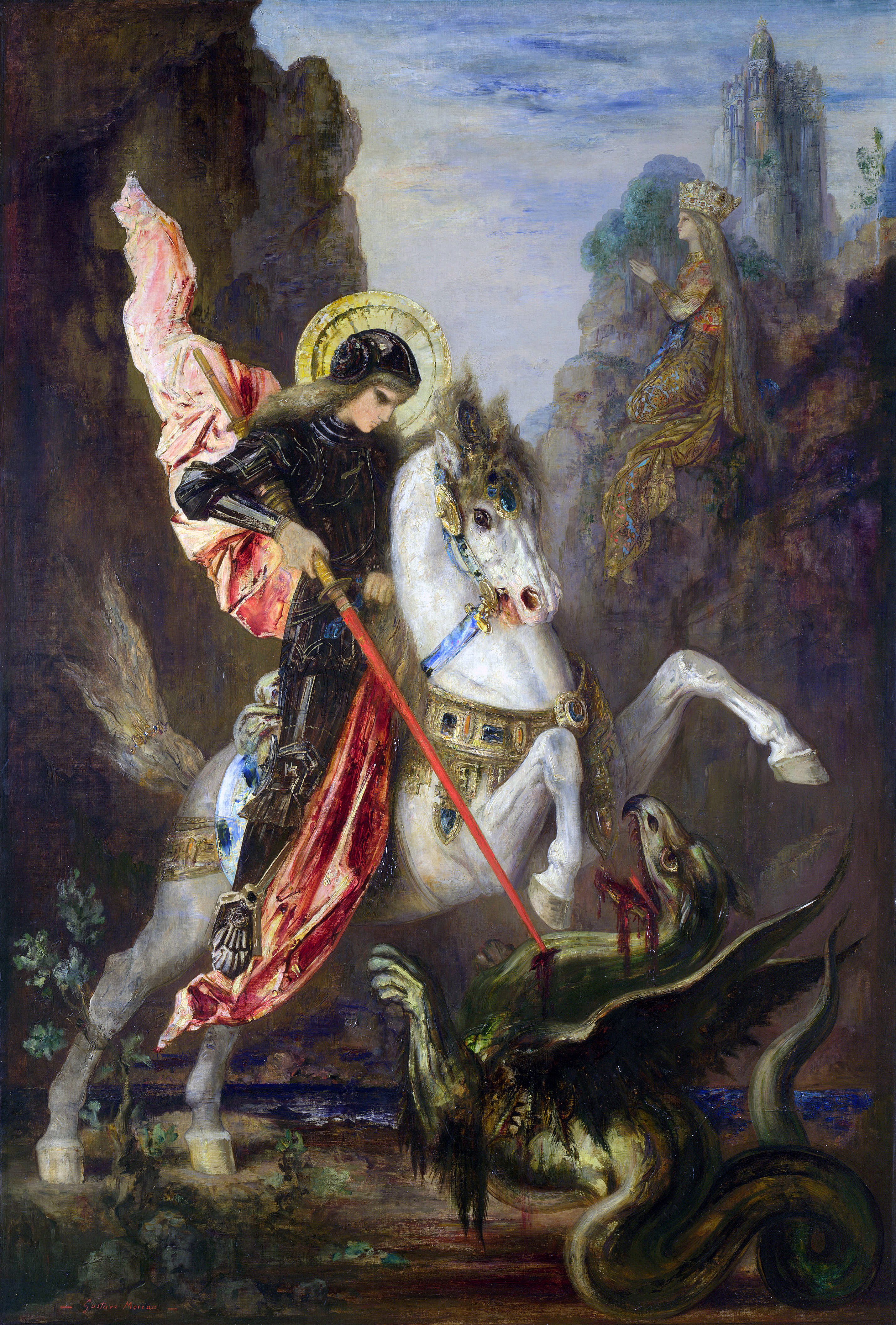
St. George


George was a soldier and martyr who suffered around 303 at Lydda (Diospolis) in Palestine. The earliest surviving record of him is a church inscription in Syria, dated about 346. Commemorations of him are numerous, early, and widespread. However, no details of his life are known. In 495 his name appears on a list of "good men, justly remembered, whose good deeds are known only to God." The best-known story about him is that he rescued a beautiful princess in Libya by killing a dragon. It should be noted that this story is unknown before the appearance in 1265 of a romance called the Golden Legend (Legendum Aureum), translated into English in 1483.

When the soldiers of the First Crusade were besieging Antioch in 1098, they had a vision of George and Demetrius (a deacon of Sirmium in Serbia, martyred under Maximian, and referred to as a "soldier of Christ," from which he was often understood to be a literal soldier) encouraging them to maintain the siege, which ultimately proved successful. Richard I ("the Lion-Heart") of England, who fought in the Holy Land in 1191-1192, placed himself and his army under George's protection, and with the return home of the Crusaders, the popularity of George in England increased greatly. Edward III founded the Order of the Garter in 1348 under his patronage, his banner (a red cross on a white field) began to be used as the English national flag in 1284, and in 1415 Henry V spoke of him to rally the troops before the battle of Agincourt ("Once more unto the breach, dear friends, once more, or close the wall up with our English dead!" and the English troops are rallied with the cry “God for Harry, England and St George.”), and in the years following George was regarded as the special patron of England, of soldiers, and of the Boy Scouts, as well as of Venice, Genoa, Portugal, and Catalonia. He is also remembered with enthusiasm in many parts of the Eastern Orthodox Church. He is a principal character in Edmund Spenser's allegorical poem The Faerie Queene, written in the late 1500's.


St. George - 23 April -Soldier, Martyr, and Patron of England

The Collect.

ALMIGHTY and everlasting God, who didst strengthen thy blessed martyr George with the virtue of constancy in faith and truth: Grant us in like manner for love of thee to despise the prosperity of this world, and to fear none of its adversities; through Jesus Christ our Lord. Amen.


The Epistle - 2 Esdras 2:42-48.

I ESDRAS saw upon the mount Sion a great people, whom I could not number, and they all praised the Lord with songs. And in the midst of them there was a young man of a high stature, taller than all the rest, and upon every one of their heads he set crowns, and was more exalted; which I marvelled at greatly. So I asked the angel, and said, Sir, what are these? He answered and said unto me, These be they that have put off the mortal clothing, and put on the immortal, and have confessed the name of God: now are they crowned, and receive palms. Then said I unto the angel. What young person is it that crowneth them, and giveth them palms in their hands? So he answered and said unto me, It is the Son of God, whom they have confessed in the world. Then began I greatly to commend them that stood so stiffly for the name of the Lord. Then the angel said unto me, Go thy way, and tell my people what manner of things, and how great wonders of the Lord thy God, thou hast seen.


The Gospel - St. Matthew 10:16-22.

BEHOLD, I send you forth as sheep in the midst of wolves: be ye therefore wise as serpents, and harmless as doves. But beware of men: for they will deliver you up to the councils, and they will scourge you in their synagogues; and ye shall he brought before governors and kings for my sake, for a witness to them and the Gentiles. But when they deliver you up, be not anxious how or what ye shall speak: for it shall be given you in that same hour what ye shall speak. For it is not ye that speak, but the Spirit of your Father which speaketh in you. And the brother shall deliver up the brother to death, and the father the child: and the children shall rise up against their parents, and cause them to be put to death. And ye shall be hated of all men for my name's sake: but he that endureth to the end shall be saved.


Monday, April 19, 2021

Alphege of Canterbury

(Elphege, AElfheah) was born about 953, during the second major period of Viking raids against England. He became first a monk and then a hermit, and then was appointed Abbot of Bath. In 984 he became Bishop of Westminster. In 994 King Ethelred the Unready sent him to parley with the Danish invaders Anlaf and Swein. The Anglo-Saxons paid tribute, but Anlaf became a Christian and swore never to invade England again. He never did. In that same year Alphege brought the newly baptized King Olaf Tryggvason of Norway to a peaceful meeting with King Ethelred, and to his confirmation at Andover. (Remark: "Unready" does not mean that the king was often unprepared; it means that he was headstrong and stubborn, and would not accept "rede," meaning counsel or advice.)

In 1005 Alphege became Archbishop of Canterbury. In 1011 the Danes overran much of southern England. The payment of the tribute agreed on (the Danegeld) did not stop them, and in September they captured Canterbury and held Alphege and other prominent persons for ransom. The others were duly paid for and released, but the price demanded for Alphege was a fantastically high 3,000 pounds (worth of course, far more than modern pounds). Alphege, knowing the poverty of his people, refused to pay or let anyone else pay for him. The infuriated Danes, at the end of a drunken feast, brought him out and repeated their demands. When he again refused, they threw various objects at him (large bones from the feast, for example) and finally an axeman delivered the death-blow. Their chief, Thorkell the Tall, tried to save him, offering all his possessions except his ship for the Archbishop's life. By his death Alphege became a national hero.

When the Dane Cnut (Canute) became King of England in 1016, he adopted a policy of conciliation, and in 1023 he brought the body of Alphege from London to Canterbury, where he was long remembered as a martyr, one who died, not precisely for professing the Christian faith, but for exercising the Christian virtue of justice. In art, he is shown with an axe, the instrument of his death, or as a shepherd defending his flock from wolves.


Alphege - 19 April - Archbishop of Canterbury and Martyr.


The Collect.

O GOD, who dost support and defend us with the glorious witness of thy blessed martyr Alphege: Grant us to go forward in his footsteps, and ever to rejoice in fellowship with him; through Jesus Christ our Lord. Amen.


The Epistle - Revelation 7:13-17.

And one of the elders answered, saying unto me, What are these which are arrayed in white robes? and whence came they? And I said unto him, Sir, thou knowest. And he said to me, These are they which came out of great tribulation, and have washed their robes, and made them white in the blood of the Lamb. Therefore are they before the throne of God, and serve him day and night in his temple: and he that sitteth on the throne shall dwell among them. They shall hunger no more, neither thirst any more; neither shall the sun light on them, nor any heat. For the Lamb which is in the midst of the throne shall feed them, and shall lead them unto living fountains of waters: and God shall wipe away all tears from their eyes.


The Gospel - St. Matthew 10:16-22.

BEHOLD, I send you forth as sheep in the midst of wolves: be ye therefore wise as serpents, and harmless as doves. But beware of men: for they will deliver you up to the councils, and they will scourge you in their synagogues; and ye shall he brought before governors and kings for my sake, for a witness to them and the Gentiles. But when they deliver you up, be not anxious how or what ye shall speak: for it shall be given you in that same hour what ye shall speak. For it is not ye that speak, but the Spirit of your Father which speaketh in you. And the brother shall deliver up the brother to death, and the father the child: and the children shall rise up against their parents, and cause them to be put to death. And ye shall be hated of all men for my name's sake: but he that endureth to the end shall be saved.


Reference & Resources:

http://elvis.rowan.edu/~kilroy/JEK/04/19.html
http://www.commonprayer.org/calend/propers/alphege.cfm
http://en.wikipedia.org/wiki/Alphege

†

Sunday, March 7, 2021

Perpetua and Her Companions, Martyrs


During a persecution of Christians under the emperor Septimius Severus, a group of Christians died together in the arena at Carthage. Their final days have been recorded for us in a document that is partly in their own words, and partly in those of an anonymous narrator (sometimes thought to be Tertullian). What follow are extracts, sometimes condensed, from that document.

Vivia Perpetua was a catchumen (i.e. a convert not yet baptized), well educated and from a prosperous family, about 22 years old, married and apparently recently widowed, with a child at her breast, and with two brothers and both parents still living. (Her father was not a Christian.) Felicity (Latin: Felicitas) was a slave woman in advanced pregnancy. With them were Revocatus (also a slave), Saturninus, and Secundus.

They were arrested and placed in a dungeon, but after a few days two deacons visited the prison and by a gift of money to the jailers arranged (1) that they should have an interval in the better part of the prison to refresh themselves, and (2) that Perpetua should be allowed to keep her child with her.

Perpetua had a vision in which she saw a golden ladder, guarded by a fierce dragon, but she climbed it, stepping on the dragon's head to do so. At the top, she found herself in a green meadow, with many white-robed figures, and in their midst a shepherd, who welcomed her and gave her a morsel of cheese from the sheep-milk. She awakened and understood that their martyrdom was certain.

Perpetua had had a brother who died of cancer when he was eight years old. She prayed for him, and received assurance in a vision that all was well with him.

Perpetua had another vision, in which she saw herself fighting against a gladiator in the arena, and winning. She understood this to signify victory over the devil.

Saturus also had a vision, which he records in his own words, in which he and the others, having died in the arena, are borne by angels into a beautiful garden, where they greet other martyrs who have gone before them, and are brought before the throne of God, surrounded by twenty-four elders (see Revelation 4), who greet them and say, "Enter into joy." Perpetua says to Saturus: "I was joyful in the flesh, and here I am more joyful still."

Now Felicitas was eight months pregnant, and the law did not allow a pregnant woman to be executed. She was accordingly fearful that her death would be postponed, and instead of dying with her fellow Christians she would be put to death later in the company of some group of criminals. She and her companions accordingly prayed, and Felicity went into labor, with the pains normal to an eight-month delivery. And a servant of the jailers said to her, "If you cry out like that now, what will you do when you are thrown to the beasts, which you despised when you refused to sacrifice?" And she replied: "Now it is I that suffer what I suffer; but then Another will be in me, who will suffer for me, because I also am about to suffer for Him." Thus she brought forth a little girl, whom a certain sister brought up as her own.
The day of their victory shone forth, and they proceeded from the prison to the amphitheater, as if to an assembly, joyous and of brilliant countenance. At the gate, the guards were going to dress them in the robes of those dedicated to Saturn and to Ceres. But that noble-minded woman [Perpetua?] said: "We are here precisely for refusing to honor your gods. By our deaths we earn the right not to wear such garments." The guards recognized the justice of her words, and let them wear their own clothing.

The men of their company were scheduled to be killed by beasts, but the wild boar turned on its keeper instead, and the bear refused to leave its cage. The leopard, however, attacked Saturus and mortally wounded him. He bade farewell to his guard, Pudens, encouraging him to obey God rather than man, and then fell unconscious.

For the young women there was prepared a fierce cow. Perpetua was first led in. She was tossed, and when she saw her tunic torn from her side, she drew it as a veil over her middle, rather mindful of her modesty than of her sufferings. Then the was called up again, and bound up her disheveled hair, for it is not becoming for a martyr to die with disheveled hair, which is a sign of mourning. She saw Felicity wounded, and took her hand and raised her up, and at the demand of the populace they were given a respite.

Now all the prisoners were to be slain with the sword, and they went to the center of the arena, first exchanging a farewell kiss of peace. The others died unmoving and silent, but when the awkward hand of the young executioner bungled her death-stroke, Perpetua cried out in pain, and herself guided his hand to her throat. Possibly such a woman could not have been slain unless she herself willed it, because she was feared by the impure spirit.


Propers for Perpetua and Her Companions - 7 March - Martyrs at Carthage

The Collect.

ALMIGHTY and everlasting God, with whom thy meek ones go forth as the mighty: Grant us so to cherish the memory of thy blessed martyrs Perpetua and her companions, that we may share their pure and steadfast faith in thee; through Jesus Christ our Lord. Amen.


The Epistle - Hebrews 10:32-39.


BUT call to remembrance the former days, in which, after ye were illuminated, ye endured a great fight of afflictions; partly, whilst ye were made a gazingstock both by reproaches and afflictions; and partly, whilst ye became companions of them that were so used. For ye had compassion of me in my bonds, and took joyfully the spoiling of your goods, knowing in yourselves that ye have in heaven a better and an enduring substance. Cast not away therefore your confidence, which hath great recompence of reward. For ye have need of patience, that, after ye have done the will of God, ye might receive the promise. For yet a little while, and he that shall come will come, and will not tarry. Now the just shall live by faith: but if any man draw back, my soul shall have no pleasure in him. But we are not of them who draw back unto perdition; but of them that believe to the saving of the soul.


The Gospel - St. Matthew 24:9-14.

THEY shall deliver you up to be afflicted, and shall kill you: and ye shall be hated of all nations for my name's sake. And then shall many be offended, and shall betray one another, and shall hate one another. And many false prophets shall rise, and shall deceive many. And because iniquity shall abound, the love of many shall wax cold. But he that shall endure unto the end, the same shall be saved. And this gospel of the kingdom shall be preached in all the world for a witness unto all nations.


Reference and Resources:
http://en.wikipedia.org/wiki/Perpetua
http://www.commonprayer.org/calend/propers/s_perpet.cfm
http://elvis.rowan.edu/~kilroy/JEK/03/07.html

+

Monday, March 1, 2021

David (Dewi) of Wales

(c. 500–589) (known in Welsh as Dewi Sant) was a church official, later regarded as a saint and as the patron saint of Wales. David contrasts with some of the other national patron saints of the British Isles, Saints George and Andrew and in that a relatively large amount of information is known about his life. However, his birth date is still uncertain, with suggestions ranging from 462 to 512

When the pagan Anglo-Saxons invaded Britain in the fifth and sixth centuries, many British Christians sought refuge in the hill country of Wales. There they developed a style of Christian life devoted to learning, asceticism, and missionary fervor. Since there were no cities, the centers of culture were the monasteries, and most abbots were bishops as well. Dewi (David in English) was the founder, abbot, and bishop of the monastery of Mynyw (Menevia in English) in Pembrokeshire. He was responsible for much of the spread of Christianity in Wales, and his monastery was sought out by many scholars from Ireland and elsewhere. He is commonly accounted the apostle of Wales, as Patrick is of Ireland. His tomb is in St. David's cathedral, on the site of ancient Mynyw, now called Ty-Dewi (House of David).

The ancient custom in Wales, as throughout Celtic Christendom, was to have bishops who were abbots of monasteries, and who had no clear territorial jurisdiction, simply traveling about as they were needed. Eventually, however, the bishops of Bangor, Llandaff, St. Asaph, and St. Davids became the heads of four territorial dioceses, to which the diocese of Monmouth and the diocese of Swansea and Brecon have been added in this century.

For many centuries the Church in Wales had closer ties with the Celtic Churches in Scotland, Ireland, and Brittany than with the Church in Anglo-Saxon England. However, after the Norman conquest of Britain (1066 and after), the Anglo-Norman Kings began to contemplate the conquest of Wales. William the Conqueror began with the subjugation of South Wales as far as Carmathen, but the Welsh uplands remained independent far longer, and the conquest was not complete until about 1300, under Edward I. But eventually all of Wales came under English control, and the Church in Wales was placed under the jurisdiction of Canterbury, and thus became identified in the minds of many with the English supremacy. In 1920 the Church in Wales (Eglwys yng Nghymru) became independent of outside jurisdiction (though still in communion with other Anglican Churches, in England and elsewhere) and clear of all ties with the government. It is bilingual and active in the preservation of the Welsh language and culture.


Propers for David of Wales - 1 March - Bishop and Confessor

The Collect.

Almighty God, who didst call thy servant David to be a faithful and wise steward of thy mysteries for the people of Wales: Mercifully grant that, following his purity of life and zeal for the gospel of Christ, we may with him receive the crown of everlasting life; through Jesus Christ our Lord, who liveth and reigneth with thee and the Holy Ghost, one God, now and ever Amen.


The Epistle - Wisdom 7:7-14.

I CALLED upon God, and the spirit of wisdom came to me. I preferred her before sceptres and thrones, and esteemed riches nothing in comparison of her. Neither compared I unto her any precious stone, because all gold in respect of her is as a little sand, and silver shall be counted as clay before her. I loved her above health and beauty, and chose to have her instead of light: for the light that cometh from her never goeth out. All good things together came to me with her, and innumerable riches in her hands. And I rejoiced in them all, because wisdom goeth before them: and I knew not that she was the mother of them. I learned diligently, and do communicate her liberally: I do not hide her riches. For she is a treasure unto men that never faileth: which they that use become the friends of God, being commended for the gifts that come from learning.


The Gospel - St. John 17:18-23.

AS thou hast sent me into the world, even so have I also sent them into the world. And for their sakes I sanctify myself, that they also might be sanctified through the truth. Neither pray I for these alone, but for them also which shall believe on me though their word; that they all may be one; as thou, Father, art in me, and I in thee, that they also may be one in us: that the world may believe that thou hast sent me. And the glory which thou gavest me I have given them; that they may be one, even as we are one: I in them, and thou in me, that they may be made perfect in one; and that the world may know that thou hast sent me, and hast loved them, as thou hast loved me.


Reference and Resources:

http://en.wikipedia.org/wiki/Saint_David
http://elvis.rowan.edu/~kilroy/JEK/03/01.html
http://www.commonprayer.org/calend/propers/david.cfm

†

Tuesday, February 2, 2021

Candlemas

[Also known as The Feast of the Presentation of Our Lord Jesus Christ and The Feast of the Purification of the Blessed Virgin Mary.]

Counting forward from December 25 as Day One, we find that Day Forty is February 2. A Jewish woman is in semi-seclusion for 40 days after giving birth to a son, and accordingly it is on February 2 that we celebrate the coming of Mary and Joseph with the infant Jesus to the Temple at Jerusalem to offer sacrifice, both on behalf of Mary and on behalf of Jesus as a first-born male. As they did so, they were greeted by the aged Simeon.

The event is described in the Gospel of Luke 2:22–40. According to the gospel, Mary and Joseph took the baby Jesus to the Temple in Jerusalem forty days after his birth to complete Mary's purification after childbirth, and to perform the redemption of the firstborn, in obedience to Law of Moses (Leviticus 12, Exodus 13:12-15, etc.).

Simeon prayed the prayer that would become known as the Nunc Dimittis, or Canticle of Simeon, which prophesied the redemption of the world by Jesus:

"Lord, now lettest Thou Thy servant depart in peace, according to Thy word, for mine eyes have seen Thy salvation, which Thou hast prepared before the face of all people, a light to enlighten the Gentiles, and the glory of Thy people Israel" (Luke 2:29-32).

Simeon then prophesied to Mary: "Behold, this child is set for the fall and rising again of many in Israel; and for a sign which shall be spoken against—yea, a sword shall pierce through thy own soul also—that the thoughts of many hearts may be revealed" (Luke 2:34-35).

The elderly prophetess Anna was also in the Temple, and offered prayers and praise to God for Jesus, and spoke to everyone there about Jesus and his role in the redemption of Israel (Luke 2:36-38).


Propers for Candlemas

The Collect.

ALMIGHTY and everliving God, we humbly beseech thy Majesty, that, as thy only-begotten Son was this day presented in the Temple in substance of our flesh, so we may be presented unto thee with pure and clean hearts, by the same thy Son Jesus Christ our Lord. Amen.


The Epistle - Malachi 3:1-5.

BEHOLD, I will send my messenger, and he shall prepare the way before me: and the Lord, whom ye seek, shall suddenly come to his temple, even the messenger of the covenant, whom ye delight in: behold, he shall come, saith the LORD of hosts. But who may abide the day of his coming? and who shall stand when he appeareth? for he is like a refiner's fire, and like fullers' sope: and he shall sit as a refiner and purifier of silver: and he shall purify the sons of Levi, and purge them as gold and silver, that they may offer unto the LORD an offering in righteousness. Then shall the offering of Judah and Jerusalem be pleasant unto the LORD, as in the days of old, and as in former years. And I will come near to you to judgment; and I will be a swift witness against the sorcerers, and against the adulterers, and against false swearers, and against those that oppress the hireling in his wages, the widow, and the fatherless, and that turn aside the stranger from his right, and fear not me, saith the LORD of hosts.


The Gospel - St. Luke 2:22-40.

AND when the days of her purification according to the law of Moses were accomplished, they brought him to Jerusalem, to present him to the Lord; (as it is written in the law of the Lord, Every male that openeth the womb shall be called holy to the Lord;) and to offer a sacrifice according to that which is said in the law of the Lord, A pair of turtle-doves, or two young pigeons. And, behold, there was a man in Jerusalem, whose name was Simeon; and the same man was just and devout, waiting for the consolation of Israel: and the Holy Ghost was upon him. And it was revealed unto him by the Holy Ghost, that he should not see death, before he had seen the Lord's Christ. And he came by the Spirit into the temple: and when the parents brought in the child Jesus, to do for him after the custom of the law, then took he him up in his arms, and blessed God, and said, Lord, now lettest thou thy servant depart in peace, according to thy word: for mine eyes have seen thy salvation, which thou hast prepared before the face of all people; a light to lighten the Gentiles, and the glory of thy people Israel. And Joseph and his mother marvelled at those things which were spoken of him. And Simeon blessed them, and said unto Mary his mother, Behold, this child is set for the fall and rising again of many in Israel; and for a sign which shall be spoken against; (yea, a sword shall pierce through thy own soul also,) that the thoughts of many hearts may be revealed. And there was one Anna, a prophetess, the daughter of Phanuel, of the tribe of Aser: she was of a great age, and had lived with an husband seven years from her virginity; and she was a widow of about fourscore and four years, which departed not from the temple, but served God with fasting and prayers night and day. And she coming in that instant gave thanks likewise unto the Lord, and spake of him to all them that looked for redemption in Jerusalem. And when they had performed all things according to the law of the Lord, they returned into Galilee, to their own city Nazareth. And the child grew, and waxed strong in spirit, filled with wisdom: and the grace of God was upon him.


Candlemas, or The Feast of the Purification of Mary - A Sermon preached by Fr. Patrick Malone on Luke 2:21-22.

Reference and Resources:

http://elvis.rowan.edu/~kilroy/JEK/02/02.html
http://www.commonprayer.org/calend/propers/purif.cfm
http://en.wikipedia.org/wiki/Candlemas

†

Monday, January 25, 2021

The Conversion of Saint Paul

The Feast of the Conversion of Saint Paul is a feast celebrated during the liturgical year on January 25, recounting the Conversion of Saul of Tarsus, who after a record of brutalizing and persecuting Christians, converted to Christianity and became the apostle Paul.

While on the road to Damascus (c. A.D. 36) to annihilate the Christian community there, Saul said he was blinded by a brilliant light and heard the voice of Christ saying, "Saul, Saul, why persecutest thou me?...And they that were with me saw indeed the light, and were afraid, but they heard not the voice...." Elsewhere Paul claims to have seen Christ, and it is on this basis that he grounds his claim to be recognized as an Apostle: "Have I not seen Jesus Christ our Lord?". Saul of Tarsus would journey into Damascus, where he was cured and attended by Ananias, being baptized into Christianity. He later took the name Paul and became one of the chief founding voices of Early Christianity. Paul's epistles, for instance, form the bulk of the New Testament of the Bible, after the combined total of the Gospel of Luke and the Acts of the Apostles (both traditionally attributed to the Apostle Luke), whose two books amount to nearly a third of the New Testament.

The Christian theological implication of the Conversion of Paul is that it witnesses the absolution of sin that is offered by faith and grace through belief in Jesus Christ. The magnitude of Paul's transgressions, such as his attempts to completely eradicate Christianity, indicate that any sinner may be forgiven, no matter how terrible his sins, except for the Unforgivable sin.


Propers for The Conversion of Saint Paul - 25 January


The Collect.

O GOD, who, through the preaching of the blessed Apostle Saint Paul, hast caused the light of the Gospel to shine throughout the world; Grant, we beseech thee, that we, having his wonderful conversion in remembrance, may show forth our thankfulness unto thee for the same, by following the holy doctrine which he taught; through Jesus Christ our Lord. Amen.


The Epistle - Acts ix. 1.

AND Saul, yet breathing out threatenings and slaughter against the disciples of the Lord, went unto the high priest, and desired of him letters to Damascus to the synagogues, that if he found any of this way, whether they were men or women, he might bring them bound unto Jerusalem. And as he journeyed, he came near Damascus: and suddenly there shined round about him a light from heaven: and he fell to the earth, and heard a voice saying unto him, Saul, Saul, why persecutest thou me? And he said, Who art thou, Lord? And the Lord said, I am Jesus whom thou persecutest: it is hard for thee to kick against the pricks. And he trembling and astonished said, Lord, what wilt thou have me to do? And the Lord said unto him, Arise, and go into the city, and it shall be told thee what thou must do. And the men which journeyed with him stood speechless, hearing a voice, but seeing no man. And Saul arose from the earth; and when his eyes were opened, he saw no man: but they led him by the hand, and brought him into Damascus. And he was three days without sight, and neither did eat nor drink. And there was a certain disciple at Damascus, named Ananias; and to him said the Lord in a vision, Ananias. And he said, Behold, I am here, Lord. And the Lord said unto him, Arise, and go into the street which is called Straight, and enquire in the house of Judas for one called Saul, of Tarsus: for, behold, he prayeth, and hath seen in a vision a man named Ananias coming in, and putting his hand on him, that he might receive his sight. Then Ananias answered, Lord, I have heard by many of this man, how much evil he hath done to thy saints at Jerusalem: and here he hath authority from the chief priests to bind all that call on thy name. But the Lord said unto him, Go thy way: for he is a chosen vessel unto me, to bear my name before the Gentiles, and kings, and the children of Israel: for I will shew him how great things he must suffer for my name's sake. And Ananias went his way, and entered into the house; and putting his hands on him said, Brother Saul, the Lord, even Jesus, that appeared unto thee in the way as thou camest, hath sent me, that thou mightest receive thy sight, and be filled with the Holy Ghost. And immediately there fell from his eyes as it had been scales: and he received sight forthwith, and arose, and was baptized. And when he had received meat, he was strengthened. Then was Saul certain days with the disciples which were at Damascus. And straightway he preached Christ in the synagogues, that he is the Son of God. But all that heard him were amazed, and said; Is not this he that destroyed them which called on this name in Jerusalem, and came hither for that intent, that he might bring them bound unto the chief priests? But Saul increased the more in strength, and confounded the Jews which dwelt at Damascus, proving that this is very Christ.


The Gospel - St. Matthew xix. 27.

PETER answered and said unto Jesus, Behold, we have forsaken all, and followed thee; what shall we have therefore? And Jesus said unto them, Verily I say unto you, That ye which have followed me, in the regeneration when the Son of man shall sit in the throne of his glory, ye also shall sit upon twelve thrones, judging the twelve tribes of Israel. And every one that hath forsaken houses, or brethren, or sisters, or father, or mother, or wife, or children, or lands, for my name's sake, shall receive an hundred-fold, and shall inherit everlasting life. But many that are first shall be last; and the last shall be first.

Reference and Resources:

http://en.wikipedia.org/wiki/The_Conversion_of_Saint_Paul
http://www.commonprayer.org/calend/propers/s_paul.cfm
http://elvis.rowan.edu/~kilroy/JEK/01/25.html
http://anglicancontinuum.blogspot.com/2009/01/conversion-of-st-paul-january-25th.html

†

Monday, January 18, 2021

The Confession of Peter


The Confession of Peter is a statement made by Saint Peter the Apostle in the Synoptic Gospels of Matthew 16:13–20, Mark 8:27–30, and Luke 9:18–20, in which he emphatically acknowledged Jesus as the "Messiah" or "Christ" (meaning the Anointed One).

The Confession of Peter is also the name of a liturgical feastday celebrated by some Christian churches. The feast also marks the beginning of the Octave for Church Unity.


Propers for the Confession of Peter - 18 January


The Collect.

Almighty Father, who inspired Simon Peter, first among the apostles, to confess Jesus as Messiah and Son of the living God: Keep Thy Church steadfast upon the rock of this faith, so that in unity and peace we may proclaim the one truth and follow the one Lord, our Savior Jesus Christ; who liveth and reigneth with Thee and the Holy Ghost, one God, now and for ever. Amen.


The Epistle - Acts 4: 8-13.

Then Peter, filled with the Holy Ghost, said unto them, Ye rulers of the people, and elders of Israel, If we this day be examined of the good deed done to the impotent man, by what means he is made whole; Be it known unto you all, and to all the people of Israel, that by the name of Jesus Christ of Nazareth, whom ye crucified, whom God raised from the dead, even by him doth this man stand here before you whole. This is the stone which was set at nought of you builders, which is become the head of the corner. Neither is there salvation in any other: for there is none other name under heaven given among men, whereby we must be saved. Now when they saw the boldness of Peter and John, and perceived that they were unlearned and ignorant men, they marvelled; and they took knowledge of them, that they had been with Jesus.


The Gospel - St. Matthew 16:13-19.

When Jesus came into the coasts of Caesarea Philippi, he asked his disciples, saying, Whom do men say that I the Son of man am? And they said, Some say that thou art John the Baptist: some, Elias; and others, Jeremias, or one of the prophets. He saith unto them, But whom say ye that I am? And Simon Peter answered and said, Thou art the Christ, the Son of the living God. And Jesus answered and said unto him, Blessed art thou, Simon Barjona: for flesh and blood hath not revealed it unto thee, but my Father which is in heaven. And I say also unto thee, That thou art Peter, and upon this rock I will build my church; and the gates of hell shall not prevail against it. And I will give unto thee the keys of the kingdom of heaven: and whatsoever thou shalt bind on earth shall be bound in heaven: and whatsoever thou shalt loose on earth shall be loosed in heaven.


Reference and Resources:
http://en.wikipedia.org/wiki/Confession_of_Peter
http://elvis.rowan.edu/~kilroy/JEK/01/18a.html

†

Sunday, January 10, 2021

The Baptism of The Lord

The baptism of Jesus marks the beginning of his public ministry. This event is recorded in the canonical gospels of Matthew, Mark and Luke. John's gospel does not directly describe Jesus' baptism.

Most modern scholars view the fact that Jesus was baptized by John the Baptist as an historical event to which a high degree of certainty can be assigned. Along with the crucifixion of Jesus most scholars view it as one of the two historically certain facts about him, and often use it as the starting points for the study of the historical Jesus.

The baptism is one of the five major milestones in the gospel narrative of the life of Jesus, the others being the Transfiguration, Crucifixion, Resurrection, and Ascension. Most Christian denominations view the baptism of Jesus as an important event and a basis for the Christian rite of baptism (Acts 19:1-7).

 In Eastern Christianity, Jesus' baptism is commemorated on 6 January, the feast of Epiphany. In the Roman Catholic Church, the Anglican Communion, the Lutheran Churches and some other Western denominations, it is recalled on a day within the following week, the feast of the baptism of the Lord. In Roman Catholicism, the baptism of Jesus is one of the Luminous Mysteries sometimes added to the Rosary. It is a Trinitarian feast in the Eastern Orthodox Churches.


Propers for the Baptism of Our Lord.

The Collect.

Father in Heaven, who at the baptism of Jesus in the River Jordan didst proclaim him thy beloved Son and anoint him with the Holy Spirit: Grant that all who are baptized into his Name may keep the covenant that they have made, and boldly confess him as Lord and Saviour; who with thee and the same Spirit liveth and reigneth, one God, in glory everlasting. Amen.


The First Lesson - Isaiah 42:1-9


The Psalter - Psalm 29


The Second Lesson - Acts 10:34-43


The Holy Gospel - St. Matthew 3:13-17


†

Wednesday, January 6, 2021

The Feast of the Epiphany


"Epiphany" means "manifestation." The full title of this feast that begins a new season of the Church Year is, "The Epiphany, or the Manifestation of Christ to the Gentiles." The Epiphany season, which extends from January 6th through Shrove Tuesday, highlights various occasions when Jesus was manifested to both Jews and Gentiles. To begin with, we will focus on the very first manifestation to the Gentiles, when wise men from the East came to visit the infant Child in Bethlehem.

Tradition says that there were three wise men, or "magi," who came from the East, following a star and seeking the newborn King of the Jews. In fact, St. Matthew says nothing about the number of visitors. The number three seems to derive from the gifts they brought, which were three in number: gold, frankincense, and myrrh. The wise men are also called "kings" because of a reference in the Psalms: The kings of Tarshish and of the isles shall give presents; the kings of Arabia and Saba shall bring gifts. (Ps. 72:10)  In the course of time, they acquired names. In the West they became known as Caspar (or Gaspard or Jasper), Melchior, and Balthazar, and other Christian traditions have also found names for them. While much has been written about who they were and what prompted them to make the journey to see Jesus, all of that seems to us to miss the point. Whether there were three of them or a hundred and three, and whether we know their names or not, the story of their journey is not about them, for their principal role is to point to Jesus, to make others aware of him, and who he is. Even they do not fully understand this. On the one hand, they bring gifts of mystical meaning that manifest the character and saving work of Jesus. On the other hand, in their desire to fulfill their quest, they seem oblivious to the potentially dangerous consequences of their very public inquiries. By alerting the jealous King Herod to the birth of a rival king, they place the life of Jesus and of every other innocent young boy of Bethlehem in jeopardy. In the end, Jesus escapes the wrath of the tyrant, but the other boys do not. Nevertheless, the wise men have a role to play, and this they do. Thanks to them, from the very beginning of the story we know that, no matter how humble his apparent origins, this Jesus is no local hero, but the universal Savior, destined to be known and worshiped throughout the world, and to bring salvation to all people.

The Feast of the Epiphany - 6 January


The Collect

O GOD, who by the leading of a star didst manifest thy only-begotten Son to the Gentiles; Mercifully grant that we, who know thee now by faith, may after this life have the fruition of thy glorious Godhead; through the same thy Son Jesus Christ our Lord. Amen.

**This Collect is to be said daily throughout the Octave.**


The Epistle - Ephesians iii. 1.

FOR this cause I Paul, the prisoner of Jesus Christ for you Gentiles, if ye have heard of the dispensation of the grace of God, which is given me to you-ward: how that by revelation he made known unto me the mystery; (as I wrote afore in few words, whereby, when ye read, ye may understand my knowledge in the mystery of Christ) which in other ages was not made known unto the sons of men, as it is now revealed unto his holy apostles and prophets by the Spirit; that the Gentiles should be fellow-heirs, and of the same body, and partakers of his promise in Christ by the gospel: whereof I was made a minister, according to the gift of the grace of God given unto me by the effectual working of his power. Unto me, who am less than the least of all saints, is this grace given, that I should preach among the Gentiles the unsearchable riches of Christ; and to make all men see what is the fellowship of the mystery, which from the beginning of the world hath been hid in God, who created all things by Jesus Christ: to the intent that now unto the principalities and powers in heavenly places might be known by the church the manifold wisdom of God, according to the eternal purpose which he purposed in Christ Jesus our Lord: in whom we have boldness and access with confidence by the faith of him.


The Gospel - St. Matthew ii. 1.

WHEN Jesus was born in Bethlehem of Judea, in the days of Herod the king, behold, there came wise men from the east to Jerusalem, saying, Where is he that is born King of the Jews? for we have seen his star in the east, and are come to worship him. When Herod the king had heard these things, he was troubled, and all Jerusalem with him. And when he had gathered all the chief priests and scribes of the people together, he demanded of them where Christ should be born. And they said unto him, In Bethlehem of Judea: for thus it is written by the prophet, And thou Bethlehem, in the land of Judah, art not the least among the princes of Judah: for out of thee shall come a Governor, that shall rule my people Israel. Then Herod, when he had privily called the wise men, enquired of them diligently what time the star appeared. And he sent them to Bethlehem, and said, Go and search diligently for the young child; and when ye have found him, bring me word again, that I may come and worship him also. When they had heard the king, they departed; and, lo, the star, which they saw in the east, went before them, till it came and stood over where the young child was. When they saw the star, they rejoiced with exceeding great joy. And when they were come into the house, they saw the young child with Mary his mother, and fell down, and worshiped him: and when they had opened their treasures, they presented unto him gifts; gold, and frankincense, and myrrh. And being warned of God in a dream that they should not return to Herod, they departed into their own country another way.


Reference and Resources:

http://en.wikipedia.org/wiki/The_Epiphany

†

Tuesday, January 5, 2021

The Prophet Micah

Micah (Hebrew: מִיכָה הַמֹּרַשְׁתִּי mīkhā hammōrashtī “Micah the Morashtite”) was a prophet in Judaism who prophesied from approximately 737 to 696 BC in Judah and is the author of the Book of Micah. He is considered one of the twelve minor prophets of the Tanakh (Hebrew Bible) and was a contemporary of the prophets Isaiah, Amos and Hosea. Micah was from Moresheth-Gath, in south-west Judah. He prophesied during the reigns of kings Jotham, Ahaz, and Hezekiah of Judah. Micah’s messages were directed chiefly toward Jerusalem. He prophesied the future destruction of Jerusalem and Samaria, the destruction and then future restoration of the Judean state, and he rebuked the people of Judah for dishonesty and idolatry. His prophecy that the Messiah would be born in the town of Bethlehem is cited in the Gospel of Matthew. Information about the end of his life is not known.


The Prophet Micah - 5 January


The Collect

O ALMIGHTY God, who hast called us to faith in thee, and hast compassed us about with so great a cloud of witnesses; Grant that we, encouraged by the good examples of thy Saints, and especially of thy servant Micah, may persevere in running the race that is set before us, until at length, through thy mercy, we with them attain to thine eternal joy; through him who is the author and finisher of our faith, thy Son Jesus Christ our Lord. Amen.


The Lesson - Micah 6:7-9

Will the Lord be pleased with thousands of rams, or with ten thousands of rivers of oil? shall I give my firstborn for my transgression, the fruit of my body for the sin of my soul? He hath shewed thee, O man, what is good; and what doth the Lord require of thee, but to do justly, and to love mercy, and to walk humbly with thy God? The Lord’s voice crieth unto the city, and the man of wisdom shall see thy name: hear ye the rod, and who hath appointed it.


The Holy Gospel - St. Matthew 10:32-36

Whosoever therefore shall confess me before men, him will I confess also before my Father which is in heaven. But whosoever shall deny me before men, him will I also deny before my Father which is in heaven.Think not that I am come to send peace on earth: I came not to send peace, but a sword. For I am come to set a man at variance against his father, and the daughter against her mother, and the daughter in law against her mother in law. And a man’s foes shall be they of his own household.


+

Tuesday, December 8, 2020

Conception of the Blessed Virgin Mary


The Collect.

O MERCIFUL God, hear the supplication of thy servants: that we who are gathered together to honour the Conception of the Virgin Mother of God, may through her intercession be delivered by thee from the perils which beset us. Through Jesus Christ thy Son our Lord, who livest and reignest with thee in the unity of the Holy Ghost, ever one God, world without end. Amen.


The Epistle - Proverbs viii. 22.

THE Lord possessed me in the beginning of his way, before his works of old. I was set up from everlasting, from the beginning, or ever the earth was. When there were no depths, I was brought forth; when there were no fountains abounding with water. Before the mountains were settled, before the hills was I brought forth: while as yet he had not made the earth, nor the fields, nor the highest part of the dust of the world. When he prepared the heavens, I was there: when he set a compass upon the face of the depth: when he established the clouds above: when he strengthened the fountains of the deep: when he gave to the sea his decree, that the waters should not pass his commandment: when he appointed the foundations of the earth: then I was by him, as one brought up with him: and I was daily his delight, rejoicing always before him; rejoicing in the habitable part of the earth: and my delights were with the sons of men. Now therefore hearken unto me, O ye children: for blessed are they that keep my ways. Hear instruction, and be wise, and refuse it not. Blessed is the man that heareth me, watching daily at my gates, waiting at the posts of my doors. For whoso findeth me findeth life, and shall obtain favour of the Lord.


The Gospel - St. Luke i. 26.

AND in the sixth month the angel Gabriel was sent from God unto a city of Galilee named Nazareth, to a Virgin espoused to a man whose name was Joseph, of the house of David; and the Virgin's name was Mary. And the angel came in unto her, and said, Hail, thou that art highly favoured, the Lord is with thee; blessed art thou among women.

†

Saturday, November 21, 2020

The Presentation of Mary


This feast day, while not based on Scriptural fact, but rather pious tradition, deals with the presentation of the Virgin Mary when she was three years old at the Temple in Jerusalem.

Tradition also has it that she spent a good deal of time there as a child with other children. Whether this is true or not is not significant. What is important is that Mary was no doubt raised in a Godly home which nurtured her sanctity.

May we make the sacrifice of raising our children in God's House, the Church, by having them attend Sunday School and in encouraging their religious life at home as well.


Propers for the Presentation of the Blessed Virgin Mary - 21 November

The Collect.

O GOD, who on this day didst vouchsafe the Blessed Virgin Mary, the dwelling-place of thy Holy Ghost, should be presented in the Temple: grant, we beseech thee; that we may be found worthy to be presented unto thee in the temple of thy glory. Through thy Son, our Lord Jesus Christ. Amen.


The Lesson - Ecclesiasticus 24:9-12


The Holy Gospel - St. Luke 11:27-28


Reference and Resources:

http://en.wikipedia.org/wiki/Presentation_of_Mary
http://www.episcopalnet.org/Saints/Nov21Presentation.html


†

Sunday, November 1, 2020

The Feast of All Saints


All Saints' Day, All Hallows, Hallowmas ("hallows" meaning "saints," and "mas" meaning "Mass"), is a feast celebrated on November 1 or on the first Sunday after Pentecost in honour of all the saints, known and unknown. Halloween is the day preceding it, and is so named because it is "The Eve of All Hallows". All Saints is also a Christian formula invoking all the faithful saints and martyrs, known or unknown. In terms of Catholic theology, the feast remembers all those who have attained the beatific vision in heaven, while the next day, All Souls' Day, commemorates the departed faithful who have not yet been purified and reached heaven.

In the early Church, Christians would celebrate the anniversary of a martyr's death for Christ (known as the saint's "birth day") by serving an All-Night Vigil, and then celebrating the Eucharist over their tomb or place of martyrdom. In the fourth century, neighboring dioceses began to transfer relics, and to celebrate the feast days of specific martyrs in common. Frequently, a number of Christians would suffer martyrdom on the same day, which naturally led to a joint commemoration. In the persecution of Diocletian the number of martyrs became so great that a separate day could not be assigned to each. But the Church, feeling that every martyr should be venerated, appointed a common day for all.

A commemoration of "All Martyrs" began to be celebrated as early as the year 270, although no specific month or date are mentioned in existing records. The first trace of a general celebration on a specific day is attested in Antioch on the Sunday after Pentecost. There is mention of a common day in a sermon of St. Ephrem the Syrian (373), and the custom is also referred to in the 74th Homily of St. John Chrysostom (†407), who speaks of a "feast of martyrs of the whole world." As early as 411, there is found among the Chaldean Christians a general commemoration of all Confessors (Commemoratio Confessorum), celebrated on the Friday after Easter.

The Western Christian holiday of All Saints Day (called Festum omnium sanctorum in Latin) falls on November 1, followed by All Souls' Day on November 2, and is a Holy Day of Obligation in the Latin Rite Roman Catholic Church, with a vigil. This feast used to have an octave. The octave was abrogated in 1955 along with other octaves.

A similar festival to All Saints celebrated in the West dates to May 13 in 609 or 610, when Pope Boniface IV consecrated the Pantheon at Rome to the Blessed Virgin and all the martyrs; the feast of the dedicatio Sanctae Mariae ad Martyres has been celebrated at Rome ever since. The chosen day, May 13, was a pagan observation of great antiquity, the culmination of three days of the Feast of the Lemures, in which were propitiated the malevolent and restless spirits of all the dead. The medieval liturgiologists based the idea that this Lemuria festival was the origin of that of All Saints on their identical dates and on the similar theme of all the dead. The feast of All Saints, on its current date, is traced to the foundation by Pope Gregory III (731-741) of an oratory in St Peter's for the relics "of the holy apostles and of all saints, martyrs and confessors, of all the just made perfect who are at rest throughout the world", with the day moved to November 1. This coincided with the Celtic pagan holiday of Samhain, which had a theme similar to that of Lemuria, but which was also a harvest festival.

The Irish, whose holiday Samhain had been, did not maintain this November 1 date for All Hallows Day, as extant historical documents attest that the celebration of All Hallows in Ireland took place in the spring: "...the Felire of Oengus and the Martyrology of Tallaght prove that the early medieval churches [in Ireland] celebrated the feast of All Saints upon 20 April." A November festival of all the saints was already widely celebrated on November 1 in the days of Charlemagne. It was made a day of obligation throughout the Frankish empire in 835, by a decree of Louis the Pious, issued "at the instance of Pope Gregory IV and with the assent of all the bishops," which confirmed its celebration on the 1st of November. The octave was added by Pope Sixtus IV (1471-1484).

The festival was retained after the Reformation in the calendar of the Church of England and in many Lutheran churches. In the Lutheran churches, such as the Church of Sweden, it assumes a role of general commemoration of the dead. In the Swedish calendar, the observance takes place on the first Saturday of November. In many Lutheran Churches, it is moved to the first Sunday of November. It is also celebrated by other Protestants of the English tradition, such as the United Church of Canada and the Wesleyan Church.

In the United Methodist Church, All Saint's Day on the first Sunday of November. It is held to remember all those that have passed away from the local church congregation. A candle is lit by the Acolyte as each person's name is called out. Then, a liturgical prayer is offered for each soul in Heaven.

In Portugal, Spain and Mexico, ofrendas (offerings) are made on this day. In Spain, the play Don Juan Tenorio is traditionally performed. In Belgium, France, Hungary, Italy, Portugal and Spain people bring flowers to the graves of dead relatives.

In Poland, Czech, Sweden, Slovenia, Slovakia, Lithuania, Croatia, Austria, Romania, Hungary and Germany, the tradition is to light candles and visit the graves of deceased relatives.

In the Philippines, the day is spent visiting the graves of deceased relatives, where they offer prayers, lay flowers, and light candles.

In English speaking countries, the festival is traditionally celebrated with the hymn "For All the Saints" by William Walsham How. The most familiar tune for this hymn is Sine Nomine by Ralph Vaughan Williams.


The Feast of All Saints - 1 November

The Collects:

O ALMIGHTY God, who hast knit together thine elect in one communion and fellowship, in the mystical body of thy Son Christ our Lord; Grant us grace so to follow thy blessed Saints in all virtuous and godly living, that we may come to those unspeakable joys which thou hast prepared for those who unfeignedly love thee; through the same thy Son Jesus Christ our Lord. Amen.

Almighty God, who by thy Holy Spirit hast made us one with thy Saints in heaven and on earth: Grant that in our earthly pilgrimage we may always be supported by this fellowship of love and prayer, and know ourselves to be surrounded by their witness to thy power and mercy. We ask this for the sake of Jesus Christ, in whom all our intercessions are acceptable through the Spirit, and who liveth and reigneth for ever and ever. Amen.

Almighty and everlasting God, we yield unto thee most high Praise and hearty thanks for the wonderful grace and virtue declared in all thy saints, who have been the chosen vessels of thy grace, and the lights of the world in their several generations: for Abraham, the father of believers, and Sarah his wife; for Moses the lawgiver, and Aaron the priest; for Miriam and Joshua, Deborah and Gideon, and Samuel with Hannah his mother, and for all the holy patriarchs; for Isaiah and all the prophets; for the Blessed Virgin Mary, the mother of Jesus Christ our Lord and God; for Peter and Paul and all the apostles; for Mary and Martha, and Mary Magdalene; for Stephen, the first martyr, and for all the martyrs; and for all other thy righteous servants, known to us and unknown; and we beseech thee that, rejoicing in their fellowship, encouraged by their examples, and aided by their prayers, we also may run with steadfastness the race that is set before us, and finish our course in faith; and that at the day of the general resurrection, we, with all those who are of the mystical body of thy Son, may be set on his right hand, and hear that his most joyful voice: "Come, ye blessed of my Father, inherit the kingdom prepared for you from the foundation of the world." Grant this, O Father, for the sake of the same thy Son Jesus Christ, our only Mediator and Advocate. Amen.


The Epistle - Revelation 7:2-17

AND I saw another angel ascending from the east, having the seal of the living God: and he cried with a loud voice to the four angels, to whom it was given to hurt the earth and the sea, saying, Hurt not the earth, neither the sea, nor the trees, till we have sealed the servants of our God in their foreheads. And I heard the number of them which were sealed: and there were sealed an hundred and forty and four thousand of all the tribes of the children of Israel. After this I beheld, and, lo, a great multitude, which no man could number, of all nations, and kindreds, and peoples, and tongues, stood before the throne, and before the Lamb, clothed with white robes, and palms in their hands; and cried with a loud voice, saying, Salvation to our God which sitteth upon the throne, and unto the Lamb. And all the angels stood round about the throne, and about the elders and the four living creatures, and fell before the throne on their faces, and worshipped God, saying, Amen: Blessing, and glory, and wisdom, and thanksgiving, and honour, and power, and might, be unto our God for ever and ever. Amen. And one of the elders answered, saying unto me, What are these which are arrayed in white robes? and whence came they? And I said unto him, Sir, thou knowest. And he said to me, These are they which came out of great tribulation, and have washed their robes, and made them white in the blood of the Lamb. Therefore are they before the throne of God, and serve him day and night in his temple: and he that sitteth on the throne shall dwell among them. They shall hunger no more, neither thirst any more; neither shall the sun light on them, nor any heat. For the Lamb which is in the midst of the throne shall feed them, and shall lead them unto living fountains of waters: and God shall wipe away all tears from their eyes.


The Gospel - St. Matthew 5:1-12

JESUS seeing the multitudes, went up into a mountain: and when he was set, his disciples came unto him: and he opened his mouth, and taught them, saying, Blessed are the poor in spirit: for their's is the kingdom of heaven. Blessed are they that mourn: for they shall be comforted. Blessed are the meek: for they shall inherit the earth. Blessed are they which do hunger and thirst after righteousness: for they shall be filled. Blessed are the merciful: for they shall obtain mercy. Blessed are the pure in heart: for they shall see God. Blessed are the peacemakers: for they shall be called the children of God. Blessed are they which are persecuted for righteousness' sake: for their's is the kingdom of heaven. Blessed are ye, when men shall revile you, and persecute you, and shall say all manner of evil against you falsely, for my sake. Rejoice, and be exceeding glad: for great is your reward in heaven: for so persecuted they the prophets which were before you.


References and Resources:

http://en.wikipedia.org/wiki/All_Saints_Dayhttp://www.commonprayer.org/calend/propers/all_snt.cfm http://www.commonprayer.org/calend/propers/all_snt.cfm
http://www.episcopalnet.org/1928bcp/propers/allsaints.html

†