Showing posts with label Anglican. Show all posts

Friday, December 2, 2022

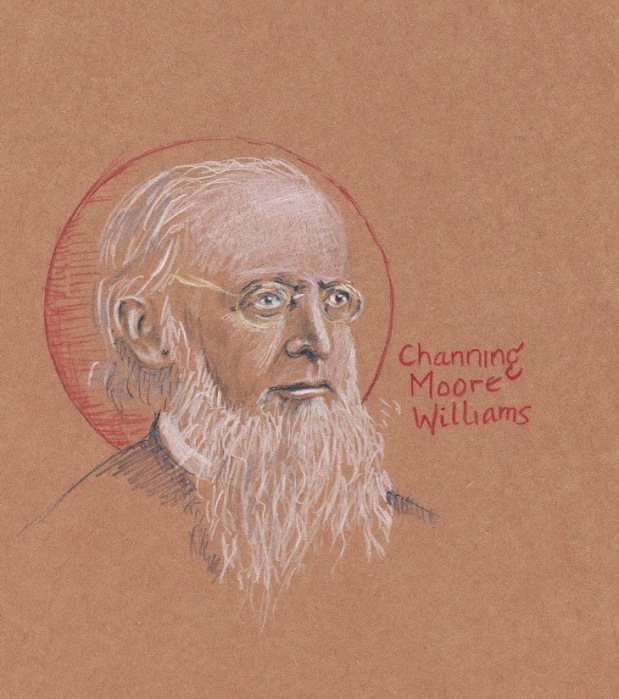
Channing Moore Williams


(17 July 1829 – 2 December 1910) was an Episcopalian missionary to China and Japan and later bishop. His saint's day on the Anglican calendar is 2 December.

Moore was born in Richmond, Virginia, and ordained a deacon in 1855. He was ordained a priest in China in 1857 and later posted to Nagasaki, Japan in 1857. In 1866, he was consecrated Bishop of China and Japan. He went to Tokyo in 1874 and founded St. Paul's University, today known as Rikkyo University in Tokyo.

In 1878 he united various national Anglican missionary efforts into the Nippon Sei Ko Kai, (i.e. the "Holy Catholic Church"), the branch of the Anglican church in Japan. He stayed on in Kyoto, Japan after a successor was appointed in 1893, returning to America only in 1908, two years before his death in Richmond in 1910.


Channing Moore Williams - 2 December - Missionary and Bishop

The Collect.

Almighty and everlasting God, we thank thee for thy servant Channing Moore Williams, whom thou didst call to preach the Gospel to the peoples of China and Japan. Raise up, we beseech thee, in this and every land heralds and evangelists of thy kingdom, that thy Church may proclaim the unsearchable riches of our Saviour Jesus Christ; who liveth and reigneth with thee and the Holy Ghost, one God, now and for ever. Amen.


The Epistle - Acts 1:1-9.

The former treatise have I made, O Theophilus, of all that Jesus began both to do and teach, Until the day in which he was taken up, after that he through the Holy Ghost had given commandments unto the apostles whom he had chosen: To whom also he shewed himself alive after his passion by many infallible proofs, being seen of them forty days, and speaking of the things pertaining to the kingdom of God: And, being assembled together with them, commanded them that they should not depart from Jerusalem, but wait for the promise of the Father, which, saith he, ye have heard of me. For John truly baptized with water; but ye shall be baptized with the Holy Ghost not many days hence. When they therefore were come together, they asked of him, saying, Lord, wilt thou at this time restore again the kingdom to Israel? And he said unto them, It is not for you to know the times or the seasons, which the Father hath put in his own power. But ye shall receive power, after that the Holy Ghost is come upon you: and ye shall be witnesses unto me both in Jerusalem, and in all Judaea, and in Samaria, and unto the uttermost part of the earth. And when he had spoken these things, while they beheld, he was taken up; and a cloud received him out of their sight.


The Gospel - St. Luke 10:1-9.

After these things the Lord appointed other seventy also, and sent them two and two before his face into every city and place, whither he himself would come. Therefore said he unto them, The harvest truly is great, but the labourers are few: pray ye therefore the Lord of the harvest, that he would send forth labourers into his harvest. Go your ways: behold, I send you forth as lambs among wolves. Carry neither purse, nor scrip, nor shoes: and salute no man by the way. And into whatsoever house ye enter, first say, Peace be to this house. And if the son of peace be there, your peace shall rest upon it: if not, it shall turn to you again. And in the same house remain, eating and drinking such things as they give: for the labourer is worthy of his hire. Go not from house to house. And into whatsoever city ye enter, and they receive you, eat such things as are set before you: And heal the sick that are therein, and say unto them, The kingdom of God is come nigh unto you.


Reference and Resources:

http://elvis.rowan.edu/~kilroy/JEK/12/02.html
http://en.wikipedia.org/wiki/Channing_Moore_Williams


+

Friday, April 9, 2021

William Law


born in 1686, became a Fellow of Emmanuel College, Cambridge in 1711, but in 1714, at the death of Queen Anne, he became a non-Juror: that is to say, he found himself unable to take the required oath of allegiance to the Hanoverian dynasty (who had replaced the Stuart dynasty) as the lawful rulers of the United Kingdom, and was accordingly ineligible to serve as a university teacher or parish minister.

He became for ten years a private tutor in the family of the historian Edward Gibbon (who, despite his generally cynical attitude toward all things Christian, invariably wrote of Law with respect and admiration), and then retired to his native King's Cliffe.

Forbidden the use of the pulpit and the lecture-hall, he preached through his books. These include Christian Perfection, The Spirit Of Love, The Spirit Of Prayer, and, best-known of all, A Serious Call To A Devout And Holy Life, published in 1728. The thesis of this last book is that God does not merely forgive our disobedience, he calls us to obedience, and to a life completely centered in Him. He says: "If you will here stop and ask yourself why you are not as pious as the primitive Christians were, your own heart will tell you that it is neither through ignorance nor inability, but because you never thoroughly intended it."


Propers for William Law - 9 April - Priest, Writer, and Non-Juror

The Collect

O God, by whose grace Thy servant William Law, enkindled with the fire of Thy love, became a burning and shining light in Thy Church: Grant that we also may be aflame with the spirit of love and discipline, and may ever walk before Thee as children of light; through Jesus Christ our Lord, who with Thee, in the unity of the Holy Ghost, liveth and reigneth, one God, now and for ever. Amen.


The Epistle - Philippians 3:7-14

The Holy Gospel - St. Matthew 6:1-6,16-21


Reference and Resources:

http://en.wikipedia.org/wiki/William_Law
http://www.io.com/~kellywp/LesserFF/Apr/Law.html
http://elvis.rowan.edu/~kilroy/JEK/04/09.html
Defence of Church Principles:Three Letters to the Bishop of Bangor, 1717-1719
An Appeal to All that Doubt...

†

Saturday, March 20, 2021

Thomas Ken

in the course of his lifetime was both rewarded and punished for his firm adherence to principle. He was born in 1637 and reared by his half-sister Anne and her husband the well-known angler Izaak Walton. He became a clergyman and served for a year at the Hague as chaplain to Mary, Princess of England and Queen of Holland, niece of King Charles II of England and wife of the Dutch King William of Orange. During this year he publicly rebuked King William for his treatment of his wife the said Mary, which may be why he was chaplain there for only a year.

Upon his return to England, he was made Royal Chaplain to King Charles. The King had a mistress, Nell Gwyn, and for his convenience wished to lodge her in his chaplain's residence. Thomas sent the King a sharp refusal, saying that it was not suitable that the Royal Chaplain should double as the Royal Pimp. Charles admired his honesty and bluntness, and when the bishopric of Bath and Wells became available soon after, he declared, "None shall have it but that little man who refused lodging to poor Nellie!" Ken was accordingly made a bishop. When Charles was on his deathbed, it was Ken whom he asked to be with him and prepare him for death.

Under the next king, James II, brother of Charles, matters were different. James converted to Roman Catholicism, the religion of his mother, and political turmoil followed. James issued a decree known as the Declaration of Indulgence, which decreed that various public offices formerly open only to Anglicans, should thereafter be open to all persons. It was feared that the King would appoint large numbers of Roman Catholics to positions of power, and eventually transfer to them the control of the government. When the King commanded the bishops to proclaim the Declaration of Indulgence, seven of them refused to do so and were by the King's command imprisoned in the Tower of London. The people of London rioted, and the bishops were freed and carried in triumph through the streets of the city. Soon after, Parliament offered the crown to the King's daughter Mary and her husband William of Orange (see above) and James fled into exile.

William and Mary naturally began their reign by demanding oaths of allegiance from all persons holding public positions, including the bishops. Thomas Ken and others (known as the Non-Jurors -- the older meaning of "juror" is "one who takes an oath," hence "perjurer" as "one who swears falsely") refused to take the oath, on the grounds that they had sworn allegiance to James, and could not during his lifetime swear allegiance to another monarch without making such oaths a mockery. They were accordingly put out of office.

Although Ken wrote much poetry, besides his hymns, he cannot be called a great poet; but he had that fine combination of spiritual insight and feeling with poetic taste which marks all great hymnwriters. As a hymnwriter he has had few equals in England; it can scarcely be said that even John Keble, though possessed of much rarer poetic gifts, surpassed him in his own sphere. In his own day he took high rank as a pulpit orator, and even royalty had to beg for a seat amongst his audiences; but his sermons are now forgotten. He lives in history, apart from his three hymns, mainly as a man of unstained purity and invincible fidelity, to conscience, weak only in a certain narrowness of view which is a frequent attribute of the intense character which he possessed. As an ecclesiastic he was a High Churchman of the old school.


Propers for Thomas Ken - 20 March - Bishop and Non-Juror


The Collect.

ALMIGHTY and everlasting God, we give thee thanks for the purity and strength with which thou didst endow thy servant Thomas Ken; and we pray that by thy grace we may have a like power to hallow and conform our souls and bodies, to the purpose of thy most holy will; through Jesus Christ our Lord. Amen.


The Epistle - Philippians 4:4-9.

Rejoice in the Lord always: and again I say, Rejoice. Let your moderation be known unto all men. The Lord is at hand. Be careful for nothing; but in every thing by prayer and supplication with thanksgiving let your requests be made known unto God. And the peace of God, which passeth all understanding, shall keep your hearts and minds through Christ Jesus. Finally, brethren, whatsoever things are true, whatsoever things are honest, whatsoever things are just, whatsoever things are pure, whatsoever things are lovely, whatsoever things are of good report; if there be any virtue, and if there be any praise, think on these things. Those things, which ye have both learned, and received, and heard, and seen in me, do: and the God of peace shall be with you.


The Gospel - St. Luke 6:17-23.

And he came down with them, and stood in the plain, and the company of his disciples, and a great multitude of people out of all Judaea and Jerusalem, and from the sea coast of Tyre and Sidon, which came to hear him, and to be healed of their diseases; And they that were vexed with unclean spirits: and they were healed. And the whole multitude sought to touch him: for there went virtue out of him, and healed them all. And he lifted up his eyes on his disciples, and said, Blessed be ye poor: for yours is the kingdom of God. Blessed are ye that hunger now: for ye shall be filled. Blessed are ye that weep now: for ye shall laugh. Blessed are ye, when men shall hate you, and when they shall separate you from their company, and shall reproach you, and cast out your name as evil, for the Son of man's sake. Rejoice ye in that day, and leap for joy: for, behold, your reward is great in heaven: for in the like manner did their fathers unto the prophets.


Reference and Resources:

http://en.wikipedia.org/wiki/Thomas_Ken
http://elvis.rowan.edu/~kilroy/JEK/03/21.html
http://ohioanglican.blogspot.com/2007/03/thomas-ken.html
http://ohioanglican.blogspot.com/2008/03/thomas-ken-bishop-and-non-juror.html

†

Tuesday, February 16, 2021

Janani Luwum


Janani Luwum was born in 1922. His father was a convert to Christianity. Janani was sent to school and eventually became a schoolteacher. In 1948 he was converted. He became very active in the East African revival movement, and became a lay reader, then a deacon, and then a priest in 1956. He was chosen to study for a year at St Augustine's College in Canterbury, England. He returned to Uganda, worked as a parish priest, and then taught at Buwalasi Theological College. He made a second visit to Britain to study at the London College of Divinity, returning to Uganda to become Principal of Buwalasi. In 1969 he was consecrated bishop of Northern Uganda.

The Church in Uganda began with the deaths of martyrs (see Martyrs of Uganda, 3 June 1886, and James Hannington and his Companions, Martyrs, 29 October 1885). Around 1900, Uganda became a British protectorate, with the chief of the Buganda tribe as nominal ruler, and with several other tribes included in the protectorate. In 1962 Uganda became an independent country within the British Commonwealth, with the Bugandan chief as president and Milton Obote, of the Lango tribe, as Prime Minister. In 1966, Obote took full control of the government. In 1971, he was overthrown by General ID Amin, Chief of Staff of the Armed Forces. Almost immediately, he began a policy of repression, arresting anyone suspected of not supporting him. Hundreds of soldiers from the Lango and Ashli tribes were shot down in their barracks. Amin ordered the expulsion of the Asian population of Uganda, about 55,000 persons, mostly small shopkeepers from India and Pakistan. Over the next few years, many Christians were killed for various offenses. A preacher who read over the radio a Psalm which mentioned Israel was shot for this in 1972.

Early in 1977, there was a small army rebellion that was put down with only seven men dead. However, Amin determined to stamp out all traces of dissent. His men killed thousands, including the entire population of Milton Obote's home village. On Sunday, 30 January, Bishop Festo Kivengere preached on "The Preciousness of Life" to an audience including many high government officials. He denounced the arbitrary bloodletting, and accused the government of abusing the authority that God had entrusted to it. The government responded on the following Saturday (5 February) by an early (1:30 am) raid on the home of the Archbishop, Janani Luwum, ostensibly to search for hidden stores of weapons. The Archbishop called on President Amin to deliver a note of protest at the policies of arbitrary killings and the unexplained disappearances of many persons. Amin accused the Archbishop of treason, produced a document supposedly by former President Obote attesting his guilt, and had the Archbishop and two Cabinet members (both committed Christians) arrested and held for military trial. The three met briefly with four other prisoners who were awaiting execution, and were permitted to pray with them briefly. Then the three were placed in a Land Rover and not seen alive again by their friends. The government story is that one of the prisoners tried to seize control of the vehicle and that it was wrecked and the passengers killed. The story believed by the Archbishop's supporters is that he refused to sign a confession, was beaten and otherwise abused, and finally shot. His body was placed in a sealed coffin and sent to his native village for burial there. However, the villagers opened the coffin and discovered the bullet holes. In the capital city of Kampala a crowd of about 4,500 gathered for a memorial service beside the grave that had been prepared for him next to that of the martyred bishop Hannington. In Nairobi, the capital of nearby Kenya, about 10,000 gathered for another memorial service. Bishop Kivengere was informed that he was about to be arrested, and he and his family fled to Kenya, as did the widow and orphans of Archbishop Luwum.

The following June, about 25,000 Ugandans came to the capital to celebrate the centennial of the first preaching of the Gospel in their country, among the participants were many who had abandoned Christianity, but who had returned to their Faith as a result of seeing the courage of Archbishop Luwum and his companions in the face of death.


Propers for Janani Luwum - 16 February - Archbishop, Confessor, and Martyr


The Collect.

Almighty God, by Whose providence the blood of the martyrs is the seed of the Church: Grant that we who remember before Thee blessed Janani, Archbishop and Martyr in Uganda, may, like him, be steadfast in our faith in Jesus Christ, to whom he gave obedience, even to death, and by his sacrifice brought forth a plentiful harvest; through Jesus Christ our Lord, who liveth and reigneth with Thee and the Holy Ghost, one God, for ever and ever. Amen.


The Epistle - Ecclesiasticus 4:20-28.

Observe the opportunity, and beware of evil; and be not ashamed when it concerneth thy soul.
For there is a shame that bringeth sin; and there is a shame which is glory and grace. Accept no person against thy soul, and let not the reverence of any man cause thee to fall. And refrain not to speak, when there is occasion to do good, and hide not thy wisdom in her beauty. For by speech wisdom shall be known: and learning by the word of the tongue. In no wise speak against the truth; but be abashed of the error of thine ignorance. Be not ashamed to confess thy sins; and force not the course of the river. Make not thyself an underling to a foolish man; neither accept the person of the mighty. Strive for the truth unto death, and the Lord shall fight for thee.

The Gospel - St. John 12: 24-32.

Verily, verily, I say unto you, Except a corn of wheat fall into the ground and die, it abideth alone: but if it die, it bringeth forth much fruit. He that loveth his life shall lose it; and he that hateth his life in this world shall keep it unto life eternal. If any man serve me, let him follow me; and where I am, there shall also my servant be: if any man serve me, him will my Father honour. Now is my soul troubled; and what shall I say? Father, save me from this hour: but for this cause came I unto this hour. Father, glorify thy name. Then came there a voice from heaven, saying, I have both glorified it, and will glorify it again. The people therefore, that stood by, and heard it, said that it thundered: others said, An angel spake to him. Jesus answered and said, This voice came not because of me, but for your sakes. Now is the judgment of this world: now shall the prince of this world be cast out. And I, if I be lifted up from the earth, will draw all men unto me.

Reference and Resources:

http://www.jananiluwumtrust.com/luwum.html
http://en.wikipedia.org/wiki/Janani_Luwum
http://satucket.com/lectionary/janani_luwum.htm

†

Friday, January 29, 2021

Charles Frederick Frazier Mackenzie

(1825–62) was a Church of England bishop of Central Africa. He is commemorated in some Anglican Church Calendars.

He was born at Portmore, Peeblesshire, Scotland, the ninth son of Colin Mackenzie and Elizabeth Forbes. Anne Mackenzie, editor of all 31 years of The Net Cast in Many Waters: Sketches from the Life of Missionaries, London, 1866–1896, was his unmarried sister. He was educated at Bishop Wearmouth school and Edinburgh Academy, and entered St John's College, Cambridge in 1844. He migrated to Caius College, where he graduated B. A. as Second Wrangler in 1848, and became a Fellow of Caius. In 1855, he went to Natal with Bishop Colenso and served as Archdeacon in the area which now partly falls under All Souls Umhlali. They worked among the English settlers till 1859. In 1860, Mackenzie became head of the Universities' Mission to Central Africa and he was consecrated bishop in St George's Cathedral, Cape Town, on 1 January 1861. Following Dr David Livingstone's request to Cambridge, Bishop Mackenzie took on the position of being the first missionary bishop in Nyasaland (now Malawi).

Moving from Cape Town, Bishop Mackenzie sailed up the Zambezi and Shire rivers with a small group to start work. He arrived at Chibisa’s village in June 1861 with the goal to establish a mission station at Magomero, near Zomba. He directly opposed the slave trade causing the enmity of the Yao. Bishop Mackenzie worked among the people of the Manganja country until January 1862 when he went on a supplies trip together with a few members of his party. The boat they were travelling on sank and as their medical supplies were lost, Bishop Mackenzie’s malaria could not be treated. He died of Blackwater fever on 31 January 1862. Dr Livingstone erected a cross over his grave.


Propers for Charles Mackenzie - 29 January - Missionary and Bishop


Almighty and Everlasting God, we thank thee for thy servant, Charles Frederick Frazier Mackenzie whom thou didst call to preach the Gospel to the people of Malawi. Raise up, we beseech thee, in this and every land evangelists and heralds of thy kingdom, that thy Church may proclaim the unsearchable riches of our Saviour Jesus Christ; who liveth and reigneth with thee and the Holy Ghost, one God, now and for ever. Amen.


The Lesson - Acts 1:1-9.


The Holy Gospel - St. Luke 10:1-9.


+

Friday, January 15, 2021

John Cosin

(30 November 1594 – 15 January 1672)

He was born at Norwich, and was educated at Norwich grammar school and at Caius College, Cambridge, where he was scholar and afterwards fellow. On taking orders he was appointed secretary to Bishop Overall of Lichfield, and then domestic chaplain to Richard Neile, Bishop of Durham. In December 1624 he was made a prebendary of Durham, and in the following year archdeacon of the East Riding of Yorkshire.

In 1628 he took his degree of D.D. He first became known as an author in 1627, when he published his Collection of Private Devotions, a manual stated to have been prepared by command of King Charles I, for the use of Queen Henrietta Maria's maids of honour. This book, together with his insistence on points of ritual in his cathedral church and his friendship with William Laud, exposed Cosin to the hostility of the Puritans; and the book was criticised by William Prynne and Henry Burton. In 1628 Cosin took part in the prosecution of a brother prebendary, Peter Smart, for a sermon against high church practices; and the prebendary was deprived.

On 8 February 1635 Cosin was appointed master of Peterhouse, Cambridge; and in 1640 he became Vice-Chancellor of the University. In October of this year he was promoted to the deanery of Peterborough. A few days before his installation the Long Parliament had met; and among the complainants who hastened to appeal to it for redress was the ex-prebendary, Smart. His petition against the new dean was considered; and early in 1641 Cosin was sequestered from his benefices. Articles of impeachment were presented against him two months later, but he was dismissed on bail. For sending the university plate to the king, he was deprived of the mastership of Peterhouse (13 March 1643).[2] He went to France, preached at Paris, and served as chaplain to some members of the household of the exiled royal family. At the Restoration he returned to England, was reinstated in the mastership (3 August 1660), restored to all his benefices, and in a few months raised to the see of Durham (December 1660) – he therefore resigned from the Mastership of Peterhouse on 18 October 1660.

Cosin was responsible for a style of church woodwork unique to County Durham, a sumptuous fusion of gothic and contemporary Jacobean forms. The font cover in Durham Cathedral is a splendid example of this, as are the displays in the churches at Sedgefield and elsewhere. The Cosin woodwork at Brancepeth has sadly been destroyed by fire.

At the convocation in 1661 Cosin played a prominent part in the revision of the prayer-book, and endeavoured with some success to bring both prayers and rubrics into better agreement with ancient liturgies. He administered his diocese successfully for eleven years; and used a large share of his revenues to promote the interests of the Church, of schools and of charitable institutions. He died in London.


Propers for John Cosin - 15 January - Bishop and Divine

The Collect.

O Almighty God, who hast compassed us about with so great a cloud of witnesses: Grant that we, encouraged by the good example of thy servant John Cosin , may persevere in running the race that is set before us, until at length, through thy mercy, we may with him attain to thine eternal joy; through Jesus Christ, the author and perfecter of our faith, who liveth and reigneth with thee and the Holy Ghost, one God, for ever and ever. Amen.


The Lesson - Micah 6:6-8.


The Gospel - St. Matthew 25:31-40.


Reference and Resources:

http://books.google.com/books/about/A_collection_of_private_devotions_for_th.html?id=UVkNAAAAYAAJ
http://anglicanhistory.org/england/cosin/aquilina_eucharistic.pdf
http://en.wikipedia.org/wiki/John_Cosin


†

Saturday, January 2, 2021

Vedanayagam Samuel Azariah

was born in 1874 in India, in the village of Vellalan Vilai, Thoothukudi District, now in Tamil Nadu. He was the son of a Christian (Anglican) presbyter, Thomas Vedanayagam, and his wife Ellen. He was educated at Christian missionary schools and at Madras Christian College.

In 1893, at the age of nineteen, he became an evangelist in the Young Men's Christian Association (YMCA), and was secretary of the YMCA in south India from 1895 to 1909. He already saw the importance of indigenization in the Christian mission, and In 1903 he helped form the Indian Missionary Society (based in Tinnevelly) and in December 1905 he was one of the founders of the National Missionary Society. For many years he served as chairman of the National Christian Council.

In 1909 he left the YMCA, to be ordained to the Anglican presbyterate. He spoke on the need for indigenisation, at the 1910 World Missionary Conference at Edinburgh; and in December 1912 he was himself ordained as the first bishop of the Anglican diocese of Dornakal in Andhra Pradesh - the first Indian Anglican bishop in India. As bishop he ordained many Indians to the presbyterate, and in 1936 he consecrated the new cathedral of the Epiphany in Dornakal, built in Indian architectural style.

Azariah saw that the mission of the Church should be an expression of its unity, and he took a leading role in negotiations for Church reunion in India. These resulted in the inauguration of the Church of South India in 1947, two years after his death.

With Bishop Henry Whitehead Bishop Vedanayagam wrote Christ in the Indian Villages (1930). In 1936 was published his India and the Christian movement. His book, Christian Giving (1954), was translated into several languages. He also wrote articles on Christian mission, such as 'The Necessity of Christian Unity for the missionary enterprise of the world' and 'The Expansion of Christianity'.

Bishop Vedanayagam died on 1 January 1945.


Vedanayagam Samuel Azariah - 2 January - Evangelist, Missionary, and Bishop.

The Collect.


Almighty and Everlasting God, we thank thee for thy servant Vedanayagam Samuel Azariah, whom thou didst call to preach the Gospel to the people of India. Raise up, we beseech thee, in this and every land evangelists and heralds of thy kingdom, that thy Church may proclaim the unsearchable riches of our Saviour Jesus Christ; who liveth and reigneth with thee and the Holy Ghost, one God, now and for ever. Amen.


The Lesson - Acts 1:1-9


The Holy Gospel - St. Luke 10:1-9


+

Wednesday, December 2, 2020

Channing Moore Williams


(17 July 1829 – 2 December 1910) was an Episcopalian missionary to China and Japan and later bishop. His saint's day on the Anglican calendar is 2 December.

Moore was born in Richmond, Virginia, and ordained a deacon in 1855. He was ordained a priest in China in 1857 and later posted to Nagasaki, Japan in 1857. In 1866, he was consecrated Bishop of China and Japan. He went to Tokyo in 1874 and founded St. Paul's University, today known as Rikkyo University in Tokyo.

In 1878 he united various national Anglican missionary efforts into the Nippon Sei Ko Kai, (i.e. the "Holy Catholic Church"), the branch of the Anglican church in Japan. He stayed on in Kyoto, Japan after a successor was appointed in 1893, returning to America only in 1908, two years before his death in Richmond in 1910.


Channing Moore Williams - 2 December - Missionary and Bishop

The Collect.

Almighty and everlasting God, we thank thee for thy servant Channing Moore Williams, whom thou didst call to preach the Gospel to the peoples of China and Japan. Raise up, we beseech thee, in this and every land heralds and evangelists of thy kingdom, that thy Church may proclaim the unsearchable riches of our Saviour Jesus Christ; who liveth and reigneth with thee and the Holy Ghost, one God, now and for ever. Amen.


The Epistle - Acts 1:1-9.

The former treatise have I made, O Theophilus, of all that Jesus began both to do and teach, Until the day in which he was taken up, after that he through the Holy Ghost had given commandments unto the apostles whom he had chosen: To whom also he shewed himself alive after his passion by many infallible proofs, being seen of them forty days, and speaking of the things pertaining to the kingdom of God: And, being assembled together with them, commanded them that they should not depart from Jerusalem, but wait for the promise of the Father, which, saith he, ye have heard of me. For John truly baptized with water; but ye shall be baptized with the Holy Ghost not many days hence. When they therefore were come together, they asked of him, saying, Lord, wilt thou at this time restore again the kingdom to Israel? And he said unto them, It is not for you to know the times or the seasons, which the Father hath put in his own power. But ye shall receive power, after that the Holy Ghost is come upon you: and ye shall be witnesses unto me both in Jerusalem, and in all Judaea, and in Samaria, and unto the uttermost part of the earth. And when he had spoken these things, while they beheld, he was taken up; and a cloud received him out of their sight.


The Gospel - St. Luke 10:1-9.

After these things the Lord appointed other seventy also, and sent them two and two before his face into every city and place, whither he himself would come. Therefore said he unto them, The harvest truly is great, but the labourers are few: pray ye therefore the Lord of the harvest, that he would send forth labourers into his harvest. Go your ways: behold, I send you forth as lambs among wolves. Carry neither purse, nor scrip, nor shoes: and salute no man by the way. And into whatsoever house ye enter, first say, Peace be to this house. And if the son of peace be there, your peace shall rest upon it: if not, it shall turn to you again. And in the same house remain, eating and drinking such things as they give: for the labourer is worthy of his hire. Go not from house to house. And into whatsoever city ye enter, and they receive you, eat such things as are set before you: And heal the sick that are therein, and say unto them, The kingdom of God is come nigh unto you.


Reference and Resources:

http://elvis.rowan.edu/~kilroy/JEK/12/02.html
http://en.wikipedia.org/wiki/Channing_Moore_Williams


+

Sunday, November 22, 2020

C.S. Lewis

Clive Staples Lewis ("Jack" Lewis to his friends) was a tutor and lecturer at Oxford University, and later Professor of Medieval and Renaissance English Literature at Cambridge University. In the judgment of many, he is the most popular and most effective explainer and defender of the Christian faith writing in English in the 20th century. He tried to make a point of avoiding disputes on matters where Christians disagree, and defending those beliefs which they hold in common. His work was valued by many Christians of widely differing backgrounds: Anglican, Baptist, Methodist, Pentecostal, Presbyterian, Roman Catholic, etc.

Lewis was a close friend of J. R. R. Tolkien, the author of The Lord of the Rings. Both authors were leading figures in the English faculty at Oxford University and in the informal Oxford literary group known as the "Inklings". According to his memoir Surprised by Joy, Lewis had been baptized in the Church of Ireland at birth, but fell away from his faith during his adolescence. Owing to the influence of Tolkien and other friends, at about the age of 30, Lewis re-converted to Christianity, becoming "a very ordinary layman of the Church of England" (Lewis 1952, p. 6). His conversion had a profound effect on his work, and his wartime radio broadcasts on the subject of Christianity brought him wide acclaim. Later in life he married the American writer Joy Gresham, who died of bone cancer four years later at the age of 45.

In early June 1961, Lewis began experiencing medical problems and was diagnosed with inflammation of the kidneys which resulted in blood poisoning. His illness caused him to miss the autumn term at Cambridge, though his health gradually began improving in 1962 and he returned that April. Lewis's health continued to improve, and according to his friend George Sayer, Lewis was fully himself by the spring of 1963. However, on July 15, 1963 he fell ill and was admitted to hospital. The next day at 5:00 pm, Lewis suffered a heart attack and lapsed into a coma, unexpectedly awaking the following day at 2:00 pm. After he was discharged from hospital, Lewis returned to the Kilns though he was too ill to return to work. As a result, he resigned from his post at Cambridge in August. Lewis's condition continued to decline and in mid-November, he was diagnosed with end stage renal failure. On November 22, 1963, Lewis collapsed in his bedroom at 5:30 pm and died a few minutes later, exactly one week before what would have been his 65th birthday. He is buried in the churchyard of Holy Trinity Church, Headington, Oxford.


Prayer:

Almighty God, whose servant C.S. Lewis received of Thy grace singular gifts of insight in understanding the truth in Christ Jesus, and of eloquence and clarity in presenting that truth to his readers: Raise up in our day faithful interpreters of Thy Word, that we, being set free from all error and unbelief, may come to the knowledge that maketh us wise unto salvation: through Jesus Christ Thy Son our Lord, who liveth and reigneth with Thee and the Holy Ghost, one God, now and for ever. Amen.


Reference and Resources:

http://elvis.rowan.edu/~kilroy/JEK/11/22.html
http://en.wikipedia.org/wiki/C.S._Lewis

†

Saturday, October 17, 2020

Henry Martyn


(18 February 1781 – 16 October 1812) was an Anglican priest and missionary to the peoples of India and Persia. Born in Truro, Cornwall, he was educated at Truro Grammar School and St John's College, Cambridge. A chance encounter with Charles Simeon led him to become a missionary. He was ordained a priest in the Church of England and became a chaplain for the British East India Company.


Martyn arrived in India in April 1806, where he preached and occupied himself in the study of linguistics. He translated the whole of the New Testament into Urdu, Persian and Judaeo-Persic. He also translated the Psalms into Persian and the Book of Common Prayer into Urdu. From India, he set out for Bushire, Shiraz, Isfahan, and Tabriz.

Martyn was seized with fever, and, though the plague was raging at Tokat, he was forced to stop there, unable to continue. On 16 October 1812 he died. He was remembered for his courage, selflessness and his religious devotion. In parts of the Anglican Communion he is celebrated with a Lesser Festival on 19 October.


Henry Martin - Missionary, Priest, and Translator - 17 October

The Collect.

O God of the nations, who didst give to thy faithful servant Henry Martyn a brilliant mind, a loving heart, and a gift for languages, that he might translate the Scriptures and other holy writings for the peoples of India and Persia: Inspire in us, we beseech thee, a love like his, eager to commit both life and talents to thee who gavest them; through Jesus Christ our Lord, who liveth and reigneth with thee and the Holy Ghost, one God, for ever and ever. Amen.


The Lesson - Isaiah 49:1-6


The Gospel - St. John 4:22-26


Reference and Resources:

http://www.ttstm.com/2011/10/october-20-henry-martyn-missionary.html
http://justus.anglican.org/resources/bio/273.html
http://en.wikipedia.org/wiki/Henry_Martyn

+

Wednesday, October 14, 2020

Samuel Isaac Joseph Schereschewsky


Schereschewsky was born in Tauroggen, Russian Lithuania 6 May 1831. He appears to have been named for his father. His mother was Rosa Salvatha. Orphaned as a young boy, it is speculated he was raised by a half-brother who was a timber merchant in good circumstance. Having shown himself to be a promising student, he was given the best education available and it was his family's intention that he become a rabbi.

At age 15 he entered The Rabbinical School at Zhitomir and was responsible for supporting himself working as a tutor and a glazier. While at the school he came into possession of a Hebrew translation of the New Testament which had been left by English missionaries to the Jews that were operating in the Zhitomir area. It was in his study of the New Testament that Samuel began to see the messianic prophecies of the Jews had been met in the person of Jesus Christ.

By the time he was 19 (1850), Schereschewsky found himself caught in a struggle of religious identity and moved to the German states to further his learning and to sort thing out and added German to the growing list of languages he had mastered (Hebrew, Yiddish, Polish, Lithuanian and Russian)

In 1854 Schereschewsky emigrated to the United States and it was in New York he made company with Christian Jews, but did not enter the Christian faith until the next spring (1855). He was Baptized in a Baptist congregation but then left for Presbyterianism and studying at the Western Theological Seminary after two years (1857) he left for the the Episcopal Church and the General Theological Seminary and had added English to his mastered tongues.

In 1859 Schereschewsky volunteered for missionary work in China and won an appointment to the Shanghai mission and was Ordained to the Diaconate 17 July 1859. Schereschewsky sailed for China, learning Shanghainese dialect of Chinese on the voyage, he arrived at Wusung on 21 December 1859.

On 28 October 1860 Schereschewsky was Ordained to the Priesthood in his mission school chapel later designated as the Church of Our Saviour by Bishop William Jones Boone of Shanghai. While serving as a Priest, Schereschewsky worked with his talent for languages, translating the Psalms into Shanghainese.

In 1877 Schereschewsky was elected Bishop of Shanghai and founded St. John's University to help educate and win converts among the local Chinese. He also began his next project of translating the Bible into the Wenli dialect of Chinese. Schereschewsky served as Bishop until 1884 as illness had slowed his work and eventually confined him to a wheelchair.

Bishop Schereschewsky moved to Tokyo, Japan with his wife to continue his work of learning languages and then translating the Bible and Book of Common Prayer into his newly learned tongues, including Mandarin, Wenli, Shanghainese and Mongolian and by my estimation he had learned and mastered at least thirteen languages - Hebrew, Yiddish, Polish, Lithuanian, Russian, German, English, Shanghainese, Mandarin, Wenli, Mongolian and Japanese.

Samuel Isaac Joseph Schereschewsky passed to the eternal life 15 October 1906 and is buried in the Aoyama Cemetery in Tokyo, next to his wife, who supported him constantly during his labors and illness. Four years before his death, he said, “I have sat in this chair for over twenty years. It seemed very hard at first. But God knew best. He kept me for the work for which I am best fitted.”

Samuel Isaac Joseph Schereschewsky - 14 October - Missionary, Translator and Bishop

The Collect.

O God, who in thy providence didst call Joseph Schereschewsky from his home in Eastern Europe to the ministry of this Church, and didst send him as a missionary to China, upholding him in his infirmity, that he might translate the Holy Scriptures into languages of that land: Lead us, we pray thee, to commit our lives and talents to thee, in the confidence that when thou givest unto thy servants any work to do, thou dost also supply the strength to do it; through Jesus Christ our Lord, who liveth and reigneth with thee and the Holy Ghost, one God, for ever and ever. Amen.


The Epsitle - 2 Corinthians 4:11-18


The Gospel - St. Luke 24:44-48


Reference and Resources:

http://en.wikipedia.org/wiki/Samuel_Isaac_Joseph_Schereschewsky
http://www.ttstm.com/2009/10/october-14-samuel-isaac-joseph.html
http://elvis.rowan.edu/~kilroy/JEK/10/14.html
http://anglicangradual.stsams.org/FTP/MSWord/2723-SIJSchereschewsky.doc

†

Thursday, September 24, 2020

Our Lady of Walsingham


In A.D. 1061 a vision of the Blessed Virgin Mary appeared to Richeldis de Faverches, a devout Saxon noblewoman. In the vision Lady Richeldis was shown the house in which Mary received the Annunciation from the Archangel Gabriel, Mary asked Lady Richeldis to build an exact replica of the house in Walsingham.

The de Faverches family had the Holy House built with provisions for it's upkeep and the building of a priory next to it. The Chapel and priory came under the care of the Augustinian Canons in the mid-12th century. The chapel became a destination for pilgrims from all over England, eventually winning Royal patronage and Royal pilgrims. The fame and wealth of the site grew to immense proportions, that it was a target of thieves from without and embezzlers from within.

In A.D. 1538, one of the chapel's greatest patrons became it's nemesis when King Henry VIII ordered the confiscation of the site's wealth along with the destruction of chapel and priory, even though two years before the Prior had accepted the King's supremacy as head of the Church of England, it would not save them. The sub-prior was executed and eleven other men from the area that complained as to the sites fate were also executed.

In the early 20th century Walsingham once again became a destination for pilgrims, Anglican, Roman, and Orthodox. In 1897 Pope Leo XIII re-established a restored Slipper Chapel as a Roman Catholic Shrine and in 1921 Fr. A.H. Patten, the CofE Vicar for Walsingham sparked Anglican interest in the pre-Reformation pilgrimage. Since then Walsingham has become a centre for ecumenical co-operation, with pilgrims from different denominations making the pilgrimage to both the Roman and Anglican shrines.


Propers for the Feast of Our Lady of Walsingham - 24 September

The Collect.

Almighty God, Father of our Lord Jesus Christ, who hast revealed the beauty of thy power by exalting the lowly virgin of Nazareth and making her the mother of our Saviour: May the prayers of Our Lady of Walsingham bring Jesus to the waiting world and fill the hearts of all thy people with the presence of her child, who liveth and reigneth with thee and Holy Ghost, one God, for ever and ever. Amen.

The Lesson - Isaiah 7:10-16.


The Gospel - St. Luke 1:26-38


Reference and Resources:

http://www.comeandseeicons.com/bvm/hsw01.htm
http://en.wikipedia.org/wiki/Our_Lady_of_Walsingham
http://www.walsinghamanglican.org.uk/welcome/index.htm
http://www.walsingham.org.uk/romancatholic/
http://www.jchristmas.fsnet.co.uk/orthodox.htm
http://www.geocities.com/athens/forum/4752/Walsingham.html
The Orthodox Christian Society of Our Lady of Walsingham
http://www.spartacus.schoolnet.co.uk/NORwalsinghamS.htm
http://a-c-ruminations.blogspot.com/2005/11/our-lady-of-walsingham.html
http://anglicanwanderings.blogspot.com/2009/06/walsingham-wanderings.html
http://ohioanglican.blogspot.com/2007/03/our-lady-of-walsingham.html

†

Sunday, September 20, 2020

John Coleridge Patteson


(1 April 1827 – 20 September 1871) was an Anglican bishop and martyr.

Patteson was educated at The King's School, Ottery St Mary, Eton and then Balliol College, Oxford. He was ordained in 1853 in the Church of England. His old tutor at Eton, George Augustus Selwyn, was the first Bishop of New Zealand, and he persuaded Patteson to become a missionary to the South Seas.

In 1855 Patteson set out to found the Melanesian Mission. He founded a college on Norfolk Island for native boys, toured the islands on the ship Southern Cross, and learned many of the local languages. In 1861 he was made Bishop of Melanesia.

Patteson's aim was to take boys from local communities, educate them in western Christian culture and return them to their communities. Persuading local people to allow their young men to depart – sometimes for years – was his principal problem.

On 20 September 1871 he was murdered on the island of Nukapu in the Solomon Islands, where he had landed alone. The explanation of his death at the time was that natives killed him as revenge for the abduction of some natives by illegal labour recruiters months earlier. These recruiters, known as "blackbirders", were considered to be virtually slave traders by members of the mission, as they enticed or abducted youths to work on plantations.

His death became a cause celebre in England and increased interest both in missionary work and in improvement of the working conditions in Melanesia. His life is celebrated in the Church of England as a saintly one, and he is commemorated with a Lesser Festival on 20 September. There is a memorial to him in the chapel of Merton College, Oxford by Thomas Woolner, which depicts his portrait surrounded by fronds, beneath which he is shown lying in the canoe, as described above


John Coleridge Patteson - 20 September - Bishop and Martyr

The Collect.

Almighty God, who didst call thy faithful servants John Coleridge Patteson and his companions to be witnesses and martyrs in the islands of Melanesia, and by their labours and sufferings didst raise up a people for thine own possession: Pour forth thy Holy Spirit upon thy Church in every land, that by the service and sacrifice of many, thy holy Name may be glorified and thy kingdom enlarged; through Jesus Christ our Lord, who liveth and reigneth with thee and the Holy Ghost, one God, for ever and ever. Amen.


The Epistle - 1 Peter 4:12-19.


The Gospel - St. Mark 8:34-38.


Reference and Resources:

http://en.wikipedia.org/wiki/John_Patteson_(bishop)
http://www.janeresture.com/patteson/index.htm

†

Saturday, September 12, 2020

John Henry Hobart

(September 14, 1775 – September 12, 1830) was the third Episcopal bishop of New York (1816–1830).

He vigorously promoted the extension of the Episcopal Church in Central and Western New York. He founded the General Theological Seminary in New York City and Geneva College, later renamed after him, in Geneva, in the Finger Lakes area of upstate New York.


John Henry Hobart - 12 September - Bishop and Theologian


The Collect.

O GOD, who dost ever hallow and protect thy Church: Raise up therein through thy Spirit good and faithful stewards of the mysteries of Christ, as thou didst in thy servant John Henry Hobart; that by their ministry and example thy people may abide in thy favour and walk in the way of truth; through Jesus Christ our Lord who liveth and reigneth with thee in the unity of the same Spirit ever, one God, world without end. Amen.


The Epistle - Hebrews 12: 1-2.


The Gospel - St. Matthew 25:31-40.


Reference and Resources:

http://en.wikipedia.org/wiki/John_Henry_Hobart
http://anglicanhistory.org/usa/jhhobart/index.html

†

Thursday, June 18, 2020

Bernard Mizeki


Bernard Mizeki was born in Portuguese East Africa (Mozambique) in about 1861. When he was twelve or a little older, he left his home and went to Capetown, South Africa, where for the next ten years he worked as a laborer, living in the slums of Capetown, but (perceiving the disastrous effects of drunkenness on many workers in the slums) firmly refusing to drink alcohol, and remaining largely uncorrupted by his surroundings. After his day's work, he attended night classes at an Anglican school. Under the influence of his teachers, from the Society of Saint John the Evangelist (SSJE, an Anglican religious order for men, popularly called the Cowley Fathers), he became a Christian and was baptized on 9 March 1886. Besides the fundamentals of European schooling, he mastered English, French, high Dutch, and at least eight local African languages. In time he would be an invaluable assistant when the Anglican church began translating its sacred texts into African languages.

After graduating from the school, he accompanied Bishop Knight-Bruce to Mashonaland, a tribal area in Southern Rhodesia (now Zimbabwe), to work there as a lay catechist. In 1891 the bishop assigned him to Nhowe, the village of paramount-chief Mangwende, and there he built a mission-complex. He prayed the Anglican hours each day, tended his subsistence garden, studied the local language (which he mastered better than any other foreigner in his day), and cultivated friendships with the villagers. He eventually opened a school, and won the hearts of many of the Mashona through his love for their children.

He moved his mission complex up onto a nearby plateau, next to a grove of trees sacred to the ancestral spirits of the Mashona. Although he had the chief's permission, he angered the local religious leaders when he cut some of the trees down and carved crosses into others. Although he opposed some local traditional religious customs, Bernard was very attentive to the nuances of the Shona Spirit religion. He developed an approach that built on people's already monotheistic faith in one God, Mwari, and on their sensitivity to spirit life, while at the same time he forthrightly proclaimed the Christ. Over the next five years (1891-1896), the mission at Nhowe produced an abundance of converts.

Many black African nationalists regarded all missionaries as working for the European colonial governments. During an uprising in 1896, Bernard was warned to flee. He refused, since he did not regard himself as working for anyone but Christ, and he would not desert his converts or his post. On 18 June 1896, he was fatally speared outside his hut. His wife and a helper went to get food and blankets for him. They later reported that, from a distance, they saw a blinding light on the hillside where he had been lying, and heard a rushing sound, as though of many wings. When they returned to the spot his body had disappeared. The place of his death has become a focus of great devotion for Anglicans and other Christians, and one of the greatest of all Christian festivals in Africa takes place there every year around the feast day that marks the anniversary of his martyrdom, June 18.


Bernard Mizeki - 18 June - Catechist, Missionary, and Martyr

The Collect.


Almighty and everlasting God, who didst enkindle the flame of thy love in the heart of thy holy martyr Bernard Mizeki: Grant to us, thy humble servants, a like faith and power of love, that we who rejoice in his triumph may profit by his example; through Jesus Christ our Lord, who liveth and reigneth with thee and the Holy Ghost, one God, for ever and ever. Amen


The Epistle - Revelation 7:13-17.


The Gospel - St Luke 12:2-12.


Reference and Resources:

http://elvis.rowan.edu/~kilroy/JEK/06/18.html
http://chi.gospelcom.net/DAILYF/2003/06/daily-06-18-2003.shtml
http://en.wikipedia.org/wiki/Bernard_Mizeki

†

Tuesday, June 16, 2020

Joseph Butler


 (18 May 1692 O.S. – 16 June 1752) was an English bishop, theologian, apologist, and philosopher. He was born in Wantage in the English county of Berkshire (now Oxfordshire). He is known, among other things, for his critique of Thomas Hobbes's egoism and John Locke's theory of personal identity. During his life and after his death, Butler influenced many philosophers, including David Hume, Thomas Reid, and Adam Smith.

The son of a Presbyterian linen-draper, he was destined for the ministry of that church, and—along with future archbishop Thomas Secker—entered Samuel Jones's dissenting academy at Gloucester (later Tewkesbury) for that purpose. Whilst there, he entered into a secret correspondence with the conformist controversialist Samuel Clarke; his letters were taken to Gloucester post office by Secker, who also collected Clarke's responses from there. Clarke later published this correspondence. In 1714, Butler decided to enter the Church of England, and went to Oriel College, Oxford. After holding various other high positions, he became rector of the rich living of Stanhope.

In 1736 he was made the head chaplain of King George II's wife Caroline, on the advice of Lancelot Blackburne. In 1738 he was appointed bishop of Bristol. He is said (apocryphally) to have declined an offer to become the archbishop of Canterbury in 1747. He became Bishop of Durham in 1750.

He is most famous for his Fifteen Sermons Preached at the Rolls Chapel (1726) and Analogy of Religion, Natural and Revealed (1736). The Analogy is an important work of Christian apologetics in the history of the controversies over deism. Butler's apologetic concentrated on "the general analogy between the principles of divine government, as set forth by the biblical revelation, and those observable in the course of nature, [an analogy which] leads us to the warrantable conclusion that there is one Author of both." Butler's arguments combined a cumulative case for faith using probabilistic reasoning to persuade deists and others to reconsider orthodox faith. Aspects of his apologetic reasoning are reflected in the writings of twentieth century Christian apologists such as C. S. Lewis and John Warwick Montgomery. Overall, his two books are remarkable and original contributions to ethics and theology. They depend for their effect entirely upon the force of their reasoning, for they have no graces of style.

The "Sermons on Human Nature" is commonly studied as an answer to Hobbes' philosophy of ethical egoism. These two books are considered by his followers to be among the most powerful and original contributions to ethics, apologetics and theology which have ever been made.

Today, he is commonly cited for the blunt epigram, "Every thing is what it is, and not another thing."
Butler died in 1752 at Rosewell House, Kingsmead Square in Bath, Somerset. His admirers praise him as an excellent man, and a diligent and conscientious churchman. Though indifferent to general literature, he had some taste in the fine arts, especially architecture.


Joseph Butler - 16 June - Apologist, Bishop, Philosopher and Theologian

The Collect.

O God, who by thy Holy Spirit giveth to some the word of wisdom, to others the word of knowledge, and to others the word of faith: We praise thy Name for the gifts of grace manifested in thy servant Joseph Butler, and we pray that thy Church may never be destitute of such gifts; through Jesus Christ our Lord, who with thee and the Holy Ghost liveth and reigneth, one God, for ever and ever. Amen.


The Lesson - Acts 13:38-44

Be it known unto you therefore, men and brethren, that through this man is preached unto you the forgiveness of sins: And by him all that believe are justified from all things, from which ye could not be justified by the law of Moses. Beware therefore, lest that come upon you, which is spoken of in the prophets; Behold, ye despisers, and wonder, and perish: for I work a work in your days, a work which ye shall in no wise believe, though a man declare it unto you. And when the Jews were gone out of the synagogue, the Gentiles besought that these words might be preached to them the next sabbath. Now when the congregation was broken up, many of the Jews and religious proselytes followed Paul and Barnabas: who, speaking to them, persuaded them to continue in the grace of God. And the next sabbath day came almost the whole city together to hear the word of God.


The Gospel - St. John 3:11-16


Verily, verily, I say unto thee, We speak that we do know, and testify that we have seen; and ye receive not our witness. If I have told you earthly things, and ye believe not, how shall ye believe, if I tell you of heavenly things? And no man hath ascended up to heaven, but he that came down from heaven, even the Son of man which is in heaven. And as Moses lifted up the serpent in the wilderness, even so must the Son of man be lifted up: That whosoever believeth in him should not perish, but have eternal life. For God so loved the world, that he gave his only begotten Son, that whosoever believeth in him should not perish, but have everlasting life.


Reference and Resources:

http://www.missionstclare.com/english/people/jun16.html
http://en.wikipedia.org/wiki/Joseph_Butler

†

Wednesday, June 10, 2020

The First Book of Common Prayer


In 1549, under the reign of Edward VI, successor to Henry VIII, the primary language of public worship in England and other areas ruled by Edward was changed from Latin to English, and the first Book of Common Prayer came into use. It was first used on Pentecost Sunday, 9 June 1549, and the occasion is now commemorated "on the first convenient day following Pentecost." The Book was the work of a commission of scholars, but primarily of Thomas Cranmer, Archbishop of Canterbury. It was based primarily upon the Latin worship tradition of the Use of Sarum (similar to, but not identical with, the Roman rite used by most Roman Catholic between 1600 and 1950), with some elements taken from the Greek liturgies of the Eastern Church, from ancient Gallican (French) rites, from the new Lutheran order of service, and from the Latin rite of Cologne.

The older usage had grown haphazardly through the centuries, and had added so many complications that it was difficult to follow (the priest often needed to juggle up to a dozen books to get through a single service). The new order pruned and simplified so that only one book other than the Bible was necessary, and so that even the laity could follow the service and participate without difficulty. Moreover, the quality of the English was outstanding. All Christians who worship in English, from Roman Catholics to Southern Baptists and beyond, are in some measure influenced by it, and all to whom it is important that the people of God understand the worship of the Church and take an active part therein have cause to be grateful for the Book of Common Prayer.


The First Book of Common Prayer


The Collect.

ALMIGHTY God, who didst guide thy servant Thomas Cranmer, with others, to render the worship of thy Church in a language understood by the people: Make us ever thankful for this our heritage, and help us so to pray in the Spirit and with the understanding also, that we may worthily magnify thy holy Name; through Jesus Christ our Lord, who liveth and reigneth with thee and the Holy Ghost ever, one God, world without end. Amen.


The Epistle - Acts 2:38-42.

THEN Peter said unto them, Repent, and be baptized every one of you in the name of Jesus Christ for the remission of sins, and ye shall receive the gift of the Holy Ghost. For the promise is unto you, and to your children, and to all that are afar off, even as many as the Lord our God shall call. And with many other words did he testify and exhort, saying, Save yourselves from this untoward generation. Then they that gladly received his word were baptized: and the same day there were added unto them about thee thousand souls. And they continued steadfastly in the apostles' doctrine and fellowship, and in breaking of bread, and in prayers.


The Gospel - St. Matthew 6:5-15.

WHEN thou prayest, thou shalt not be as the hypocrites are: for they love to pray standing in the synagogues and in the corners of the streets, that they may be seen of men. Verily I say unto you, They have their reward. But thou, when thou prayest, enter into thy closet, and when thou hast shut thy door, pray to thy Father which is in secret; and thy Father which seeth in secret shall reward thee openly. But when ye pray, use not vain repetitions, as the heathen do: for they think that they shall be heard for their much speaking. Be not ye therefore like unto them: for your Father knoweth what things ye have need of, before ye ask them. After this manner therefore pray ye: Our Father which art in heaven, Hallowed be thy name. Thy kingdom come. Thy will be done in earth, as it is in heaven. Give us this day our daily bread. And forgive us our debt, as we forgive our debtors. And lead us not into temptation, but deliver us from evil: For thine is the kingdom, and the power, and the glory, for ever. Amen. For if ye forgive men their trespasses, your heavenly Father will also forgive you: but if ye forgive not men their trespasses, neither will your Father forgive your trespasses.


Reference and Resources:

http://elvis.rowan.edu/~kilroy/JEK/06/09b.html
http://www.commonprayer.org/calend/propers/prayerbk.cfm
http://en.wikipedia.org/wiki/Book_of_Common_Prayer
http://www.eskimo.com/~lhowell/bcp1662/index.html

†

Thursday, April 9, 2020

William Law


born in 1686, became a Fellow of Emmanuel College, Cambridge in 1711, but in 1714, at the death of Queen Anne, he became a non-Juror: that is to say, he found himself unable to take the required oath of allegiance to the Hanoverian dynasty (who had replaced the Stuart dynasty) as the lawful rulers of the United Kingdom, and was accordingly ineligible to serve as a university teacher or parish minister.

He became for ten years a private tutor in the family of the historian Edward Gibbon (who, despite his generally cynical attitude toward all things Christian, invariably wrote of Law with respect and admiration), and then retired to his native King's Cliffe.

Forbidden the use of the pulpit and the lecture-hall, he preached through his books. These include Christian Perfection, The Spirit Of Love, The Spirit Of Prayer, and, best-known of all, A Serious Call To A Devout And Holy Life, published in 1728. The thesis of this last book is that God does not merely forgive our disobedience, he calls us to obedience, and to a life completely centered in Him. He says: "If you will here stop and ask yourself why you are not as pious as the primitive Christians were, your own heart will tell you that it is neither through ignorance nor inability, but because you never thoroughly intended it."


Propers for William Law - 9 April - Priest, Writer, and Non-Juror

The Collect

O God, by whose grace Thy servant William Law, enkindled with the fire of Thy love, became a burning and shining light in Thy Church: Grant that we also may be aflame with the spirit of love and discipline, and may ever walk before Thee as children of light; through Jesus Christ our Lord, who with Thee, in the unity of the Holy Ghost, liveth and reigneth, one God, now and for ever. Amen.


The Epistle - Philippians 3:7-14

The Holy Gospel - St. Matthew 6:1-6,16-21


Reference and Resources:

http://en.wikipedia.org/wiki/William_Law
http://www.io.com/~kellywp/LesserFF/Apr/Law.html
http://elvis.rowan.edu/~kilroy/JEK/04/09.html
Defence of Church Principles:Three Letters to the Bishop of Bangor, 1717-1719
An Appeal to All that Doubt...

†

Friday, March 20, 2020

Thomas Ken

in the course of his lifetime was both rewarded and punished for his firm adherence to principle. He was born in 1637 and reared by his half-sister Anne and her husband the well-known angler Izaak Walton. He became a clergyman and served for a year at the Hague as chaplain to Mary, Princess of England and Queen of Holland, niece of King Charles II of England and wife of the Dutch King William of Orange. During this year he publicly rebuked King William for his treatment of his wife the said Mary, which may be why he was chaplain there for only a year.

Upon his return to England, he was made Royal Chaplain to King Charles. The King had a mistress, Nell Gwyn, and for his convenience wished to lodge her in his chaplain's residence. Thomas sent the King a sharp refusal, saying that it was not suitable that the Royal Chaplain should double as the Royal Pimp. Charles admired his honesty and bluntness, and when the bishopric of Bath and Wells became available soon after, he declared, "None shall have it but that little man who refused lodging to poor Nellie!" Ken was accordingly made a bishop. When Charles was on his deathbed, it was Ken whom he asked to be with him and prepare him for death.

Under the next king, James II, brother of Charles, matters were different. James converted to Roman Catholicism, the religion of his mother, and political turmoil followed. James issued a decree known as the Declaration of Indulgence, which decreed that various public offices formerly open only to Anglicans, should thereafter be open to all persons. It was feared that the King would appoint large numbers of Roman Catholics to positions of power, and eventually transfer to them the control of the government. When the King commanded the bishops to proclaim the Declaration of Indulgence, seven of them refused to do so and were by the King's command imprisoned in the Tower of London. The people of London rioted, and the bishops were freed and carried in triumph through the streets of the city. Soon after, Parliament offered the crown to the King's daughter Mary and her husband William of Orange (see above) and James fled into exile.

William and Mary naturally began their reign by demanding oaths of allegiance from all persons holding public positions, including the bishops. Thomas Ken and others (known as the Non-Jurors -- the older meaning of "juror" is "one who takes an oath," hence "perjurer" as "one who swears falsely") refused to take the oath, on the grounds that they had sworn allegiance to James, and could not during his lifetime swear allegiance to another monarch without making such oaths a mockery. They were accordingly put out of office.

Although Ken wrote much poetry, besides his hymns, he cannot be called a great poet; but he had that fine combination of spiritual insight and feeling with poetic taste which marks all great hymnwriters. As a hymnwriter he has had few equals in England; it can scarcely be said that even John Keble, though possessed of much rarer poetic gifts, surpassed him in his own sphere. In his own day he took high rank as a pulpit orator, and even royalty had to beg for a seat amongst his audiences; but his sermons are now forgotten. He lives in history, apart from his three hymns, mainly as a man of unstained purity and invincible fidelity, to conscience, weak only in a certain narrowness of view which is a frequent attribute of the intense character which he possessed. As an ecclesiastic he was a High Churchman of the old school.


Propers for Thomas Ken - 20 March - Bishop and Non-Juror


The Collect.

ALMIGHTY and everlasting God, we give thee thanks for the purity and strength with which thou didst endow thy servant Thomas Ken; and we pray that by thy grace we may have a like power to hallow and conform our souls and bodies, to the purpose of thy most holy will; through Jesus Christ our Lord. Amen.


The Epistle - Philippians 4:4-9.

Rejoice in the Lord always: and again I say, Rejoice. Let your moderation be known unto all men. The Lord is at hand. Be careful for nothing; but in every thing by prayer and supplication with thanksgiving let your requests be made known unto God. And the peace of God, which passeth all understanding, shall keep your hearts and minds through Christ Jesus. Finally, brethren, whatsoever things are true, whatsoever things are honest, whatsoever things are just, whatsoever things are pure, whatsoever things are lovely, whatsoever things are of good report; if there be any virtue, and if there be any praise, think on these things. Those things, which ye have both learned, and received, and heard, and seen in me, do: and the God of peace shall be with you.


The Gospel - St. Luke 6:17-23.

And he came down with them, and stood in the plain, and the company of his disciples, and a great multitude of people out of all Judaea and Jerusalem, and from the sea coast of Tyre and Sidon, which came to hear him, and to be healed of their diseases; And they that were vexed with unclean spirits: and they were healed. And the whole multitude sought to touch him: for there went virtue out of him, and healed them all. And he lifted up his eyes on his disciples, and said, Blessed be ye poor: for yours is the kingdom of God. Blessed are ye that hunger now: for ye shall be filled. Blessed are ye that weep now: for ye shall laugh. Blessed are ye, when men shall hate you, and when they shall separate you from their company, and shall reproach you, and cast out your name as evil, for the Son of man's sake. Rejoice ye in that day, and leap for joy: for, behold, your reward is great in heaven: for in the like manner did their fathers unto the prophets.


Reference and Resources:

http://en.wikipedia.org/wiki/Thomas_Ken
http://elvis.rowan.edu/~kilroy/JEK/03/21.html
http://ohioanglican.blogspot.com/2007/03/thomas-ken.html
http://ohioanglican.blogspot.com/2008/03/thomas-ken-bishop-and-non-juror.html

†

Sunday, February 16, 2020

Janani Luwum

Janani Luwum was born in 1922. His father was a convert to Christianity. Janani was sent to school and eventually became a schoolteacher. In 1948 he was converted. He became very active in the East African revival movement, and became a lay reader, then a deacon, and then a priest in 1956. He was chosen to study for a year at St Augustine's College in Canterbury, England. He returned to Uganda, worked as a parish priest, and then taught at Buwalasi Theological College. He made a second visit to Britain to study at the London College of Divinity, returning to Uganda to become Principal of Buwalasi. In 1969 he was consecrated bishop of Northern Uganda.

The Church in Uganda began with the deaths of martyrs (see Martyrs of Uganda, 3 June 1886, and James Hannington and his Companions, Martyrs, 29 October 1885). Around 1900, Uganda became a British protectorate, with the chief of the Buganda tribe as nominal ruler, and with several other tribes included in the protectorate. In 1962 Uganda became an independent country within the British Commonwealth, with the Bugandan chief as president and Milton Obote, of the Lango tribe, as Prime Minister. In 1966, Obote took full control of the government. In 1971, he was overthrown by General ID Amin, Chief of Staff of the Armed Forces. Almost immediately, he began a policy of repression, arresting anyone suspected of not supporting him. Hundreds of soldiers from the Lango and Ashli tribes were shot down in their barracks. Amin ordered the expulsion of the Asian population of Uganda, about 55,000 persons, mostly small shopkeepers from India and Pakistan. Over the next few years, many Christians were killed for various offenses. A preacher who read over the radio a Psalm which mentioned Israel was shot for this in 1972.

Early in 1977, there was a small army rebellion that was put down with only seven men dead. However, Amin determined to stamp out all traces of dissent. His men killed thousands, including the entire population of Milton Obote's home village. On Sunday, 30 January, Bishop Festo Kivengere preached on "The Preciousness of Life" to an audience including many high government officials. He denounced the arbitrary bloodletting, and accused the government of abusing the authority that God had entrusted to it. The government responded on the following Saturday (5 February) by an early (1:30 am) raid on the home of the Archbishop, Janani Luwum, ostensibly to search for hidden stores of weapons. The Archbishop called on President Amin to deliver a note of protest at the policies of arbitrary killings and the unexplained disappearances of many persons. Amin accused the Archbishop of treason, produced a document supposedly by former President Obote attesting his guilt, and had the Archbishop and two Cabinet members (both committed Christians) arrested and held for military trial. The three met briefly with four other prisoners who were awaiting execution, and were permitted to pray with them briefly. Then the three were placed in a Land Rover and not seen alive again by their friends. The government story is that one of the prisoners tried to seize control of the vehicle and that it was wrecked and the passengers killed. The story believed by the Archbishop's supporters is that he refused to sign a confession, was beaten and otherwise abused, and finally shot. His body was placed in a sealed coffin and sent to his native village for burial there. However, the villagers opened the coffin and discovered the bullet holes. In the capital city of Kampala a crowd of about 4,500 gathered for a memorial service beside the grave that had been prepared for him next to that of the martyred bishop Hannington. In Nairobi, the capital of nearby Kenya, about 10,000 gathered for another memorial service. Bishop Kivengere was informed that he was about to be arrested, and he and his family fled to Kenya, as did the widow and orphans of Archbishop Luwum.

The following June, about 25,000 Ugandans came to the capital to celebrate the centennial of the first preaching of the Gospel in their country, among the participants were many who had abandoned Christianity, but who had returned to their Faith as a result of seeing the courage of Archbishop Luwum and his companions in the face of death.


Propers for Janani Luwum - 16 February - Archbishop, Confessor, and Martyr


The Collect.

Almighty God, by Whose providence the blood of the martyrs is the seed of the Church: Grant that we who remember before Thee blessed Janani, Archbishop and Martyr in Uganda, may, like him, be steadfast in our faith in Jesus Christ, to whom he gave obedience, even to death, and by his sacrifice brought forth a plentiful harvest; through Jesus Christ our Lord, who liveth and reigneth with Thee and the Holy Ghost, one God, for ever and ever. Amen.


The Epistle - Ecclesiasticus 4:20-28.

Observe the opportunity, and beware of evil; and be not ashamed when it concerneth thy soul.
For there is a shame that bringeth sin; and there is a shame which is glory and grace. Accept no person against thy soul, and let not the reverence of any man cause thee to fall. And refrain not to speak, when there is occasion to do good, and hide not thy wisdom in her beauty. For by speech wisdom shall be known: and learning by the word of the tongue. In no wise speak against the truth; but be abashed of the error of thine ignorance. Be not ashamed to confess thy sins; and force not the course of the river. Make not thyself an underling to a foolish man; neither accept the person of the mighty. Strive for the truth unto death, and the Lord shall fight for thee.

The Gospel - St. John 12: 24-32.

Verily, verily, I say unto you, Except a corn of wheat fall into the ground and die, it abideth alone: but if it die, it bringeth forth much fruit. He that loveth his life shall lose it; and he that hateth his life in this world shall keep it unto life eternal. If any man serve me, let him follow me; and where I am, there shall also my servant be: if any man serve me, him will my Father honour. Now is my soul troubled; and what shall I say? Father, save me from this hour: but for this cause came I unto this hour. Father, glorify thy name. Then came there a voice from heaven, saying, I have both glorified it, and will glorify it again. The people therefore, that stood by, and heard it, said that it thundered: others said, An angel spake to him. Jesus answered and said, This voice came not because of me, but for your sakes. Now is the judgment of this world: now shall the prince of this world be cast out. And I, if I be lifted up from the earth, will draw all men unto me.

Reference and Resources:

http://www.jananiluwumtrust.com/luwum.html
http://en.wikipedia.org/wiki/Janani_Luwum
http://satucket.com/lectionary/janani_luwum.htm

†