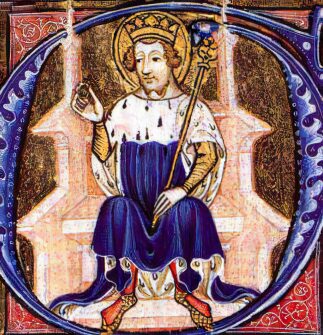
King Kamehameha IV and his wife Emma were Christian rulers who encouraged the building of Christian schools and hospitals, and who contributed greatly to the spread of Christianity among the Hawaiian people.
The King was worried by the growth of American political influence, directly connected with the work of American missionaries, many of whom openly favored annexation of the islands by the United States. He accordingly invited the Church of England to send missionaries and to establish a presence in Hawaii. (While touring England as a prince, he had attended worship services, and had been favorably impressed.) But, although the King's support of the Church of England was perhaps politically motivated, his support of Christianity was not. He and his wife were earnest in their devotion to both the material and the spiritual welfare of their people. The King personally translated the Book of Common Prayer and much of the Hymnal into Hawaiian.
Their only son died in 1863, and the King died, apparently of grief, on 30 November 1864. The Queen devoted the remainder of her life to charitable endeavors (Queen's Hospital, the largest civilian hospital in Hawaii, is largely her doing). She died in 1885.
King Kamehameha IV and Queen Emma of Hawaii - 28 November
The Collect.
O Sovereign God, who raised up (King) Kamehameha (IV) and (Queen) Emma to be rulers in Hawaii, and didst inspire and enable them to be diligent in good works for the welfare of their people and the good of thy Church: Receive our thanks for their witness to the Gospel; and grant that we, with them, may attain to the crown of glory that fadeth not away; through Jesus Christ our Savior and Redeemer, who with thee and the Holy Ghost liveth and reigneth, one God, for ever and ever. Amen.
The Epistle - Acts 17:22-31.
The Holy Gospel - St.Matthew 25:31-40.
Reference and Resource:
http://en.wikipedia.org/wiki/Kamehameha_IV
http://en.wikipedia.org/wiki/Queen_Emma_of_Hawaii
http://elvis.rowan.edu/~kilroy/JEK/11/28.html
+
Showing posts with label King. Show all posts
Monday, November 28, 2022
Wednesday, May 26, 2021
Augustine of Canterbury
was a Benedictine monk who became the first Archbishop of Canterbury in 598. He is considered the "Apostle to the English",a founder of the English Church, and a patron of England.
The Christian Church was established in the British Isles well before 300. Some scholars believe that it was introduced by missionaries from the Eastern or Greek-speaking half of the Mediterranean world. Celtic Christianity had its own distinctive culture, and Greek scholarship flourished in Ireland for several centuries after it had died elsewhere in Western Europe.
However, in the fifth century Britain was invaded by non-Christian Germanic tribes: the Angles, Saxons, and Jutes. They conquered the native Celtic Christians (despite resistance by, among others, a leader whose story has come down to us, doubtless with some exaggeration, as that of King Arthur), or drove them north and west into Cornwall, Wales, Scotland, and Ireland. From these regions Celtic Christian missionaries returned to England to preach the Gospel to the heathen invaders.
Augustine was the prior of a monastery in Rome when Pope Gregory the Great chose him in 595 to lead a mission to Britain to convert the pagan King Æthelberht of Kent to Christianity. Kent was probably chosen because it was near the Christian kingdoms in Gaul, and because Æthelberht had married a Christian princess, Bertha, daughter of Charibert, the King of Paris, who was expected to exert some influence over her husband. Although the missionaries considered turning back before they reached Kent, Gregory urged them on, and in 597 Augustine landed on the Isle of Thanet and proceeded to Æthelberht's main town of Canterbury.
Æthelberht allowed the missionaries to preach freely and converted to Christianity, giving the missionaries land to found a monastery outside the city walls. Augustine was consecrated bishop of the English, and converted many of the king's subjects, including thousands during a mass baptism on Christmas Day in 597. Pope Gregory sent more missionaries in 601, along with encouraging letters and gifts for the churches, although attempts to persuade the native Celtic bishops to submit to Augustine's authority failed.
Augustine was consecrated bishop and established his headquarters at Canterbury. From his day to the present, there has been an unbroken succession of archbishops of Canterbury. Roman Catholic bishops were established at London and Rochester in 604, and a school was founded to train Anglo-Saxon priests and missionaries. Augustine also arranged the consecration of his successor, Laurence of Canterbury.
In 603, he held a conference with the leaders of the already existing Christian congregations in Britain, but failed to reach an accommodation with them, largely due to his own tactlessness, and his insistence (contrary, it may be noted, to Gregory's explicit advice) on imposing Roman customs on a church long accustomed to its own traditions of worship. It is said that the English bishops, before going to meet Augustine, consulted a hermit with a reputation for wisdom and holiness, asking him, "Shall we accept this man as our leader, or not?" The hermit replied, "If, at your meeting, he rises to greet you, then accept him, but if he remains seated, then he is arrogant and unfit to lead, and you ought to reject him." Augustine, alas, remained seated. It took another sixty years before the breach was healed.
Augustine died in 604 and was soon revered as a saint. The Church of England remained in communion with The Church of Rome until it declared its independence in the sixteenth century.
Augustine - 26 May - First Archbishop of Canterbury
The Collect.
O Lord our God, who by thy Son Jesus Christ didst call thine apostles and send them forth to preach the Gospel to the nations: We bless thy holy name for thy servant Augustine, first Archbishop of Canterbury, whose labors in propagating thy Church among the English people we commemorate today; and we pray that all whom thou dost call and send may do thy will, and bide thy time, and see thy glory; through Jesus Christ our Lord, who liveth and reigneth with thee and the Holy Ghost, one God, for ever and ever. Amen.
The Epistle - 2 Corinthians 5:17-20.
IF any man be in Christ, he is a new creature: old things are passed away; behold, all things are become new. And all things are of God, who hath reconciled us to himself by Jesus Christ, and hath given to us the ministry of reconciliation to wit, that God was in Christ, reconciling the world unto himself, not imputing their trespasses unto them; and hath committed unto us the word of reconciliation. Now then we are ambassadors for Christ, as though God did beseech you by us: we pray you in Christ's stead, be ye reconciled to God.
The Gospel - St. Matthew 13:31-33.
ANOTHER parable put Jesus forth unto them, saying, The kingdom of heaven is like to a grain of mustard seed, which a man took, and sowed in his field: which indeed is the least of all seeds: but when it is grown, it is the greatest among herbs, and becometh a tree, so that the birds of the air come and lodge in the branches thereof. Another parable spake he unto them; The kingdom of heaven is like unto leaven, which a woman took, and hid in three measures of meal, till the whole was leavened. All these things spake Jesus unto the multitude in parables.
Reference and Resources:
http://elvis.rowan.edu/~kilroy/JEK/05/26.html
http://en.wikipedia.org/wiki/Augustine_of_Canterbury
http://www.commonprayer.org/calend/propers/s_august.cfm
†
Saturday, May 22, 2021
Constantine The Great
Arguably one of the most significant figures in the history of Europe and of the Church, there are literally libraries of information on this legendary man.
On this day we remember the heavenly birth of Constantine and his contributions to the Church, it's liberations from persecution and elevation to prominence and as the first secular ruler in "Christendom".
Constantine the Great - 22 May - Emperor and Confessor.
The Collect.
Almighty God, who gave unto the world the enlightened rule of thy confessor Constantine, we humbly beseech thee, that by his example we may further thy earthly kingdom in truth and freedom and defend it from the powers of darkness until the coming of our Lord and Saviour Christ Jesus, who with thee and the Holy Ghost reigneth as one God, now and forever. Amen.
The Epistle - Philippians 4:4-9.
REJOICE in the Lord alway: and again I say, Rejoice, Let your moderation be known unto all men. The Lord is at hand. Be anxious for nothing; but in every thing by prayer and supplication with thanksgiving let your requests be made known unto God. And the peace of God, which passeth all understanding, shall keep your hearts and minds through Christ Jesus. Finally, brethren, whatsoever things are true, whatsoever things are honest, whatsoever things are just, whatsoever things are pure, whatsoever things are lovely, whatsoever things are of good report; if there be any virtue, and if there be any praise, think on these things. Those things, which ye have both learned, and received, and heard, and seen in me, do: and the God of peace shall be with you.
The Gospel - St. Matthew 25:31-40.
WHEN the Son of man shall come in his glory, and all the holy angels with him, then shall he sit upon the throne of his glory: and before him shall be gathered all nations: and he shall separate them one from another, as a shepherd divideth his sheep from the goats: and he shall set the sheep on his right hand, but the goats on the left. Then shall the King say unto them on his right hand, Come, ye blessed of my Father, inherit the kingdom prepared for you from the foundation of the world: for I was an hungred, and ye gave me meat: I was thirsty, and ye gave me drink: I was a stranger, and ye took me in: naked, and ye clothed me: I was sick, and ye visited me: I was in prison, and ye came unto me. Then shall the righteous answer him, saying, Lord, when saw we thee an hungred, and fed thee? or thirsty, and gave thee drink? When saw we thee a stranger, and took thee in? or naked, and clothed thee? Or when saw we thee sick, or in prison, and came unto thee? And the King shall answer and say unto them, Verily I say unto you, Inasmuch as ye have done it unto one of the lease of these my brethren, ye have done it unto me.
Reference and Resources:
†
Labels:
Christianity,
Constantinople,
History,
King,
Propers,
Rome,
Saints
Thursday, May 20, 2021
Æthelberht of East Anglia
Died near Hereford, England, c. 793-794. King Ethelbert had a considerable cultus as a wonder worker and martyr during the middle ages. However, some, such as William of Malmesbury, have misgivings about the continuance of his veneration. He cited the authority of Saint Dunstan (f.d. May 19) and the witness of miracles as reasons to allow the cultus to continue. Ethelbert was murdered at Sutton Walls in Herefordshire, apparently for dynastic reasons at the instigation of the wife of Offa of Mercia.
His pious "vita," written by Giraldus Cambrensis (Gerald of Wales), tells us that Ethelbert was a man of prayer from his childhood. While still very young, he succeeded his father Ethelred as king of East Anglia and ruled benevolently for 44 years. It is said that his usual maxim is that the higher the station of man, the humbler he ought to be. This was the rule for his own conduct.
Desiring to secure stability for his kingdom by an heir, he sought the hand of the virtuous Alfreda (Aelfthryth), daughter of the powerful King Offa. With this in mind, he visited Offa at Sutton-Walls, four miles from Hereford. He was courteously entertained, but after some days, treacherously murdered by Grimbert, an officer of King Offa, through the contrivance of Queen Quendreda who wanted to add his kingdom to their own.
His body was secretly buried by the river Lugg at Maurdine of Marden, but miracles revealed its hiding place. Soon it was moved to a church at Fernley (Heath of Fern), now called Hereford. The town grew around the church bearing Ethelbert's name after King Wilfrid of Mercia enlarged and enriched it. Hereford became the second most important pilgrimage site (next to Canterbury) in medieval England. The body was burned by the Danes in 1050, but Ethelbert's head was buried at Westminster. Ethelbert's feast is kept in the dioceses of Cardiff and Northampton. He is titular patron of the cathedral at Hereford, and the churches at Marden (Herefordshire), Little Dean (Gloucestershire), and eleven others in East Anglia.
Quendreda died miserably within three months after her crime. Her daughter Alfreda became a hermit at Croyland. Offa made atonement for the sin of his queen by a pilgrimage to Rome, where he founded a school for the English. Egfrid, the only son of Offa, died after a reign of some months, and the Mercian crown was translated into the family descended of Penda.
Æthelberht II of East Anglia - 20 May - King
The Collect.
O Almighty God, who hast knit together Thine elect in one communion and fellowship in the mystical body of Thy Son Jesus Christ, our Lord: grant us grace so to follow Thy blessed saints in all virtuous and godly living, that we may come to the unspeakable joys which Thou hast prepared for those who unfeignedly love Thee; through the same, Jesus Christ, Thy Son, our Lord, who liveth and reigneth with Thee and the Holy Ghost: ever one God, world without end. Amen.
The First Lesson - Revelation 7: 2-17
The Holy Gospel - St. Matthew 5: 1-12
+
His pious "vita," written by Giraldus Cambrensis (Gerald of Wales), tells us that Ethelbert was a man of prayer from his childhood. While still very young, he succeeded his father Ethelred as king of East Anglia and ruled benevolently for 44 years. It is said that his usual maxim is that the higher the station of man, the humbler he ought to be. This was the rule for his own conduct.
Desiring to secure stability for his kingdom by an heir, he sought the hand of the virtuous Alfreda (Aelfthryth), daughter of the powerful King Offa. With this in mind, he visited Offa at Sutton-Walls, four miles from Hereford. He was courteously entertained, but after some days, treacherously murdered by Grimbert, an officer of King Offa, through the contrivance of Queen Quendreda who wanted to add his kingdom to their own.
His body was secretly buried by the river Lugg at Maurdine of Marden, but miracles revealed its hiding place. Soon it was moved to a church at Fernley (Heath of Fern), now called Hereford. The town grew around the church bearing Ethelbert's name after King Wilfrid of Mercia enlarged and enriched it. Hereford became the second most important pilgrimage site (next to Canterbury) in medieval England. The body was burned by the Danes in 1050, but Ethelbert's head was buried at Westminster. Ethelbert's feast is kept in the dioceses of Cardiff and Northampton. He is titular patron of the cathedral at Hereford, and the churches at Marden (Herefordshire), Little Dean (Gloucestershire), and eleven others in East Anglia.
Quendreda died miserably within three months after her crime. Her daughter Alfreda became a hermit at Croyland. Offa made atonement for the sin of his queen by a pilgrimage to Rome, where he founded a school for the English. Egfrid, the only son of Offa, died after a reign of some months, and the Mercian crown was translated into the family descended of Penda.
Æthelberht II of East Anglia - 20 May - King
The Collect.
O Almighty God, who hast knit together Thine elect in one communion and fellowship in the mystical body of Thy Son Jesus Christ, our Lord: grant us grace so to follow Thy blessed saints in all virtuous and godly living, that we may come to the unspeakable joys which Thou hast prepared for those who unfeignedly love Thee; through the same, Jesus Christ, Thy Son, our Lord, who liveth and reigneth with Thee and the Holy Ghost: ever one God, world without end. Amen.
The First Lesson - Revelation 7: 2-17
The Holy Gospel - St. Matthew 5: 1-12
+
Tuesday, May 18, 2021
Eric of Sweden
Erik IX Jedvardsson was ruler of much of Sweden from 1150 to 1160. He was the head of a Christian kingdom with nearby pagan kingdoms, all sharing an old tradition of fighting. Around 1155, he headed an expedition into Finland, then loosely under Swedish rule, to consolidate Swedish authority there and to establish a protected Christian mission, headed by Henry of Uppsala, now considered the founder of the Church in Finland (see 19 Jan). Erik is also known for undertaking to provide Sweden with fair laws and fair courts, and for measures designed to assist the poor and the infirm. As he was in church on 18 May 1160, the day after Ascension Day, he was told that a pagan Danish army was approaching to kill him. He replied, "Let us at least finish the sacrifice. The rest of the feast I shall keep elsewhere." As he was leaving the church, the pagans rushed upon him and killed him.
Erik was honored both as an upholder of the Christian faith and as a national hero, the ancestor of a long line of Swedish kings. Within thirty years after his death his name appeared on the Swedish Calendar, and he is accounted the principal patron of Sweden, as (for example) Patrick is of Ireland. The silver casket with his remains still rests in the cathedral at Uppsala.
Propers for Erik of Sweden - 18 May - King and Martyr
The Collect.
O God, who didst call thy servant Erik of Sweden to an earthly throne that he might advance thy heavenly kingdom, and didst give him zeal for thy Church and love for thy people: Mercifully grant that we who commemorate him this day may be fruitful in good works, and attain to the glorious crown of thy saints; through Jesus Christ our Lord, who liveth and reigneth with thee and the Holy Spirit, one God, for ever and ever. Amen.
The Epistle - 2 Esdras 2:42-48.
I ESDRAS saw upon the mount Sion a great people, whom I could not number, and they all praised the Lord with songs. And in the midst of them there was a young man of a high stature, taller than all the rest, and upon every one of their heads he set crowns, and was more exalted; which I marvelled at greatly. So I asked the angel, and said, Sir, what are these? He answered and said unto me, These be they that have put off the mortal clothing, and put on the immortal, and have confessed the name of God: now are they crowned, and receive palms. Then said I unto the angel. What young person is it that crowneth them, and giveth them palms in their hands? So he answered and said unto me, It is the Son of God, whom they have confessed in the world. Then began I greatly to commend them that stood so stiffly for the name of the Lord. Then the angel said unto me, Go thy way, and tell my people what manner of things, and how great wonders of the Lord thy God, thou hast seen.
The Gospel - St. Matthew 10:16-22.
BEHOLD, I send you forth as sheep in the midst of wolves: be ye therefore wise as serpents, and harmless as doves. But beware of men: for they will deliver you up to the councils, and they will scourge you in their synagogues; and ye shall he brought before governors and kings for my sake, for a witness to them and the Gentiles. But when they deliver you up, be not anxious how or what ye shall speak: for it shall be given you in that same hour what ye shall speak. For it is not ye that speak, but the Spirit of your Father which speaketh in you. And the brother shall deliver up the brother to death, and the father the child: and the children shall rise up against their parents, and cause them to be put to death. And ye shall be hated of all men for my name's sake: but he that endureth to the end shall be saved.
Reference and Resources:
http://www.commonprayer.org/calend/propers/com_mart.cfm
http://en.wikipedia.org/wiki/St._Erik
http://elvis.rowan.edu/~kilroy/JEK/05/17.html
†
Thursday, March 18, 2021
King Edward the Martyr

(c. 962–18 March 978) was king of England from 975 until he was murdered in 978. Edward is thought to have been the son of King Edgar and Æthelflæd. His succession to the throne was contested by supporters of his half-brother Æthelred, but with Dunstan's support, Edward was acknowledged by the Witan and crowned king by Dunstan and Oswald of Worcester.
Edward's reign was short and disturbed by factional strife. He was killed at Corfe Castle by servants of his stepmother the Queen Dowager Ælfthryth (Elfrida) on 18 March 978. Edward became known as "the Martyr" because of his violent end, the fact that the party opposed to him had been irreligious, and the fact that he himself had always acted as a defender of the Church. Within a short time he was regarded as a saint and his cult was established at Shaftesbury Abbey where he had been reburied circa 980. Many miracles were reported at the tomb of St Edward, including the healing of lepers and the blind. He is recognized as a saint in the Eastern Orthodox Church, the Roman Catholic Church, and the Anglican Communion.
Propers for Edward of Wessex - 18 March - King and Martyr
The Collect.
ALMIGHTY and everlasting God, who didst strengthen thy blessed martyr Edward of Wessex with the virtue of constancy in faith and truth: Grant us in like manner for love of thee to despise the prosperity of this world, and to fear none of its adversities; through Jesus Christ our Lord. Amen.
The Epistle - 2 Esdras 2:42-48.
I ESDRAS saw upon the mount Sion a great people, whom I could not number, and they all praised the Lord with songs. And in the midst of them there was a young man of a high stature, taller than all the rest, and upon every one of their heads he set crowns, and was more exalted; which I marvelled at greatly. So I asked the angel, and said, Sir, what are these? He answered and said unto me, These be they that have put off the mortal clothing, and put on the immortal, and have confessed the name of God: now are they crowned, and receive palms. Then said I unto the angel. What young person is it that crowneth them, and giveth them palms in their hands? So he answered and said unto me, It is the Son of God, whom they have confessed in the world. Then began I greatly to commend them that stood so stiffly for the name of the Lord. Then the angel said unto me, Go thy way, and tell my people what manner of things, and how great wonders of the Lord thy God, thou hast seen.
The Gospel - St. Matthew 10:16-22.
BEHOLD, I send you forth as sheep in the midst of wolves: be ye therefore wise as serpents, and harmless as doves. But beware of men: for they will deliver you up to the councils, and they will scourge you in their synagogues; and ye shall he brought before governors and kings for my sake, for a witness to them and the Gentiles. But when they deliver you up, be not anxious how or what ye shall speak: for it shall be given you in that same hour what ye shall speak. For it is not ye that speak, but the Spirit of your Father which speaketh in you. And the brother shall deliver up the brother to death, and the father the child: and the children shall rise up against their parents, and cause them to be put to death. And ye shall be hated of all men for my name's sake: but he that endureth to the end shall be saved.
Reference and Resources:
http://www.commonprayer.org/calend/propers/com_mart.cfm
http://en.wikipedia.org/wiki/Edward_the_martyr
http://saints.sqpn.com/sainte36.htm
http://ohioanglican.blogspot.com/2008/03/st-edward-martyr.html
†
Thursday, February 25, 2021
Æthelberht of Kent
(also Æthelbert, Aethelberht, Aethelbert, or Ethelbert) (c. 560 – February 24, 616) was King of Kent from about 580 or 590 until his death. In his Ecclesiastical History of the English People, the monk Bede lists Aethelberht as the third king to hold imperium over other Anglo-Saxon kingdoms. In the late 9th century Anglo-Saxon Chronicle Æthelberht is referred to as a bretwalda, or "Britain-ruler". He was the first English king to convert to Christianity.
He was the son of Eormenric, whom he succeeded as king, according to the Chronicle. He married Bertha, daughter of Charibert, king of the Franks, thus building an alliance with the most powerful state in Western Europe at that time; the marriage probably took place before Æthelberht came to the throne. The influence of Bertha may have led to Pope Gregory I’s decision to send Augustine as a missionary from Rome. Augustine landed on the Isle of Thanet in east Kent in 597. Shortly thereafter, Æthelberht was converted to Christianity, churches were established and wider-scale conversion to Christianity began. Æthelberht provided the new church with land in Canterbury, at what came to be known as St Augustine's Abbey, thus establishing one of the foundation-stones of what ultimately became the Anglican church.
Æthelberht’s code of laws for Kent, the earliest written code in any Germanic language, instituted a complex system of fines. Kent was rich, with strong trade ties to the continent, and it may be that Æthelberht instituted royal control of trade. Coinage began circulating in Kent during his reign for the first time since the Anglo-Saxon invasion.
Æthelberht was later canonised for his role in establishing Christianity among the Anglo-Saxons. His feast day was originally February 24, but was changed to February 25.
Propers for Æthelbert - 25 February - King and Confessor
The Collect.
O ALMIGHTY God, who didst call thy servant Ethelbert of Kent to an earthly throne that he might advance Thy heavenly kingdom, and didst give him zeal for Thy Church and love for Thy people: Mercifully grant that we who commemorate him this day may be fruitful in good works, and attain to the glorious crown of Thy saints; through Jesus Christ our Lord, who liveth and reigneth with Thee and the Holy Ghost, one God, for ever and ever. Amen.
The Epistle - Hebrews 12:1-2.
SEEING we also are compassed about with so great a of cloud of witnesses, let us lay aside every weight, and the sin which doth so easily beset us, and let us run with patience the race that is set before us, looking unto Jesus the author and finisher of our faith; who for the joy that was set before him endured the cross, despising the shame, and is set down at the right hand of the throne of God.
The Gospel - St. Matthew 25:31-40.
WHEN the Son of man shall come in his glory, and all the holy angels with him, then shall he sit upon the throne of his glory: and before him shall be gathered all nations: and he shall separate them one from another, as a shepherd divideth his sheep from the goats: and he shall set the sheep on his right hand, but the goats on the left. Then shall the King say unto them on his right hand, Come, ye blessed of my Father, inherit the kingdom prepared for you from the foundation of the world: for I was an hungred, and ye gave me meat: I was thirsty, and ye gave me drink: I was a stranger, and ye took me in: naked, and ye clothed me: I was sick, and ye visited me: I was in prison, and ye came unto me. Then shall the righteous answer him, saying, Lord, when saw we thee an hungred, and fed thee? or thirsty, and gave thee drink? When saw we thee a stranger, and took thee in? or naked, and clothed thee? Or when saw we thee sick, or in prison, and came unto thee? And the King shall answer and say unto them, Verily I say unto you, Inasmuch as ye have done it unto one of the lease of these my brethren, ye have done it unto me.
Reference and Resources:
http://www.orthodoxengland.btinternet.co.uk/ethlbert.htm
http://en.wikipedia.org/wiki/Ethelbert_of_Kent
http://www.commonprayer.org/calend/propers/common.cfm
http://elvis.rowan.edu/~kilroy/JEK/02/25.html
†
Saturday, January 30, 2021
King Charles the Martyr
(19 November 1600 – 30 January 1649) was King of England, King of Scotland and King of Ireland from 27 March 1625 until his execution.
Charles famously engaged in a struggle for power with the Parliament of England. He was an advocate of the Divine Right of Kings, and many in England feared that he was attempting to gain absolute power. Many of his actions, particularly the levying of taxes without Parliament's consent, caused widespread opposition.
Religious conflicts permeated Charles's reign. He married a Catholic princess, Henrietta Maria of France, over the objections of Parliament and public opinion. He further allied himself with controversial religious figures, including the ecclesiastic Richard Montagu and William Laud, whom Charles appointed Archbishop of Canterbury. Many of Charles's subjects felt this brought the Church of England too close to Roman Catholicism. Charles's later attempts to force religious reforms upon Scotland led to the Bishops' Wars that weakened England's government and helped precipitate his downfall.
His last years were marked by the English Civil War, in which he was opposed by the forces of Parliament, which challenged his attempts to augment his own power, and by Puritans, who were hostile to his religious policies and Catholic sympathy. Charles was defeated in the first Civil War (1642 - 1645), after which Parliament expected him to accept demands for a constitutional monarchy. He instead remained defiant by attempting to forge an alliance with Scotland and escaping to the Isle of Wight. This provoked a second Civil War (1648 - 1649) and a second defeat for Charles, who was subsequently captured, tried, convicted, and executed for high treason.
Charles was never a Roman Catholic, and firmly refused all urgings to become one, saying that he believed the Church of England to be more truly Catholic than the Church of Rome. However, there were many Roman Catholics in his family. His mother, Anne of Denmark, had converted to Rome. His own wife, Henrietta Maria, a French princess whom he had married in what was originally a political alliance but ended as a love match, was a Roman Catholic. His oldest son Charles became a Roman on his deathbed, and his second son, later James II, became one while still healthy, and lost his throne on account of it. It was accordingly not surprising that the Puritans accused him of being secretly disposed toward Rome, and that they regarded all his moves toward religious toleration as part of a Roman Catholic plan to seize the government.
The monarchy was then abolished and a republic called the Commonwealth of England was declared. Charles's son, Charles II, became King after the restoration of the monarchy in 1660.
Propers for Charles I - 30 January - King of England, Scotland and Ireland - Martyr
The Collect.
Blessed Lord, in whose sight the death of thy saints is precious; we magnify thy Name for that abundant grace bestowed on our late Martyred Sovereign; by which he was enabled so cheerfully to follow the steps of his blessed Master and Saviour, in a constant meek bearing of all barbarous indignities, and at last resisting unto blood; and even then, according to the same pattern, praying for his murderers. Let his memory, O Lord, be ever blessed among us, that we may follow the example of his patience, and charity; And grant, that this our Land may be freed from the vengeance of his blood, and Thy mercy glorified in the forgiveness of our sins; and all for Jesus Christ His sake. Amen.
The Epistle - I St Peter 2: 13-23.
Submit yourselves to every ordinance of man for the Lord's sake: whether it be to the king, as supreme; Or unto governors, as unto them that are sent by him for the punishment of evildoers, and for the praise of them that do well. For so is the will of God, that with well doing ye may put to silence the ignorance of foolish men: As free, and not using your liberty for a cloke of maliciousness, but as the servants of God. Honour all men. Love the brotherhood. Fear God. Honour the king. Servants, be subject to your masters with all fear; not only to the good and gentle, but also to the froward. For this is thankworthy, if a man for conscience toward God endure grief, suffering wrongfully. For what glory is it, if, when ye be buffeted for your faults, ye shall take it patiently? but if, when ye do well, and suffer for it, ye take it patiently, this is acceptable with God. For even hereunto were ye called: because Christ also suffered for us, leaving us an example, that ye should follow his steps: Who did no sin, neither was guile found in his mouth: Who, when he was reviled, reviled not again; when he suffered, he threatened not; but committed himself to him that judgeth righteously:
The Gospel - St Matthew xxi., 33-42 .
Hear another parable: There was a certain householder, which planted a vineyard, and hedged it round about, and digged a wine press in it, and built a tower, and let it out to husbandmen, and went into a far country: And when the time of the fruit drew near, he sent his servants to the husbandmen, that they might receive the fruits of it. And the husbandmen took his servants, and beat one, and killed another, and stoned another. Again, he sent other servants more than the first: and they did unto them likewise. But last of all he sent unto them his son, saying, They will reverence my son. But when the husbandmen saw the son, they said among themselves, This is the heir; come, let us kill him, and let us seize on his inheritance. And they caught him, and cast him out of the vineyard, and slew him. When the lord therefore of the vineyard cometh, what will he do unto those husbandmen? They say unto him, He will miserably destroy those wicked men, and will let out his vineyard unto other husbandmen, which shall render him the fruits in their seasons. Jesus saith unto them, Did ye never read in the scriptures, The stone which the builders rejected, the same is become the head of the corner: this is the Lord's doing, and it is marvellous in our eyes?
Reference and Resources:
http://en.wikipedia.org/wiki/Charles_I_of_England
http://anglicanhistory.org/charles/kcm.html
http://elvis.rowan.edu/~kilroy/JEK/01/30a.html
†
Saturday, November 28, 2020
Kamehameha and Emma of Hawaii
King Kamehameha IV and his wife Emma were Christian rulers who encouraged the building of Christian schools and hospitals, and who contributed greatly to the spread of Christianity among the Hawaiian people.
The King was worried by the growth of American political influence, directly connected with the work of American missionaries, many of whom openly favored annexation of the islands by the United States. He accordingly invited the Church of England to send missionaries and to establish a presence in Hawaii. (While touring England as a prince, he had attended worship services, and had been favorably impressed.) But, although the King's support of the Church of England was perhaps politically motivated, his support of Christianity was not. He and his wife were earnest in their devotion to both the material and the spiritual welfare of their people. The King personally translated the Book of Common Prayer and much of the Hymnal into Hawaiian.
Their only son died in 1863, and the King died, apparently of grief, on 30 November 1864. The Queen devoted the remainder of her life to charitable endeavors (Queen's Hospital, the largest civilian hospital in Hawaii, is largely her doing). She died in 1885.
King Kamehameha IV and Queen Emma of Hawaii - 28 November
The Collect.
O Sovereign God, who raised up (King) Kamehameha (IV) and (Queen) Emma to be rulers in Hawaii, and didst inspire and enable them to be diligent in good works for the welfare of their people and the good of thy Church: Receive our thanks for their witness to the Gospel; and grant that we, with them, may attain to the crown of glory that fadeth not away; through Jesus Christ our Savior and Redeemer, who with thee and the Holy Ghost liveth and reigneth, one God, for ever and ever. Amen.
The Epistle - Acts 17:22-31.
The Holy Gospel - St.Matthew 25:31-40.
Reference and Resource:
http://en.wikipedia.org/wiki/Kamehameha_IV
http://en.wikipedia.org/wiki/Queen_Emma_of_Hawaii
http://elvis.rowan.edu/~kilroy/JEK/11/28.html
+
The King was worried by the growth of American political influence, directly connected with the work of American missionaries, many of whom openly favored annexation of the islands by the United States. He accordingly invited the Church of England to send missionaries and to establish a presence in Hawaii. (While touring England as a prince, he had attended worship services, and had been favorably impressed.) But, although the King's support of the Church of England was perhaps politically motivated, his support of Christianity was not. He and his wife were earnest in their devotion to both the material and the spiritual welfare of their people. The King personally translated the Book of Common Prayer and much of the Hymnal into Hawaiian.
Their only son died in 1863, and the King died, apparently of grief, on 30 November 1864. The Queen devoted the remainder of her life to charitable endeavors (Queen's Hospital, the largest civilian hospital in Hawaii, is largely her doing). She died in 1885.
King Kamehameha IV and Queen Emma of Hawaii - 28 November
The Collect.
O Sovereign God, who raised up (King) Kamehameha (IV) and (Queen) Emma to be rulers in Hawaii, and didst inspire and enable them to be diligent in good works for the welfare of their people and the good of thy Church: Receive our thanks for their witness to the Gospel; and grant that we, with them, may attain to the crown of glory that fadeth not away; through Jesus Christ our Savior and Redeemer, who with thee and the Holy Ghost liveth and reigneth, one God, for ever and ever. Amen.
The Epistle - Acts 17:22-31.
The Holy Gospel - St.Matthew 25:31-40.
Reference and Resource:
http://en.wikipedia.org/wiki/Kamehameha_IV
http://en.wikipedia.org/wiki/Queen_Emma_of_Hawaii
http://elvis.rowan.edu/~kilroy/JEK/11/28.html
+
Friday, November 20, 2020
King Edmund the Martyr
When the heathen Anglo-Saxons invaded Christian Britain in the 400's, they eventually established seven kingdoms: Essex, Wessex, Sussex (East Saxons, West Saxons, and South Saxons), Mercia, Northumbria, and East Anglia (three kingdoms of the Angles), and the Jute kingdom of Kent. (The borders between these ancient kingdoms are still borders between regions speaking English with different accents today.) Under the influence of missionaries from the Celts and from continental Europe, these peoples became Christian, only to be faced themselves by a wave of heathen invaders.
Edmund's father was King Æthelweard who died in 854, and was succeeded by Edmund when the boy was a fourteen-year-old. Edmund was said to have been crowned by St Humbert on 25 December 855 at Burna (probably Bures St Mary, Suffolk), which at that time functioned as the royal capital.
Almost nothing is known of the life of Edmund during the next fourteen years. It was recorded that Edmund was a model king who treated all with equal justice and was unbending to flatterers. It was also written that he retired for a year to his royal tower at Hunstanton and learned the whole Psalter, so that he could recite it from memory.
In 869 the Danes invaded East Anglia and set-up camp at Thetford. Edmund was determined to drive the heathens from his kingdom and protect his Christian subjects from further abuses at the hands of the pagan marauders. Edmund and his army engaged the Danes under Ubbe Ragnarsson and Ivar the Boneless, but his forces were unable to withstand the fury of the Norsemen, with Edmund being captured. The Danish captains gave Edmund terms in hopes of expanding their holdings, but those terms Edmund could not accept. Edmund chose to die a martyr rather than renounce Christ and live under pagan overlords and he was executed on the field of battle.
He is venerated as a saint and a martyr in the Anglican, Eastern and Roman churches. It is said that the king's body was ultimately interred at Beadoriceworth, the modern Bury St Edmunds, where the pilgrimage to his shrine was encouraged by the 12th century monks' enlargement of the church. Edmund's popularity among the Anglo-Norman nobility helped justify claims of continuity with pre-Norman traditions; a banner of St. Edmund's arms was carried at the Battle of Agincourt.
King Edmund the Martyr - 20 November
The Collect.
O God of ineffable mercy, who didst give grace and fortitude to blessed Edmund the king to triumph over the enemy of his people by nobly dying for thy Name: Bestow on us thy servants, we beseech thee, the shield of faith, wherewith we may withstand the assaults of our ancient enemy; through Jesus Christ our Redeemer, who liveth and reigneth with thee and the Holy Ghost, one God, now and for ever. Amen.
The Lesson - Revelation 12. 10-12a.
The Gospel - St. Matthew 10. 34-39.
Reference and Resources:
http://www.excitingholiness.org/first-edition/index.cgi?m11/d20a.html
http://en.wikipedia.org/wiki/Edmund_the_martyr
http://elvis.rowan.edu/~kilroy/JEK/11/20.html
†
Monday, October 26, 2020
Alfred the Great
(Old English: Ælfrēd, Ælfrǣd, "elf counsel") (849 – 26 October 899) was King of Wessex from 871 to 899. Alfred is noted for his defence of the Anglo-Saxon kingdoms of southern England against the Vikings, becoming the only English monarch to be accorded the epithet "the Great". Alfred was the first King of the West Saxons to style himself "King of the Anglo-Saxons". Details of his life are described in a work by the Welsh scholar and bishop Asser. Alfred was a learned man who encouraged education and improved his kingdom's legal system and military structure. He is regarded as a saint by some Catholics, but has never been officially canonized. The Anglican Communion venerates him as a hero of the Christian Church, with a feast day of 26 October, and he may often be found depicted in stained glass in Church of England parish churches.
Alfred the Great - 26 October - King and Hero of the Church
The Collect
O GOD, who didst call thy servant Alfred to an earthly-throne that he might advance thy heavenly kingdom, and didst endue him with zeal for thy Church and charity towards thy people: Mercifully grant that we who commemorate his example may be fruitful in good works, and attain to the glorious fellowship of thy saints; through Jesus Christ our Lord. Amen
The Epistle - Wisdom 6:1-3,9-12,24-25
The Gospel - St. Luke 6:43-49
Reference and Resources:
http://en.wikipedia.org/wiki/Alfred_the_Great
http://www.io.com/~kellywp/LesserFF/Oct/Alfred.html
+
Tuesday, October 13, 2020
Translation of St. Edward the Confessor
Edward was born in 1003. He was the last Saxon king to rule (for more than a few months) in England. He is called "Edward the Confessor" to distinguish him from another King of England, Edward the Martyr (c962-979).
In Christian biographies, the term "confessor" is often used to denote someone who has born witness to the faith by his life, but who did not die as a martyr. Edward was the son of King Ethelred the Unready. This does not mean that he was unprepared, but rather that he was stubborn and willful, and would not accept "rede," meaning advice or counsel.
Aethelred was followed by several Danish kings of England, during whose rule young Edward and his mother took refuge in Normandy. But the last Danish king named Edward as his successor, and he was crowned in 1042. Opinions on his success as a king vary. Some historians consider him weak and indecisive, and say that his reign paved the way for the Norman Conquest. Others say that his prudent management gave England more than twenty years of peace and prosperity, with freedom from foreign domination, at a time when powerful neighbors might well have dominated a less adroit ruler. He was diligent in public and private worship, generous to the poor, and accessible to subjects who sought redress of grievances.
While in exile, he had vowed to make a pilgrimage to Rome if his family fortunes mended. However, his council told him that it was not expedient for him to be so long out of the country. Accordingly, he spent his pilgrimage money instead on the relief of the poor and the building of Westminster Abbey, which stands today (rebuilt in the thirteenth century) as one of the great churches of England, burial place of her kings and others deemed worthy of special honor.
Edward died on 5 January 1066, leaving no offspring; and after his death, the throne was claimed by his wife's brother, Harold the Saxon, and by William, Duke of Normandy. William defeated and slew Harold at the Battle of Hastings (14 October 1066), and thereafter the kings and upper classes of England were Norman-French rather than Anglo-Saxon. Edward is remembered, not on the day of his death, but on the anniversary of the moving ("translation") of his corpse to a new tomb, a date which is also the anniversary of the eve of the Battle of Hastings, the end of Saxon England.
The Translation of St. Edward the Confessor - 13 October
The Collect.
O GOD, who hast crowned the blessed King Edward, thy Confessor, with everlasting glory: make us, we beseech thee, so to venerate him on earth, that we may reign with him hereafter in heaven; through Jesus Christ our Lord. Amen.
The Epistle - Philippians 4:4-9.
The Gospel - St. Matthew 25:31-40.
References and Resources:
http://elvis.rowan.edu/~kilroy/JEK/10/13.html
http://www.commonprayer.org/calend/propers/s_edwar.cfm
http://en.wikipedia.org/wiki/Edward_the_Confessor
†
Monday, October 12, 2020
Edwin of Northumbria
(c. 586 – 12 October 632/633) was the son of Ælle king of Deira and seems to have had (at least) two siblings. His sister Acha was married to Æthelfrith, king of neighboring Bernicia. An otherwise unknown sibling fathered Hereric, who in turn fathered Abbess Hilda of Whitby and Hereswith, wife to king Anna of East Anglia's brother Æthelric.
After the death of his father, Edwin was deposed and exiled by Æthelric an usurper. Edwin traveled around the kingdoms of Britain and had found refuge in several royal houses, eventually marrying Cwenburg, Princess of Mercia. From refuge with King Rædwald of the East Angles, Edwin with his allies fought his rival Æthelric with the usurper being killed in the battle, thus Edwin was placed on the throne of Northumbria and made a vassal of Rædwald.
During his exile, Edwin had learned about Christianity from several of his hosts and with his restoration was contemplating his own conversion along with that of his kingdom. Edwin was very indecisive and held-back in his decision for fear of risk to his throne, but eventually, he gave in to the counsel of Paulinus of York and was Baptized on 12 April 627.
After his conversion, Edwin's star seems to rise with many victories, both political and military and Edwin was the most powerful king among the Anglo-Saxons, ruling Bernicia, Deira and much of eastern Mercia, the Isle of Man and Anglesey. His alliance with Kent, the subjection of Wessex, and his recent successes added to his power and authority. The imperium, as Bede calls it, that Edwin possessed was later equated with the idea of a Bretwalda, a later concept invented by West Saxon kings in the 9th century. Put simply, success confirmed Edwin's overlordship, and failure would diminish it.
It wasn't until the early 630's that Edwin was challenged for regional power. In 632/633 his vassals Penda of Mercia and Cadwallon of Gwynedd formed an alliance to resist Northumbrian overlordship. Edwin faced Penda and Cadwallon at the Battle of Hatfield Chase in the autumn of 632/633, and was defeated and killed. For a time his body was (allegedly) hidden in Sherwood Forest at a location that became the village of Edwinstowe (trans. Edwin's resting place). Of his two grown sons by Cwenburh of Mercia, Osfrith died at Hatfield, and Eadfrith was captured by Penda and killed some time afterward.
Edwin is considered a martyr as that his adversary Penda and the Mercians were pagans.
Edwin of Northumbria - 12 October - King, Convert, and Martyr
The Collect.
ALMIGHTY and everlasting God, who didst strengthen thy blessed martyr Edwin with the virtue of constancy in faith and truth: Grant us in like manner for love of thee to despise the prosperity of this world, and to fear none of its adversities; through Jesus Christ our Lord. Amen.
The Epistle - 2 Esdras 2:42-48
The Gospel - St. Matthew 10:16-22
Reference and Resources:
http://www.commonprayer.org/calend/propers/com_mart.cfm
http://en.wikipedia.org/wiki/Edwin_of_Northumbria
http://comfortablewords.blogspot.com/2009/10/conversion-of-st-edwin.html
†
Monday, September 28, 2020
Wenceslaus of Bohemia
Son of Vratislav I, Duke of Bohemia, whose family had been converted by Saint Cyril and Saint Methodius, and Drahomira, daughter of a pagan chief; she was baptized on her wedding day, but who apparently never seriously took to the faith. Grandson and student of Saint Ludmilla.
Duke of Bohemia, ascending to power when his father was killed during a pagan backlash against Christianity, which he fought against with prayer and patience. Murdered by his brother Boleslaus at the door of a church; killed for political reasons, but normally listed as a martyr since the politics arose from his faith. Miracles reported at his tomb. The subject of the Christmas carol Good King Wenceslas.
Wenceslaus I - 28 September - Duke of Bohemia and Martyr.
The Collect.
ALMIGHTY and everlasting God, who didst strengthen thy blessed martyr Wenceslaus with the virtue of constancy in faith and truth: Grant us in like manner for love of thee to despise the prosperity of this world, and to fear none of its adversities; through Jesus Christ our Lord. Amen.
The Lesson - 2 Esdras 2:42-48.
I ESDRAS saw upon the mount Sion a great people, whom I could not number, and they all praised the Lord with songs. And in the midst of them, there was a young man of a high stature, taller than all the rest, and upon every one of their heads he set crowns and was more exalted; which I marvelled at greatly. So I asked the angel, and said, Sir, what are these? He answered and said unto me, These be they that have put off the mortal clothing, and put on the immortal, and have confessed the name of God: now are they crowned, and receive palms. Then said I unto the angel. What young person is it that crowneth them, and giveth them palms in their hands? So he answered and said unto me, It is the Son of God, whom they have confessed in the world. Then began I greatly to commend them that stood so stiffly for the name of the Lord. Then the angel said unto me, Go thy way, and tell my people what manner of things, and how great wonders of the Lord thy God, thou hast seen.
The Gospel - St. Matthew 10:16-22.
BEHOLD, I send you forth as sheep in the midst of wolves: be ye, therefore, wise as serpents, and harmless as doves. But beware of men: for they will deliver you up to the councils, and they will scourge you in their synagogues; and ye shall he brought before governors and kings for my sake, for a witness to them and the Gentiles. But when they deliver you up, be not anxious how or what ye shall speak: for it shall be given you in that same hour what ye shall speak. For it is not ye that speak, but the Spirit of your Father which speaketh in you. And the brother shall deliver up the brother to death, and the father the child: and the children shall rise up against their parents, and cause them to be put to death. And ye shall be hated of all men for my name's sake: but he that endureth to the end shall be saved.
Reference and Resources:
http://en.wikipedia.org/wiki/Saint_Wenceslaus_I,_Duke_of_Bohemia
http://saints.sqpn.com/saint-wenceslaus-of-bohemia/
+
Tuesday, August 25, 2020
Louis IX of France
born in 1214 and became a devout Christian and king of France. He attended Mass often, prayed frequently, was given to charity (as evidenced in the building of a hospital for the poor and blind) and was an impartial judge in the affairs of his subjects.
Louis was instrumental in garnering support for the crusades, and he himself helped fight in the battles which responded to the Muslim invasions.
He built the beautiful Saint-Chappelle at Paris, where is housed the purported relic of the Crown of Thorns of Christ, which Louis received of Baldwin, the Latin emperor at Constantinople. He died in 1270.
Louis is a wonderful example for us as one, who because he had much, was able to give much in the Name of Christ. May we pray God to raise up Christian rulers, dignataries and elected officials who are more willing to serve than to be served.
Louis IX of France - 25 August - King and Confessor
The Collect.
O GOD, who didst call thy servant Louis to an earthly throne that he might advance thy heavenly kingdom, and didst endue him with zeal for thy Church and charity towards thy people: Mercifully grant that we who commemorate his example may be fruitful in good works, and attain to the glorious fellowship of thy saints; through Jesus Christ our Lord. Amen.
The Epistle - Hebrews 12:1-2.
SEEING we also are compassed about with so great a of cloud of witnesses, let us lay aside every weight, and the sin which doth so easily beset us, and let us run with patience the race that is set before us, looking unto Jesus the author and finisher of our faith; who for the joy that was set before him endured the cross, despising the shame, and is set down at the right hand of the throne of God.
The Gospel - St. Luke 6:17-23.
JESUS came down and stood in the plain, with the company of his disciples, and a great multitude of people out of all Judea and Jerusalem, and from the sea coasts of Tyre and Sidon, which came to hear him, and to be healed of their diseases; and they that were vexed with unclean spirits: and they were healed. And the whole multitude sought to touch him: for there went virtue out of him, and healed them all. And he lifted up his eyes on his disciples, and said, Blessed be ye poor: for yours is the kingdom of God. Blessed are ye that hunger now: for ye shall be filled. Blessed are ye that weep now: for ye shall laugh. Blessed are ye, when men shall hate you, and when they shall separate you from their company, and shall reproach you, and cast out your name as evil, for the Son of man's sake. Rejoice ye in that day, and leap for joy: for, behold, your reward is great in heaven.
Reference and Resources:
http://en.wikipedia.org/wiki/Louis_IX_of_France
http://www.episcopalnet.org/Saints/Aug25Louis.html
http://www.flameword.org/calend/propers/louis.cfm
†
Louis was instrumental in garnering support for the crusades, and he himself helped fight in the battles which responded to the Muslim invasions.
He built the beautiful Saint-Chappelle at Paris, where is housed the purported relic of the Crown of Thorns of Christ, which Louis received of Baldwin, the Latin emperor at Constantinople. He died in 1270.
Louis is a wonderful example for us as one, who because he had much, was able to give much in the Name of Christ. May we pray God to raise up Christian rulers, dignataries and elected officials who are more willing to serve than to be served.
Louis IX of France - 25 August - King and Confessor
The Collect.
O GOD, who didst call thy servant Louis to an earthly throne that he might advance thy heavenly kingdom, and didst endue him with zeal for thy Church and charity towards thy people: Mercifully grant that we who commemorate his example may be fruitful in good works, and attain to the glorious fellowship of thy saints; through Jesus Christ our Lord. Amen.
The Epistle - Hebrews 12:1-2.
SEEING we also are compassed about with so great a of cloud of witnesses, let us lay aside every weight, and the sin which doth so easily beset us, and let us run with patience the race that is set before us, looking unto Jesus the author and finisher of our faith; who for the joy that was set before him endured the cross, despising the shame, and is set down at the right hand of the throne of God.
The Gospel - St. Luke 6:17-23.
JESUS came down and stood in the plain, with the company of his disciples, and a great multitude of people out of all Judea and Jerusalem, and from the sea coasts of Tyre and Sidon, which came to hear him, and to be healed of their diseases; and they that were vexed with unclean spirits: and they were healed. And the whole multitude sought to touch him: for there went virtue out of him, and healed them all. And he lifted up his eyes on his disciples, and said, Blessed be ye poor: for yours is the kingdom of God. Blessed are ye that hunger now: for ye shall be filled. Blessed are ye that weep now: for ye shall laugh. Blessed are ye, when men shall hate you, and when they shall separate you from their company, and shall reproach you, and cast out your name as evil, for the Son of man's sake. Rejoice ye in that day, and leap for joy: for, behold, your reward is great in heaven.
Reference and Resources:
http://en.wikipedia.org/wiki/Louis_IX_of_France
http://www.episcopalnet.org/Saints/Aug25Louis.html
http://www.flameword.org/calend/propers/louis.cfm
†
Wednesday, August 5, 2020
Oswald of Northumbria
(c 604 – August 5, 642) was King of Northumbria from 634 until his death, and is now venerated as a Christian saint.
He was the son of Æthelfrith of Bernicia and came to rule after spending a period in exile; after defeating the British ruler Cadwallon ap Cadfan, Oswald brought the two Northumbrian kingdoms of Bernicia and Deira once again under a single ruler, and promoted the spread of Christianity in Northumbria.
He was given a strongly positive assessment by the historian Bede, writing a little less than a century after Oswald's death, who regarded Oswald as a saintly king; it is also Bede who is the main source for present-day historical knowledge of Oswald. After eight years of rule, in which he was the most powerful ruler in Britain, Oswald was killed in the Battle of Maserfield.
Oswald of Northumbria - 5 August - King and Martyr
The Collect.
Lord God our King, who by the hand of thy servant Oswald didst lift up the standard of the cross in the land of Northumbria, that thy Gospel might be preached in that land: Plant, we beseech thee, the standard of the cross in our hearts, and let thy grace shine forth in our lives, that thereby many may be drawn to the knowledge and love of thee; through Jesus Christ our Lord, who liveth and reigneth with thee and the Holy Ghost, one God, now and ever. Amen.
The Epistle - 2 Esdras 2:42-48.
The Gospel - St. Matthew 10:16-22.
Reference and Resources:
http://saints.sqpn.com/sainto25.htm
http://en.wikipedia.org/wiki/Oswald_of_Northumbria
http://www.commonprayer.org/calend/propers/com_mart.cfm
http://elvis.rowan.edu/~kilroy/JEK/08/05.html
-
†
Wednesday, July 15, 2020
Vladimir The Great
Old East Slavic: Володимѣръ Свѧтославичь Old Norse as Valdamarr Sveinaldsson, Russian: Влади́мир, Vladimir, Ukrainian: Володимир, Volodymyr, (c. 958 near Pskov – 15 July 1015, Berestovo) was a Varangian (Viking) grand prince of Kiev.
Vladimir's father was the Varangian prince Sviatoslav of the Rurik dynasty. After the death of his father in 972, Vladimir, who was then prince of Novgorod, was forced to flee to Scandinavia in 976 after his brother Yaropolk had murdered his other brother Oleg and conquered Rus. In Sweden with the help from his relative Ladejarl Håkon Sigurdsson, ruler of Norway, assembled a Varangian army and reconquered Novgorod from Yaropolk.
By 980 Vladimir had consolidated the Kievan realm from modern day Ukraine to the Baltic Sea and had solidified the frontiers against incursions of Bulgarian, Baltic, and Eastern nomads. Originally a pagan, Vladimir converted to Christianity in 988, and proceeded to have all of Kievan Rus baptized.
Vladimir the Great - 15 July - King of Rus
The Collect.
Almighty God, who hast compassed us about with so great a cloud of witnesses: Grant that we, encouraged by the good example of thy servant Vladimir , may persevere in running the race that is set before us, until at length, through thy mercy, we may with him attain to thine eternal joy; through Jesus Christ, the author and perfecter of our faith, who liveth and reigneth with thee and the Holy Ghost, one God, for ever and ever. Amen.
The Epistle - Micah 6:6-8.
Wherewith shall I come before the LORD, and bow myself before the high God? shall I come before him with burnt offerings, with calves of a year old? Will the LORD be pleased with thousands of rams, or with ten thousands of rivers of oil? shall I give my firstborn for my transgression, the fruit of my body for the sin of my soul? He hath shewed thee, O man, what is good; and what doth the LORD require of thee, but to do justly, and to love mercy, and to walk humbly with thy God?
The Gospel - St. Matthew 25:31-40
When the Son of man shall come in his glory, and all the holy angels with him, then shall he sit upon the throne of his glory: And before him shall be gathered all nations: and he shall separate them one from another, as a shepherd divideth his sheep from the goats: And he shall set the sheep on his right hand, but the goats on the left. Then shall the King say unto them on his right hand, Come, ye blessed of my Father, inherit the kingdom prepared for you from the foundation of the world: For I was an hungred, and ye gave me meat: I was thirsty, and ye gave me drink: I was a stranger, and ye took me in: Naked, and ye clothed me: I was sick, and ye visited me: I was in prison, and ye came unto me. Then shall the righteous answer him, saying, Lord, when saw we thee an hungred, and fed thee? or thirsty, and gave thee drink? When saw we thee a stranger, and took thee in? or naked, and clothed thee? Or when saw we thee sick, or in prison, and came unto thee? And the King shall answer and say unto them, Verily I say unto you, Inasmuch as ye have done it unto one of the least of these my brethren, ye have done it unto me.
Reference and Resources:
http://en.wikipedia.org/wiki/Vladimir_I_of_Kiev
http://anglicangradual.stsams.org/FTP/Acrobat/3511-CmS1.pdf
†
Vladimir's father was the Varangian prince Sviatoslav of the Rurik dynasty. After the death of his father in 972, Vladimir, who was then prince of Novgorod, was forced to flee to Scandinavia in 976 after his brother Yaropolk had murdered his other brother Oleg and conquered Rus. In Sweden with the help from his relative Ladejarl Håkon Sigurdsson, ruler of Norway, assembled a Varangian army and reconquered Novgorod from Yaropolk.
By 980 Vladimir had consolidated the Kievan realm from modern day Ukraine to the Baltic Sea and had solidified the frontiers against incursions of Bulgarian, Baltic, and Eastern nomads. Originally a pagan, Vladimir converted to Christianity in 988, and proceeded to have all of Kievan Rus baptized.
Vladimir the Great - 15 July - King of Rus
The Collect.
Almighty God, who hast compassed us about with so great a cloud of witnesses: Grant that we, encouraged by the good example of thy servant Vladimir , may persevere in running the race that is set before us, until at length, through thy mercy, we may with him attain to thine eternal joy; through Jesus Christ, the author and perfecter of our faith, who liveth and reigneth with thee and the Holy Ghost, one God, for ever and ever. Amen.
The Epistle - Micah 6:6-8.
Wherewith shall I come before the LORD, and bow myself before the high God? shall I come before him with burnt offerings, with calves of a year old? Will the LORD be pleased with thousands of rams, or with ten thousands of rivers of oil? shall I give my firstborn for my transgression, the fruit of my body for the sin of my soul? He hath shewed thee, O man, what is good; and what doth the LORD require of thee, but to do justly, and to love mercy, and to walk humbly with thy God?
The Gospel - St. Matthew 25:31-40
When the Son of man shall come in his glory, and all the holy angels with him, then shall he sit upon the throne of his glory: And before him shall be gathered all nations: and he shall separate them one from another, as a shepherd divideth his sheep from the goats: And he shall set the sheep on his right hand, but the goats on the left. Then shall the King say unto them on his right hand, Come, ye blessed of my Father, inherit the kingdom prepared for you from the foundation of the world: For I was an hungred, and ye gave me meat: I was thirsty, and ye gave me drink: I was a stranger, and ye took me in: Naked, and ye clothed me: I was sick, and ye visited me: I was in prison, and ye came unto me. Then shall the righteous answer him, saying, Lord, when saw we thee an hungred, and fed thee? or thirsty, and gave thee drink? When saw we thee a stranger, and took thee in? or naked, and clothed thee? Or when saw we thee sick, or in prison, and came unto thee? And the King shall answer and say unto them, Verily I say unto you, Inasmuch as ye have done it unto one of the least of these my brethren, ye have done it unto me.
Reference and Resources:
http://en.wikipedia.org/wiki/Vladimir_I_of_Kiev
http://anglicangradual.stsams.org/FTP/Acrobat/3511-CmS1.pdf
†
Tuesday, May 26, 2020
Augustine of Canterbury
was a Benedictine monk who became the first Archbishop of Canterbury in 598. He is considered the "Apostle to the English",a founder of the English Church, and a patron of England.
The Christian Church was established in the British Isles well before 300. Some scholars believe that it was introduced by missionaries from the Eastern or Greek-speaking half of the Mediterranean world. Celtic Christianity had its own distinctive culture, and Greek scholarship flourished in Ireland for several centuries after it had died elsewhere in Western Europe.
However, in the fifth century Britain was invaded by non-Christian Germanic tribes: the Angles, Saxons, and Jutes. They conquered the native Celtic Christians (despite resistance by, among others, a leader whose story has come down to us, doubtless with some exaggeration, as that of King Arthur), or drove them north and west into Cornwall, Wales, Scotland, and Ireland. From these regions Celtic Christian missionaries returned to England to preach the Gospel to the heathen invaders.
Augustine was the prior of a monastery in Rome when Pope Gregory the Great chose him in 595 to lead a mission to Britain to convert the pagan King Æthelberht of Kent to Christianity. Kent was probably chosen because it was near the Christian kingdoms in Gaul, and because Æthelberht had married a Christian princess, Bertha, daughter of Charibert, the King of Paris, who was expected to exert some influence over her husband. Although the missionaries considered turning back before they reached Kent, Gregory urged them on, and in 597 Augustine landed on the Isle of Thanet and proceeded to Æthelberht's main town of Canterbury.
Æthelberht allowed the missionaries to preach freely and converted to Christianity, giving the missionaries land to found a monastery outside the city walls. Augustine was consecrated bishop of the English, and converted many of the king's subjects, including thousands during a mass baptism on Christmas Day in 597. Pope Gregory sent more missionaries in 601, along with encouraging letters and gifts for the churches, although attempts to persuade the native Celtic bishops to submit to Augustine's authority failed.
Augustine was consecrated bishop and established his headquarters at Canterbury. From his day to the present, there has been an unbroken succession of archbishops of Canterbury. Roman Catholic bishops were established at London and Rochester in 604, and a school was founded to train Anglo-Saxon priests and missionaries. Augustine also arranged the consecration of his successor, Laurence of Canterbury.
In 603, he held a conference with the leaders of the already existing Christian congregations in Britain, but failed to reach an accommodation with them, largely due to his own tactlessness, and his insistence (contrary, it may be noted, to Gregory's explicit advice) on imposing Roman customs on a church long accustomed to its own traditions of worship. It is said that the English bishops, before going to meet Augustine, consulted a hermit with a reputation for wisdom and holiness, asking him, "Shall we accept this man as our leader, or not?" The hermit replied, "If, at your meeting, he rises to greet you, then accept him, but if he remains seated, then he is arrogant and unfit to lead, and you ought to reject him." Augustine, alas, remained seated. It took another sixty years before the breach was healed.
Augustine died in 604 and was soon revered as a saint. The Church of England remained in communion with The Church of Rome until it declared its independence in the sixteenth century.
Augustine - 26 May - First Archbishop of Canterbury
The Collect.
O Lord our God, who by thy Son Jesus Christ didst call thine apostles and send them forth to preach the Gospel to the nations: We bless thy holy name for thy servant Augustine, first Archbishop of Canterbury, whose labors in propagating thy Church among the English people we commemorate today; and we pray that all whom thou dost call and send may do thy will, and bide thy time, and see thy glory; through Jesus Christ our Lord, who liveth and reigneth with thee and the Holy Ghost, one God, for ever and ever. Amen.
The Epistle - 2 Corinthians 5:17-20.
IF any man be in Christ, he is a new creature: old things are passed away; behold, all things are become new. And all things are of God, who hath reconciled us to himself by Jesus Christ, and hath given to us the ministry of reconciliation to wit, that God was in Christ, reconciling the world unto himself, not imputing their trespasses unto them; and hath committed unto us the word of reconciliation. Now then we are ambassadors for Christ, as though God did beseech you by us: we pray you in Christ's stead, be ye reconciled to God.
The Gospel - St. Matthew 13:31-33.
ANOTHER parable put Jesus forth unto them, saying, The kingdom of heaven is like to a grain of mustard seed, which a man took, and sowed in his field: which indeed is the least of all seeds: but when it is grown, it is the greatest among herbs, and becometh a tree, so that the birds of the air come and lodge in the branches thereof. Another parable spake he unto them; The kingdom of heaven is like unto leaven, which a woman took, and hid in three measures of meal, till the whole was leavened. All these things spake Jesus unto the multitude in parables.
Reference and Resources:
http://elvis.rowan.edu/~kilroy/JEK/05/26.html
http://en.wikipedia.org/wiki/Augustine_of_Canterbury
http://www.commonprayer.org/calend/propers/s_august.cfm
†
Friday, May 22, 2020
Constantine The Great
Arguably one of the most significant figures in the history of Europe and of the Church, there are literally libraries of information on this legendary man.
On this day we remember the heavenly birth of Constantine and his contributions to the Church, it's liberations from persecution and elevation to prominence and as the first secular ruler in "Christendom".
Constantine the Great - 22 May - Emperor and Confessor.
The Collect.
Almighty God, who gave unto the world the enlightened rule of thy confessor Constantine, we humbly beseech thee, that by his example we may further thy earthly kingdom in truth and freedom and defend it from the powers of darkness until the coming of our Lord and Saviour Christ Jesus, who with thee and the Holy Ghost reigneth as one God, now and forever. Amen.
The Epistle - Philippians 4:4-9.
REJOICE in the Lord alway: and again I say, Rejoice, Let your moderation be known unto all men. The Lord is at hand. Be anxious for nothing; but in every thing by prayer and supplication with thanksgiving let your requests be made known unto God. And the peace of God, which passeth all understanding, shall keep your hearts and minds through Christ Jesus. Finally, brethren, whatsoever things are true, whatsoever things are honest, whatsoever things are just, whatsoever things are pure, whatsoever things are lovely, whatsoever things are of good report; if there be any virtue, and if there be any praise, think on these things. Those things, which ye have both learned, and received, and heard, and seen in me, do: and the God of peace shall be with you.
The Gospel - St. Matthew 25:31-40.
WHEN the Son of man shall come in his glory, and all the holy angels with him, then shall he sit upon the throne of his glory: and before him shall be gathered all nations: and he shall separate them one from another, as a shepherd divideth his sheep from the goats: and he shall set the sheep on his right hand, but the goats on the left. Then shall the King say unto them on his right hand, Come, ye blessed of my Father, inherit the kingdom prepared for you from the foundation of the world: for I was an hungred, and ye gave me meat: I was thirsty, and ye gave me drink: I was a stranger, and ye took me in: naked, and ye clothed me: I was sick, and ye visited me: I was in prison, and ye came unto me. Then shall the righteous answer him, saying, Lord, when saw we thee an hungred, and fed thee? or thirsty, and gave thee drink? When saw we thee a stranger, and took thee in? or naked, and clothed thee? Or when saw we thee sick, or in prison, and came unto thee? And the King shall answer and say unto them, Verily I say unto you, Inasmuch as ye have done it unto one of the lease of these my brethren, ye have done it unto me.
Reference and Resources:
†
Labels:
Christianity,
Constantinople,
History,
King,
Propers,
Rome,
Saints
Wednesday, May 20, 2020
Æthelberht of East Anglia
Died near Hereford, England, c. 793-794. King Ethelbert had a considerable cultus as a wonder worker and martyr during the middle ages. However, some, such as William of Malmesbury, have misgivings about the continuance of his veneration. He cited the authority of Saint Dunstan (f.d. May 19) and the witness of miracles as reasons to allow the cultus to continue. Ethelbert was murdered at Sutton Walls in Herefordshire, apparently for dynastic reasons at the instigation of the wife of Offa of Mercia.
His pious "vita," written by Giraldus Cambrensis (Gerald of Wales), tells us that Ethelbert was a man of prayer from his childhood. While still very young, he succeeded his father Ethelred as king of East Anglia and ruled benevolently for 44 years. It is said that his usual maxim is that the higher the station of man, the humbler he ought to be. This was the rule for his own conduct.
Desiring to secure stability for his kingdom by an heir, he sought the hand of the virtuous Alfreda (Aelfthryth), daughter of the powerful King Offa. With this in mind, he visited Offa at Sutton-Walls, four miles from Hereford. He was courteously entertained, but after some days, treacherously murdered by Grimbert, an officer of King Offa, through the contrivance of Queen Quendreda who wanted to add his kingdom to their own.
His body was secretly buried by the river Lugg at Maurdine of Marden, but miracles revealed its hiding place. Soon it was moved to a church at Fernley (Heath of Fern), now called Hereford. The town grew around the church bearing Ethelbert's name after King Wilfrid of Mercia enlarged and enriched it. Hereford became the second most important pilgrimage site (next to Canterbury) in medieval England. The body was burned by the Danes in 1050, but Ethelbert's head was buried at Westminster. Ethelbert's feast is kept in the dioceses of Cardiff and Northampton. He is titular patron of the cathedral at Hereford, and the churches at Marden (Herefordshire), Little Dean (Gloucestershire), and eleven others in East Anglia.
Quendreda died miserably within three months after her crime. Her daughter Alfreda became a hermit at Croyland. Offa made atonement for the sin of his queen by a pilgrimage to Rome, where he founded a school for the English. Egfrid, the only son of Offa, died after a reign of some months, and the Mercian crown was translated into the family descended of Penda.
Æthelberht II of East Anglia - 20 May - King
The Collect.
O Almighty God, who hast knit together Thine elect in one communion and fellowship in the mystical body of Thy Son Jesus Christ, our Lord: grant us grace so to follow Thy blessed saints in all virtuous and godly living, that we may come to the unspeakable joys which Thou hast prepared for those who unfeignedly love Thee; through the same, Jesus Christ, Thy Son, our Lord, who liveth and reigneth with Thee and the Holy Ghost: ever one God, world without end. Amen.
The First Lesson - Revelation 7: 2-17
The Holy Gospel - St. Matthew 5: 1-12
+
His pious "vita," written by Giraldus Cambrensis (Gerald of Wales), tells us that Ethelbert was a man of prayer from his childhood. While still very young, he succeeded his father Ethelred as king of East Anglia and ruled benevolently for 44 years. It is said that his usual maxim is that the higher the station of man, the humbler he ought to be. This was the rule for his own conduct.
Desiring to secure stability for his kingdom by an heir, he sought the hand of the virtuous Alfreda (Aelfthryth), daughter of the powerful King Offa. With this in mind, he visited Offa at Sutton-Walls, four miles from Hereford. He was courteously entertained, but after some days, treacherously murdered by Grimbert, an officer of King Offa, through the contrivance of Queen Quendreda who wanted to add his kingdom to their own.
His body was secretly buried by the river Lugg at Maurdine of Marden, but miracles revealed its hiding place. Soon it was moved to a church at Fernley (Heath of Fern), now called Hereford. The town grew around the church bearing Ethelbert's name after King Wilfrid of Mercia enlarged and enriched it. Hereford became the second most important pilgrimage site (next to Canterbury) in medieval England. The body was burned by the Danes in 1050, but Ethelbert's head was buried at Westminster. Ethelbert's feast is kept in the dioceses of Cardiff and Northampton. He is titular patron of the cathedral at Hereford, and the churches at Marden (Herefordshire), Little Dean (Gloucestershire), and eleven others in East Anglia.
Quendreda died miserably within three months after her crime. Her daughter Alfreda became a hermit at Croyland. Offa made atonement for the sin of his queen by a pilgrimage to Rome, where he founded a school for the English. Egfrid, the only son of Offa, died after a reign of some months, and the Mercian crown was translated into the family descended of Penda.
Æthelberht II of East Anglia - 20 May - King
The Collect.
O Almighty God, who hast knit together Thine elect in one communion and fellowship in the mystical body of Thy Son Jesus Christ, our Lord: grant us grace so to follow Thy blessed saints in all virtuous and godly living, that we may come to the unspeakable joys which Thou hast prepared for those who unfeignedly love Thee; through the same, Jesus Christ, Thy Son, our Lord, who liveth and reigneth with Thee and the Holy Ghost: ever one God, world without end. Amen.
The First Lesson - Revelation 7: 2-17
The Holy Gospel - St. Matthew 5: 1-12
+
Subscribe to:
Posts (Atom)