Tuesday, September 7, 2010

Enurchus of Orleans

is said to have been a martyr; but nothing really known of him. He might possibly be identified with an Eortius who took part in the council of Valencia (374). Nothing is known about the date of his death, but in 1604 his name was added to the calendar of the Book of Common Prayer from the York Breviary to distinguish the birthday of Queen Elizabeth I.

Propers for Enurchus - Bishop and Martyr
----------------------


The Collect.

Almighty God, mercifully look upon our infirmities: that whereas we are afflicted by the burden of our sins; the glorious intercession of thy Martyr and Bishop blessed Enurchus. may be our succour and defense. Through Jesus Christ our Lord. Amen.


The Epistle - St. James 1:12–18.

Dearly beloved: Blessed is the man that endureth temptation: for when he is tried, he shall receive the crown of life, which the Lord hath promised to them that love him. Let no man say when he is tempted, I am tempted of God: for God cannot be tempted with evil, neither tempteth he any man: But every man is tempted, when he is drawn away of his own lust, and enticed. Then when lust hath conceived, it bringeth forth sin: and sin, when it is finished, bringeth forth death. Do not err, my beloved brethren. Every good gift and every perfect gift is from above, and cometh down from the Father of lights, with whom is no variableness, neither shadow of turning. Of his own will begat he us with the word of truth, that we should be a kind of first fruits of his creatures.


The Gospel - St. Luke 14:25–33.

At that time: Jesus unto the multitudes: If any man come to me, and hate not his father, and mother, and wife, and children, and brethren, and sisters, yea, and his own life also, he cannot be my disciple. And whosoever doth not bear his cross, and come after me, cannot be my disciple. For which of you, intending to build a tower, sitteth not down first, and counteth the cost, whether he have sufficient to finish it? Lest haply, after he hath laid the foundation, and is not able to finish it, all that behold it begin to mock him, Saying, This man began to build, and was not able to finish. Or what king, going to make war against another king, sitteth not down first, and consulteth whether he be able with ten thousand to meet him that cometh against him with twenty thousand? Or else, while the other is yet a great way off, he sendeth an ambassage, and desireth conditions of peace. So likewise, whosoever he be of you that forsaketh not all that he hath, he cannot be my disciple.


Reference and Resources:

http://www.eskimo.com/~lhowell/bcp1662/notes/saints.html
http://societies.anglican.org/anglocatholic/anglicanmissal/s_mass02.htm
http://www.answers.com/topic/evurtius

†

Monday, September 6, 2010

Today's Propers

Monday Following The Fourteenth Sunday After Trinity - {Trinity XIV}(Labour Day)[] {09/06/2010} - 1928 BCP (1945 Lectionary)


Morning Prayer (click for link)

Evening Prayer (click for link)


The Collect(s) for the Day.

ALMIGHTY and everlasting God, give unto us the increase of faith, hope, and charity; and, that we may obtain that which thou dost promise, make us to love that which thou dost command; through Jesus Christ our Lord. Amen.

†

Labour Day

The Collect.

ALMIGHTY God, our heavenly Father, who declarest thy glory and showest forth thy handiwork in the heavens and in the earth: Deliver us, we beseech thee, in our several callings, from the service of mammon, that we may do the work which thou givest us to do, in truth, in beauty and in righteousness, with singleness of heart as thy servants, and to the benefit of our fellow men; for the sake of him who came among us as one that serveth, thy Son Jesus Christ our Lord. Amen.


The Epistle - Ecclesiastes 3: i, 9-13.

TO every thing there is a season, and a time to every purpose under the heaven. What profit hath he that worketh in that wherein he laboureth? I have seen the travail, which God hath given to the sons of men to be exercised in it. He hath made every thing beautiful in his time: also he hath set the world in their heart, so that no man can find out the work that God maketh from the beginning to the end. I know that there is nothing better for them, but for a man to rejoice, and to do good in his life. And also that every man should eat and drink, and enjoy the good of all his labour, it is the gift of God.


The Gospel - St. Luke 12:13-21.

One of the company said unto him, Master, speak to my brother, that he divide the inheritance with me. And he said unto him, Man, who made me a judge or a divider over you? And he said unto them, Take heed, and beware of covetousness: for a man's life consisteth not in the abundance of the things which he possesseth. And he spake a parable unto them, saying, The ground of a certain rich man brought forth plentifully: And he thought within himself, saying, What shall I do, because I have no room where to bestow my fruits? And he said, This will I do: I will pull down my barns, and build greater; and there will I bestow all my fruits and my goods. And I will say to my soul, Soul, thou hast much goods laid up for many years; take thine ease, eat, drink, and be merry. But God said unto him, Thou fool, this night thy soul shall be required of thee: then whose shall those things be, which thou hast provided? So is he that layeth up treasure for himself, and is not rich toward God.

†

Sunday, September 5, 2010

Today's Propers

The Fourteenth Sunday After Trinity - {Trinity XIV}()[] {09/05/2010} - 1928 BCP (1945 Lectionary)


Morning Prayer (click for link)

Evening Prayer (click for link)


The Collect(s) for the Day.

ALMIGHTY and everlasting God, give unto us the increase of faith, hope, and charity; and, that we may obtain that which thou dost promise, make us to love that which thou dost command; through Jesus Christ our Lord. Amen.

†

The Fourteenth Sunday after Trinity

The Collect.

ALMIGHTY and everlasting God, give unto us the increase of faith, hope, and charity; and, that we may obtain that which thou dost promise, make us to love that which thou dost command; through Jesus Christ our Lord. Amen.


The Epistle - Galatians v. 16.

I SAY then, Walk in the Spirit, and ye shall not fulfil the lust of the flesh. For the flesh lusteth against the Spirit, and the Spirit against the flesh: and these are contrary the one to the other: so that ye cannot do the things that ye would. But if ye be led of the Spirit, ye are not under the law. Now the works of the flesh are manifest, which are these; Adultery, fornication, uncleanness, lasciviousness, idolatry, witchcraft, hatred, variance, emulations, wrath, strife, seditions, heresies, envyings, murders, drunkenness, revellings, and such like: of the which I tell you before, as I have also told you in time past, that they which do such things shall not inherit the kingdom of God. But the fruit of the Spirit is love, joy, peace, long-suffering, gentleness, goodness, faith, meekness, temperance: against such there is no law. And they that are Christ's have crucified the flesh with the affections and lusts.


The Gospel - St. Luke xvii. 11.

AND it came to pass, as Jesus went to Jerusalem, that he passed through the midst of Samaria and Galilee. And as he entered into a certain village, there met him ten men that were lepers, which stood afar off: and they lifted up their voices, and said, Jesus, Master, have mercy on us. And when he saw them, he said unto them, Go shew yourselves unto the priests. And it came to pass, that, as they went, they were cleansed. And one of them, when he saw that he was healed, turned back, and with a loud voice glorified God, and fell down on his face at his feet, giving him thanks: and he was a Samaritan. And Jesus answering said, Were there not ten cleansed? but where are the nine? There are not found that returned to give glory to God, save this stranger. And he said unto him, Arise, go thy way: thy faith hath made thee whole.


Sermon - Fr. Robert Hart

†

Saturday, September 4, 2010

Teresa of Calcutta

(August 26, 1910 – September 5, 1997), born Agnesë Gonxhe Bojaxhiu (pronounced [aɡnɛs ɡɔnˈdʒa bɔˈjadʒju]), was an Albanian Roman Catholic nun with Indian citizenship who founded the Missionaries of Charity in Kolkata (Calcutta), India in 1950. For over 45 years she ministered to the poor, sick, orphaned, and dying, while guiding the Missionaries of Charity's expansion, first throughout India and then in other countries.

There are volumes of information on Mother Teresa and there is little I can do to expand it, but I would like to say that in light of some who would love to see her memory torn-down as a threat to their secularist/atheist agenda, the life of Blessed Teresa of Calcutta is a prime example of "love the Lord thy God with all thy heart, and with all thy soul, and with all thy mind, and with all thy strength: and thy neighbour as thyself" (St. Matthew 22:37, St. Mark 12:30 & St. Luke 10:27)


The Collect.

Heavenly Father, whose Son Jesus Christ came, not to be ministered unto, but to minister: Grant us the grace to follow in his footsteps, and to show forth thy love by loving and serving our neighbors, and coming, as did Blessed Teresa of Calcutta, to the rescue of those in need; for the sake of the same thy Son Jesus Christ our Lord, who liveth and reigneth with thee and the Holy Ghost, one God, now and for ever. Amen.


Reference and Resources:

http://en.wikipedia.org/wiki/Mother_Teresa
http://www.ttstm.com/2009/09/september-5-teresa-of-calcutta-mother.html

†

Today's Propers

Saturday Following The Thirteenth Sunday After Trinity - {Trinity XIII}()[] {09/04/2010} - 1928 BCP (1945 Lectionary)


Morning Prayer (click for link)

Evening Prayer (click for link)


The Collect(s) for the Day.

ALMIGHTY and merciful God, of whose only gift it cometh that thy faithful people do unto thee true and laudable service; Grant, we beseech thee, that we may so faithfully serve thee in this life, that we fail not finally to attain thy heavenly promises; through the merits of Jesus Christ our Lord. Amen.

†

Friday, September 3, 2010

Today's Propers

Friday Following The Thirteenth Sunday After Trinity - {Trinity XIII}(Martyrs of September)[] {09/03/2010} - 1928 BCP (1945 Lectionary)


Morning Prayer (click for link)

Evening Prayer (click for link)


The Collect(s) for the Day.

ALMIGHTY and merciful God, of whose only gift it cometh that thy faithful people do unto thee true and laudable service; Grant, we beseech thee, that we may so faithfully serve thee in this life, that we fail not finally to attain thy heavenly promises; through the merits of Jesus Christ our Lord. Amen.

†

The Martyrs of September

In this modern day we always hear the tired rant of the secularists and atheists of "separation of Church and State" and "when politics and religion mix, people die" and other implications of religion intervening in politics. It is only those people who are truly knowledgeable of history know the reverse is true.

The Romans, Nazis and Communists attempted to control religion in the name of the state, in the process killing millions of believers. The French Revolution is no exception.

On this day in 1792, French revolutionaries in Paris executed 191 priests who refused to swear oaths agreeing to total government control of the Church. The revolutionaries did not have the courage to do this in public. Instead they sent a “Vigilance Committee” (a vigilante band of about 150 armed men) to kill the priests in their prisons.

They were imprisoned in the Abbey of St-Germain-des-Prés, Hôtel des Carmes in the rue de Rennes, Prison de la Force, and Seminaire de Saint-Firmin in Paris, France by the Legislative Assembly for refusing to take the oath to support the civil constitution of the clergy. This act placed priests under the control of the state, and had been condemned by the Vatican.


Propers for the Martyrs of September

The Collect.

O GOD who vouchsafest unto us to keep the remembrance of thy holy Martyrs of Paris: grant, we beseech thee, that we may rejoice in the perpetual felicity of their fellowship in heaven. Through Jesus Christ our Lord, who liveth and reigneth with thee and the Holy Ghost. Amen.


The Epistle - 2 Esdras 2:42-48.

I ESDRAS saw upon the mount Sion a great people, whom I could not number, and they all praised the Lord with songs. And in the midst of them there was a young man of a high stature, taller than all the rest, and upon every one of their heads he set crowns, and was more exalted; which I marvelled at greatly. So I asked the angel, and said, Sir, what are these? He answered and said unto me, These be they that have put off the mortal clothing, and put on the immortal, and have confessed the name of God: now are they crowned, and receive palms. Then said I unto the angel. What young person is it that crowneth them, and giveth them palms in their hands? So he answered and said unto me, It is the Son of God, whom they have confessed in the world. Then began I greatly to commend them that stood so stiffly for the name of the Lord. Then the angel said unto me, Go thy way, and tell my people what manner of things, and how great wonders of the Lord thy God, thou hast seen.


The Gospel - St. Matthew 10:16-22.

BEHOLD, I send you forth as sheep in the midst of wolves: be ye therefore wise as serpents, and harmless as doves. But beware of men: for they will deliver you up to the councils, and they will scourge you in their synagogues; and ye shall he brought before governors and kings for my sake, for a witness to them and the Gentiles. But when they deliver you up, be not anxious how or what ye shall speak: for it shall be given you in that same hour what ye shall speak. For it is not ye that speak, but the Spirit of your Father which speaketh in you. And the brother shall deliver up the brother to death, and the father the child: and the children shall rise up against their parents, and cause them to be put to death. And ye shall be hated of all men for my name's sake: but he that endureth to the end shall be saved.


Reference and Resources:

http://saints.sqpn.com/martyrs-of-september/
http://suburbanbanshee.wordpress.com/2009/09/02/the-martyrs-of-september/

†

Thursday, September 2, 2010

Today's Propers

Thursday Following The Thirteenth Sunday After Trinity - {Trinity XIII}(Martyrs of New Guinea)[] {09/02/2010} - 1928 BCP (1945 Lectionary)


Morning Prayer (click for link)

Evening Prayer (click for link)


The Collect(s) for the Day.

ALMIGHTY and merciful God, of whose only gift it cometh that thy faithful people do unto thee true and laudable service; Grant, we beseech thee, that we may so faithfully serve thee in this life, that we fail not finally to attain thy heavenly promises; through the merits of Jesus Christ our Lord. Amen.

†

The Martyrs of New Guinea

New Guinea (also called Irian), one of the world's largest islands, has a difficult terrain that discourages travel between districts. Consequently, it is home to many isolated tribes, with many different cultures and languages. Christian missionaries began work there in the 1860's, but proceeded slowly.

When World War II threatened Papua and New Guinea, it was obvious that missionaries of European origin were in danger. There was talk of leaving. Bishop Philip Strong wrote to his clergy:

"We must endeavour to carry on our work. God expects this of us. The church at home, which sent us out, will surely expect it of us. The universal church expects it of us. The people whom we serve expect it of us. We could never hold up our faces again if, for our own safety, we all forsook Him and fled, when the shadows of the Passion began to gather around Him in His spiritual and mystical body, the Church in Papua."

They stayed. Almost immediately there were arrests. Eight clergymen and two laymen were executed "as an example" on September 2, 1942. In the next few years, many Papuan Christians of all Churches risked their own lives to care for the wounded.


Propers for The Martyrs of New Guinea

The Collect.

Almighty God, we remember before thee this day the blessed martyrs of New Guinea, who, following the example of their Savior, laid down their lives for their friends; and we pray thee that we, who honor their memory, may imitate their loyalty and faith; through Jesus Christ our Lord, who liveth and reigneth with thee and the Holy Ghost, one God, for ever and ever. Amen.


The Epistle - Revelation 7:13-17


The Gospel - St. Luke 12:4-12


Reference and Resources:

http://elvis.rowan.edu/~kilroy/JEK/09/02.html
http://anglicanhistory.org/aus/png/bell_ruins1946.html


†

Wednesday, September 1, 2010

Today's Propers

Wednesday Following The Thirteenth Sunday After Trinity - {Trinity XIII}(Giles)[] {09/01/2010} - 1928 BCP (1945 Lectionary)


Morning Prayer (click for link)

Evening Prayer (click for link)


The Collect(s) for the Day.

ALMIGHTY and merciful God, of whose only gift it cometh that thy faithful people do unto thee true and laudable service; Grant, we beseech thee, that we may so faithfully serve thee in this life, that we fail not finally to attain thy heavenly promises; through the merits of Jesus Christ our Lord. Amen.

†

Giles of Nîmes

An Abbot, said to have been born of illustrious Athenian (Greek) parentage about the middle of the seventh century. Early in life he devoted himself exclusively to spiritual things, but, finding his noble birth and high repute for sanctity in his native land an obstacle to his perfection, he passed over to Gaul, where he established himself first in a wilderness near the mouth of the Rhone and later by the River Gard. But here again the fame of his sanctity drew multitudes to him, so he withdrew to a dense forest near Nîmes, where in the greatest solitude he spent many years, his sole companion being a hind (deer).

This last retreat was finally discovered by the king's hunters, who had pursued the hind to its place of refuge. The king [who according to the legend was Wamba (or Flavius?), King of the Visigoths, but who must have been a Frank, since the Franks had expelled the Visigoths from the neighborhood of Nîmes almost a century and a half earlier] conceived a high esteem for solitary, and would have heaped every honour upon him; but the humility of the saint was proof against all temptations. He consented, however, to receive thenceforth some disciples, and built a monastery in his valley, which he placed under the rule of St. Benedict. Here he died in the early part of the eighth century, with the highest repute for sanctity and miracles.


Propers for Giles - Hermit, Monk and Abbot


The Collect.

O GOD, by whose grace the blessed (abbot) Giles enkindled with the fire of thy love, became a burning and a shining light in thy Church: Grant that we may be inflamed with the same spirit of discipline and love, and ever walk before thee as children of light; through Jesus Christ our Lord. Amen.


The Epistle - Philippians 3:7-15.

HOWBEIT what things were gain to me, these have I counted loss for Christ. Yea verily, and I count all things to be loss for the excellency of the knowledge of Christ Jesus my Lord: for whom I suffer the loss of all things, and do count them but dung, that I may gain Christ, and be found in him, not having a righteousness of mine own, even that which is of the law, but that which is through faith in Christ, the righteousness which is of God by faith: that I may know him, and the power of his resurrection, and the fellowship of his sufferings, becoming conformed unto his death; if by any means I may attain unto the resurrection of the dead. Not that I have already obtained, or am already made perfect: but I press on, if so be that I may apprehend that for which also I was apprehended by Christ Jesus. Brethren, I count not myself yet to have apprehended: but one thing I do, forgetting the things which are behind, and stretching forward to the things which are before, I press on toward the goal unto the prize of the high calling of God in Christ Jesus. Let us therefore, as many as be perfect, be thus minded: and if in anything ye are otherwise minded, even this shall God reveal unto you.


The Gospel - St. Luke 12:22-37.

JESUS said unto his disciples, Therefore I say unto you. Be not anxious for your life, what ye shall eat; neither for the body, what ye shall put on. The life is more than meat, and the body is more than raiment. Consider the ravens: for they neither sow nor reap; which neither have storehouse nor barn; and God feedeth them: how much more are ye better than the fowls? And which of you by being anxious can add a cubit to his span of life? If ye then be not able to do that which is least, why are ye anxious for the rest? Consider the lilies how they grow: they toil not, they spin not; and yet I say unto you, that Solomon in all his glory was not arrayed like one of these. If then God so clothe the grass, which is to day in the field, and to morrow is cast into the oven; how much more will he clothe you, O ye of little faith? And seek not ye what ye shall eat, or what ye shall drink, neither be ye of anxious mind. For all these things do the nations of the world seek after: and your Father knoweth that ye have need of these things. But rather seek ye the kingdom of God; and all these things shall he added unto you. Fear not, little flock; for it is your Father's good pleasure to give you the kingdom. Sell that ye have, and give alms; provide yourselves bags which wax not old, a treasure in the heavens that faileth not, where no thief approacheth, neither moth corrupteth. For where your treasure is, there will your heart be also. Let your loins be girded about, and your lamps burning; and ye yourselves like unto men that wait for their lord, when he will return from the wedding; that when he cometh and knocketh, they may open unto him immediately. Blessed are those servants, whom the lord when he cometh shall find watching: verily I say unto you, that he shall gird himself, and make them to sit down to meat, and will come forth and serve them.


Reference and Resources:

http://www.commonprayer.org/calend/propers/com_mona.cfm
http://en.wikipedia.org/wiki/Saint_Giles
http://oldhundredth.blogspot.com/2009/09/septeber-1-saint-giles-abbot.html

†

Tuesday, August 31, 2010

Today's Propers

Tuesday Following The Thirteenth Sunday After Trinity - {Trinity XIII}(Aidan of Lindisfarne)[] {08/31/2010} - 1928 BCP (1945 Lectionary)


Morning Prayer (click for link)

Evening Prayer (click for link)


The Collect(s) for the Day.

ALMIGHTY and merciful God, of whose only gift it cometh that thy faithful people do unto thee true and laudable service; Grant, we beseech thee, that we may so faithfully serve thee in this life, that we fail not finally to attain thy heavenly promises; through the merits of Jesus Christ our Lord. Amen.

†

Aidan of Lindisfarne

the Apostle of Northumbria (died 651), was the founder and first bishop of the monastery on the island of Lindisfarne in England. A Christian missionary, he is credited with restoring Christianity to Northumbria. Aidan is the anglified form of the original Old Irish Áedán.

The Gospel first came to the northern English in 627, When King Edwin of Northumbria was converted by a mission from Canterbury led by Bishop Paulinus, who established his see at York. Edwin's death in battle in 632 was followed by a severe pagan reaction. A year later, Edwin's exiled nephew Oswald gained the kingdom, and proceeded at once to restore the Christian mission.

During his exile, Oswald had lived at Columba's monastery of Iona, where he had been converted and baptized. Hence he sent to Iona, rather than to Canterbury, for missionaries. The first monk to preach was a man named Corman, who had no success, and returned to Iona to complain that the Northumbrians were a savage and unteachable race. A young monk named Aidan responded, "Perhaps you were too harsh with them, and they might have responded better to a gentler approach." At this, Aidan found himself appointed to lead a second expedition to Northumbria. He centered his work, not at York, but in imitation of his home monastery, on Lindisfarne, an island off the northeast coast of England, now often called Holy Isle.

With his fellow monks and the English youths whom he trained, Aidan restored Christianity in Northumbria, King Oswald often serving as his interpreter, and extended the mission through the midlands as far south as London.

Aidan died at the royal town of Bamborough, 31 August, 651. The historian Bede said of him: "He neither sought nor loved anything of this world, but delighted in distributing immediately to the poor whatever was given him by kings or rich men of the world. He traversed both town and country on foot, never on horseback, unless compelled by some urgent necessity. Wherever on his way he saw any, either rich or poor, he invited them, if pagans, to embrace the mystery of the faith; or if they were believers, he sought to strengthen them in their faith and stir them up by words and actions to alms and good works.


Propers for Aidan - Missionary, Abbot and Bishop

The Collect.

O ALMIGHTY God, who in thy providence didst choose thy servant Aidan to be an apostle to the people of England, to bring those who were wandering in darkness and error to the true light and knowledge of thee: Grant us so to walk in that light, that we may come at last to the light of everlasting life; through the merits of Jesus Christ thy Son our Lord. Amen.


The Epistle - 1 Corinthians 9:16-23.

FOR though I preach the gospel, I have nothing to glory of: for necessity is laid upon me; yea, woe is unto me, if I preach not the gospel! For if I do this thing willingly, I have a reward: but if against my will, a dispensation of the gospel is committed unto me. What is my reward then? Verily that, when I preach the gospel, I may make the gospel of Christ without charge, that I abuse not my power in the gospel. For though I be free from all men, yet have I made myself servant unto all, that I might gain the more. And unto the Jews I became as a Jew, that I might gain the Jews; to them that are under the law, as under the law (though not being myself under the law), that I might gain them that are under the law; to them that are without law, as without law, (being not without law to God, but under the law to Christ,) that I might gain them that are without law. To the weak became I as weak, that I might gain the weak: I am made all things to all men, that I might by all means save some. And this I do for the gospel's sake, that I might be partaker thereof with you.


The Gospel - St. Matthew 19:27-30.

THEN answered Peter and said unto Jesus, Behold, we have forsaken all, and followed thee; what shall we have therefore? And Jesus said unto them, Verily I say unto you, That ye which have followed me, in the regeneration when the Son of man shall sit in the throne of his glory, ye also shall sit upon twelve thrones, judging the twelve tribes of Israel. And every one that hath forsaken houses, or brethren, or sisters, or father, or mother, or wife, or children, or lands, for my name's sake, shall receive an hundredfold, and shall inherit everlasting life. But many that are first shall be last; and the last shall be first.


Reference and Resources:

http://baptistbard.blogspot.com/2009/08/august-31-aidan-of-lindisfarne.html
http://elvis.rowan.edu/~kilroy/JEK/08/31.html
http://oldhundredth.blogspot.com/2009/08/august-31-saint-aidan-bishop-and.html
http://www.commonprayer.org/calend/propers/aidan.cfm
http://en.wikipedia.org/wiki/Aidan_of_Lindisfarne

†

Monday, August 30, 2010

Today's Propers

Monday Following The Thirteenth Sunday After Trinity - {Trinity XIII}()[] {08/30/2010} - 1928 BCP (1945 Lectionary)


Morning Prayer (click for link)

Evening Prayer (click for link)


The Collect(s) for the Day.

ALMIGHTY and merciful God, of whose only gift it cometh that thy faithful people do unto thee true and laudable service; Grant, we beseech thee, that we may so faithfully serve thee in this life, that we fail not finally to attain thy heavenly promises; through the merits of Jesus Christ our Lord. Amen.

†

Sunday, August 29, 2010

Today's Propers

The Thirteenth Sunday After Trinity - {Trinity XIII}()[] {08/29/2010} - 1928 BCP (1945 Lectionary)


Morning Prayer (click for link)

Evening Prayer (click for link)


The Collect(s) for the Day.

ALMIGHTY and merciful God, of whose only gift it cometh that thy faithful people do unto thee true and laudable service; Grant, we beseech thee, that we may so faithfully serve thee in this life, that we fail not finally to attain thy heavenly promises; through the merits of Jesus Christ our Lord. Amen.

†

The Thirteenth Sunday after Trinity

The Collect.

ALMIGHTY and merciful God, of whose only gift it cometh that thy faithful people do unto thee true and laudable service; Grant, we beseech thee, that we may so faithfully serve thee in this life, that we fail not finally to attain thy heavenly promises; through the merits of Jesus Christ our Lord. Amen.


The Epistle - Galatians iii. 16.

TO Abraham and his seed were the promises made. He saith not, And to seeds, as of many; but as of one, And to thy seed, which is Christ. And this I say, that the covenant, that was confirmed before of God in Christ, the law, which was four hundred and thirty years after, cannot disannul, that it should make the promise of none effect. For if the inheritance be of the law, it is no more of promise: but God gave it to Abraham by promise. Wherefore then serveth the law? It was added because of transgressions, till the seed should come to whom the promise was made; and it was ordained by angels in the hand of a mediator. Now a mediator is not a mediator of one, but God is one. Is the law then against the promises of God? God forbid: for if there had been a law given which could have given life, verily righteousness should have been by the law. But the scripture hath concluded all under sin, that the promise by faith of Jesus Christ might be given to them that believe.


The Gospel - St. Luke x. 23.

BLESSED are the eyes which see the things that ye see: for I tell you, that many prophets and kings have desired to see those things which ye see, and have not seen them; and to hear those things which ye hear, and have not heard them. And, behold, a certain lawyer stood up, and tempted him, saying, Master, what shall I do to inherit eternal life? He said unto him, What is written in the law? how readest thou? And he answering said, Thou shalt love the Lord thy God with all thy heart, and with all thy soul, and with all thy strength, and with all thy mind; and thy neighbour as thyself. And he said unto him, Thou hast answered right: this do, and thou shalt live. But he, willing to justify himself, said unto Jesus, And who is my neighbour? And Jesus answering said, A certain man went down from Jerusalem to Jericho, and fell among thieves, which stripped him of his raiment, and wounded him, and departed, leaving him half dead. And by chance there came down a certain priest that way: and when he saw him, he passed by on the other side. And likewise a Levite, when he was at the place, came and looked on him, and passed by on the other side. But a certain Samaritan, as he journeyed, came where he was: and when he saw him, he had compassion on him, and went to him, and bound up his wounds, pouring in oil and wine, and set him on his own beast, and brought him to an inn, and took care of him. And on the morrow when he departed, he took out two pence, and gave them to the host, and said unto him, Take care of him; and whatsoever thou spendest more, when I come again, I will repay thee. Which now of these three, thinkest thou, was neighbour unto him that fell among the thieves? And he said, He that shewed mercy on him. Then said Jesus unto him, Go, and do thou likewise.


†

Saturday, August 28, 2010

Beheading of John the Baptist

The biblical account portrays the beheading of Saint John the Baptist by Herod Antipas. According to the Synoptic Gospels, Herod had imprisoned John because he reproved Herod for divorcing his wife (Phasaelis), and unlawfully taking his brother Herod Philip I's wife, Herodias. On Herod's birthday, Herodias' daughter (traditionally named Salome) danced before the king and his guests. Her dancing pleased Herod so much that in his drunkenness he promised to give her anything she desired, up to half of his kingdom. When the daughter asked her mother what she should request, she was told to ask for the head of John the Baptist on a platter. Although Herod was appalled by the request, he reluctantly agreed and had John executed in the prison.


Propers for the Martyrdom of The Forerunner

The Collect.

We pray thee, O Lord, that this solemn festival of John Baptist thy blessed Forerunner and Martyr: may effectually bestow upon us thy succour, to the attainment of everlasting salvation. In the name of Our Lord and Saviour, Who livest and reignest with the Father and the Holy Ghost.


The Epistle - Jeremiah 1:17-19.


The Gospel - St. Mark 6:17-29.


Reference and Resources:

http://en.wikipedia.org/wiki/Beheading_of_John_the_Baptist
http://www.episcopalnet.org/1928bcp/propers/Missal/August29.html
http://www.issuesetc.org/podcast/Show45082808H2S2.mp3


†

Today's Propers

Saturday Following The Twelfth Sunday After Trinity - {Trinity XII}(Augustine of Hippo)[] {08/28/2010} - 1928 BCP (1945 Lectionary)


Morning Prayer (click for link)

Evening Prayer (click for link)


The Collect(s) for the Day.

ALMIGHTY and everlasting God, who art always more ready to hear than we to pray, and art wont to give more than either we desire or deserve; Pour down upon us the abundance of thy mercy; forgiving us those things whereof our conscience is afraid, and giving us those good things which we are not worthy to ask, but through the merits and mediation of Jesus Christ, thy Son, our Lord. Amen.

†

Augustine of Hippo

Aurelius Augustinus, Augustine of Hippo, or Saint Augustine (November 13, 354 – August 28, 430) was one of the most important figures in the development of Western Christianity, there considered to be one of the church fathers. He framed the concepts of original sin and just war.

In Roman Catholicism and the Anglican Communion, he is a saint and pre-eminent Doctor of the Church, and the patron of the Augustinian religious order. Many Protestants, especially Calvinists, consider him to be one of the theological fathers of Reformation teaching on salvation and grace. In the Eastern Orthodox Church he is a saint, and his feast day is celebrated annually on June 15, though a minority are of the opinion that he is a heretic, primarily because of his statements concerning what became known as the filioque clause. Among the Orthodox he is called Blessed Augustine, or St. Augustine the Blessed. "Blessed" here does not mean that he is less than a saint, but is a title bestowed upon him as a sign of respect. The Orthodox do not remember Augustine so much for his theological speculations as for his writings on spirituality.

Augustine was one of the greatest theologians of Western Christianity. (In his day the Mediterranean world consisted of an Eastern, Greek-speaking half and a Western, Latin-speaking half, with different ways of looking at things, and different habits of thought.) He was born 13 November 354 in North Africa, about 45 miles south of the Mediterranean, in the town of Tagaste in Numidia (now Souk-Ahras in Algeria), near ancient Carthage (modern Tunis). His mother, Monnica, was a Christian, and his father for many years a pagan (although he became a Christian before his death). His mother undertook to bring him up as a Christian, and on one level he always found something attractive about Christ, but in the short run he was more interested in the attractions of sex, fame, and pride in his own cleverness. After a moderate amount of running around as a teen-ager, he took a mistress, who bore him a son when he was about eighteen. Theirs was a long-term relationship, apparently with faithfulness on both sides, and the modern reader is left wondering why he did not simply marry the girl. He never tells us this (and in fact never tells us her name), so that we can only guess. It seems likely that she was a freedwoman, and the laws forbade marriage between a free-born Roman citizen and a slave, or an ex-slave.

He was from the beginning a brilliant student, with an eager intellectual curiousity, but he never mastered Greek -- he tells us that his first Greek teacher was a brutal man who constantly beat his students, and Augustine rebelled and vowed never to learn Greek. By the time he realized that he really needed to know Greek, it was too late; and although he acquired a smattering of the language, he was never really at home in it. However, his mastery of Latin was another matter. He became an expert both in the eloquent use of the language and in the use of clever arguments to make his points. He became a teacher of rhetoric in Carthage, but was dissatisfied. It was the custom for students to pay their fees to the professor on the last day of the term, and many students attended faithfully all term, and then did not pay. In his late twenties, Augustine decided to leave Africa and seek his fortune in Rome.

Augustine prospered in Rome, and was eventually appointed chief professor of rhetoric for the city of Milan, at that time the capital city of the Empire in the West. It should be noted that this was an extremely prestigious appointment. In classical times, when laws were often made and issues voted on by huge public assemblies, when even juries typically had several hundred members, and when a man's public influence, or even on occasion his life, depended on his ability to sway large audiences, rhetoric -- the art of manipulating an audience -- was a skill that few men thought they could afford to neglect. (Socrates was one of the few, and we know what happened to him!) The art, at first intensely practical, had by Augustine's day become a display form admired for its own sake. However, the admiration was there. Every lawyer, arguing a case, was expected to give an eloquent speech, full of classical allusions and standard rhetorical flourishes. And Augustine was at the top of the field.

In Milan Augustine met the bishop Ambrose, and was startled to find in him a reasonableness of mind and belief, a keenness of thought, and an integrity of character far in excess of what he had found elsewhere. For the first time, Augustine saw Christianity as a religion fit for a philosopher.

He continued to hear Bishop Ambrose. And finally, partly because Ambrose had answers for his questions, partly because he admired Ambrose personally, and chiefly (or so he believed) because God touched his heart, he was converted to Christianity in 386 and was baptised by Ambrose at Easter of 387. About 12 years later he wrote an account of his life up to a time shortly after his conversion, a book called the Confessions, a highly readable work available in English. Ostensibly an autobiography, it is more an outpouring of penitence and thanksgiving.

After his conversion, Augustine went back to his native Africa in 387, where he was ordained a priest in 391 and consecrated bishop of Hippo in 396. It was not his intention to become a priest. He was visiting the town of Hippo, was in church hearing a sermon, and the bishop, without warning, said, "This congregation is in need of more priests, and I believe that the ordination of Augustine would be to the glory of God." Willing hands dragged Augustine forward, and the bishop together with his council of priests laid hands on Augustine and ordained him to the priesthood. (The experience may have colored Augustine's perception of such questions as, "Does a man come to God because he has chosen to do so, or because God has chosen him, and drawn him to Himself?") A few years later, when the Bishop of Hippo died, Augustine was chosen to succeed him.

He was a diligent shepherd of his flock, but he also found time to write extensively. He was an admirer of Jerome, and wrote him a letter hoping to establish a friendship, but the letter went astray. (In those days there was no public post office, and if you wanted to send a letter to a friend in Athens, you entrusted it to someone you knew who was travelling to Athens, or at least in that general direction, with instructions to deliver it or pass it on to someone else who would oblige.) Jerome did not get the letter, and the contents became public knowledge before he heard of it. Augustine, in addition to saying how much he admired Jerome, had offered some criticisms of something Jerome had written. Jerome was furious, and came close to writing Augustine off altogether. However, Augustine wrote him a second letter, apologizing and explaining what had happened, and Jerome was mollified. They had a long and intellectually substantial correspondence.

Augustine died on August 28, 430 during the siege of Hippo by the Vandals. He is said to have encouraged its citizens to resist the attacks, primarily on the grounds that the Vandals adhered to the Arian heresy. It is also said that he died just as the Vandals were tearing down the city walls of Hippo.

After conquering the city, the Vandals destroyed all of it but Augustine's cathedral and library, which they left untouched. Tradition indicates that his body was later moved to Pavia, where they are said to remain to this day.

Augustine was one of the most prolific Latin authors, and the list of his works consists of more than a hundred separate titles. They include apologetic works against the heresies of the Arians, Donatists, Manichaeans and Pelagians, texts on Christian doctrine, notably De doctrina Christiana (On Christian Doctrine), exegetical works such as commentaries on Genesis, the Psalms and Paul's Letter to the Romans, many sermons and letters, and the Retractationes (Retractions), a review of his earlier works which he wrote near the end of his life. Apart from those, Augustine is probably best known for his Confessiones (Confessions), which is a personal account of his earlier life, and for De civitate Dei (The City of God, consisting of 22 books), which he wrote to restore the confidence of his fellow Christians, which was badly shaken by the sack of Rome by the Visigoths in 410.

Augustine remains a central figure, both within Christianity and in the history of Western thought, and is considered by modern historian Thomas Cahill to be the first medieval man and the last classical man. In both his philosophical and theological reasoning, he was greatly influenced by Stoicism, Platonism and Neo-platonism, particularly by the work of Plotinus, author of the Enneads, probably through the mediation of Porphyry and Victorinus (as Pierre Hadot has argued). His generally favorable view of Neoplatonic thought contributed to the "baptism" of Greek thought and its entrance into the Christian and subsequently the European intellectual tradition. His early and influential writing on the human will, a central topic in ethics, would become a focus for later philosophers such as Schopenhauer and Nietzsche. In addition, Augustine was influenced by the work of both Virgil (known for his teaching on language) and Cicero (known for his teaching on argument).

Augustine's concept of original sin was expounded in his works against the Pelagians. However, Eastern Orthodox theologians, while they believe all humans were damaged by the original sin of Adam and Eve, have key disputes with Augustine about this doctrine, and as such this is viewed as a key source of division between East and West. His writings helped formulate the theory of the just war. He also advocated the use of force against the Donatists, asking "Why ... should not the Church use force in compelling her lost sons to return, if the lost sons compelled others to their destruction?" (The Correction of the Donatists, 22–24). St. Thomas Aquinas took much from Augustine's theology while creating his own unique synthesis of Greek and Christian thought after the widespread rediscovery of the work of Aristotle. While Augustine's doctrine of divine predestination would never be wholly forgotten within the Roman Catholic Church, finding eloquent expression in the works of Bernard of Clairvaux, Reformation theologians such as Martin Luther and John Calvin would look back to him as the inspiration for their avowed capturing of the Biblical Gospel. Bishop John Fisher of Rochester, a chief opponent of Luther, articulated an Augustinian view of grace and salvation consistent with Church doctrine, thus encompassing both Augustine’s soteriology and his teaching on the authority of and obedience to the Catholic Church. Later, within the Roman Catholic Church, the writings of Cornelius Jansen, who claimed heavy influence from Augustine, would form the basis of the movement known as Jansenism; some Jansenists went into schism and formed their own church.

Augustine was canonized by popular acclaim, and later recognized as a Doctor of the Church in 1303 by Pope Boniface VIII. His feast day is August 28, the day on which he died. He is considered the patron saint of brewers, printers, theologians, sore eyes, and a number of cities and dioceses. The latter part of Augustine's Confessions consists of an extended meditation on the nature of time. Catholic theologians generally subscribe to Augustine's belief that God exists outside of time in the "eternal present"; that time only exists within the created universe because only in space is time discernible through motion and change. His meditations on the nature of time are closely linked to his consideration of the human ability of memory. Frances Yates in her 1966 study, The Art of Memory argues that a brief passage of the Confessions, X.8.12, in which Augustine writes of walking up a flight of stairs and entering the vast fields of memory clearly indicates that the ancient Romans were aware of how to use explicit spatial and architectural metaphors as a mnemonic technique for organizing large amounts of information. According to Leo Ruickbie, Augustine's arguments against magic, differentiating it from miracle, were crucial in the early Church's fight against paganism and became a central thesis in the later denunciation of witches and witchcraft.


Propers for Augustine of Hippo - Bishop, Father and Doctor of the Church and Theologian

The Collect.

O LORD God, who art the light of the minds that know thee, the life of the souls that Love thee, and the strength of the hearts that serve thee: Help us, after the example of thy servant Saint Augustine, so to know thee that we may truly love thee, so to love thee that we may fully serve thee, whom to serve is perfect freedom; through Jesus Christ our Lord. Amen.


The Epistle Hebrews 12:22-24, 28-29.

BUT ye are come unto mount Sion, and unto the city of living God, the heavenly Jerusalem, and to an innumerable company of angels, to the general assembly and church of the firstborn, which are written in heaven, and to God the Judge of all, and to the spirits of just men made perfect, and to Jesus the mediator of the new covenant, and to the blood of sprinkling, that speaketh better things than that of Abel. Wherefore we receiving a kingdom which cannot be moved, let us have grace, whereby we may serve God acceptably with reverence and godly fear: for our God is a consuming fire.


The Gospel St. John 17:1-8.

THESE words spake Jesus, and lifted up his eyes to heaven, and said, Father, the hour is come; glorify thy Son, that thy Son also may glorify thee: as thou hast given him power over all flesh, that he should give eternal life to as many as thou hast given him. And this is life eternal, that they might know thee the only true God, and Jesus Christ, whom thou hast sent. I have glorified thee on the earth: I have finished the work which thou gavest me to do. And now, O Father, glorify thou me with thine own self with the glory which I had with thee before the world was. I have manifested thy name unto the men which thou gavest me out of the world: thine they were, and thou gavest them me; and they have kept thy word. Now they have known that all things whatsoever thou hast given me are of thee. For I have given unto them the words which thou gavest me; and they have received them, and have known surely that I came out from thee, and they have believed that thou didst send me.


References and Sources:

http://baptistbard.blogspot.com/2009/08/august-28-augustine-of-hippo-convert.html
http://elvis.rowan.edu/~kilroy/JEK/08/28.html
http://comfortablewords.blogspot.com/2009/08/st-augustine-of-hippo.html
http://en.wikipedia.org/wiki/Augustine_of_Hippo
http://weedon.blogspot.com/2009/08/commemoration-of-saint-augustine-of.html
http://www.commonprayer.org/calend/propers/august_h.cfm
http://02continuum.wordpress.com/2009/08/28/augustines-prayer-to-our-lady-of-mercy/
http://oldhundredth.blogspot.com/2009/08/august-28-saint-augustine-bishop.html


†

Friday, August 27, 2010

Today's Propers

Friday Following The Twelfth Sunday After Trinity - {Trinity XII}()[] {08/27/2010} - 1928 BCP (1945 Lectionary)


Morning Prayer (click for link)

Evening Prayer (click for link)


The Collect(s) for the Day.

ALMIGHTY and everlasting God, who art always more ready to hear than we to pray, and art wont to give more than either we desire or deserve; Pour down upon us the abundance of thy mercy; forgiving us those things whereof our conscience is afraid, and giving us those good things which we are not worthy to ask, but through the merits and mediation of Jesus Christ, thy Son, our Lord. Amen.

†

Thursday, August 26, 2010

Today's Propers

Thursday Following The Twelfth Sunday After Trinity - {Trinity XII}()[] {08/26/2010} - 1928 BCP (1945 Lectionary)


Morning Prayer (click for link)

Evening Prayer (click for link)


The Collect(s) for the Day.

ALMIGHTY and everlasting God, who art always more ready to hear than we to pray, and art wont to give more than either we desire or deserve; Pour down upon us the abundance of thy mercy; forgiving us those things whereof our conscience is afraid, and giving us those good things which we are not worthy to ask, but through the merits and mediation of Jesus Christ, thy Son, our Lord. Amen.

†

Wednesday, August 25, 2010

Today's Propers

Wednesday Following The Twelfth Sunday After Trinity - {Trinity XII}(Genesius of Rome)[] {08/25/2010} - 1928 BCP (1945 Lectionary)


Morning Prayer (click for link)

Evening Prayer (click for link)


The Collect(s) for the Day.

ALMIGHTY and everlasting God, who art always more ready to hear than we to pray, and art wont to give more than either we desire or deserve; Pour down upon us the abundance of thy mercy; forgiving us those things whereof our conscience is afraid, and giving us those good things which we are not worthy to ask, but through the merits and mediation of Jesus Christ, thy Son, our Lord. Amen.

†

Genesius of Rome

It seems that the art of mocking the Christian faith is nothing new to those in the acting profession, but it is ironic that one of the first actors to mock Christianity was also a martyr for the faith and became a patron saint to faithful thespians.

The biography of Genesius is very unclear with various accounts having him born in different locations within the Roman Empire. What we do know is that he resided at Rome and was the leader of a troupe of actors and comedians, though not a successful one.

Genesius was eager to change his fortunes and try to get his star to rise in the competitive Roman entertainment market. He came-up with a bold new idea for a show that would mock the Christian minority and their rites and practices which was under an intense persecution during the reign of the emperor Diocletian, in an attempt to win an Imperial patronage.

Genesius went undercover to the Christians of Rome and became a catechumen, similar to the immersion into character that actors use today. He knew that he may be captured by the authorities if the Church he attended was raided, and was prepared to deny any faith in the Christian religion and make a quick sacrifice to the pagan gods to prove his loyalty to the emperor.

When it was time to ready his group for the show, Genesius quit attending Church and wrote the script for his play casting himself in the lead role of a catechumen. His theater company rehearsed the play prior to any performance and all of the actors had memorized their lines. Genesius sent an invitation to Emperor Diocletian in the hopes that Cesar would attend.

The night of the opening performance Genesius was thrilled to learn that Diocletian was in the audience and that his plan may just succeed. The show began and the play moved along as scripted until Genesius big scene in which his character was to receive the Sacrament of Baptism with the intention of mocking the Christian rite and practice. When the actor playing the part of the priest poured the water on Genesius head he underwent a conversion as if he was undergoing the Sacrament in earnest at the hand of a real priest.

Genesius seemed to the others of his company to be taking the act to a new level and they tried to improvise when he went off script but Genesius was quiet and fixed his gaze off-stage and was missing all of his ques. To keep the show moving the other actors reverted to the script and two of them that where playing the part of soldiers arrested Genesius character and took him before Diocletian, whom Genesius had included in the script as an added touch in his attempt to win the tyrant's favour. When to be part of the show Diocletian commanded Genesius' character to renounce Christ, Genesius declined, The emperor thought at first this was an attempt to add some realism to the show and again commanded him to renounce his faith, Genesius responded "There's nothing you can do or threaten to remove Jesus Christ from my heart and my mouth. Once I mocked his holy name and now I detest and regret that time. I came so late to the Kingdom and cannot leave it now."

After realizing that something had changed and this was no longer and act, Diocletian became enraged and had Genesius arrested by the Praetorian Guards, who then took Genesius away to be tortured in an attempt to have him renounce the Christian God. After he had been tortured for some time Genesius still would not recant or renounce Christ, Diocletian ordered him beheaded and thereby making him a martyr of the faith he wished to mock.


Propers for Genesius of Rome - Martyr

Prayer of St Genesius.

THERE is no King but Him whom I have seen. I adore and worship Him, and for His sake, even though I be slain a thousand times, I will always be His. Torments are not able to take Christ from my mouth, nor from my heart. Bitterly do I regret that I detested His Holy Name in holy men, and came so late, like a haughty soldier, to adoring the true King. Amen.


The Collect.

ALMIGHTY and everlasting God, who didst strengthen thy blessed martyr Genesius with the virtue of constancy in faith and truth: Grant us in like manner for love of thee to despise the prosperity of this world, and to fear none of its adversities; through Jesus Christ our Lord. Amen.


The Epistle - 2 Esdras 2:42-48.


The Gospel - St. Matthew 10:16-22.


Reference and Resources:

http://en.wikipedia.org/wiki/Genesius_of_Rome
http://baptistbard.blogspot.com/2009/08/august-25-genesius-actor-martyr-convert.html
http://www.stgenesius.com/
http://www.commonprayer.org/calend/propers/com_mart.cfm


†

Tuesday, August 24, 2010

Today's Propers

Tuesday Following The Twelfth Sunday After Trinity - {Trinity XII}(Bartholomew the Apostle)[] {08/24/2010} - 1928 BCP (1945 Lectionary)


Morning Prayer (click for link)

Evening Prayer (click for link)


The Collect(s) for the Day.

ALMIGHTY and everlasting God, who art always more ready to hear than we to pray, and art wont to give more than either we desire or deserve; Pour down upon us the abundance of thy mercy; forgiving us those things whereof our conscience is afraid, and giving us those good things which we are not worthy to ask, but through the merits and mediation of Jesus Christ, thy Son, our Lord. Amen.

†

Bartholomew the Apostle

was one of the twelve Apostles of Jesus. Bartholomew (Greek: Βαρθολομαίος, transliterated "Bartholomaios") comes from the Aramaic bar-Tôlmay (תולמי‎‎‎‎‎-בר‎‎), meaning son of Tolmay (Ptolemy) or son of the furrows (perhaps a ploughman). Many have, based on this meaning, assumed it was not a given name, but a family name.

Though Bartholomew is listed among the Twelve Apostles in the three Synoptic gospels: Matthew, Mark, and Luke, and also appears as one of the witnesses of the Ascension (Acts 1:4, 12, 13), each time named in the company of Philip, he is one of the apostles of whom no word is reported nor any individual action recorded in the New Testament.

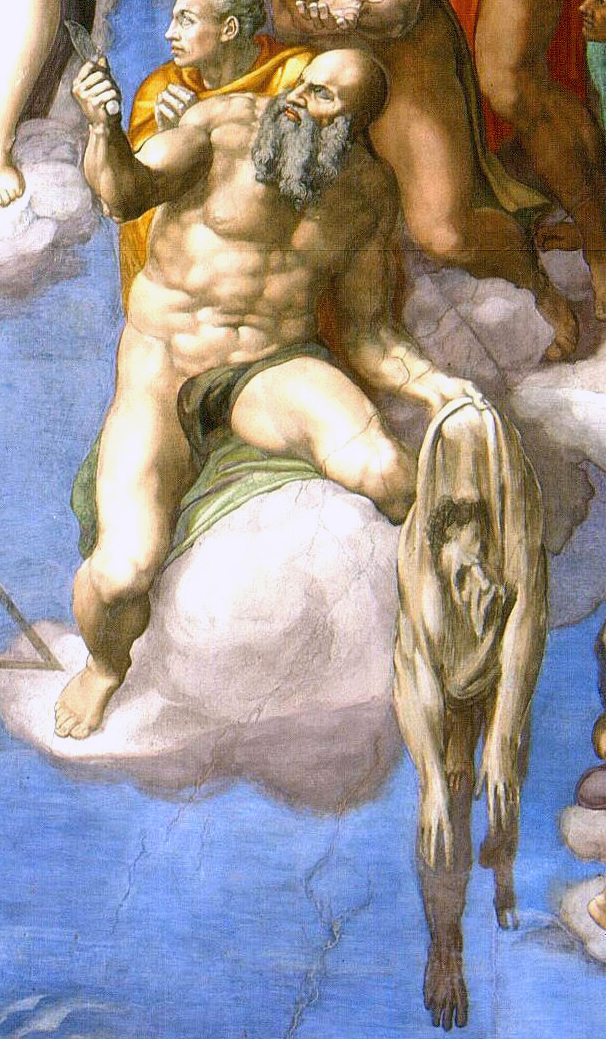
We have no certain information about Bartholomew's later life. The majority tradition, with varying details, is that Bartholomew preached in Armenia, and was finally skinned alive and beheaded in Albanus or Albanopolis on the Caspian Sea. His emblem in art is a flaying knife. The flayed Bartholomew can be seen in Michelangelo's Sistine painting of the Last Judgement. He is holding his skin. The face on the skin is generally considered to be a self-portrait of Michelangelo.


Propers for Saint Bartholomew the Apostle

The Collect.

O ALMIGHTY and everlasting God, who didst give to thine Apostle Bartholomew grace truly to believe and to preach thy Word; Grant, we beseech thee, unto thy Church, to love that Word which he believed, and both to preach and receive the same; through Jesus Christ our Lord. Amen.


The Epistle - Acts v. 12.

BY the hands of the apostles were many signs and wonders wrought among the people; (and they were all with one accord in Solomon's porch. And of the rest durst no man join himself to them: but the people magnified them. And believers were the more added to the Lord, multitudes both of men and women.) Insomuch that they brought forth the sick into the streets, and laid them on beds and couches, that at the least the shadow of Peter passing by might overshadow some of them. There came also a multitude out of the cities round about unto Jerusalem, bringing sick folks, and them which were vexed with unclean spirits: and they were healed every one.


The Gospel - St. Luke xxii. 24.

AND there was also a strife among them, which of them should be accounted the greatest. And he said unto them, The kings of the Gentiles exercise lordship over them; and they that exercise authority upon them are called benefactors. But ye shall not be so: but he that is greatest among you, let him be as the younger; and he that is chief, as he that doth serve. For whether is greater, he that sitteth at meat, or he that serveth? is not he that sitteth at meat? but I am among you as he that serveth. Ye are they which have continued with me in my temptations. And I appoint unto you a kingdom, as my Father hath appointed unto me; that ye may eat and drink at my table in my kingdom, and sit on thrones judging the twelve tribes of Israel.


Reference and Resources:

http://en.wikipedia.org/wiki/St._Bartholomew
http://www.commonprayer.org/calend/propers/s_barth.cfm
http://elvis.rowan.edu/~kilroy/JEK/08/24.html
http://www.episcopalnet.org/1928bcp/propers/stbartholomew.html


†

Monday, August 23, 2010

Today's Propers

Monday Following The Twelfth Sunday After Trinity - {Trinity XII}()[] {08/23/2010} - 1928 BCP (1945 Lectionary)


Morning Prayer (click for link)

Evening Prayer (click for link)


The Collect(s) for the Day.

ALMIGHTY and everlasting God, who art always more ready to hear than we to pray, and art wont to give more than either we desire or deserve; Pour down upon us the abundance of thy mercy; forgiving us those things whereof our conscience is afraid, and giving us those good things which we are not worthy to ask, but through the merits and mediation of Jesus Christ, thy Son, our Lord. Amen.

†

Sunday, August 22, 2010

Today's Propers

The Twelfth Sunday After Trinity - {Trinity XII}()[] {08/22/2010} - 1928 BCP (1945 Lectionary)


Morning Prayer (click for link)

Evening Prayer (click for link)


The Collect(s) for the Day.

ALMIGHTY and everlasting God, who art always more ready to hear than we to pray, and art wont to give more than either we desire or deserve; Pour down upon us the abundance of thy mercy; forgiving us those things whereof our conscience is afraid, and giving us those good things which we are not worthy to ask, but through the merits and mediation of Jesus Christ, thy Son, our Lord. Amen.

†

The Twelfth Sunday after Trinity

The Collect.

ALMIGHTY and everlasting God, who art always more ready to hear than we to pray, and art wont to give more than either we desire or deserve; Pour down upon us the abundance of thy mercy; forgiving us those things whereof our conscience is afraid, and giving us those good things which we are not worthy to ask, but through the merits and mediation of Jesus Christ, thy Son, our Lord. Amen.


The Epistle - 2 Corinthians iii. 4.

SUCH trust have we through Christ to God-ward: not that we are sufficient of ourselves to think any thing as of ourselves; but our sufficiency is of God; who also hath made us able ministers of the new testament; not of the letter, but of the spirit: for the letter killeth, but the spirit giveth life. But if the ministration of death, written and engraven in stones, was glorious, so that the children of Israel could not steadfastly behold the face of Moses for the glory of his countenance; which glory was to be done away: how shall not the ministration of the spirit be rather glorious? For if the ministration of condemnation be glory, much more doth the ministration of righteousness exceed in glory.


The Gospel - St. Mark vii. 31.

JESUS, departing from the coasts of Tyre and Sidon, came unto the sea of Galilee, through the midst of the coasts of Decapolis. And they bring unto him one that was deaf, and had an impediment in his speech; and they beseech him to put his hand upon him. And he took him aside from the multitude, and put his fingers into his ears, and he spit, and touched his tongue; and looking up to heaven, he sighed, and saith unto him, Ephphatha, that is, Be opened. And straightway his ears were opened, and the string of his tongue was loosed, and he spake plain. And he charged them that they should tell no man: but the more he charged them, so much the more a great deal they published it; and were beyond measure astonished, saying, He hath done all things well: he maketh both the deaf to hear, and the dumb to speak.

†