Sunday, December 20, 2015

John of Kronstadt


(Russian: Иоанн Кронштадтский) (October 19, 1829, Sura, Arkhangelsk–December 20, 1908, Kronstadt) was a Russian Orthodox Christian presbyter and a member of the synod of the Russian Orthodox Church. He was a striking, unconventional personality, deeply pious and immensely energetic. He was one of the most internationally famous and beloved Orthodox Christian leaders of his time.

He was born as Ivan Ilyich Sergiyev (Russian: Иван Ильич Сергиев) on 19 October 1829 at Sura, near the White Sea, in Russia.

Writing about his life he once recalled an evening when everyone had already gone to bed. “I could not sleep, and I still failed to understand anything I was taught. I still read poorly and could not remember anything I was told. I became so depressed I fell to my knees and began to pray. I don’t know whether I had spent a long time in that position or not, but suddenly something shook my whole being. It was as if a veil had fallen from my eyes, and my mind had been opened, and I remembered clearly my teacher of that day and his lesson. I also recalled the topic and the examples he had given. I felt so light and joyous inside.” After this experience he did so well he became one of the first in his class to be chosen to go to seminary, and after seminary to the Theological Academy in St Petersburg.

Throughout his studies, John thought about the importance of forgiveness, meekness, and love, and came to believe that these were the very center and power of Christianity, and that only one path—the path of humble love—leads to God and the triumph of His righteousness. He also thought a great deal about the Savior’s death on the Cross at Golgotha, and pitied those who did not know Jesus Christ. He wished to preach to them about His death and Resurrection. He dreamed about becoming a missionary to distant China, but saw that there was a great deal of work for a genuine pastor of Christ’s flock both in his own city and the surrounding towns.

From 1855 he worked as a priest in Saint Andrew's Cathedral, Kronstadt, the naval base on the outskirts of St Petersburg. Here he committed himself to charity, especially to those who were remote from the Church, and travelled extensively throughout the Russian empire. He was a member of the conservative Union of the Russian People, but did not commit himself politically.

From the beginning he also concerned himself with the material needs of the poor. He would shop for food, go to the pharmacy for prescriptions, to the doctor for help, many times giving the poor his last few coins. The inhabitants of Kronstadt would see him returning home barefoot and without his cassock. Often parishioners would bring shoes to his wife, saying to her, “Your husband has given away his shoes to someone, and will come home barefoot.” He would also write articles for the newspaper exhorting the people of Kronstadt to “support the poor morally and materially.” These appeals touched the hearts of many and Fr John organized many charitable efforts. Realizing that his individual charity was insufficient for aiding the needy, he founded the Orthodox Christian House Parish Trusteeship of St Andrew the First-Called. This brotherhood coordinated many charitable efforts throughout the city and helped many needy people.

When speaking to other priests about their vocation he would say, “You are a representative of the faith of the Church, O priest; you are a representative of Christ the Lord Himself. You should be a model of meekness, purity, courage, perseverance, patience, and lofty spirit. You are doing the work of God and must not let anything discourage you.”

In the early 1890s Father John became well known, and people from all over Russia came to him every day in thousands. Even the dying Tsar Alexander III, in 1894, summoned him to Livadia Palace so he could be served communion by John. The bishops treated him with high respect. He was already greatly venerated at the time he died, on 20 December 1908.

In 1909 Nicholas II wrote an order to establish commemoration of St John in the Church. Following it the Holy Synod issued an edict to commemorate Father John annually at the day of his death.

He was canonized by the Russian Orthodox Church Outside Russia in 1964, and by the Russian Orthodox Church in 1990. Archbishop John Maximovitch of Shanghai and San Francisco (later glorified as a Saint, as well) played an active role in preparation of St. John's canonization. His life and work are commemorated on the feast days of December 20.


Propers for John of Kronstadt - Priest and Teacher

The Collect.

O ALMIGHTY God, who hast called us to faith in thee, and hast compassed us about with so great a cloud of witnesses; Grant that we, encouraged by the good examples of thy Saints, and especially of thy servant John of Kronstadt, may persevere in running the race that is set before us, until at length, through thy mercy, we with them attain to thine eternal joy; through him who is the author and finisher of our faith, thy Son Jesus Christ our Lord. Amen.


The Epistle - Philippians 4:4-9.

REJOICE in the Lord alway: and again I say, Rejoice, Let your moderation be known unto all men. The Lord is at hand. Be anxious for nothing; but in every thing by prayer and supplication with thanksgiving let your requests be made known unto God. And the peace of God, which passeth all understanding, shall keep your hearts and minds through Christ Jesus. Finally, brethren, whatsoever things are true, whatsoever things are honest, whatsoever things are just, whatsoever things are pure, whatsoever things are lovely, whatsoever things are of good report; if there be any virtue, and if there be any praise, think on these things. Those things, which ye have both learned, and received, and heard, and seen in me, do: and the God of peace shall be with you.


The Gospel - St. Matthew 25:31-40.

WHEN the Son of man shall come in his glory, and all the holy angels with him, then shall he sit upon the throne of his glory: and before him shall be gathered all nations: and he shall separate them one from another, as a shepherd divideth his sheep from the goats: and he shall set the sheep on his right hand, but the goats on the left. Then shall the King say unto them on his right hand, Come, ye blessed of my Father, inherit the kingdom prepared for you from the foundation of the world: for I was an hungred, and ye gave me meat: I was thirsty, and ye gave me drink: I was a stranger, and ye took me in: naked, and ye clothed me: I was sick, and ye visited me: I was in prison, and ye came unto me. Then shall the righteous answer him, saying, Lord, when saw we thee an hungred, and fed thee? or thirsty, and gave thee drink? When saw we thee a stranger, and took thee in? or naked, and clothed thee? Or when saw we thee sick, or in prison, and came unto thee? And the King shall answer and say unto them, Verily I say unto you, Inasmuch as ye have done it unto one of the least of these my brethren, ye have done it unto me.


+

Saturday, December 19, 2015

Antiphons of Advent - O Clavis David

O Clavis David - Anglican use - December 19


O Key of David, Sceptre and the house of Israel; that openest and no man shutteth, and shuttest and no man openeth: Come and bring forth the prisoners out of the prison house.

Ember Saturday in Advent

The Collect.

Almighty and everlasting God, by whose Spirit the whole body of thy faithful people is governed and sanctified: Receive our supplications and prayers, which we offer before thee for all members of thy holy Church, that in their vocation and ministry they may truly and godly serve thee; through our Lord and Saviour Jesus Christ, who liveth and reigneth with thee, in the unity of the same Spirit, one God, now and for ever. Amen.


The Lesson - Exodus 19:3-8.


The Epistle - 1 Peter 4:7-11.


The Holy Gospel - St. Matthew 16:24-27


†

Friday, December 18, 2015

Antiphons of Advent - O Radix Jesse

O Radix Jesse - Anglican use - December 18


O Root of Jesse, which standest for an ensign of the people, at whom kings shall stop their mouths, whom the Gentiles shall seek: Come and deliver us, and tarry not.

Ember Friday in Advent

The Collect.

O God, who didst lead thy holy apostles to ordain ministers in every place: Grant that thy Church, under the guidance of the Holy Ghost, may choose suitable men for the ministry of Word and Sacrament, and may uphold them in their work for the extension of thy kingdom; through him who is the Shepherd and Bishop of our souls, Jesus Christ our Lord, who liveth and reigneth with thee and the same Spirit, one God, for ever and ever. Amen.


The Lesson - 1 Samuel 3:1-10.


The Epistle - Ephesians 4:11-16.


The Holy Gospel - St. Matthew 9:35-38


†

Flannan of Killaloe

Son of an Irish chieftain named Turdough. Intellectual and spiritual student of the monk Saint Molua. Despite family opposition, he became a monk. Missionary monk throughout Ireland, Scotland, and the Hebrides.

First bishop of Killaloe, Ireland, consecrated by Pope John IV in Rome. Recited the entire Psalter daily. His preaching was so persuasive that his own father gave up power to become a monk.


Propers for Flannan of Killaloe - Monastic, Missionary and Bishop

The Collect.

O God, whose blessed Son became poor that we through his poverty might be rich: Deliver us, we pray thee, from an inordinate love of this world, that, inspired by the devotion of thy servant 1., we may serve thee with singleness of heart, and attain to the riches of the age to come; through the same thy Son Jesus Christ our Lord, who liveth and reigneth with thee, in the unity of the Holy Ghost, one God, now and for ever. Amen.


The Lesson - Song of Solomon 8:6-7


The Holy Gospel - St. Luke 12:33-37


+

Thursday, December 17, 2015

Antiphons of Advent - O Adonai

O Adonai - Anglican use - December 17


O Adonai, Leader of the house of Israel, who appearedst in the bush to Moses in a flame of fire, and gavest him the law in Sinai: Come and redeem us with an outstretched arm.

The Martyrs of Gaza

On this date in the Byzantine (Christian) city of Gaza, 60 Christian soldiers were martyred for their faith by Arab Mohammedan invaders. The soldiers along with the rest of the inhabitants had been promised quarter to surrender and end the siege of that city, instead the treacherous Mohammedans demanded that they renounce their faith or face death.

After many attempts at persuasion, torture and threats, the brave soldiers continued to confess their faith in Jesus Christ as Lord and Saviour. When all attempts to break the 60 Christians failed, the Saracen emir had the 60 (still in chains) cut down by his men in front of the martyrs families and the other Christians of Gaza.


Propers for the Martyrs of Gaza

The Collect

O Almighty God, by whose grace and power thy holy martyrs of Gaza triumphed over suffering and were faithful even unto death: Grant us, who now remember them with thanksgiving, to be so faithful in our witness to thee in this world, that we may receive with them the crown of life; through Jesus Christ our Lord, who liveth and reigneth with thee and the Holy Ghost, one God, for ever and ever. Amen.


The Lesson - Jeremiah 15:15-21


The Holy Gospel - St. Mark 8:34-38


+

Wednesday, December 16, 2015

Ember Wednesday in Advent

The Collect.

Almighty God, the giver of all good gifts, who of thy divine providence hast appointed various orders in thy Church: Give thy grace, we humbly beseech thee, to all who are [now] called to any office and ministry for thy people; and so fill them with the truth of thy doctrine and clothe them with holiness of life, that they may faithfully serve before thee, to the glory of thy great Name and for the benefit of thy holy Church; through Jesus Christ our Lord, who liveth and reigneth with thee, in the unity of the Holy Spirit, one God, now and for ever. Amen.


The Epistle - Acts xiii. 44.

THE next sabbath day came almost the whole city together to hear the word of God. But when the Jews saw the multitudes, they were filled with envy, and spake against those things which were spoken by Paul, contradicting and blaspheming. Then Paul and Barnabas waxed bold, and said, It was necessary that the word of God should first have been spoken to you: but seeing ye put it from you, and judge yourselves unworthy of everlasting life, lo, we turn to the Gentiles. For so hath the Lord commanded us, saying, I have set thee to be a light of the Gentiles, that thou shouldest be for salvation unto the ends of the earth. And when the Gentiles heard this, they were glad, and glorified the word of the Lord: and as many as were ordained to eternal life believed. And the word of the Lord was published throughout all the region.


The Gospel - St. Luke iv. 16.

JESUS came to Nazareth, where he had been brought up: and, as his custom was, he went into the synagogue on the sabbath day, and stood up for to read. And there was delivered unto him the book of the prophet Esaias. And when he had opened the book, he found the place where it was written, The Spirit of the Lord is upon me, because he hath anointed me to preach the gospel to the poor; he hath sent me to heal the brokenhearted, to preach deliverance to the captives, and recovering of sight to the blind, to set at liberty them that are bruised, to preach the acceptable year of the Lord. And he closed the book, and he gave it again to the minister, and sat down. And the eyes of all them that were in the synagogue were fastened on him. And he began to say unto them, This day is this scripture fulfilled in your ears.

†

Monday, December 14, 2015

All Saints of Lincolnshire

Lincolnshire was once a hub of activity and holiness. There are at least 101 Saints closely associated with Lincolnshire. One could add many others who passed through (several of them giving their names to places on the way – for example St. Helen who found the Holy Cross and her son St. Constantine who passed this way having become Emperor in York). Here is a short list:

St. Oswald (d. 642); St. Ostrythe; St. Ailred (Ethelred) (d. 716); St. Werburgh Abbess (circa 785); St. Chad (d. 672); St. Botolph (d 680); St. Adulph (d. 680); St. Simon the Zealot; St. Guthlac (673- 714); St. Pega (Pea) (d. 719); St. Bertram (8th Century); St. Cissa (8th Century); St. Etheldritha (Alfreda) (d. 835); the Martyrs of Croyland: Sts. Theodore Abbot, Askega Prior, Swethin Subprior, Elfgete Deacon, Sabinus Subdeacon, Grimkell, Agamund Centenarians, Herbert Chanter, Egred, Ulric Servers, Egelred and the Seventy Companions (martyred 870); St. Thurketyl (887-975); St. Helen and St. Constantine; St. Hibald (d. 690); St. Paulinus (d. 644); St. Herefrid (d. 747); St. Aethelheard; St. Elwin (Aethelwine); St. Aldwyn (5th Century); St. Edilhun and St. Egbert; St. Erkenwald (d. 693); St. Werburgh (d. 700); St. Werburg of Mercia (d. 785).


Propers for All Saints of Lincolnshire


The Collect.


O Almighty God, who hast compassed us about with so great a cloud of witnesses: Grant that we, encouraged by the good example of thy servants The Saints of Lincolnshire , may persevere in running the race that is set before us, until at length, through thy mercy, we may with him attain to thine eternal joy; through Jesus Christ, the author and perfecter of our faith, who liveth and reigneth with thee and the Holy Ghost, one God, for ever and ever. Amen.


The Lesson - Micah 6:6-8.


Wherewith shall I come before the Lord, and bow myself before the high God? shall I come before him with burnt offerings, with calves of a year old? Will the Lord be pleased with thousands of rams, or with ten thousands of rivers of oil? shall I give my firstborn for my transgression, the fruit of my body for the sin of my soul? He hath shewed thee, O man, what is good; and what doth the Lord require of thee, but to do justly, and to love mercy, and to walk humbly with thy God?


The Holy Gospel - St. Matthew 25:31-40.

When the Son of man shall come in his glory, and all the holy angels with him, then shall he sit upon the throne of his glory: And before him shall be gathered all nations: and he shall separate them one from another, as a shepherd divideth his sheep from the goats: And he shall set the sheep on his right hand, but the goats on the left. Then shall the King say unto them on his right hand, Come, ye blessed of my Father, inherit the kingdom prepared for you from the foundation of the world: For I was an hungred, and ye gave me meat: I was thirsty, and ye gave me drink: I was a stranger, and ye took me in: Naked, and ye clothed me: I was sick, and ye visited me: I was in prison, and ye came unto me. Then shall the righteous answer him, saying, Lord, when saw we thee an hungred, and fed thee? or thirsty, and gave thee drink? When saw we thee a stranger, and took thee in? or naked, and clothed thee? Or when saw we thee sick, or in prison, and came unto thee? And the King shall answer and say unto them, Verily I say unto you, Inasmuch as ye have done it unto one of the least of these my brethren, ye have done it unto me.


+

Sunday, December 13, 2015

Third Sunday in Advent (Gaudete)

The Collect.

O LORD Jesus Christ, who at thy first coming didst send thy messenger to prepare thy way before thee; Grant that the ministers and stewards of thy mysteries may likewise so prepare and make ready thy way, by turning the hearts of the disobedient to the wisdom of the just, that at thy second coming to judge the world we may be found an acceptable people in thy sight, who livest and reignest with the Father and the Holy Spirit ever, one God, world without end. Amen.


The Epistle - 1 Corinthians iv. 1.
LET a man so account of us, as of the ministers of Christ, and stewards of the mysteries of God. Moreover it is required in stewards, that a man be found faithful. But with me it is a very small thing that I should be judged of you, or of man's judgment: yea, I judge not mine own self. For I know nothing against myself; yet am I not hereby justified: but he that judgeth me is the Lord. Therefore judge nothing before the time, until the Lord come, who both will bring to light the hidden things of darkness, and will make manifest the counsels of the hearts: and then shall every man have praise of God.


The Gospel - St. Matthew xi. 2.

NOW when John had heard in the prison the works of Christ, he sent two of his disciples, and said unto him, Art thou he that should come, or do we look for another? Jesus answered and said unto them, Go and shew John again those things which ye do hear and see: the blind receive their sight, and the lame walk, the lepers are cleansed, and the deaf hear, the dead are raised up, and the poor have the gospel preached to them. And blessed is he, whosoever shall not be offended in me. And as they departed, Jesus began to say unto the multitudes concerning John, What went ye out into the wilderness to see? A reed shaken with the wind? But what went ye out for to see? A man clothed in soft raiment? behold, they that wear soft clothing are in kings' houses. But what went ye out for to see? A prophet? yea, I say unto you, and more than a prophet. For this is he, of whom it is written, Behold, I send my messenger before thy face, which shall prepare thy way before thee.
†

Lucy of Syracuse

The early Roman lists of martyrs commemorate Lucy, virgin and martyr, on 13 December, and her name, with that of Agatha, appears in the Roman Liturgy as an example of those who have gone before us, in whose company we join in giving thanks and praise to God. Aside from this, little is known of her, except that she lived in Syracuse in Sicily, and probably died around 304.

Lucy had dedicated her life and virginity to Christ, when she was promised to a pagan for marriage she refused and distributed her dowry to the poor. She was given over to magistrate Paschasius, who ordered her to burn a sacrifice to the emperor's image. Lucy replied that she had given all that she had: "I offer to Him myself, let Him do with His offering as it pleases Him." Sentenced to be defiled in a brothel, Lucy asserted:

“No one's body is polluted so as to endanger the soul if it has not pleased the mind. If you were to lift my hand to your idol and so make me offer against my will, I would still be guiltless in the sight of the true God, who judges according to the will and knows all things. If now, against my will, you cause me to be polluted, a twofold purity will be gloriously imputed to me. You cannot bend my will to your purpose; whatever you do to my body, that cannot happen to me.”


The Christian tradition states that when the guards came to take her away they found her so filled with the Holy Spirit that she was stiff and heavy as a mountain; they could not move her even when they hitched her to a team of oxen. Even with a dagger through her throat she prophesied against her persecutor. As final torture, her eyes were gouged out prior to her execution, yet miraculously she could still see.

In Sweden and elsewhere, the day is observed by having one of the daughters of the house dress in a white robe with a crown of lighted candles and go singing from room to room (presumably followed by an adult with a fire extinguisher) early in the morning when it is still dark to awaken the other family members and to offer them St. Lucy's Cakes and hot coffee.

Propers for Lucy of Syracuse - Martyr


The Collect.

ALMIGHTY and everlasting God, who didst strengthen thy blessed martyr Lucy with the virtue of constancy in faith and truth: Grant us in like manner for love of thee to despise the prosperity of this world, and to fear none of its adversities; through Jesus Christ our Lord. Amen.


The Epistle - 2 Corinthians 10:17-11:2.

BRETHREN: he that glorieth, let him glory in the Lord.
For not he that commendeth himself is approved, but whom the Lord commendeth.
Would to God ye could bear with me a little in my folly: and indeed bear with me.
For I am jealous over you with godly jealousy: for I have espoused you to one husband, that I may present you as a chaste virgin to Christ.


The Gospel - St. Matthew 10:16-22.

BEHOLD, I send you forth as sheep in the midst of wolves: be ye therefore wise as serpents, and harmless as doves. But beware of men: for they will deliver you up to the councils, and they will scourge you in their synagogues; and ye shall he brought before governors and kings for my sake, for a witness to them and the Gentiles. But when they deliver you up, be not anxious how or what ye shall speak: for it shall be given you in that same hour what ye shall speak. For it is not ye that speak, but the Spirit of your Father which speaketh in you. And the brother shall deliver up the brother to death, and the father the child: and the children shall rise up against their parents, and cause them to be put to death. And ye shall be hated of all men for my name's sake: but he that endureth to the end shall be saved.


Reference and Resources:

http://www.episcopalnet.org/1928bcp/propers/Missal/Dec13.html
http://www.commonprayer.org/calend/propers/com_mart.cfm
http://www.newadvent.org/cathen/09414a.htm
http://elvis.rowan.edu/~kilroy/JEK/12/13.html
http://en.wikipedia.org/wiki/St._Lucy
†

Saturday, December 12, 2015

Edburga of Thanet

Edburga of Minster-in-Thanet was the, apparently only, daughter of King Centwine of Wessex and his wife, Engyth. She was a disciple of St. Mildred and became Abbess of her Abbey at Minster-in-Thanet in AD 716.

A woman of great ability and zealous in her pursuit of knowledge, she secured several Royal charters for her monastery. She was a friend and correspondent of St. Boniface and is to be identified with Heaburg, more commonly called Bugga, to whom several interesting letters of his are addressed, including the account of the Monk of Much Wenlock's vision of heaven. Unfortunately, hers to him are not preserved. His letters to Edburga were written in 718 and 719, before she had become an abbess.

Between 718 and 722 her mother wrote to Boniface and soon after, Edburga herself wrote to him, sending him an altar cloth and some money. She went to Rome, a good many years later, and there met Boniface, who sent a message through her to Aethelbert, King of Kent, promising to pray for him. Edburga built a new church for her monastery and removed, into it, the body of her re predecessor, St. Mildred. St. Edburga died at Minster on 13th December AD 759 and was buried alongside her, but both appear to have later been translated to the chapel of St. Gregory's Hospital in Canterbury.


Propers for Edburga of Thanet - Abbes


The Collect.

O GOD, by whose grace the blessed (abbes) Edburga enkindled with the fire of thy love, became a burning and a shining light in thy Church: Grant that we may be inflamed with the same spirit of discipline and love, and ever walk before thee as children of light; through Jesus Christ our Lord. Amen.


The Epistle - Philippians 3:7-15.

HOWBEIT what things were gain to me, these have I counted loss for Christ. Yea verily, and I count all things to be loss for the excellency of the knowledge of Christ Jesus my Lord: for whom I suffer the loss of all things, and do count them but dung, that I may gain Christ, and be found in him, not having a righteousness of mine own, even that which is of the law, but that which is through faith in Christ, the righteousness which is of God by faith: that I may know him, and the power of his resurrection, and the fellowship of his sufferings, becoming conformed unto his death; if by any means I may attain unto the resurrection of the dead. Not that I have already obtained, or am already made perfect: but I press on, if so be that I may apprehend that for which also I was apprehended by Christ Jesus. Brethren, I count not myself yet to have apprehended: but one thing I do, forgetting the things which are behind, and stretching forward to the things which are before, I press on toward the goal unto the prize of the high calling of God in Christ Jesus. Let us therefore, as many as be perfect, be thus minded: and if in anything ye are otherwise minded, even this shall God reveal unto you.


The Gospel - St. Luke 12:22-37.

JESUS said unto his disciples, Therefore I say unto you. Be not anxious for your life, what ye shall eat; neither for the body, what ye shall put on. The life is more than meat, and the body is more than raiment. Consider the ravens: for they neither sow nor reap; which neither have storehouse nor barn; and God feedeth them: how much more are ye better than the fowls? And which of you by being anxious can add a cubit to his span of life? If ye then be not able to do that which is least, why are ye anxious for the rest? Consider the lilies how they grow: they toil not, they spin not; and yet I say unto you, that Solomon in all his glory was not arrayed like one of these. If then God so clothe the grass, which is to day in the field, and to morrow is cast into the oven; how much more will he clothe you, O ye of little faith? And seek not ye what ye shall eat, or what ye shall drink, neither be ye of anxious mind. For all these things do the nations of the world seek after: and your Father knoweth that ye have need of these things. But rather seek ye the kingdom of God; and all these things shall he added unto you. Fear not, little flock; for it is your Father's good pleasure to give you the kingdom. Sell that ye have, and give alms; provide yourselves bags which wax not old, a treasure in the heavens that faileth not, where no thief approacheth, neither moth corrupteth. For where your treasure is, there will your heart be also. Let your loins be girded about, and your lamps burning; and ye yourselves like unto men that wait for their lord, when he will return from the wedding; that when he cometh and knocketh, they may open unto him immediately. Blessed are those servants, whom the lord when he cometh shall find watching: verily I say unto you, that he shall gird himself, and make them to sit down to meat, and will come forth and serve them.


Reference and Resources:

http://en.wikipedia.org/wiki/Edburga_of_Minster-in-Thanet
http://saints.sqpn.com/saint-edburga-of-thanet/
http://www.earlybritishkingdoms.com/adversaries/bios/edburgaminster.html


+

Friday, December 11, 2015

Damasus I of Rome

He was born around 305, probably near the city of Egitania, Lusitania, in what is the present-day village of Idanha-a-Velha, Portugal, then part of the Western Roman Empire. His life coincided with the rise of Emperor Constantine I and the reunion and re-division of the Western and Eastern Roman Empires, which is associated with the legitimization of Christianity and its later adoption as the official religion of the Roman state in 380.

Raised in a pious family; his father was a priest in Rome, Italy and Damasus served for a time as deacon in his father‘s church, Saint Laurence. Priest. Assistant to Pope Liberius. Chosen 37th pope in a disputed election in which a minority chose the anti-pope Ursinus. The two reigned simultaneously in Rome which eventually led to violence between their supporters and false accusations of Damasus having committed a crime.

Damasus I was active in defending the Catholic Church against the threat of schisms. In two Roman synods (368 and 369) he condemned Arianism, Apollinarianism and Macedonianism, and sent legates to the First Council of Constantinople that was convoked in 381 to address these heresies.

Economic patron of his secretary, Saint Jerome, commissioning him to make the translation of scripture now known as the Vulgate. Damasus restored catacombs, shrines, and the tombs of martyrs, and wrote poetry and metrical inscriptions about and dedicated to martyrs. They state that he would like to be buried in the catacombs with the early martyrs, but that the presence of one of his lowly status would profane such an august place. Ten of his letters, personal and pontifical, have survived.

Propers for Damasus I - Bishop of Rome


The Collect.

O ALMIGHTY God, who hast called us to faith in thee, and hast compassed us about with so great a cloud of witnesses; Grant that we, encouraged by the good examples of thy Saints, and especially of thy servant Damasus, may persevere in running the race that is set before us, until at length, through thy mercy, we with them attain to thine eternal joy; through him who is the author and finisher of our faith, thy Son Jesus Christ our Lord. Amen.


The Epistle - Philippians 4:4-9.

REJOICE in the Lord alway: and again I say, Rejoice, Let your moderation be known unto all men. The Lord is at hand. Be anxious for nothing; but in every thing by prayer and supplication with thanksgiving let your requests be made known unto God. And the peace of God, which passeth all understanding, shall keep your hearts and minds through Christ Jesus. Finally, brethren, whatsoever things are true, whatsoever things are honest, whatsoever things are just, whatsoever things are pure, whatsoever things are lovely, whatsoever things are of good report; if there be any virtue, and if there be any praise, think on these things. Those things, which ye have both learned, and received, and heard, and seen in me, do: and the God of peace shall be with you.


 The Holy Gospel - St. Luke 6:17-23. 

JESUS came down and stood in the plain, with the company of his disciples, and a great multitude of people out of all Judea and Jerusalem, and from the sea coasts of Tyre and Sidon, which came to hear him, and to be healed of their diseases; and they that were vexed with unclean spirits: and they were healed. And the whole multitude sought to touch him: for there went virtue out of him, and healed them all. And he lifted up his eyes on his disciples, and said, Blessed be ye poor: for yours is the kingdom of God. Blessed are ye that hunger now: for ye shall be filled. Blessed are ye that weep now: for ye shall laugh. Blessed are ye, when men shall hate you, and when they shall separate you from their company, and shall reproach you, and cast out your name as evil, for the Son of man's sake. Rejoice ye in that day, and leap for joy: for, behold, your reward is great in heaven.


Reference and Resources:

http://saints.sqpn.com/pope-saint-damasus-i/
http://en.wikipedia.org/wiki/Pope_Damasus_I


+

Thursday, December 10, 2015

Adam Scotus

Adam of Dryburgh (c. 1140 – 1212) was a late 12th and early 13th century Anglo-Scottish theologian, writer and Premonstratensian and Carthusian monk. He entered Dryburgh Abbey as a young man, rising to become abbot (1184-1188), before converting to Carthusianism and moving to Witham. He was also sometimes known by various other later names, including Adam the Carthusian, Adam Anglicus and Adam Scotus.

He was born around 1140 in the Anglo-Scottish border area (Northumberland & Scottish Borders) to parents whose names and identity are unknown. The details of his earliest education are not known either, but at some stage he may have studied under the great Hugh of St Victor. He is known to have rejected a clerical life in favour of monasticism, entering the Premonstratensian house of Dryburgh Abbey and becoming a priest there in 1165 at the age of twenty five.

Adam served under the first two abbots, Roger and Gerard, before in 1184 Adam himself became abbot. It is not clear if Adam became a full abbot or if he was just acting abbot or coadjutor. Abbot Gerard may have become incapacitated by illness, and Adam apparently refused to be blessed by a bishop while Abbot Gerard still lived. Adam was summoned to Prémontré, France, by its abbot the head of Adam's order. While in France Adam visited the Carthusian priory of Val St Pierre, which impressed him so much that he himself vowed to become a Carthusian, resigning his abbacy at Dryburgh. In this he was following in the footsteps of Abbot Roger, first head of Dryburgh Abbey, who had retired to Val St Pierre in 1177.

Adam returned to Britain and visited Hugh of Lincoln, Bishop of Lincoln. After consulting with this senior Carthusian figure and future saint, Adam joined Hugh's old priory at Witham, Somerset. The Premonstratensians did not give up trying to get him back, however, and it was only after the intervention from Bishop Hugh that a letter of release was issued to Adam. Adam would remain at Witham until his death, perhaps in the year 1212. He had no children, was said to have been of medium height; he was noted for his cheerfulness, his skill as a preacher and his good memory.

Adam was also a prolific writer, which included many sermons as well as theological and other religious texts. Among his most famous works were De tripartito tabernaculo, written at Dryburgh in 1180, and Liber de quadripartito exercitio cellae', written at Witham. His writings were first published by Aegidius Gourmont in Paris in 1518. Later in that century the churchman John Bale gave more writings to Adam by mistakenly attributing six works to Adam five of which he had no connection with.


Propers for Adam Scotus - Monastic and Theologian

The Collect.

GOD, who hast endowed thy servant Adam Scotus with clarity of faith and holiness of life: Grant us to keep with steadfast minds the faith which he taught, and in his fellowship to be made partakers of eternal glory; through Jesus Christ our Lord. Amen.


The Epistle - Wisdom 7:7-14.

I CALLED upon God, and the spirit of wisdom came to me. I preferred her before sceptres and thrones, and esteemed riches nothing in comparison of her. Neither compared I unto her any precious stone, because all gold in respect of her is as a little sand, and silver shall be counted as clay before her. I loved her above health and beauty, and chose to have her instead of light: for the light that cometh from her never goeth out. All good things together came to me with her, and innumerable riches in her hands. And I rejoiced in them all, because wisdom goeth before them: and I knew not that she was the mother of them. I learned diligently, and do communicate her liberally: I do not hide her riches. For she is a treasure unto men that never faileth: which they that use become the friends of God, being commended for the gifts that come from learning.


The Gospel - St. John 17:18-23.

AS thou hast sent me into the world, even so have I also sent them into the world. And for their sakes I sanctify myself, that they also might be sanctified through the truth. Neither pray I for these alone, but for them also which shall believe on me through their word; that they all may be one; as thou, Father, art in me, and I in thee, that they also may be one in us: that the world may believe that thou hast sent me. And the glory which thou gavest me I have given them; that they may be one, even as we are one: I in them, and thou in me, that they may be made perfect in one; and that the world may know that thou hast sent me, and hast loved them, as thou hast loved me.


Reference and Resources:

http://en.wikipedia.org/wiki/Adam_of_Dryburgh

†

Wednesday, December 9, 2015

Budoc of Dol

Born a prince, the son of a king of Brittany; his mother was Azenor, princess of Brest, France. Legend says that his mother was set adrift in a cask, and that Budoc was born at sea with Saint Brigid of Ireland in attendance. Educated in a monastery near Waterford, Ireland. Abbot at Youghal, Ireland. Bishop of Dol, Brittany for 26 years. Several places in Devon and Cornwall in England are named after him.

Saint Budoc was the Bishop of Dol in Brittany. The details of his life are shrouded in legend. He is reputed to have been grandson of the King of Brest. Budoc was supposed to have been born at sea under incredible circumstances. His mother, Princess Azenor of Brest, had been falsely accused of infidelity by her jealous stepmother. Budoc's furious father, the King of Goello (Treguier), had Azenor exiled, and near Brest had thrown his pregnant wife into the sea in a cask. There Budoc was born attended in his mother's visions by Saint Brigid. She took refuge in Ireland, where Budoc was raised. Both Azenor and Budoc were later welcomed back to the Kingdom of Brest after Azenor's stepmother fell ill, and upon her deathbed recanted the evil lies she had spread. (Evans, 1919) Budoc was raised and educated at Youghal monastery, and later became its abbot. The vita of Breton Saint Winwaloe describes Budoc as a teacher living on the island of Laurea. Later Budoc was elected bishop, and then returned to Brittany, where he succeeded Saint Samson and Saint Maglorius as bishop of Dol and ruled for 26 years (according to the 10th century vita of Maglorius and the 11th century 'Chronicle of Dol').

Budoc is reputed to have sailed across the Plymouth Sound, until he found an inlet on the Devon side of the River Tamar. He landed in Budshead Creek, part of the present district of Plymouth called St Budeaux. His supposed activity suggests the foundation of an early church in Plymouth. However, there is no evidence of the name in Devon prior to the 16th century. There is also an ancient church said to have been dedicated by him at Budock in Cornwall, and there was once one in Oxford too.

Propers for Budoc of Dol - Monastic, Missionary and Bishop

The Collect.

O ALMIGHTY God, who hast called us to faith in thee, and hast compassed us about with so great a cloud of witnesses: Grant that we, encouraged by the good examples of thy Saints, and especially of thy servant Budoc of Dol, may persevere in running the race that is set before us, until at length, through thy mercy, we with them attain to thine eternal joy; through him who is the author and finisher of our faith, thy Son Jesus Christ our Lord. Amen.


The Epistle - Philippians 3:7-15.

HOWBEIT what things were gain to me, these have I counted loss for Christ. Yea verily, and I count all things to be loss for the excellency of the knowledge of Christ Jesus my Lord: for whom I suffer the loss of all things, and do count them but dung, that I may gain Christ, and be found in him, not having a righteousness of mine own, even that which is of the law, but that which is through faith in Christ, the righteousness which is of God by faith: that I may know him, and the power of his resurrection, and the fellowship of his sufferings, becoming conformed unto his death; if by any means I may attain unto the resurrection of the dead. Not that I have already obtained, or am already made perfect: but I press on, if so be that I may apprehend that for which also I was apprehended by Christ Jesus. Brethren, I count not myself yet to have apprehended: but one thing I do, forgetting the things which are behind, and stretching forward to the things which are before, I press on toward the goal unto the prize of the high calling of God in Christ Jesus. Let us therefore, as many as be perfect, be thus minded: and if in anything ye are otherwise minded, even this shall God reveal unto you.


The Gospel - St. Luke 10:1-9.

AFTER these things the Lord appointed other seventy also, and sent them two and two before his face into every city and place, whither he himself would come. Therefore said he unto them, The harvest truly is great, but the labourers are few: pray ye therefore the Lord of the harvest, that he would send forth labourers into his harvest. Go your ways: behold, I send you forth as lambs among wolves. Carry neither purse, nor pack, nor shoes: and salute no man by the way. And into whatsoever house ye enter, first say, Peace be to this house. And if the son of peace be there, your peace shall rest upon it: if not, it shall turn to you again. And in the same house remain, eating and drinking such things as they give: for the labourer is worthy of his hire. Go not from house to house. And into whatso ever city ye enter, and they receive you, eat such things as are set before you: and heal the sick that are therein, and say unto them, The kingdom of God is come nigh unto you.


Reference and Resources:

http://en.wikipedia.org/wiki/Budoc
http://saints.sqpn.com/saint-budoc-of-brittany/

†

Tuesday, December 8, 2015

Conception of the Blessed Virgin Mary

The Collect.

O MERCIFUL God, hear the supplication of thy servants: that we who are gathered together to honour the Conception of the Virgin Mother of God, may through her intercession be delivered by thee from the perils which beset us. Through Jesus Christ thy Son our Lord, who livest and reignest with thee in the unity of the Holy Ghost, ever one God, world without end. Amen.


The Epistle - Proverbs viii. 22.

THE Lord possessed me in the beginning of his way, before his works of old. I was set up from everlasting, from the beginning, or ever the earth was. When there were no depths, I was brought forth; when there were no fountains abounding with water. Before the mountains were settled, before the hills was I brought forth: while as yet he had not made the earth, nor the fields, nor the highest part of the dust of the world. When he prepared the heavens, I was there: when he set a compass upon the face of the depth: when he established the clouds above: when he strengthened the fountains of the deep: when he gave to the sea his decree, that the waters should not pass his commandment: when he appointed the foundations of the earth: then I was by him, as one brought up with him: and I was daily his delight, rejoicing always before him; rejoicing in the habitable part of the earth: and my delights were with the sons of men. Now therefore hearken unto me, O ye children: for blessed are they that keep my ways. Hear instruction, and be wise, and refuse it not. Blessed is the man that heareth me, watching daily at my gates, waiting at the posts of my doors. For whoso findeth me findeth life, and shall obtain favour of the Lord.


The Gospel - St. Luke i. 26.

AND in the sixth month the angel Gabriel was sent from God unto a city of Galilee named Nazareth, to a Virgin espoused to a man whose name was Joseph, of the house of David; and the Virgin's name was Mary. And the angel came in unto her, and said, Hail, thou that art highly favoured, the Lord is with thee; blessed art thou among women.

†

Monday, December 7, 2015

Servus

(d. 7 December 484) African martyr. A nobleman, he was tortured and then executed for being an orthodox Christian by the Arian Vandals who were then masters of Africa. Additional details of his life are not extant.


Propers for Servus - Martyr


The Collect.

ALMIGHTY and everlasting God, who didst strengthen thy blessed martyr Servus with the virtue of constancy in faith and truth: Grant us in like manner for love of thee to despise the prosperity of this world, and to fear none of its adversities; through Jesus Christ our Lord. Amen.


The Epistle - 2 Esdras 2:42-48.

I ESDRAS saw upon the mount Sion a great people, whom I could not number, and they all praised the Lord with songs. And in the midst of them there was a young man of a high stature, taller than all the rest, and upon every one of their heads he set crowns, and was more exalted; which I marvelled at greatly. So I asked the angel, and said, Sir, what are these? He answered and said unto me, These be they that have put off the mortal clothing, and put on the immortal, and have confessed the name of God: now are they crowned, and receive palms. Then said I unto the angel. What young person is it that crowneth them, and giveth them palms in their hands? So he answered and said unto me, It is the Son of God, whom they have confessed in the world. Then began I greatly to commend them that stood so stiffly for the name of the Lord. Then the angel said unto me, Go thy way, and tell my people what manner of things, and how great wonders of the Lord thy God, thou hast seen.


The Gospel - St. Matthew 10:16-22.

BEHOLD, I send you forth as sheep in the midst of wolves: be ye therefore wise as serpents, and harmless as doves. But beware of men: for they will deliver you up to the councils, and they will scourge you in their synagogues; and ye shall he brought before governors and kings for my sake, for a witness to them and the Gentiles. But when they deliver you up, be not anxious how or what ye shall speak: for it shall be given you in that same hour what ye shall speak. For it is not ye that speak, but the Spirit of your Father which speaketh in you. And the brother shall deliver up the brother to death, and the father the child: and the children shall rise up against their parents, and cause them to be put to death. And ye shall be hated of all men for my name's sake: but he that endureth to the end shall be saved.


+


Servus

(d. 7 December 484) African martyr. A nobleman, he was tortured and then executed for being an orthodox Christian by the Arian Vandals who were then masters of Africa. Additional details of his life are not extant.


Propers for Servus - Martyr


The Collect.

ALMIGHTY and everlasting God, who didst strengthen thy blessed martyr Servus with the virtue of constancy in faith and truth: Grant us in like manner for love of thee to despise the prosperity of this world, and to fear none of its adversities; through Jesus Christ our Lord. Amen.


The Epistle - 2 Esdras 2:42-48.

I ESDRAS saw upon the mount Sion a great people, whom I could not number, and they all praised the Lord with songs. And in the midst of them there was a young man of a high stature, taller than all the rest, and upon every one of their heads he set crowns, and was more exalted; which I marvelled at greatly. So I asked the angel, and said, Sir, what are these? He answered and said unto me, These be they that have put off the mortal clothing, and put on the immortal, and have confessed the name of God: now are they crowned, and receive palms. Then said I unto the angel. What young person is it that crowneth them, and giveth them palms in their hands? So he answered and said unto me, It is the Son of God, whom they have confessed in the world. Then began I greatly to commend them that stood so stiffly for the name of the Lord. Then the angel said unto me, Go thy way, and tell my people what manner of things, and how great wonders of the Lord thy God, thou hast seen.


The Gospel - St. Matthew 10:16-22.

BEHOLD, I send you forth as sheep in the midst of wolves: be ye therefore wise as serpents, and harmless as doves. But beware of men: for they will deliver you up to the councils, and they will scourge you in their synagogues; and ye shall he brought before governors and kings for my sake, for a witness to them and the Gentiles. But when they deliver you up, be not anxious how or what ye shall speak: for it shall be given you in that same hour what ye shall speak. For it is not ye that speak, but the Spirit of your Father which speaketh in you. And the brother shall deliver up the brother to death, and the father the child: and the children shall rise up against their parents, and cause them to be put to death. And ye shall be hated of all men for my name's sake: but he that endureth to the end shall be saved.


+


Sunday, December 6, 2015

The Second Sunday in Advent

The Collect.

BLESSED Lord, who hast caused all holy Scriptures to be written for our learning; Grant that we may in such wise hear them, read, mark, learn, and inwardly digest them, that by patience and comfort of thy holy Word, we may embrace, and ever hold fast, the blessed hope of everlasting life, which thou hast given us in our Saviour Jesus Christ. Amen.


The Epistle - Romans xv. 4.

WHATSOEVER things were written aforetime were written for our learning, that we through patience and comfort of the scriptures might have hope. Now the God of patience and consolation grant you to be likeminded one toward another according to Christ Jesus: that ye may with one mind and one mouth glorify God, even the Father of our Lord Jesus Christ. Wherefore receive ye one another, as Christ also received us to the glory of God. Now I say that Jesus Christ was a minister of the circumcision for the truth of God, to confirm the promises made unto the fathers: and that the Gentiles might glorify God for his mercy; as it is written, For this cause I will confess to thee among the Gentiles, and sing unto thy name. And again he saith, Rejoice, ye Gentiles, with his people. And again, Praise the Lord, all ye Gentiles; and laud him, all ye people. And again, Esaias saith, There shall be a root of Jesse, and he that shall rise to reign over the Gentiles; in him shall the Gentiles trust. Now the God of hope fill you with all joy and peace in believing, that ye may abound in hope, through the power of the Holy Ghost.


The Gospel - St. Luke xxi. 25.

AND there shall be signs in the sun, and in the moon, and in the stars; and upon the earth distress of nations, with perplexity; the sea and the waves roaring; men's hearts failing them for fear, and for looking after those things which are coming on the earth: for the powers of heaven shall be shaken. And then shall they see the Son of man coming in a cloud with power and great glory. And when these things begin to come to pass, then look up, and lift up your heads; for your redemption draweth nigh. And he spake to them a parable; Behold the fig tree, and all the trees; when they now shoot forth, ye see and know of your own selves that summer is now nigh at hand. So likewise ye, when ye see these things come to pass, know ye that the kingdom of God is nigh at hand. Verily I say unto you, This generation shall not pass away, till all be fulfilled. Heaven and earth shall pass away: but my words shall not pass away.

†

Nicholas of Myra

was born in Asia Minor during the third century in the Greek colony of Patara in Lycia in the Roman province of Asia- today Antalya, Turkey — at a time when the region was Hellenistic in its culture and outlook. Nicholas became bishop of the city of Myra. He was very religious from an early age and devoted his life entirely to Christianity. According to legend, Nicholas was said to have rigorously observed the canonical fasts of Wednesdays and Fridays, even when an infant, by abstaining on those days from his mother's breasts. Nicholas is said to have been born to relatively affluent Christian parents in Patara, Lycia, where he also received his early schooling.

As the patron saint also of sailors, Nicholas is claimed to have been a sailor or fisherman himself. More likely, however, is that one of his family businesses involved managing a fishing fleet. When his parents died, Nicholas received his inheritance but is said to have given it away to the poor. So was St Nicholas a working, albeit wealthy, man who complemented his day job with caring for his congregation, or was he a full-time bishop? The impressive list of deeds of Nicholas seems to point to the latter. This does not mean, however, that his appointment to priest or bishop meant a complete rupture with his former life. More likely this was a gradual process.

Nicholas's early activities as a priest are said to have occurred during the persecution of Christians under the reign of co-ruling Roman Emperors Diocletian (reigned 284–305) and Maximian (reigned 286–305) In the Eastern Empire Galerius (reigned 305–311) continued the persecution until 311 when he issued a general edict of toleration from his deathbed. Nicholas survived this period, although his activities at the time are uncertain.

Following Galerius' death his surviving co-ruler Licinius (reigned 307–324) mostly tolerated Christians. As a result their community was allowed to further develop, and the various bishops who acted as their leaders managed to concentrate religious, social, and political influence as well as wealth in their hands. In many cases they acted as the heads of their respective cities. It is apparently in this period that Nicholas rose to become bishop of Myra. Judging from tradition, he was probably well loved and respected in his area, mostly as a result of his charitable activities. As with other bishops of the time, Nicholas's popularity would serve to ensure his position and influence during and after this period.

The destruction of several pagan temples is also attributed to him, among them the temple of Artemis. Because the celebration of Diana's birth is on December 6, some authors have speculated that this date was deliberately chosen for Nicholas's feast day to overshadow or replace the pagan celebrations.

Not only was Nicholas intolerant of pagans, he was also intolerant of Arianism. Nicholas is listed as a participant in the First Council of Nicaea. There according to legend he became so angry upon hearing the views of Arius that he rushed over to the heretic and gave him a tremendous box on his ears, sending him to the ground.

Nicholas is also known for coming to the defence of the falsely accused, often preventing them from being executed, and for his intercession on behalf of sailors and other travelers. The popular veneration of Nicholas as a saint seems to have started relatively early. Justinian I, Emperor of the Eastern Roman Empire (reigned 527–565) is reported to have built a temple (i.e. a church building) in Nicholas's honor in Constantinople.


Propers for Nicholas - Bishop of Myra

The Collect.

Grant, we beseech Thee, O Almighty God: that the solemn feast of Blessed Nicholas, Thy Confessor and Bishop, may both increase our devotion and further our salvation through the reception of your grace; through Jesus Christ our Lord, who liveth and reigneth with Thee and the Holy Ghost, ever one God, world without end. Amen.


The Epistle - Philippians 4:4-9.

REJOICE in the Lord alway: and again I say, Rejoice, Let your moderation be known unto all men. The Lord is at hand. Be anxious for nothing; but in every thing by prayer and supplication with thanksgiving let your requests be made known unto God. And the peace of God, which passeth all understanding, shall keep your hearts and minds through Christ Jesus. Finally, brethren, whatsoever things are true, whatsoever things are honest, whatsoever things are just, whatsoever things are pure, whatsoever things are lovely, whatsoever things are of good report; if there be any virtue, and if there be any praise, think on these things. Those things, which ye have both learned, and received, and heard, and seen in me, do: and the God of peace shall be with you.


The Gospel - St. Matthew 25:31-40.

WHEN the Son of man shall come in his glory, and all the holy angels with him, then shall he sit upon the throne of his glory: and before him shall be gathered all nations: and he shall separate them one from another, as a shepherd divideth his sheep from the goats: and he shall set the sheep on his right hand, but the goats on the left. Then shall the King say unto them on his right hand, Come, ye blessed of my Father, inherit the kingdom prepared for you from the foundation of the world: for I was a hungered, and ye gave me meat: I was thirsty, and ye gave me drink: I was a stranger, and ye took me in: naked, and ye clothed me: I was sick, and ye visited me: I was in prison, and ye came unto me. Then shall the righteous answer him, saying, Lord, when saw we thee an hungered, and fed thee? or thirsty, and gave thee drink? When saw we thee a stranger, and took thee in? or naked, and clothed thee? Or when saw we thee sick, or in prison, and came unto thee? And the King shall answer and say unto them, Verily I say unto you, Inasmuch as ye have done it unto one of the least of these my brethren, ye have done it unto me.


Reference and Resources:

http://en.wikipedia.org/wiki/St._Nicholas
http://anglicancontinuum.blogspot.com/2007/12/st-nicholos-december-6th.html
http://www.commonprayer.org/calend/propers/nicholas.cfm
http://elvis.rowan.edu/~kilroy/JEK/12/06.html

†

Saturday, December 5, 2015

Clement of Alexandria

A native of Athens, was converted to Christianity by Pantaenus, founder of the Catechetical School at Alexandria (then the intellectual capital of the Mediterranean world), and succeeded his teacher as head of the School about 180.

For over 20 years he labored effectively as an apologist for the faith and catechist of the faithful. He regarded the science and philosophy of the Greeks as being, like the Torah of the Hebrews, a preparation for the Gospel, and the curriculum of his School undertook to give his students both a knowledge the Gospel of Christ and a sound liberal education. His speculative theology, his scholarly defense of the faith and his willingness to meet non-Christian scholars on their own grounds, helped to establish the good reputation of Christianity in the world of learning and prepare the way for his pupils.

Clement is not on the present Roman calendar (having been removed by Bellarmine at the time of Galileo, when the Roman See was undergoing a period of wariness about intellectual venturesomeness), but is on the Eastern calendar and many modern revisions of the Anglican calendar. His influence has been considerable.

Propers for Clement of Alexandria - Priest, Teacher and Apologist


The Collect.

O GOD, who hast enlightened thy Church by the teaching of thy servant Clement: Enrich us evermore, we beseech thee, with thy heavenly grace, and raise up faithful witnesses who by their life and doctrine will set forth the truth of thy salvation; through Jesus Christ our Lord. Amen.


The Epistle - 2 Peter 1:2-8.

GRACE and peace be multiplied unto you through the knowledge of God, and of Jesus our Lord, according as his divine power hath given unto us all things that pertain unto life and godliness, through the knowledge of him that hath called us to glory and virtue: whereby are given unto us exceeding great and precious promises: that by these ye might be partakers of the divine nature, having escaped the corruption that is in the world through lust. And beside this, giving all diligence, add to your faith virtue; and to virtue knowledge; and to knowledge temperance; and to temperance patience; and to patience godliness; and to godliness brotherly kindness; and to brotherly kindness charity. For if these things be in you, and abound, they make you that ye shall neither be barren nor unfruitful in the knowledge of our Lord Jesus Christ.


The Gospel - St. John 6:57-63.

AS the living Father hath sent me, and I live by the Father: so he that eateth me, even he shall live by me. This is that bread which came down from heaven: not as your fathers did eat manna, and are dead: he that eateth of this bread shall live for ever. These things said he in the synagogue, as he taught in Capernaum. Many therefore of his disciples, when they had heard this, said, This is an hard saying; who can hear it? When Jesus knew in himself that his disciples murmured at it, he said unto them, Doth this offend you? What and if ye shall see the Son of man ascend up where he was before? It is the spirit that quickeneth; the flesh profiteth nothing: the words that I speak unto you, they are spirit, and they are life.

Reference and Resources:

http://en.wikipedia.org/wiki/Clement_of_alexandria
http://www.commonprayer.org/calend/propers/clement.cfm
http://elvis.rowan.edu/~kilroy/JEK/12/05.html

+

Simon Sutherland

On this blog I have included the biographies of many great and notable Christians. Today I would like to include that of one of my heroes and ancestors, the Rev. Simon Sutherland. The Sutherland family had come to America from Scotland with others of the Society of Friends (Quakers) and settled in Dutchess County, NY. The American Revolution was a time of great upheaval, not only for America, but also for the Sutherland family. Simon's grand-father was a devoted Quaker and pacifist and had been jailed by both sides during the war for his failure to support them. Simon's father on the other-hand left the Quaker faith as he supported and fought for the Patriot cause, turning to the Baptist denomination.

Below is a biography of the Rev. Sutherland from the book Centennial history of the Steuben Baptist Association, with information in brackets and italics were added from my records (local histories, military and Church records and family tradition) to fill the narrative.

One of the notable characters of the early history of Milo was Simon Sutherland, a faithful and earnest preacher of the Baptist faith. He was born in Stanford Dutchess County in 1779 and married in 1799 Tacey Lapham. They moved into Yates Co. [still part of Ontario Co.] in 1803. He was licensed to preach by the Benton church (1st Milo) Oct 6 1806.

Elder Sutherland preached without compensation for some time, indeed it was on his part a firm resolve in the early part of his ministry to accept no compensation for his ministerial labor. On one occasion when they [the Sutherland family] had lost their cow, some friends started a subscription to buy them another. Upon getting possession of the paper he (Simon Sutherland) threw it under the "forestick" determined to allow nothing of the kind. He supported himself and family by the labor of his hands and preached with zeal and effect to the pioneers of the surrounding country, sometimes going ten miles or more from home on foot to attend his appointments. He formed the first and second Baptist churches in Milo.

In the War of 1812 his brother Roger was a captain [Ontario Co., NY Militia] and the Elder went and served under him [as a Chaplain and Sergeant]. Simon Sutherland's unit was part of the force that took and held Ft. Niagara from the British and Canadian forces until forced to withdraw due to poor supply, morale and mutiny. After the withdraw Elder Sutherland served on the board of court martial that heard cases related to events at Ft. Niagara.

Elder Sutherland had seven daughters and one son, who was accidentally killed by a horse while a small lad and lost three daughters during an epidemic of the measles, yet his faith never wavered in spite of the tragedies.

Elder Simon Sutherland was instrumental in forming churches in Starkey (Now Dundee) Barrington (now Wayne Village) and Pulteney. In the latter town he resided twelve years a minister, in all up-wards of fifty years a preacher. He moved from Pulteney to Starkey where he lived several years and finally died near his old home in Milo Dec 1864 aged 85. He was made of stuff that belongs to the heroes and was ever true to his faith and calling while he was kind, gentle and self sacrificing in domestic and social life.

Elder Sutherland in his old age would often tell with tremulous voice, in his quaint way, of his journeyings from Second Milo to Eddy town and Harpending's Corners through the wilderness guided by marked trees, taking his chances with wild beasts, to dispense the everlasting word of God, holding services at all three places in one day - morning, afternoon and evening.

In the Churchyard Cemetery at Second Milo there is a large monument at his grave, with a Veterans Administration placard attached to it.

Sutherland Simon, Rev.
1864 Dec 5
B1779 Jun 4 in Dutchess Co., NY; died in Milo, ae 85/6
[War of 1812]

+

Wednesday, December 2, 2015

Channing Moore Williams

(17 July 1829 – 2 December 1910) was an Episcopalian missionary to China and Japan and later bishop. His saint's day on the Anglican calendar is 2 December.

Moore was born in Richmond, Virginia, and ordained a deacon in 1855. He was ordained a priest in China in 1857 and later posted to Nagasaki, Japan in 1857. In 1866, he was consecrated Bishop of China and Japan. He went to Tokyo in 1874 and founded St. Paul's University, today known as Rikkyo University in Tokyo.

In 1878 he united various national Anglican missionary efforts into the Nippon Sei Ko Kai, (i.e. the "Holy Catholic Church"), the branch of the Anglican church in Japan. He stayed on in Kyoto, Japan after a successor was appointed in 1893, returning to America only in 1908, two years before his death in Richmond in 1910.


Propers for Channing Moore Williams - Missionary & Bishop

The Collect.

Almighty and everlasting God, we thank thee for thy servant Channing Moore Williams, whom thou didst call to preach the Gospel to the peoples of China and Japan. Raise up, we beseech thee, in this and every land heralds and evangelists of thy kingdom, that thy Church may proclaim the unsearchable riches of our Saviour Jesus Christ; who liveth and reigneth with thee and the Holy Ghost, one God, now and for ever. Amen.


The Epistle - Acts 1:1-9.

The former treatise have I made, O Theophilus, of all that Jesus began both to do and teach, Until the day in which he was taken up, after that he through the Holy Ghost had given commandments unto the apostles whom he had chosen: To whom also he shewed himself alive after his passion by many infallible proofs, being seen of them forty days, and speaking of the things pertaining to the kingdom of God: And, being assembled together with them, commanded them that they should not depart from Jerusalem, but wait for the promise of the Father, which, saith he, ye have heard of me. For John truly baptized with water; but ye shall be baptized with the Holy Ghost not many days hence. When they therefore were come together, they asked of him, saying, Lord, wilt thou at this time restore again the kingdom to Israel? And he said unto them, It is not for you to know the times or the seasons, which the Father hath put in his own power. But ye shall receive power, after that the Holy Ghost is come upon you: and ye shall be witnesses unto me both in Jerusalem, and in all Judaea, and in Samaria, and unto the uttermost part of the earth. And when he had spoken these things, while they beheld, he was taken up; and a cloud received him out of their sight.


The Gospel - St. Luke 10:1-9.

After these things the Lord appointed other seventy also, and sent them two and two before his face into every city and place, whither he himself would come. Therefore said he unto them, The harvest truly is great, but the labourers are few: pray ye therefore the Lord of the harvest, that he would send forth labourers into his harvest. Go your ways: behold, I send you forth as lambs among wolves. Carry neither purse, nor scrip, nor shoes: and salute no man by the way. And into whatsoever house ye enter, first say, Peace be to this house. And if the son of peace be there, your peace shall rest upon it: if not, it shall turn to you again. And in the same house remain, eating and drinking such things as they give: for the labourer is worthy of his hire. Go not from house to house. And into whatsoever city ye enter, and they receive you, eat such things as are set before you: And heal the sick that are therein, and say unto them, The kingdom of God is come nigh unto you.


Reference and Resources:

http://elvis.rowan.edu/~kilroy/JEK/12/02.html
http://en.wikipedia.org/wiki/Channing_Moore_Williams


+

Tuesday, December 1, 2015

Charles de Foucauld


Born in Strasbourg on September 15, 1858, he grew up in a family which was a part of the French aristocracy. Orphaned at the age of six, he and his sister Marie were brought up by their grandfather, Colonel de Morlet. During a difficult adolescence, he completely lost his faith, becoming an agnostic. In 1876 he entered the Saint-Cyr Military Academy. He later was a French army officer in Algeria and Tunisia, but left the army in 1882 and went as an explorer to Morocco (1883–1884).

On his subsequent return to France and towards the end of October 1886, at the age of 28, he went through a conversion experience.

In 1890 he joined the Cistercian Trappist order first in France and then at Akbès in Syria, but left in 1897 to follow an undefined religious vocation in Nazareth. He began to lead a solitary life of prayer, near a convent of Poor Clares and it was suggested to him that he be ordained. In 1901 at the age of 43 he was ordained in Viviers, France and returned to the Sahara in Algeria and lived a virtually eremetical life. He first settled in Beni Abbes, near the Moroccan border, building a small hermitage for ‘adoration and hospitality’, which he soon referred to as the ‘Fraternity’.

Later he moved to be with the Tuareg people, in Tamanghasset in southern Algeria. This region is the central part of the Sahara with the Ahaggar Mountains (the Hoggar) immediately to the west. Charles used the highest point in the region, the Assekrem, as a place of retreat. Living close to the Tuareg, and sharing their life and hardships, he made a ten-year study of their language and cultural traditions. He learned the language and worked on a dictionary and grammar. His dictionary manuscript was published posthumously in 4 volumes and has become known among Berberologues for its rich and apt descriptions. He formulated the idea of founding a new religious order, which only became a reality after his death, under the name of the Little Brothers of Jesus. (See also: Louis Massignon)

On December 1, 1916, he was shot to death outside his Tamanrasset compound, by passing marauders connected with the Senussi Bedouin; this act is to be seen against the general background of the uprising against French colonial power, World War I and famine in the Hoggar. He was beatified by Pope Benedict XVI on November 13, 2005 and is listed as a martyr in the liturgy of the Catholic Church.


Propers for Charles de Foucauld - Priest, Monastic and Martyr

Collect.

ALMIGHTY and everlasting God, who didst strengthen thy blessed martyr Charles de Foucauld with the virtue of constancy in faith and truth: Grant us in like manner for love of thee to despise the prosperity of this world, and to fear none of its adversities; through Jesus Christ
our Lord. Amen.


The Epistle - Philippians 3:7-15.

HOWBEIT what things were gain to me, these have I counted loss for Christ. Yea verily, and I count all things to be loss for the excellency of the knowledge of Christ Jesus my Lord: for whom I suffer the loss of all things, and do count them but dung, that I may gain Christ, and be found in him, not having a righteousness of mine own, even that which is of the law, but that which is through faith in Christ, the righteousness which is of God by faith: that I may know him, and the power of his resurrection, and the fellowship of his sufferings, becoming conformed unto his death; if by any means I may attain unto the resurrection of the dead. Not that I have already obtained, or am already made perfect: but I press on, if so be that I may apprehend that for which also I was apprehended by Christ Jesus. Brethren, I count not myself yet to have apprehended: but one thing I do, forgetting the things which are behind, and stretching forward to the things which are before, I press on toward the goal unto the prize of the high calling of God in Christ Jesus. Let us therefore, as many as be perfect, be thus minded: and if in anything
ye are otherwise minded, even this shall God reveal unto you.


The Gospel - St. Luke 6:17-23.

JESUS came down and stood in the plain, with the company of his disciples, and a great multitude of people out of all Judaea and Jerusalem, and from the sea coasts of Tyre and Sidon, which came to hear him, and to be healed of their diseases; and they that were vexed with unclean spirits: and they were healed. And the whole multitude sought to touch him: for there went virtue out of him, and healed them all. And he lifted up his eyes on his disciples, and said, Blessed be ye poor: for your's is the kingdom of God. Blessed are ye that hunger now: for ye shall be filled. Blessed are ye that weep now: for ye shall laugh. Blessed are ye, when men shall hate you, and when they shall sep-arate you from their company, and shall reproach you, and cast out your name as evil, for the Son of man's sake. Rejoice ye in that day, and leap for joy: for, behold, your reward is great in heaven.


Reference and Resources:

http://en.wikipedia.org/wiki/Charles_de_Foucauld
http://jameswoodward.wordpress.com/2009/12/01/charles-de-foucauld/

†

Monday, November 30, 2015

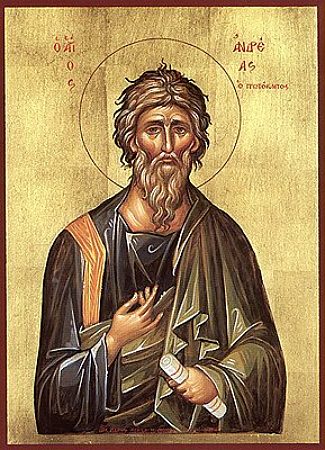
St. Andrew the Apostle

(Greek: Ανδρέας, Andreas), called in the Orthodox tradition Protocletos, or the First-called, is a Christian Apostle and the elder brother of Saint Peter. The name "Andrew" (from Greek : ανδρεία, manhood, or valour), like other Greek names, appears to have been common among the Jews from the second or third century B.C. No Hebrew or Aramaic name is recorded for him.

The Bible records that St Andrew was a son of Jonah, or John, (Matthew 16:17; John 1:42). He was born in Bethsaida on the Sea of Galilee (John 1:44). Both he and his brother Peter were fishermen by trade, hence the tradition that Jesus called them to be his disciples by saying that He will make them "fishers of men" (Greek: ἁλιείς ἀνθρώπων, halieis anthropon). At the beginning of Jesus' public life they occupied the same house at Capernaum (Mark 1:21, 29).

From the Gospel of John we learn that Andrew was a disciple of John the Baptist, whose testimony first led him and John the Evangelist to follow Jesus (John 1:35-40). Andrew at once recognized Jesus as the Messiah, and hastened to introduce Him to his brother(John 1:41). Thenceforth the two brothers were disciples of Christ. On a subsequent occasion, prior to the final call to the apostolate, they were called to a closer companionship, and then they left all things to follow Jesus (Luke 5:11; Matthew 4:19-20; Mark 1:17-18).

In the gospels he is referred to as being present on some important occasions as one of the disciples more closely attached to Jesus (Mark 13:3; John 6:8, 12:22); but in Acts there is only a bare mention of him (1:13).

Eusebius quotes Origen as saying Andrew preached in Asia Minor and in Scythia, along the Black Sea as far as the Volga and Kiev. Hence he became a patron saint of Romania and Russia. According to tradition, he founded the See of Byzantium in AD 38, installing Stachys as bishop (the only bishopric in that neighbourhood before that time had been established at Heraclea). This See would later develop into the Patriarchate of Constantinople. Andrew is recognized as its Patron Saint.

He is said to have been martyred by crucifixion at Patras (Patrae) in Achaea, on a cross of the form called Crux decussata (X-shaped cross) and commonly known as "St. Andrew's cross", at his own request, as he deemed himself unworthy to be crucified on the same type of cross on which Christ was crucified. Saint Andrew is the patron of Patras. According to tradition his relics were moved from Patras to Constantinople, and thence to St. Andrews (see below). Local legends say that the relics were sold to the Romans. The head of the saint, considered as one of the treasures of St. Peter's Basilica, was given by the Byzantine despot Thomas Palaeologus to Pope Pius II in 1461. In recent years, the relics were kept in the Vatican City, but were sent back to Patras by decision of the Pope Paul VI in 1964. The relics, which consist of the small finger, part of the top of the cranium of Saint Andrew and small parts of the cross, have since that time been kept in the Church of St. Andrew at Patras in a special tomb, and are reverenced in a special ceremony every November 30.

St. Andrew Basilica at Patras, where the saint's relics are kept, said to be erected over the place of his martyrdom. The apocryphal Acts of Andrew, mentioned by Eusebius, Epiphanius and others, is among a disparate group of Acts of the Apostles that were traditionally attributed to Leucius Charinus. "These Acts may be the latest of the five leading apostolic romances. The Acts, as well as a Gospel of St. Andrew, appear among rejected books in the Decretum Gelasianum connected with the name of Pope Gelasius I. The Acts of Andrew was edited and published by Constantin von Tischendorf in the Acta Apostolorum apocrypha (Leipzig, 1821) Another version of the Andrew legend is found in the Passio Andreae, published by Max Bonnet (Supplementum II Codicis apocryphi, Paris, 1895).

Propers for Saint Andrew the Apostle


The Collect.

ALMIGHTY God, who didst give such grace unto thy holy Apostle Saint Andrew, that he readily obeyed the calling of thy Son Jesus Christ, and followed him without delay; Grant unto us all, that we, being called by thy holy Word, may forthwith give up ourselves obediently to fulfill thy holy commandments; through the same Jesus Christ our Lord. Amen.


The Epistle - Romans x. 9.

IF thou shalt confess with thy mouth the Lord Jesus, and shalt believe in thine heart that God hath raised him from the dead, thou shalt be saved. For with the heart man believeth unto righteousness; and with the mouth confession is made unto salvation. For the scripture saith, Whosoever believeth on him shall not be ashamed. For there is no difference between the Jew and the Greek: for the same Lord over all is rich unto all that call upon him. For whosoever shall call upon the name of the Lord shall be saved. How then shall they call on him in whom they have not believed? and how shall they believe in him of whom they have not heard? and how shall they hear without a preacher? and how shall they preach, except they be sent? as it is written, How beautiful are the feet of them that preach the gospel of peace, and bring glad tidings of good things ! But they have not all obeyed the gospel. For Esaias saith, Lord, who hath believed our report? So then faith cometh by hearing, and hearing by the word of God. But I say, Have they not heard? Yes verily, their sound went into all the earth, and their words unto the ends of the world. But I say, Did not Israel know? First Moses saith, I will provoke you to jealousy by them that are no people, and by a foolish nation I will anger you. But Esaias is very bold, and saith, I was found of them that sought me not; I was made manifest unto them that asked not after me. But to Israel he saith, All day long I have stretched forth my hands unto a disobedient and gainsaying people.


The Gospel - St. Matthew iv. 18.

JESUS, walking by the sea of Galilee, saw two brethren, Simon called Peter, and Andrew his brother, casting a net into the sea: for they were fishers. And he saith unto them, Follow me, and I will make you fishers of men. And they straightway left their nets, and followed him. And going on from thence, he saw other two brethren, James the son of Zebedee, and John his brother, in a ship with Zebedee their father, mending their nets; and he called them. And they immediately left the ship and their father. and followed him.


Reference and Resources:

http://en.wikipedia.org/wiki/St._Andrew
http://www.commonprayer.org/calend/propers/s_andr.cfm
http://elvis.rowan.edu/~kilroy/JEK/11/30.html

†